

Workout Recovery: 8 Signs Your Body Needs More Rest, Food or Sleep
You finish a difficult workout feeling tired and slightly sore. The next morning, your legs feel heavy. A day later, you are ready to train again.
For most people, this is a normal part of exercise.
But what happens when the soreness never seems to settle, your usual weights suddenly feel heavier, your sleep is getting worse, and every workout requires more effort than it did a few weeks ago?
That may be a sign that your workout recovery is not keeping pace with your training.
Exercise is a physical stress. That stress is useful because it provides a stimulus for your body to adapt. But the workout itself is only part of the process. Adequate food, sleep, rest, hydration, and sensible training progression help determine how well you recover from that stress.
This is why training harder is not always the solution when progress slows.
Sometimes the body needs a greater training stimulus. At other times, it needs more opportunity to recover from the stimulus it has already received.
Poor workout recovery does not automatically mean you are “overtraining.” It may simply mean that your current combination of exercise, work, calorie restriction, sleep, and everyday stress is exceeding your present recovery capacity.
Here are eight signs worth paying attention to—and how to decide whether you may need more rest, better nutrition, more sleep, or a medical assessment.

Why Workout Recovery Matters for Fitness and Muscle Growth
Exercise temporarily disrupts normal physiological balance.
A demanding training session can:
- Fatigue muscles.
- Use stored glycogen.
- Create mechanical stress within muscle tissue.
- Challenge the nervous system.
- Increase fluid losses through sweating.
- Temporarily reduce exercise performance.
These effects are not necessarily harmful. They are part of the reason exercise produces adaptation.
With appropriate recovery, the body responds to repeated training by becoming better prepared for similar demands in the future.
Depending on the type of training, adaptations may include greater strength, improved cardiorespiratory fitness, increased muscular endurance, better movement efficiency, and changes in muscle size.
But repeatedly adding training stress without sufficient recovery can eventually interfere with performance rather than improve it.
Exercise Creates the Stimulus, Recovery Allows Adaptation
It is tempting to think that progress happens only while you are exercising.
In reality, the workout provides the signal. Much of the repair and adaptation occurs between training sessions.
Effective workout recovery depends on several interacting factors:
- Appropriate training volume and intensity.
- Adequate total energy intake.
- Sufficient protein.
- Carbohydrate availability according to training demands.
- Hydration.
- Sleep quantity and quality.
- Rest between demanding sessions.
- Psychological and occupational stress.
- Overall health.
This is why there is no single recovery supplement or technique that can compensate for problems in all these areas.
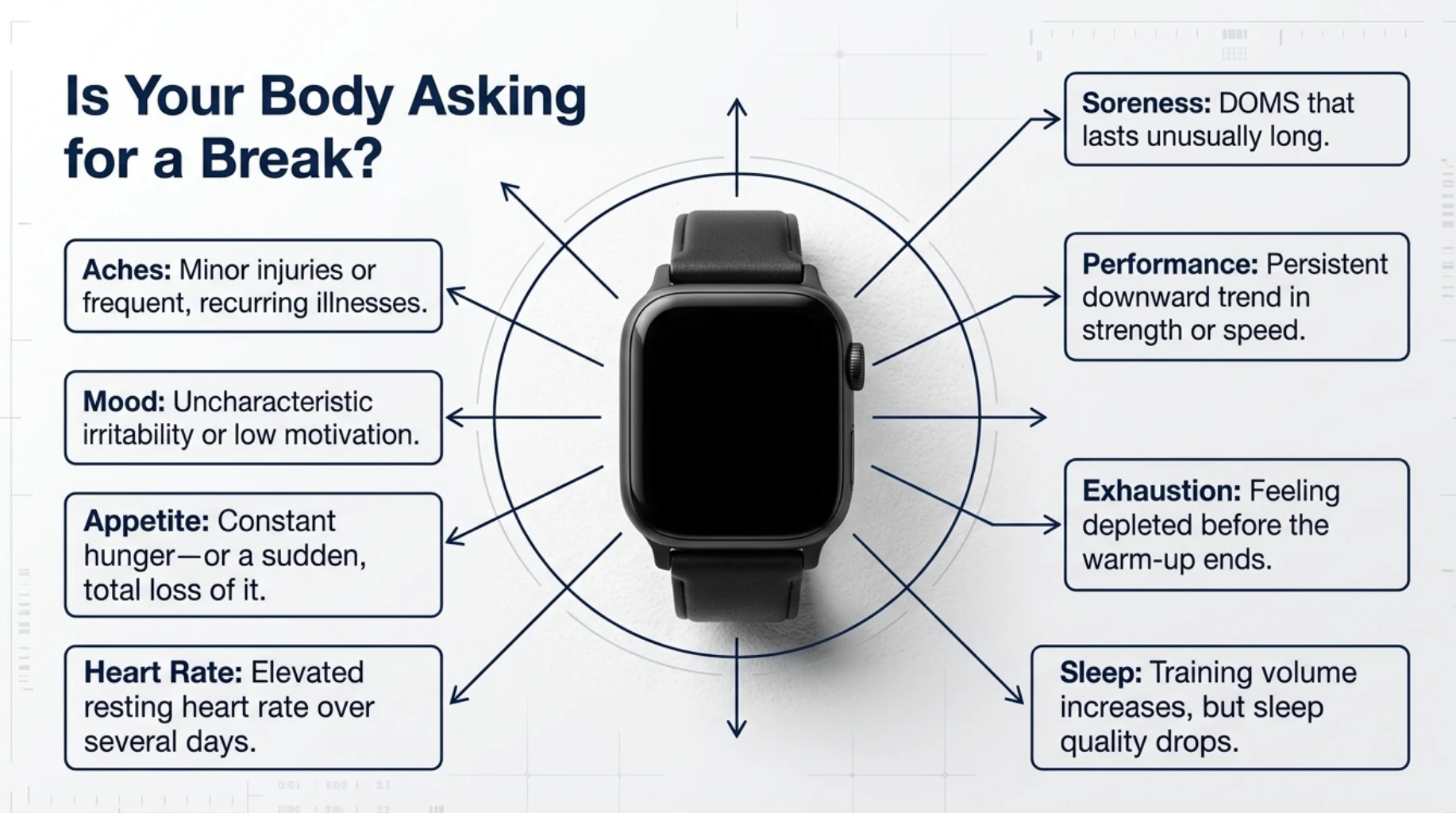
8 Signs Your Workout Recovery May Be Inadequate
No single symptom proves that you are under-recovered.
A poor workout can happen after a stressful day. Muscle soreness can occur after trying a new exercise. Resting heart rate can temporarily increase after poor sleep or dehydration.
Patterns matter more than isolated events.
If several of the following signs occur repeatedly, it may be time to examine your workout recovery more carefully.
1. Muscle Soreness Is Lasting Longer Than Usual
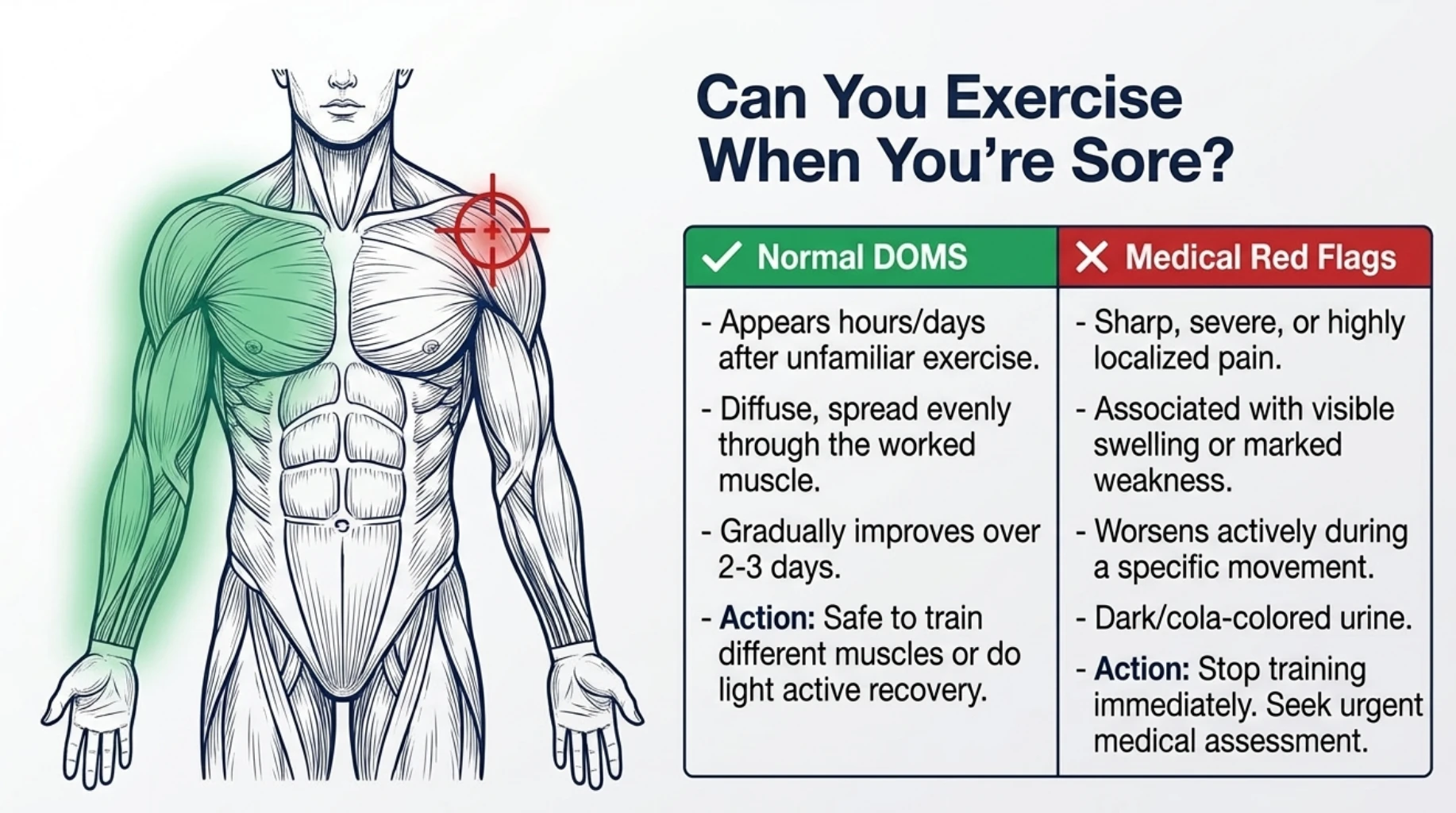
Delayed-onset muscle soreness, commonly called DOMS, often appears after unfamiliar or demanding exercise.
It typically develops several hours after training, is often most noticeable over the following day or two, and then gradually improves.
Soreness does not automatically mean something has gone wrong.
But if your muscles remain significantly sore every time you are due to train them again, your training load may be exceeding your current recovery capacity.
This can happen when you:
- Increase training volume too quickly.
- Introduce several new exercises at once.
- Perform excessive eccentric exercise.
- Train the same muscle groups hard without sufficient recovery.
- Return to exercise too aggressively after a long break.
- Combine hard training with inadequate sleep or food intake.
The solution is not necessarily complete rest for a week. Sometimes the training programme simply needs better progression.
When Muscle Soreness Is More Than a Workout Recovery Issue
Normal post-exercise soreness is generally diffuse within the muscles that were trained and gradually improves.
Sharp, severe, worsening, or highly localised pain should not automatically be labelled DOMS.
Pain associated with substantial swelling, loss of function, marked weakness, or injury during a particular movement may require assessment.
Severe muscle pain and weakness accompanied by dark or cola-coloured urine after strenuous exercise requires urgent medical attention because it can occur with rhabdomyolysis.
2. Your Strength or Exercise Performance Is Declining
One disappointing workout means very little.
You may perform poorly because you slept badly, trained at a different time, skipped a meal, had a stressful day, or simply had an unusually difficult session.
A persistent downward trend is different.
Signs may include:
- Weights that normally feel manageable becoming consistently heavy.
- Completing fewer repetitions at the same load.
- Running or cycling at a slower pace despite similar effort.
- Needing longer recovery between sets.
- Repeatedly failing to complete normal workouts.
- Feeling that every session requires unusually high effort.
If performance keeps deteriorating while you continue increasing training, the answer may not be another harder workout.
It may be time to reduce training stress temporarily and examine sleep, nutrition, illness, and other sources of fatigue.
Workout Recovery Is About Trends, Not One Bad Gym Session
This distinction prevents unnecessary anxiety.
Performance naturally fluctuates.
Strength, motivation, heart rate, sleep, and perceived exertion can vary from day to day.
Instead of reacting to every poor workout, look for patterns across several sessions.
If performance returns after a good night’s sleep or an easier day, there may be little reason for concern.
If it continues declining for weeks despite consistent training, something deserves attention.
3. You Feel Exhausted Before You Even Start Exercising
There is a difference between not feeling motivated to exercise and feeling physically depleted.
Everyone occasionally thinks:
“I don’t feel like training today.”
Often, motivation improves once the workout begins.
Persistent exhaustion is different.
If your warm-up feels unusually difficult, your legs constantly feel heavy, or you feel physically drained before most sessions, recovery may be inadequate.
Possible contributors include:
- Insufficient sleep.
- High training volume.
- Inadequate calorie intake.
- Low carbohydrate availability for demanding training.
- Dehydration.
- Psychological stress.
- Acute illness.
- A medical cause of fatigue.
This is why fatigue should not automatically be solved with more caffeine or a stronger pre-workout supplement.
The underlying reason matters.
4. Your Sleep Is Getting Worse Instead of Better
Regular physical activity generally supports better sleep, but the relationship between training and sleep works in both directions.
If you consistently sleep too little, workout recovery becomes more difficult.
Repeated sleep restriction can affect:
- Exercise performance.
- Reaction time.
- Mood.
- Appetite regulation.
- Glucose metabolism.
- Perception of effort.
- Recovery between training sessions.
Very demanding training combined with substantial life stress may also coincide with difficulty falling asleep or staying asleep in some individuals.
If your training volume is increasing while your sleep duration is decreasing, that combination deserves attention.
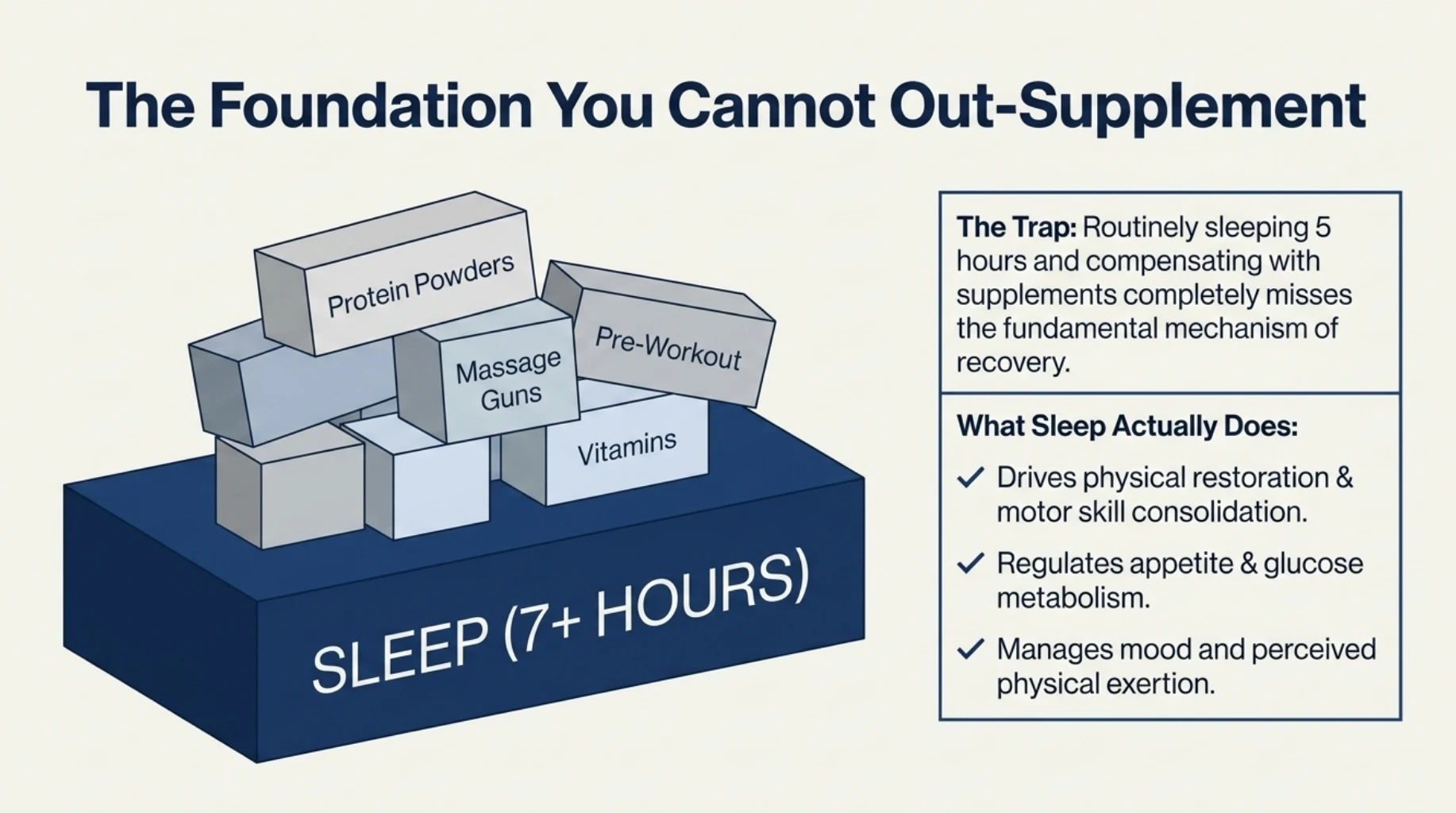
Sleep and Workout Recovery: The Part You Cannot Out-Supplement
Recovery products are easy to market because they provide something tangible to buy.
Sleep is less exciting.
But routinely sleeping for five hours while training hard and then trying to compensate with protein powders, vitamins, massage devices, or supplements misses one of the most important components of recovery.
Most adults should generally aim for at least seven hours of sleep per night, although individual sleep needs vary.
If you regularly wake feeling unrefreshed despite spending adequate time in bed, the problem may also be sleep quality rather than simply sleep duration.
Persistent snoring, witnessed breathing pauses, morning headaches, excessive daytime sleepiness, or resistant hypertension may warrant evaluation for sleep disorders such as obstructive sleep apnoea.
5. Your Resting Heart Rate Is Persistently Higher Than Usual
Wearable devices have made resting heart rate easy to monitor.
This can be useful, but the numbers need context.
A temporarily elevated resting heart rate can occur because of:
- Poor sleep.
- Psychological stress.
- Dehydration.
- Heat.
- Alcohol.
- Caffeine.
- Illness or fever.
- Changes in medication.
- Recent hard training.
Therefore, one elevated smartwatch reading does not prove poor workout recovery.
Your personal trend is more informative.
If resting heart rate remains clearly above your usual baseline while performance, sleep, and energy are also deteriorating, it can add another piece to the recovery picture.
Do Not Diagnose Yourself From a Smartwatch
Wearable data can be useful for identifying trends, but it should not replace symptoms and clinical assessment.
The same applies to heart-rate variability, sleep scores, recovery scores, and other proprietary metrics.
A device can provide data.
It cannot always tell you why the number changed.
6. You Are Constantly Hungry—or Your Appetite Has Disappeared
Hard training increases energy requirements.
If food intake does not increase appropriately—or is deliberately reduced because someone is trying to lose weight—the gap between energy demand and energy intake can become substantial.
Persistent hunger can be one clue that the body is receiving less energy than it needs.
However, appetite responses vary. Very demanding training, illness, psychological stress, heat, and other factors can sometimes suppress appetite rather than increase it.
This is why appetite alone cannot diagnose inadequate nutrition.
The broader context matters.
Workout Recovery Becomes Harder During Aggressive Dieting
This is particularly relevant for people trying to lose fat while simultaneously increasing their training.
A moderate calorie deficit may be appropriate for weight reduction.
But combining:
- A large calorie deficit,
- frequent hard workouts,
- high daily step targets,
- insufficient protein, and
- poor sleep
can create a substantial recovery challenge.
If weight is falling rapidly while strength, mood, sleep, and training performance are also deteriorating, it may be worth reconsidering the aggressiveness of the programme.
Successful weight loss should not be judged only by how quickly the scale moves.
7. Your Mood, Motivation or Concentration Is Deteriorating
Physical training is only one source of stress.
Your body does not experience exercise in complete isolation from work pressure, family responsibilities, poor sleep, travel, illness, and emotional stress.
When total stress becomes excessive, people may notice:
- Unusual irritability.
- Reduced enthusiasm for training.
- Difficulty concentrating.
- Persistent low energy.
- Feeling mentally and physically drained.
- A general reduction in well-being.
These symptoms are non-specific and can occur for many reasons.
But when they appear alongside declining exercise performance and persistent fatigue, inadequate workout recovery should be considered as one possibility.
8. Minor Aches, Illnesses or Injuries Keep Appearing
Exercise involves repeated mechanical stress. Appropriate training allows tissues to adapt to that stress.
But rapidly increasing training volume, poor technique, inadequate recovery, and repeatedly exercising through pain can increase the likelihood of problems.
Pay attention when you repeatedly develop:
- Persistent tendon discomfort.
- Joint pain.
- Recurring strains.
- Localised pain that worsens during exercise.
- Repeated interruptions to training because something hurts.
Recurrent illness alongside high training stress can also be a reason to review the overall programme, although frequent infections have many possible causes and should not automatically be blamed on exercise.
The key principle is simple: persistent pain is not evidence that a workout is working.
Poor Workout Recovery: Do You Need More Rest, Food or Sleep?
Once you recognise that recovery may be inadequate, the next question is what needs to change.
There is no single answer for everyone.
| What You Notice | What to Examine |
|---|---|
| Persistent soreness and falling performance | Training volume, intensity and rest between hard sessions |
| Constant fatigue with short sleep | Sleep duration and sleep quality |
| Hard training during aggressive weight loss | Total energy intake and size of calorie deficit |
| Poor performance during demanding endurance or repeated high-intensity exercise | Carbohydrate availability and overall nutrition |
| Poor muscle recovery with low-protein meals | Protein quantity and distribution |
| Thirst, headache or poor performance in hot conditions | Fluid and electrolyte losses |
| Fatigue despite adequate rest and nutrition | Illness, medication effects, stress or other medical causes |
Sometimes the solution is straightforward: sleep longer, eat adequately, or schedule an easier training day.
At other times, persistent fatigue despite apparently good workout recovery deserves medical evaluation rather than another adjustment to the exercise programme.
Workout Recovery and Nutrition: Are You Eating Enough?
Nutrition for recovery is often reduced to one question:
“How much protein should I take after my workout?”
Protein matters, but that question is too narrow.
Your body also needs sufficient overall energy to support training and recovery.
Someone can consume a high-protein shake after exercise while still eating too little overall for the amount of training being performed.
This is particularly common when people simultaneously attempt to:
- Lose weight rapidly.
- Increase gym frequency.
- Reach a very high step count.
- Perform additional cardio.
- Restrict carbohydrates.
The result can be a programme that looks disciplined on paper but becomes increasingly difficult to recover from.
Protein for Workout Recovery
Dietary protein provides amino acids required for muscle repair and adaptation.
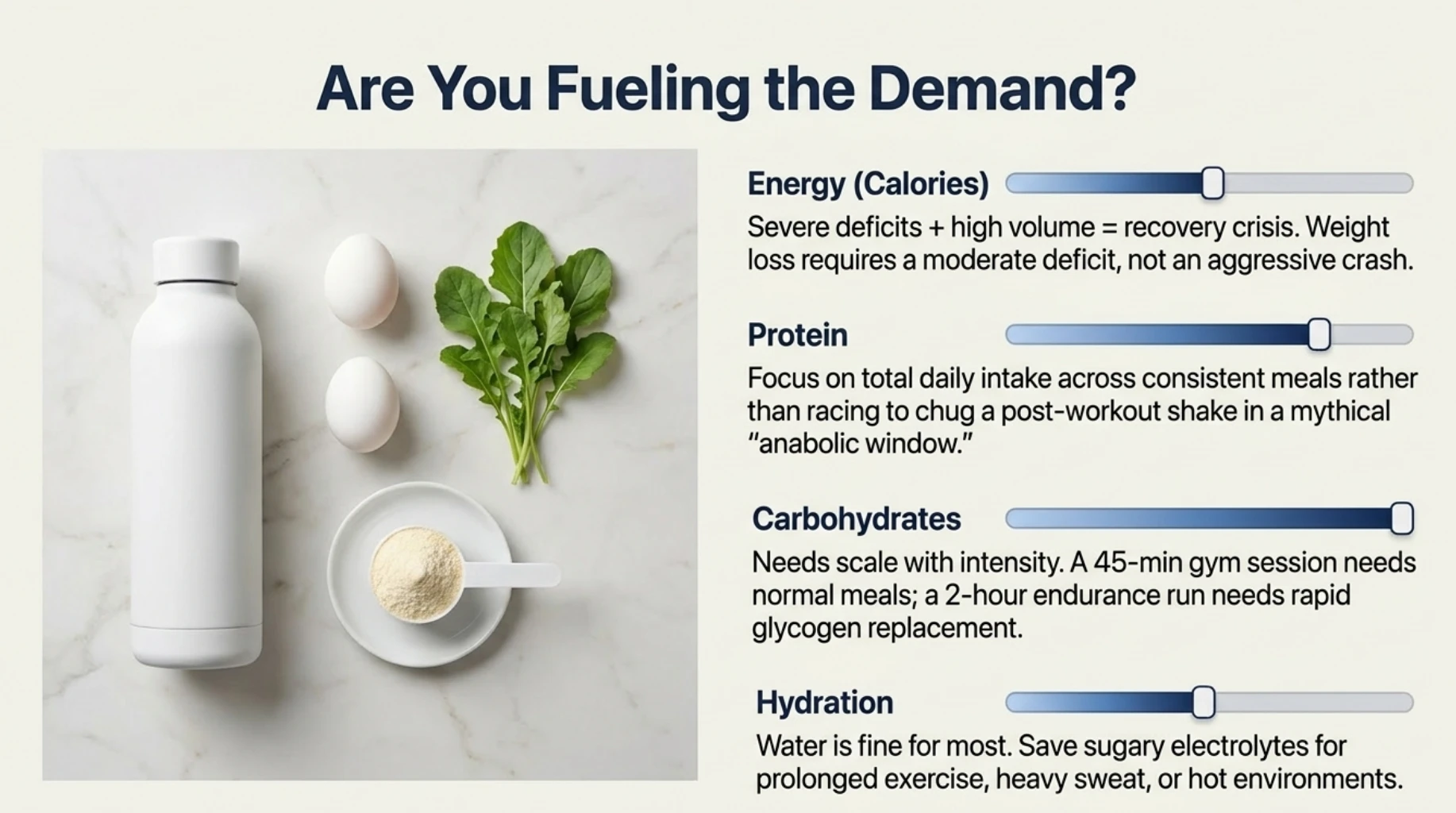
Rather than focusing exclusively on an immediate post-workout shake, it is useful to consider total daily protein intake and how protein is distributed across meals.
Practical protein sources include:
- Eggs.
- Milk and curd.
- Paneer.
- Tofu and soy foods.
- Dal and pulses.
- Fish.
- Chicken and other lean meats where consumed.
Protein requirements depend on body size, training, age, calorie intake, goals, and health conditions.
More is not automatically better, and very high protein intake cannot compensate for poor training design or chronic sleep deprivation.
Do You Need Protein Immediately After Exercise?
The idea of an extremely narrow “anabolic window” has often been exaggerated.
Consuming an appropriate protein-containing meal or snack around the training period can be useful, but most recreational exercisers do not need to panic if they cannot drink a protein shake within minutes of completing their final repetition.
Total daily intake and consistent meal patterns are generally more important than racing from the last set to the shaker bottle.
Carbohydrates Also Have a Role in Workout Recovery
Carbohydrates help replenish muscle glycogen used during exercise.
How important rapid carbohydrate replacement becomes depends heavily on the training performed.
Someone doing a moderate gym session with plenty of recovery time before the next workout has different needs from an endurance athlete completing multiple demanding sessions.
Carbohydrate needs therefore depend on:
- Exercise duration.
- Exercise intensity.
- Training frequency.
- Total training volume.
- Time before the next demanding session.
There is no requirement for every person to consume a large amount of sugar immediately after every workout.
Normal carbohydrate-containing meals may be sufficient for many recreational exercisers.
Hydration Matters, but Not Everyone Needs an Electrolyte Drink
Exercise increases fluid loss through sweating.
Losses become greater during prolonged activity, hot weather, humid conditions, and exercise performed by people who sweat heavily.
For many ordinary gym sessions, drinking water and eating normal meals may be sufficient.
Electrolyte replacement becomes more relevant when exercise is prolonged, sweat losses are substantial, environmental conditions are hot, or rapid rehydration is necessary.
Automatically drinking a sugary sports beverage after every short workout is unnecessary for most people.
Good Workout Recovery Does Not Require a Cupboard Full of Supplements
Recovery supplements can sometimes be useful when they solve a genuine nutritional need or provide convenience.
But the foundation remains remarkably ordinary:
- Appropriate training.
- Enough food.
- Adequate protein.
- Carbohydrate appropriate to training demand.
- Hydration.
- Sufficient sleep.
- Rest between demanding sessions.
If these foundations are consistently poor, adding more supplements rarely solves the underlying problem.
Sleep and Workout Recovery: Why More Training Cannot Replace More Sleep
Sleep is one of the most important components of workout recovery, yet it is often the first thing people sacrifice when life becomes busy.
A common pattern is to wake earlier to exercise while continuing to go to bed at the same time. The workout gets added, but sleep gets removed.
For someone previously sleeping eight hours, occasionally losing some sleep may not create an obvious problem. But consistently sleeping five or six hours while increasing training volume can make recovery increasingly difficult.
Sleep supports several processes relevant to exercise, including physical restoration, cognitive function, learning of motor skills, mood regulation, and metabolic health.
Poor sleep can also make a normal workout feel harder than it should.
How Much Sleep Do You Need for Workout Recovery?
There is no single sleep duration that guarantees perfect recovery for every person.
For most healthy adults, regularly obtaining at least seven hours of sleep is generally recommended, while some people function best with more.
Training demands can also influence how much recovery an individual feels they need.
Instead of focusing only on a number, consider whether you:
- Wake feeling reasonably refreshed.
- Remain alert during the day.
- Can maintain normal training performance.
- Fall asleep and stay asleep reasonably well.
- Need excessive caffeine simply to function.
If you spend adequate time in bed but remain persistently exhausted, simply extending sleep opportunity may not solve the problem. Sleep quality and possible sleep disorders should also be considered.
Can You Catch Up on Sleep at the Weekend?
Additional sleep after a period of sleep restriction may help reduce some accumulated sleep debt, but relying on the weekend to repeatedly compensate for very short sleep during the working week is not an ideal recovery strategy.
A more sustainable goal is to protect adequate sleep on most nights.
This may require changing bedtime, reducing late-night screen use, adjusting very late training sessions if they interfere with sleep, or addressing symptoms such as snoring, insomnia, or frequent night-time awakenings.
How Many Rest Days Do You Need for Workout Recovery?
There is no universal rule that everyone needs exactly one, two, or three rest days per week.
The answer depends on what you mean by a training day.
Six days of easy walking creates a very different recovery demand from six days of heavy resistance training, high-intensity intervals, or long-distance running.
Recovery requirements depend on:
- Training intensity.
- Training volume.
- Exercise selection.
- Which muscle groups are trained.
- Training experience.
- Age.
- Sleep.
- Nutrition.
- Other physical and psychological stress.
Someone following a well-designed programme may exercise on several consecutive days because different sessions create different demands.
Another person may need considerably more recovery between hard workouts.
This is why workout recovery should be programmed rather than determined by a fixed social-media rule.
Rest Day Does Not Always Mean Staying on the Sofa
A rest day can still include normal daily movement.
For many people, easy activities such as walking, gentle cycling, or mobility work are perfectly compatible with recovery.
The important distinction is between low-demand movement and another training session that adds substantial fatigue.
Someone recovering from illness, injury, severe fatigue, or a particularly demanding event may occasionally benefit from more complete rest.
Active Recovery vs Complete Rest: Which Is Better?
Active recovery generally means performing low-intensity physical activity during the recovery period.
This might include:
- Easy walking.
- Gentle cycling.
- Light mobility exercises.
- Very low-intensity recreational activity.
Some people find that light movement reduces stiffness and makes them feel better after training.
However, active recovery should remain genuinely easy.
Turning a recovery walk into a hard 10-kilometre hike or turning an easy cycling session into intervals defeats the purpose if the goal is reducing training stress.
Complete rest may be more appropriate when someone is acutely ill, significantly injured, or experiencing substantial fatigue.
Neither strategy is universally superior. Context matters.
Workout Recovery After 40: Does Age Change the Rules?
Turning 40 does not suddenly make the body fragile.
Many people become stronger and fitter in their forties, fifties, and beyond, particularly if they begin structured exercise after years of inactivity.
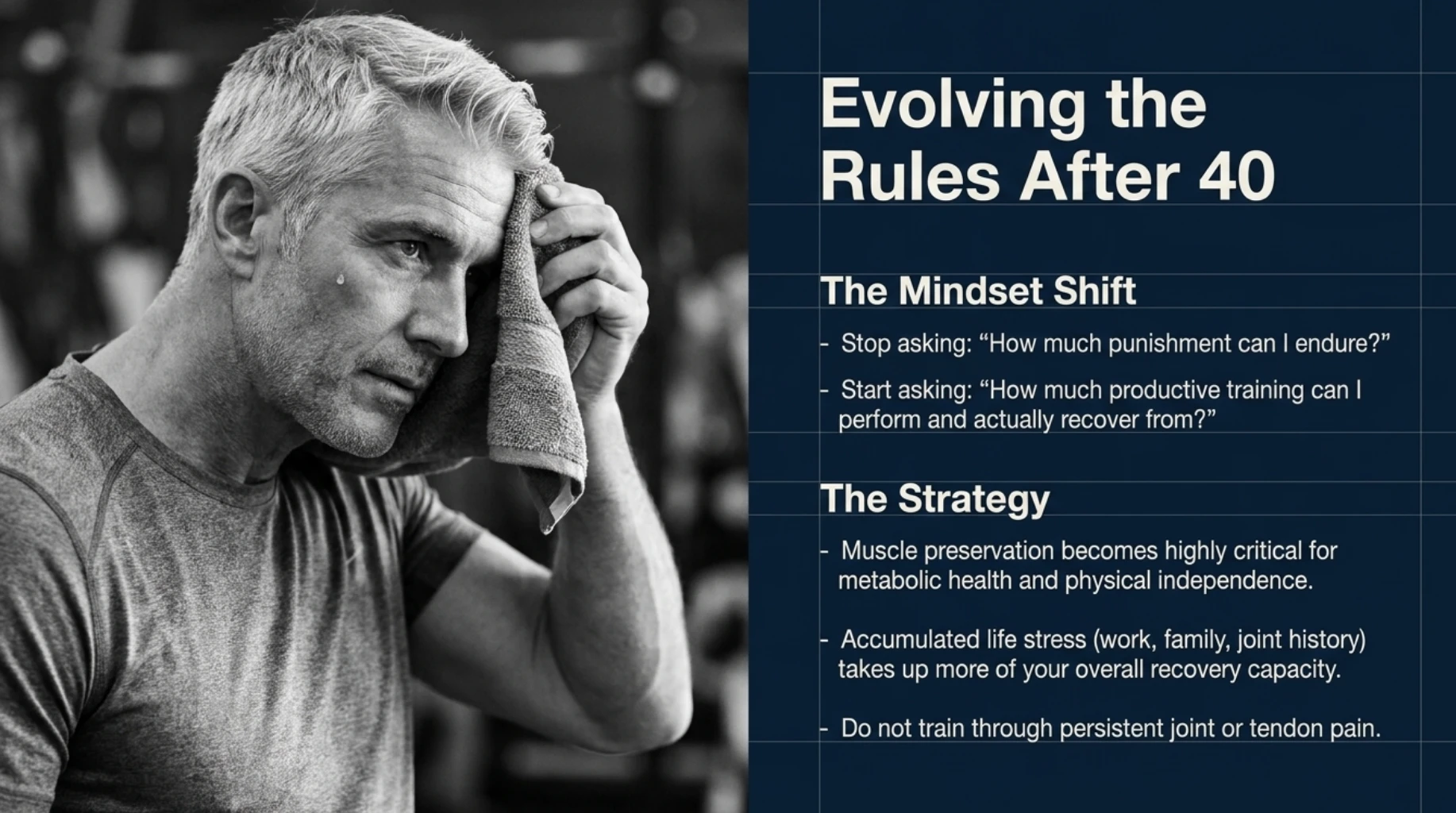
However, recovery can become more important as training age, chronological age, work stress, sleep disruption, joint problems, and other health factors accumulate.
Midlife is therefore a good time to stop thinking of exercise as simply:
“How much can I do?”
and start asking:
“How much productive training can I perform and recover from consistently?”
That distinction is important for long-term workout recovery and injury prevention.
Muscle Preservation Makes Recovery Particularly Important After 40
Resistance training becomes increasingly valuable with ageing because maintaining muscle strength supports mobility, metabolic health, balance, and physical independence.
But more resistance training is not automatically better.
The programme still needs to allow adaptation.
A sensible midlife strategy includes:
- Progressive resistance training.
- Appropriate aerobic exercise.
- Adequate protein.
- Sufficient overall nutrition.
- Regular sleep.
- Rest between demanding sessions.
- Attention to persistent pain rather than repeatedly training through it.
Workout Recovery During Weight Loss
Trying to lose fat while improving fitness creates an additional challenge.
Weight reduction generally requires an energy deficit, while demanding exercise increases energy requirements.
These goals are not incompatible. Many people successfully lose fat while maintaining or improving fitness.
But the size of the calorie deficit matters.
More aggressive restriction can make it harder to:
- Maintain training performance.
- Recover between sessions.
- Preserve lean tissue.
- Consume sufficient protein and micronutrients.
- Maintain energy and adherence.
This is particularly important during rapid weight loss.
Faster Weight Loss Is Not Always Better Workout Recovery
Imagine someone who has recently started exercising.
They cut food intake dramatically, stop eating most carbohydrate-rich foods, begin strength training five days per week, perform cardio after every session, and aim for 15,000 steps every day.
For the first few weeks, body weight may fall quickly.
Then they notice:
- Persistent fatigue.
- Declining gym performance.
- Poor sleep.
- Increasing hunger.
- Reduced motivation.
- Constant soreness.
The instinct may be to exercise harder because weight loss has started slowing.
But the programme may already be too aggressive.
Sometimes better workout recovery requires a more sustainable calorie deficit rather than another cardio session.
Low Energy Availability: When the Body Is Not Getting Enough Fuel
Low energy availability occurs when dietary energy intake is insufficient to support both exercise demands and the body’s normal physiological functions.
This is more complex than simply “not eating enough calories” on one particular day.
When low energy availability becomes prolonged or severe, it can affect multiple body systems.
It is particularly relevant to athletes and highly active individuals, but recreational exercisers who combine substantial training with aggressive food restriction can also be at risk.
Relative Energy Deficiency in Sport (RED-S)
Relative Energy Deficiency in Sport, commonly called RED-S, describes a syndrome in which problematic low energy availability contributes to impaired physiological functioning and can affect health and performance.
Potential consequences can involve:
- Reproductive function.
- Bone health.
- Metabolic function.
- Immune function.
- Cardiovascular health.
- Psychological health.
- Training performance.
RED-S can affect both women and men.
In women, menstrual disturbances can be an important warning sign, although having apparently regular periods does not necessarily exclude low energy availability.
Persistent fatigue, recurrent injuries, impaired performance, restrictive eating, and menstrual changes in a highly active person deserve proper assessment rather than simply being labelled poor workout recovery.
Is Poor Workout Recovery the Same as Overtraining?
No.
The word “overtraining” is used far too casually.
Feeling tired after several difficult workouts does not mean you have overtraining syndrome.
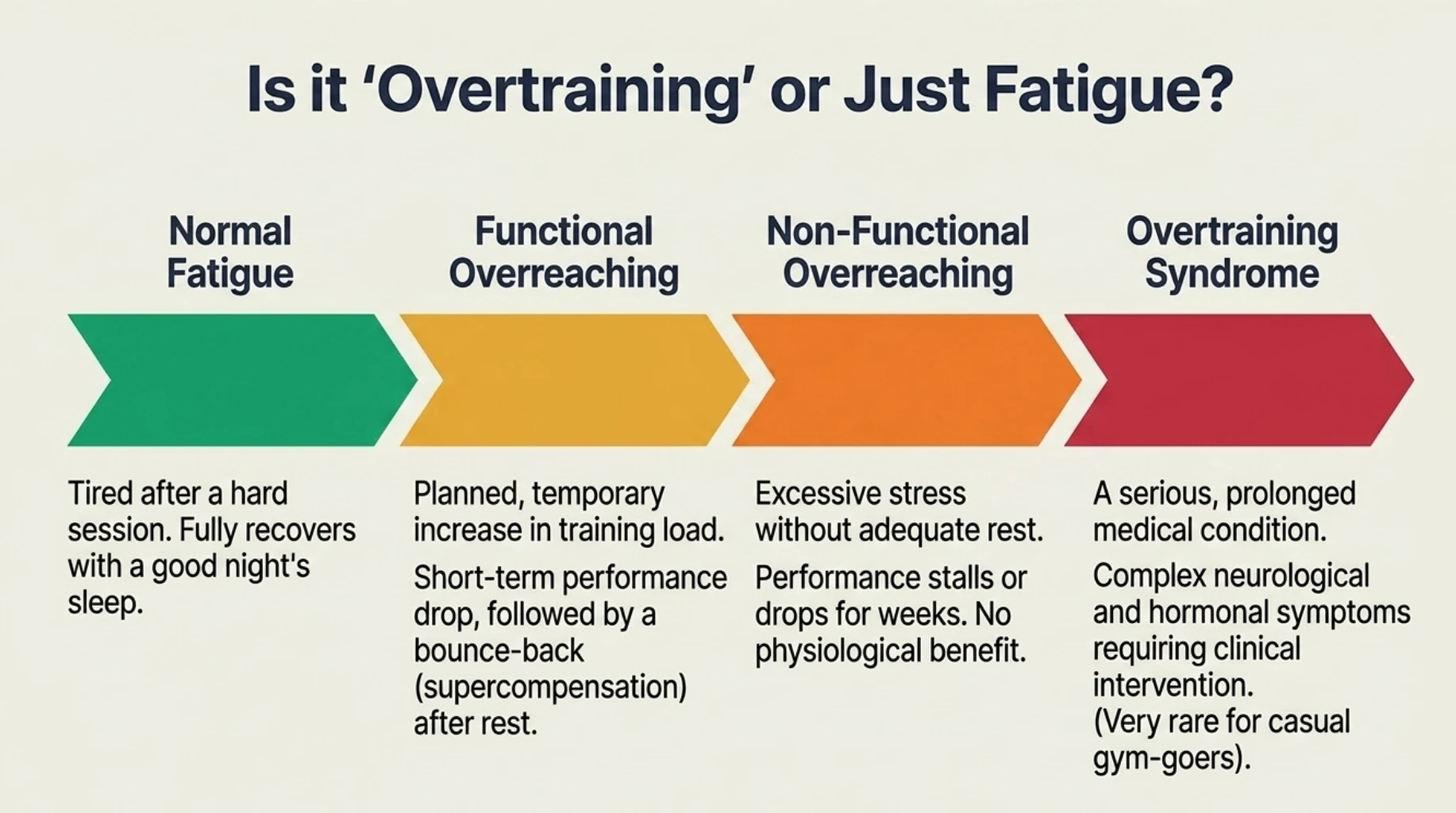
Training stress exists on a spectrum.
Functional Overreaching
Some training programmes deliberately include short periods of increased training load.
Performance may temporarily decline, but after adequate recovery the athlete adapts and performance improves.
This is often described as functional overreaching.
Non-Functional Overreaching
If excessive training stress continues without adequate recovery, performance deterioration may persist for longer and may be accompanied by disturbances in mood and other symptoms.
Recovery can take considerably longer, and there is no useful performance benefit from the excessive training load.
Overtraining Syndrome
Overtraining syndrome is a much more serious and prolonged condition characterised by persistent performance impairment and a complex collection of symptoms after other possible explanations have been considered.
It is not diagnosed from:
- Feeling sore after leg day.
- Having one bad workout.
- Feeling tired for two days.
- A smartwatch giving you a poor recovery score.
True overtraining syndrome is relatively uncommon and requires a broader clinical and training assessment.
Can You Exercise When You Are Sore?
Sometimes.
Mild muscle soreness does not automatically require complete rest.
You may be able to train a different muscle group, perform lower-intensity activity, or complete an easier session without difficulty.
However, training decisions should consider the severity and nature of the symptoms.
If soreness substantially alters your movement, limits range of motion, reduces strength, or makes normal exercise technique difficult, additional recovery may be sensible.
Sharp or localised pain should not simply be trained through on the assumption that it is DOMS.
Should You Take a Deload Week?
A deload is a planned temporary reduction in training stress.
Depending on the programme, this may involve reducing:
- Training volume.
- Training intensity.
- Number of hard sets.
- Training frequency.
- Or a combination of these factors.
Not every recreational exerciser needs a formally scheduled deload every few weeks.
But periods of reduced training can be useful when fatigue has accumulated, after a demanding training block, during stressful periods of life, or when performance indicates that recovery is becoming inadequate.
A deload is not lost progress.
It is one tool for managing training fatigue.
When Poor Workout Recovery May Actually Be a Medical Problem
Persistent fatigue should not automatically be blamed on exercise.
If symptoms continue despite reducing training and improving sleep and nutrition, other causes may need investigation.
Depending on the individual, fatigue and declining performance can occur with conditions such as anaemia, iron deficiency, thyroid disorders, infections, sleep disorders, nutritional deficiencies, medication effects, and other medical problems.
Seek medical evaluation when exercise-related symptoms include:
- Chest pain or pressure.
- Fainting or near-fainting.
- Unusual or progressive breathlessness.
- Persistent or significant palpitations.
- Severe or worsening localised pain.
- Marked unexplained muscle weakness.
- Dark urine after strenuous exercise.
- Persistent fever or recurrent illness.
- Unexplained weight loss.
- Prolonged fatigue despite adequate rest.
- Repeated stress injuries.
- Significant menstrual disturbances in physically active women.
These are situations where simply adding another rest day or protein shake may not address the underlying problem.
A Simple Workout Recovery Check Before Your Next Hard Session
You do not need sophisticated technology to pay attention to recovery.
Before another demanding workout, consider a few basic questions:
- Did I sleep reasonably well?
- Am I still unusually sore from the previous session?
- Does my warm-up feel normal?
- Am I eating enough for my current training load?
- Is my performance stable or progressively declining?
- Am I dealing with unusually high work or emotional stress?
- Do I have pain rather than ordinary muscle soreness?
- Am I becoming ill?
One imperfect answer does not necessarily mean you should cancel the workout.
But several warning signs occurring together may justify reducing the intensity or volume, changing the session, or taking additional recovery.
Workout Recovery Should Be Flexible, Not Fearful
Paying attention to recovery should not make people afraid of challenging exercise.
Hard training has a place.
Progressive overload has a place.
Feeling tired after a demanding session is normal.
The goal is not to avoid fatigue completely. It is to distinguish productive training stress from a pattern in which fatigue continually accumulates and performance deteriorates.
Good workout recovery allows you to train hard enough to create adaptation and recover well enough to repeat that training consistently.
How to Improve Workout Recovery Without Making It Complicated
Recovery has become an industry. Foam rollers, massage guns, compression garments, cold-water immersion, supplements, wearable recovery scores, and specialised drinks are all marketed as ways to help the body recover faster.
Some recovery strategies can be useful in specific situations.
But for most recreational exercisers, the biggest improvements in workout recovery usually come from getting the fundamentals right.
Before buying another recovery product, examine your training, food, sleep, and overall stress.
1. Match Your Training Load to Your Current Fitness
Many recovery problems begin with doing too much too quickly.
This is particularly common when someone returns to exercise after several months or years of inactivity.
The enthusiasm is understandable. The body, however, still needs time to adapt.
A programme that is appropriate for someone who has trained consistently for five years may be completely inappropriate for a beginner.
Increase training volume and intensity progressively rather than trying to make every session harder than the previous one.
2. Protect Your Sleep
If you regularly sacrifice sleep to create time for exercise, reconsider the schedule.
For example, waking at 5:00 a.m. for a workout while routinely going to bed after midnight may eventually become counterproductive.
Exercise and sleep should support each other rather than compete for the same limited hours.
Persistent insomnia, excessive daytime sleepiness, loud snoring, witnessed breathing pauses, or regularly waking unrefreshed deserve attention rather than being accepted as normal.
3. Eat Enough for the Training You Are Doing
Nutrition needs should reflect training demand.
A person walking for 30 minutes three times per week has different requirements from someone performing frequent resistance training, long-distance running, or high-volume endurance exercise.
This becomes particularly important during weight loss.
A calorie deficit can be appropriate, but increasing exercise while repeatedly reducing food intake can eventually make workout recovery more difficult.
4. Include Protein Across the Day
Instead of relying on one large protein-rich dinner, include meaningful protein sources across meals.
For an Indian diet, practical options can include:
- Eggs.
- Milk and curd.
- Paneer.
- Tofu.
- Soy foods.
- Dal and pulses.
- Rajma and chana.
- Fish or chicken where consumed.
Protein supplements can provide convenience, but they are not compulsory if dietary intake is adequate.
5. Do Not Remove Carbohydrates Automatically
Carbohydrates are frequently reduced when people begin a fat-loss programme.
There is nothing inherently wrong with modifying carbohydrate intake when clinically appropriate, but extremely restrictive intake may make demanding training more difficult for some people.
Carbohydrate needs depend on exercise type, duration, intensity, and frequency.
Useful carbohydrate-containing foods can include whole grains, rice, roti, oats, potatoes, fruit, pulses, and other minimally processed foods according to individual requirements.
The appropriate quantity depends on the person’s overall diet and training goals.
6. Hydrate According to Your Needs
There is no need to force excessive amounts of water simply because you exercise.
At the same time, substantial dehydration can impair performance and make exercise feel harder.
Fluid needs increase with heat, humidity, exercise duration, and sweat losses.
People exercising outdoors during an Indian summer may have very different fluid requirements from someone completing a short workout in an air-conditioned gym.
Hydration advice therefore needs context.
7. Schedule Easier Training When Needed
Not every workout needs to be a personal record.
Training programmes can include easier sessions, lower-volume periods, or deloads when appropriate.
This is not a sign of weakness or lack of discipline.
Training is productive only when the body can adapt to it.
8. Consider Stress Outside the Gym
Your recovery capacity is influenced by more than exercise.
A demanding work week, family stress, travel, poor sleep, or illness can change how well you tolerate your usual programme.
A workout that is normally manageable may feel considerably harder during a period of high life stress.
Adjusting training temporarily can sometimes be more sensible than insisting that the programme must remain identical regardless of circumstances.
Common Workout Recovery Myths
Myth 1: More Muscle Soreness Means a Better Workout
Soreness is not a reliable measure of workout quality.
DOMS is often greater after unfamiliar exercise, high eccentric loading, or a sudden increase in training volume.
As your body adapts to an exercise, soreness may decrease even though the workout remains effective.
You do not need to wake up struggling to walk after every leg session for your muscles to become stronger.
Myth 2: No Pain, No Gain
Exercise can be challenging and uncomfortable, particularly during demanding sets or cardiovascular training.
But pain is not a requirement for progress.
Sharp, persistent, or worsening pain should not be treated as evidence of an effective workout.
Learning to distinguish effort from injury-related pain is an important part of long-term training.
Myth 3: You Need a Protein Shake Immediately After Exercise
Protein after exercise can support muscle protein synthesis, but the idea that progress is lost unless a shake is consumed immediately after the final repetition exaggerates the importance of precise timing.
Total daily protein intake, meal distribution, and the overall quality of the diet matter greatly.
If you can eat a normal protein-containing meal after training, a supplement may not be necessary.
Myth 4: Everyone Needs Electrolytes After a Workout
Most people do not need a specialised electrolyte drink after every short gym session.
Electrolyte replacement becomes more relevant with prolonged exercise, substantial sweating, hot environments, and situations where rapid replacement of fluid and sodium losses is important.
For many routine workouts, water and normal meals are sufficient.
Myth 5: More Protein Can Compensate for Poor Sleep
Protein and sleep serve different roles.
A high-protein diet cannot reproduce the physiological effects of adequate sleep.
If someone routinely sleeps five hours per night, increasing protein from an adequate intake to an excessive intake is unlikely to solve poor workout recovery.
Myth 6: Training Seven Days a Week Produces Faster Results
Training frequency alone does not determine progress.
Seven days of appropriately programmed activity may be perfectly manageable for one person, while seven consecutive demanding sessions may be excessive for another.
The type, intensity, volume, and distribution of training matter more than simply counting how many days you exercise.
Myth 7: Feeling Tired Means You Have Overtraining Syndrome
Fatigue is common and non-specific.
Poor sleep, inadequate food intake, psychological stress, illness, dehydration, and a difficult training session can all cause temporary fatigue.
True overtraining syndrome involves a much more prolonged deterioration in performance and cannot be diagnosed from a few tired days.
Myth 8: Rest Days Cause Muscle Loss
You do not lose meaningful amounts of muscle because you take an appropriate rest day.
Muscle loss is influenced by much longer-term factors such as prolonged inactivity, ageing, inadequate nutrition, illness, and insufficient training stimulus.
Rest between demanding sessions is part of training, not an interruption of it.
Should You Use a Fitness Watch to Track Workout Recovery?
Wearable devices can provide useful information about activity, heart rate, sleep patterns, and training load.
Some devices also generate a daily “readiness” or “recovery” score based on combinations of heart rate, heart-rate variability, sleep, and activity data.
These scores can be interesting, but they should not become the sole determinant of whether you exercise.
If your watch says your recovery is poor but you feel well, slept adequately, have no unusual symptoms, and your warm-up feels normal, the number needs context.
Likewise, a perfect recovery score should not persuade you to ignore significant pain or illness.
Use wearable data as additional information rather than a medical diagnosis.
Workout Recovery for Beginners
Beginners often experience more soreness because their bodies are being exposed to unfamiliar movements and training stress.
This does not mean beginners need elaborate recovery protocols.
The most important approach is to avoid progressing too quickly.
A beginner should focus on:
- Learning correct exercise technique.
- Starting with manageable training volume.
- Allowing recovery between challenging sessions.
- Increasing difficulty gradually.
- Eating adequately.
- Sleeping consistently.
The goal of the first few weeks is not to discover how much punishment the body can tolerate.
It is to build a routine that can continue for months and years.
Frequently Asked Questions About Workout Recovery
How Long Does Workout Recovery Take?
There is no fixed recovery period for every workout. Recovery depends on the exercise performed, training intensity and volume, muscle groups involved, training experience, nutrition, sleep, age, and overall health.
A light session may require little recovery, while a demanding unfamiliar workout can affect performance and soreness for several days.
How Do I Know If I Need a Rest Day?
Consider an easier day or additional rest when several signs occur together, such as persistent soreness, declining performance, unusual fatigue, poor sleep, or difficulty completing your normal warm-up.
One symptom in isolation does not necessarily mean you must stop exercising.
What Should I Eat for Workout Recovery?
A balanced diet that provides sufficient total energy, adequate protein, carbohydrate appropriate to training demand, micronutrients, and fluids forms the foundation of recovery nutrition.
The exact requirements vary according to body size, training volume, goals, and health conditions.
Is Protein or Carbohydrate More Important After Exercise?
They serve different purposes. Protein provides amino acids needed for muscle repair and adaptation, while carbohydrate helps restore glycogen used during exercise.
The relative importance and timing depend on the type of exercise and how soon another demanding session will occur.
Does Sleep Affect Muscle Recovery?
Yes. Sleep supports physical and cognitive recovery, and repeated sleep restriction can negatively affect training performance, mood, metabolic health, and perceived effort.
Can I Train the Same Muscle When It Is Still Sore?
Mild soreness does not automatically prevent training, but severe soreness that alters movement, reduces strength, or interferes with technique may justify more recovery or a modified session.
Sharp or highly localised pain should not simply be assumed to be normal soreness.
Do I Need Supplements for Workout Recovery?
Most recreational exercisers do not need a large collection of recovery supplements.
Supplements may be useful when they address a genuine dietary need or provide convenience, but they cannot replace appropriate training, sufficient food, adequate protein, hydration, and sleep.
Why Am I Not Recovering Even Though I Take Rest Days?
Rest days are only one component of recovery.
Persistent fatigue may also relate to inadequate sleep, insufficient calorie intake, low carbohydrate availability for demanding exercise, psychological stress, illness, medication effects, or an underlying medical condition.
Final Thought
A hard workout can make you tired. A good training programme should gradually make you stronger. If your exercise routine is consistently doing the first without producing the second, recovery is one of the first places worth looking.
If you want a personalized metabolic assessment and lifestyle strategy, you can book a consultation here:
Book an Appointment