

Rest Days From Exercise: Why Recovery Is Part of a Good Fitness Plan
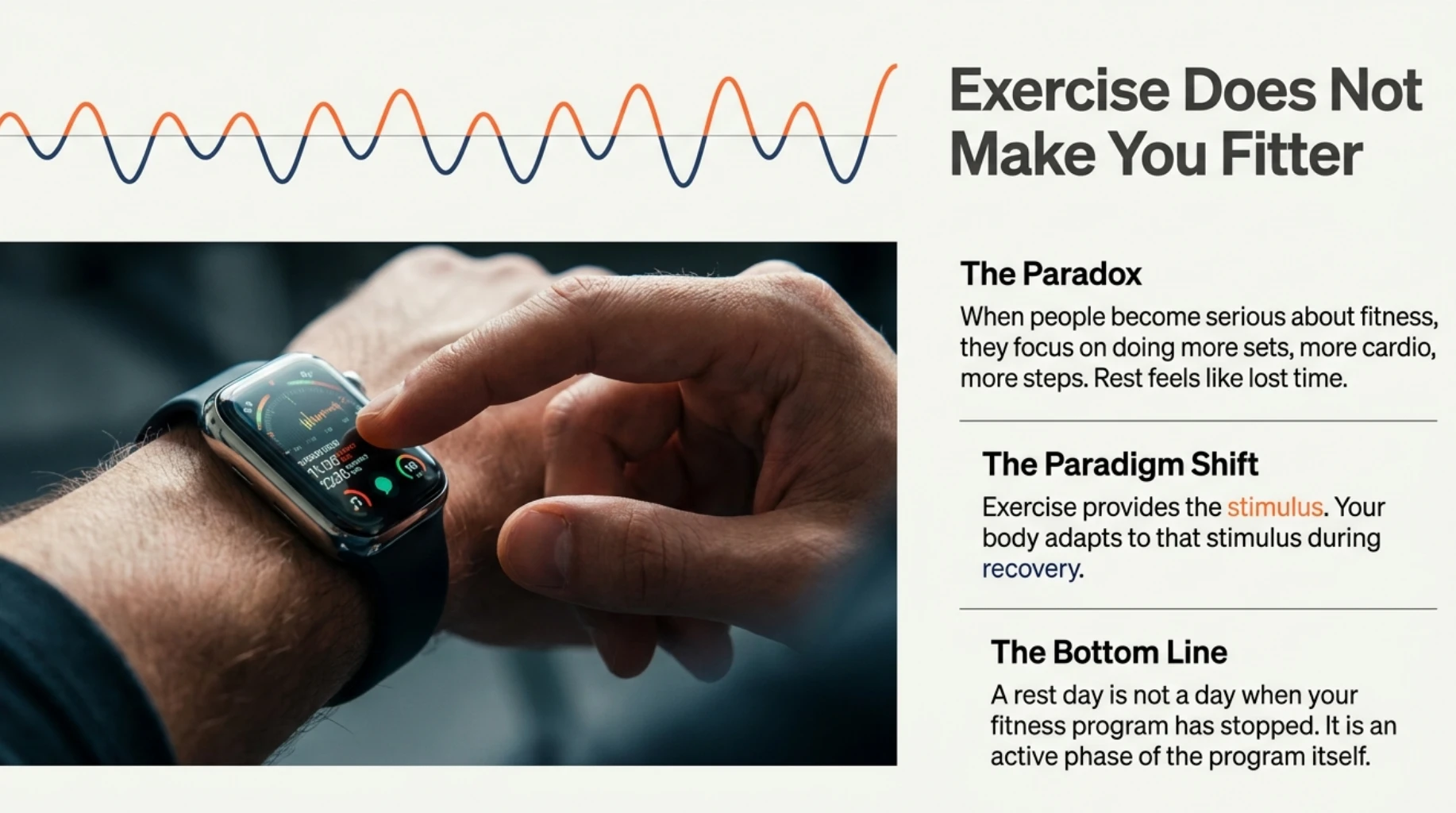
When people become serious about fitness, they often focus on doing more.
More workouts.
More steps.
More cardio.
More sets.
More calories burned.
Rest can begin to feel like lost time.
Some people even feel guilty when they miss the gym for a day.
But exercise does not make you fitter simply because you are exercising.
Exercise provides the stimulus.
Your body adapts to that stimulus during recovery.
This is why rest days from exercise should not automatically be viewed as days when your fitness programme has stopped.
They can be an important part of the programme itself.
Resistance training temporarily stresses muscle fibres. Hard endurance exercise challenges energy stores, muscles, tendons and the cardiovascular system. High-intensity training also creates substantial physiological fatigue.
Your body then needs time and resources to recover from that stress.
Given adequate recovery, the body adapts.
But if demanding training repeatedly exceeds your ability to recover, performance can stagnate or decline.
This does not mean everyone needs to sit on the sofa every alternate day.
Recovery is more sophisticated than that.
A rest day can involve complete rest, easy walking, mobility work or another form of low-intensity activity depending on what your body needs.
The real question is therefore not:

“Should I exercise or rest?”
It is:
“How much training can I recover from well enough to keep progressing?”
Why Do We Need Rest Days From Exercise?
Every meaningful workout creates some degree of physiological stress.
This is not inherently harmful.
In fact, it is necessary.
Without sufficient training stress, there is little reason for the body to adapt.
The problem occurs when training stress is repeatedly added without adequate recovery.
Exercise can temporarily influence:
- Muscle tissue.
- Muscle glycogen.
- Tendons and connective tissues.
- The nervous system.
- Fluid balance.
- Energy availability.
- Perceived fatigue.
The extent of these changes depends on the workout.
A comfortable 20-minute walk does not create the same recovery demand as a heavy lower-body resistance session or a long-distance run.
That distinction is essential when deciding how many rest days from exercise you actually need.
Exercise Is the Stimulus; Recovery Allows Adaptation
A useful way to understand training is to think of it as a repeated cycle:
Training stimulus → fatigue → recovery → adaptation → next training stimulus.
During a challenging workout, performance capacity may temporarily decrease because fatigue accumulates.
During recovery, the body repairs tissue, replenishes energy stores and adapts to the demands that were placed upon it.
If the next appropriate training stimulus is then provided, fitness can gradually improve.
Problems can arise at either extreme.
Too little training provides insufficient stimulus.
Too much training with inadequate recovery creates excessive fatigue.
Good programming attempts to find the productive middle ground.
What Actually Happens During Exercise Recovery?
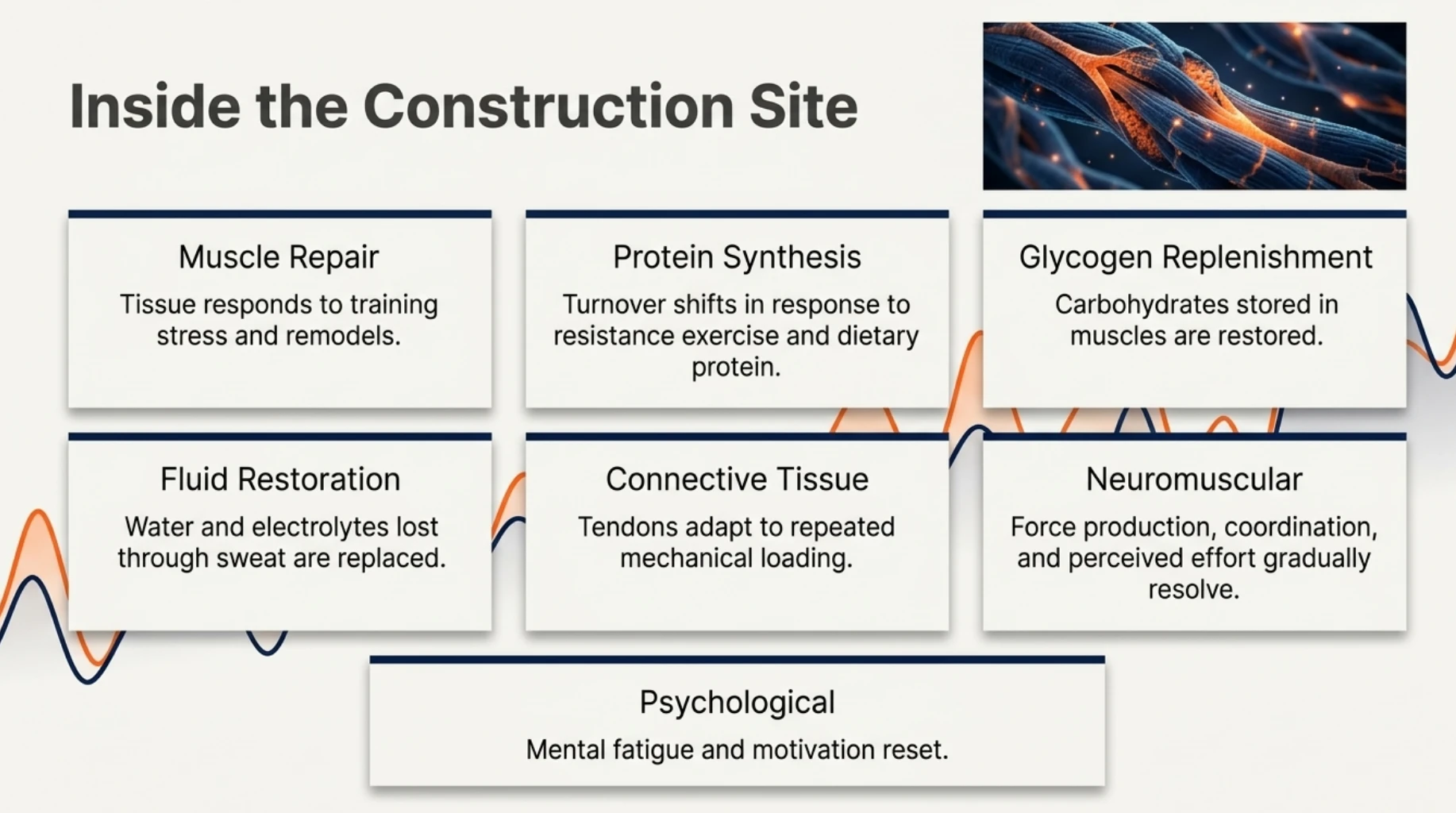
Recovery is not one single biological process.
Several processes occur simultaneously.
| Recovery Process | What Is Happening? |
|---|---|
| Muscle repair | Muscle tissue responds to training stress and remodels during recovery. |
| Protein synthesis | Muscle protein turnover shifts in response to resistance exercise and dietary protein. |
| Glycogen replenishment | Carbohydrate stored in muscle can be restored after exercise. |
| Fluid restoration | Water and electrolytes lost through sweat need to be replaced. |
| Connective-tissue recovery | Tendons and other tissues adapt to repeated mechanical loading over time. |
| Neuromuscular recovery | Fatigue affecting force production, coordination and perceived effort gradually resolves. |
| Psychological recovery | Mental fatigue and motivation can also be influenced by demanding training schedules. |
This is why recovery cannot be replaced by a single supplement, protein shake or massage gun.
Recovery is a whole-body process.
Do Muscles Grow While You Are Resting?
In a simplified sense, yes.
Resistance training provides the stimulus that initiates muscular adaptation.
But the rebuilding and remodelling processes continue after you leave the gym.
Resistance exercise can increase muscle protein synthesis for an extended period afterwards, particularly in people who are relatively new to training.
Protein intake provides amino acids required to support this process.
Sleep and adequate energy intake also contribute to the overall recovery environment.
This is why training the same muscle as hard as possible every day is not automatically the fastest route to muscle growth.
More Exercise Does Not Always Mean More Progress
This is one of the hardest concepts for highly motivated beginners to accept.
Exercise has a dose-response relationship.
Increasing training from very little to an appropriate amount can produce substantial benefits.
But once training volume becomes excessive relative to recovery capacity, simply adding more exercise does not guarantee better results.
Imagine strength training as medication.
Too little may provide insufficient stimulus.
An appropriate dose can produce adaptation.
An unnecessarily high dose may produce more fatigue without proportionally greater benefit.
The objective is not to perform the maximum exercise you can survive.
It is to perform the amount you can recover from and progressively adapt to.
Rest Days From Exercise Do Not Always Mean Complete Rest
The term “rest day” can be misleading because it sounds as though you should avoid all movement.
That is rarely necessary for a healthy person.
There is a major difference between:
- A hard resistance-training session.
- A 45-minute easy walk.
- A demanding interval workout.
- Gentle mobility exercises.
- Competitive sport.
- Normal daily activity.
A day without structured hard training can still include plenty of movement.
This is often described as active recovery.
Complete Rest vs Active Recovery
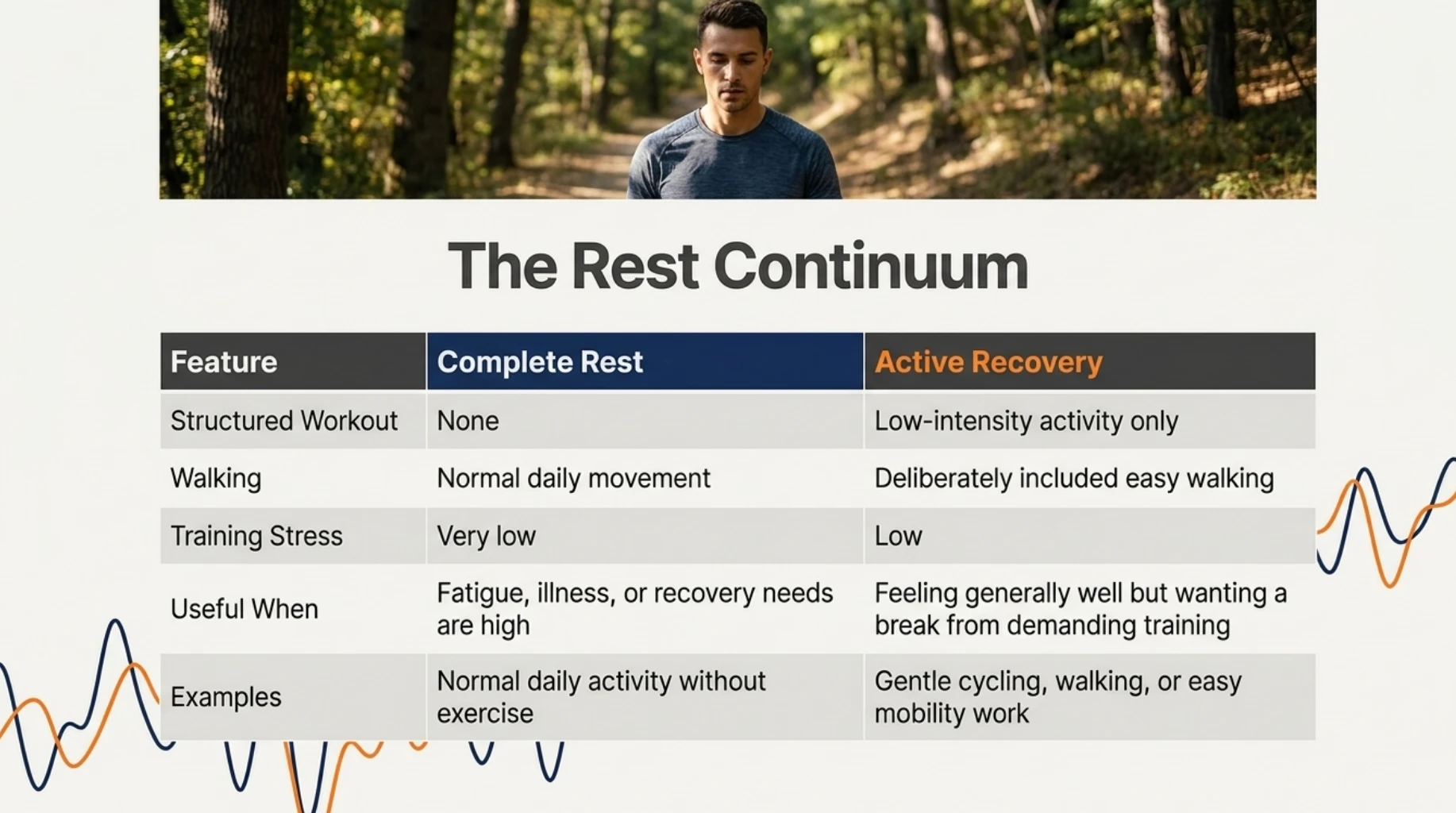
| Feature | Complete Rest | Active Recovery |
|---|---|---|
| Structured workout | None | Low-intensity activity only |
| Walking | Normal daily movement | Easy walking may be deliberately included |
| Training stress | Very low | Low |
| Useful when | Fatigue, illness or recovery needs are higher | You feel generally well but want a break from demanding training |
| Examples | Normal daily activity without exercise | Walking, gentle cycling or easy mobility work |
Both approaches can be useful.
The correct choice depends on why you need recovery.
What Is Active Recovery?
Active recovery means performing physical activity at an intensity low enough that it does not create substantial additional fatigue.
Examples might include:
- An easy walk.
- Gentle cycling.
- Comfortable swimming.
- Light mobility work.
- Easy recreational movement.
The key word is easy.
If your “recovery run” becomes a personal-best attempt, it is no longer much of a recovery session.
Does Active Recovery Make Muscles Recover Faster?
Light movement can help some people feel less stiff and may improve subjective recovery.
But active recovery should not be presented as a magical way to eliminate all exercise-induced fatigue or soreness.
Its biggest practical advantage is often that it allows you to remain physically active without adding another demanding workout.
For many adults, an easy walk on a non-training day is completely compatible with recovery.
How Many Rest Days From Exercise Do You Need?
There is no universal number.
The popular idea that everyone needs exactly one or two rest days each week is too simplistic.
Recovery requirements depend on:
- Exercise type.
- Training intensity.
- Training volume.
- Fitness level.
- Training age.
- Age.
- Sleep.
- Nutrition.
- Energy intake.
- Psychological stress.
- Medical conditions.
A person walking for general health can usually be active on most or all days.
A beginner performing challenging full-body resistance training may need more recovery between sessions.
An experienced athlete may train daily but alternate muscle groups, intensities and types of exercise.
How Much Recovery Do Different Workouts Need?
| Exercise | Typical Recovery Demand | Important Consideration |
|---|---|---|
| Easy walking | Low | Can usually be performed frequently |
| Moderate aerobic exercise | Low to moderate | Depends on duration and fitness |
| Heavy resistance training | Moderate to high | Recovery depends on muscles trained, volume and intensity |
| High-intensity intervals | High | Repeated hard sessions may require substantial recovery |
| Long endurance session | Moderate to high | Depends greatly on duration and training status |
| Competitive sport | Variable to high | Includes muscular, metabolic and psychological demands |
These are general patterns rather than fixed recovery times.
Do You Need 48 Hours Between Strength Workouts?
You may have heard that every muscle needs exactly 48 hours of rest before it can be trained again.
This is a useful beginner guideline, but it should not be treated as a biological law.
Recovery depends on what you actually did.
Three light sets of an exercise do not create the same fatigue as a high-volume session performed close to muscular failure.
Training experience also matters.
A beginner may experience substantial soreness after a relatively modest session, while an experienced lifter may tolerate similar training with little disruption.
Can You Strength Train Every Day?
Potentially, but that does not mean every muscle should be trained maximally every day.
Experienced trainees sometimes distribute resistance training across the week by alternating muscle groups.
For example:
| Day | Example Training Focus |
|---|---|
| Monday | Upper body |
| Tuesday | Lower body |
| Wednesday | Easy cardio or recovery |
| Thursday | Upper body |
| Friday | Lower body |
| Saturday | Moderate cardio or recreational activity |
| Sunday | Rest or active recovery |
This is only one example.
A beginner may do better with two or three full-body resistance sessions each week rather than trying to train seven days.
Do You Need Rest Days From Walking?
Usually not in the same way that you need recovery from strenuous exercise.
Walking is relatively low intensity for most healthy adults and can often be performed daily.
However, context matters.
A sedentary person who suddenly increases from 2,000 steps per day to 20,000 steps may develop foot, ankle, knee or tendon symptoms.
A long mountain hike is also very different from a 30-minute neighbourhood walk.
Even low-intensity activities can create excessive load when volume increases too quickly.
Rest Days From Exercise for Muscle Growth
If your goal is muscle growth, recovery is particularly important because resistance training and recovery work together.
Muscle hypertrophy depends on several factors:
- Adequate resistance-training stimulus.
- Sufficient weekly training volume.
- Progressive overload.
- Adequate protein.
- Sufficient energy availability.
- Sleep.
- Recovery between demanding sessions.
More training volume can sometimes produce more muscle growth, but only up to the point where the additional work can be recovered from.
Beyond that point, extra sets may simply produce additional fatigue.
Muscle Soreness Does Not Tell the Whole Recovery Story
Many people decide whether they are recovered based entirely on soreness.
This is unreliable.
You can be sore and still capable of training.
You can also have very little soreness while still carrying significant fatigue.
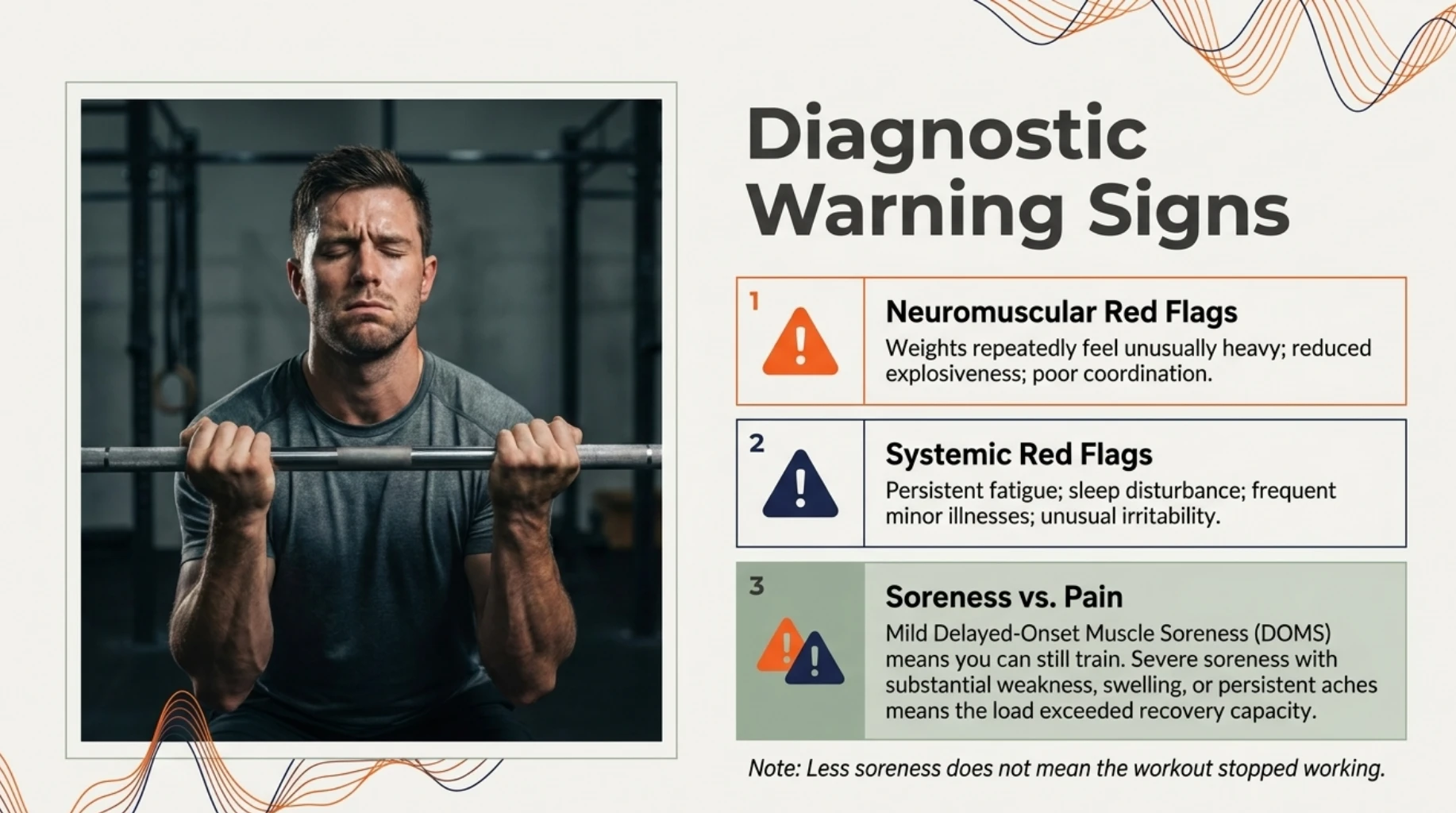
Delayed-onset muscle soreness, or DOMS, commonly appears after unfamiliar exercise, particularly movements involving substantial eccentric muscle action.
As your body becomes accustomed to the training, soreness often decreases even though the workout remains effective.
Therefore:
less soreness does not mean the workout stopped working.
Should You Exercise When Your Muscles Are Sore?
Mild soreness does not necessarily require complete rest.
You may be able to:
- Train a different muscle group.
- Perform easy aerobic activity.
- Reduce the load or volume.
- Use a recovery day.
Severe soreness associated with substantial weakness, swelling, significant movement restriction or unusually dark urine is different and should not be treated as ordinary post-workout soreness.
Rest Days From Exercise and the Nervous System
Muscle tissue is not the only contributor to fatigue.
Training also requires neural drive, coordination and concentration.
Heavy resistance exercise, sprinting and technically demanding sports can produce fatigue that is not adequately described by muscle soreness alone.
You may notice:
- Weights feeling unusually heavy.
- Reduced explosiveness.
- Poor coordination.
- Slower reaction.
- Lower motivation.
One bad workout does not necessarily mean you need a week off.
But a persistent decline across several sessions deserves attention.
Sleep Is One of the Most Important Recovery Tools
You cannot optimise recovery while chronically neglecting sleep.
Sleep supports numerous processes relevant to exercise, including:
- Physical recovery.
- Neurological function.
- Appetite regulation.
- Glucose metabolism.
- Mood.
- Learning and motor skill development.
Someone training intensely while regularly sleeping five hours per night may struggle to recover regardless of how carefully the weekly workout split is designed.
Before buying another recovery supplement, it is often worth examining sleep.
Rest Days Cannot Fully Compensate for Chronic Sleep Deprivation
Suppose someone performs four demanding workouts each week and has three rest days.
On paper, the programme appears to provide plenty of recovery.
But if the person sleeps poorly every night, consumes inadequate protein and is under substantial psychological stress, those three days may not provide the expected recovery.
Recovery depends on the complete physiological environment, not simply whether “REST” appears on the calendar.
Protein and Exercise Recovery
Dietary protein provides amino acids needed for the repair and remodelling of muscle proteins.
For people performing regular resistance training, adequate daily protein intake is therefore important.
However, protein cannot rescue a poorly designed programme indefinitely.
A high-protein diet does not make unlimited training recoverable.
Training stimulus, nutrition and recovery must work together.
Carbohydrates and Recovery
Carbohydrates are stored in muscle and liver as glycogen.
Long or high-intensity exercise can substantially reduce muscle glycogen.
Carbohydrate intake helps replenish these stores.
This becomes particularly important for people who:
- Train for long durations.
- Perform high-intensity exercise.
- Train more than once per day.
- Participate in endurance sports.
- Have another demanding session within a relatively short period.
A person performing three moderate gym sessions per week does not require the same aggressive refuelling strategy as a competitive endurance athlete.
Hydration Is Part of Recovery
Exercise-associated fluid loss depends on temperature, humidity, workout duration, intensity, clothing and individual sweat rate.
Significant dehydration can impair physical performance and increase perceived effort.
Recovery therefore includes replacing the fluid lost during training.
People exercising for long periods or sweating heavily may also need to consider electrolyte replacement rather than drinking water alone.
Rest Days From Exercise During Weight Loss
Recovery can become more difficult during calorie restriction.
A calorie deficit means less energy is available overall, particularly when the deficit is aggressive.
At the same time, many people trying to lose weight make the mistake of simultaneously:
- Eating much less.
- Increasing cardio dramatically.
- Starting resistance training.
- Trying to reach very high step counts.
This can create a large increase in training stress while reducing the resources available for recovery.
The result may be fatigue, poor performance and difficulty maintaining the programme.
During fat loss, the objective should not be to punish the body with the maximum possible exercise.
The objective is to create a sustainable energy deficit while preserving muscle, strength and health.
Rest Days From Exercise Are Not Lazy Days
A rest day can still include normal movement, work, household activity and walking.
The purpose is not to become completely sedentary.
The purpose is to temporarily reduce structured training stress so that adaptation can catch up with the work you have already performed.
For someone who struggles with guilt when taking a day away from the gym, this distinction matters.
Recovery is not a failure to train. Recovery is one of the conditions that allows training to work.
How Do You Know If You Need a Rest Day?
Your training calendar is useful, but your body does not always follow the calendar perfectly.
Some weeks you may recover quickly. During others, poor sleep, work pressure, illness, travel or a harder-than-usual training session can increase your recovery needs.
This is why rest days from exercise should not be based only on a rigid rule such as “Sunday is always my rest day.”
You should also pay attention to changes in performance, energy, motivation and physical symptoms.
A single tired day is usually not concerning.
But several signs appearing together—and persisting across multiple workouts—may indicate that your current training load is exceeding your ability to recover.
Signs That You May Need More Recovery
| Possible Sign | What It May Suggest |
|---|---|
| Persistent muscle soreness | The previous training load may have been greater than your current recovery capacity. |
| Declining workout performance | Accumulated fatigue may be interfering with strength, endurance or training quality. |
| Weights repeatedly feel unusually heavy | You may not have recovered adequately from previous sessions. |
| Persistent fatigue | Training, sleep, nutrition, illness or psychological stress may need reassessment. |
| Reduced motivation | Can occur with excessive training stress, although many other factors can contribute. |
| Sleep disturbance | High training stress or poor recovery may contribute in some people. |
| Unusual irritability | May accompany accumulated physical and psychological fatigue. |
| Persistent aches and pains | Training load or exercise technique may require modification. |
| Frequent minor illnesses | Heavy training combined with inadequate recovery may be one contributing factor. |
| Loss of enthusiasm for training | May indicate psychological fatigue or an unnecessarily demanding programme. |
None of these signs alone proves that someone is “overtraining.”
They should be interpreted in context.
What Is Overtraining?
The word overtraining is used far too casually.
People sometimes describe themselves as overtrained simply because their legs are sore after squats.
True overtraining syndrome is much more serious and is generally associated with prolonged excessive training stress accompanied by inadequate recovery and a persistent reduction in performance.
It is not the same as being tired after several hard workouts.
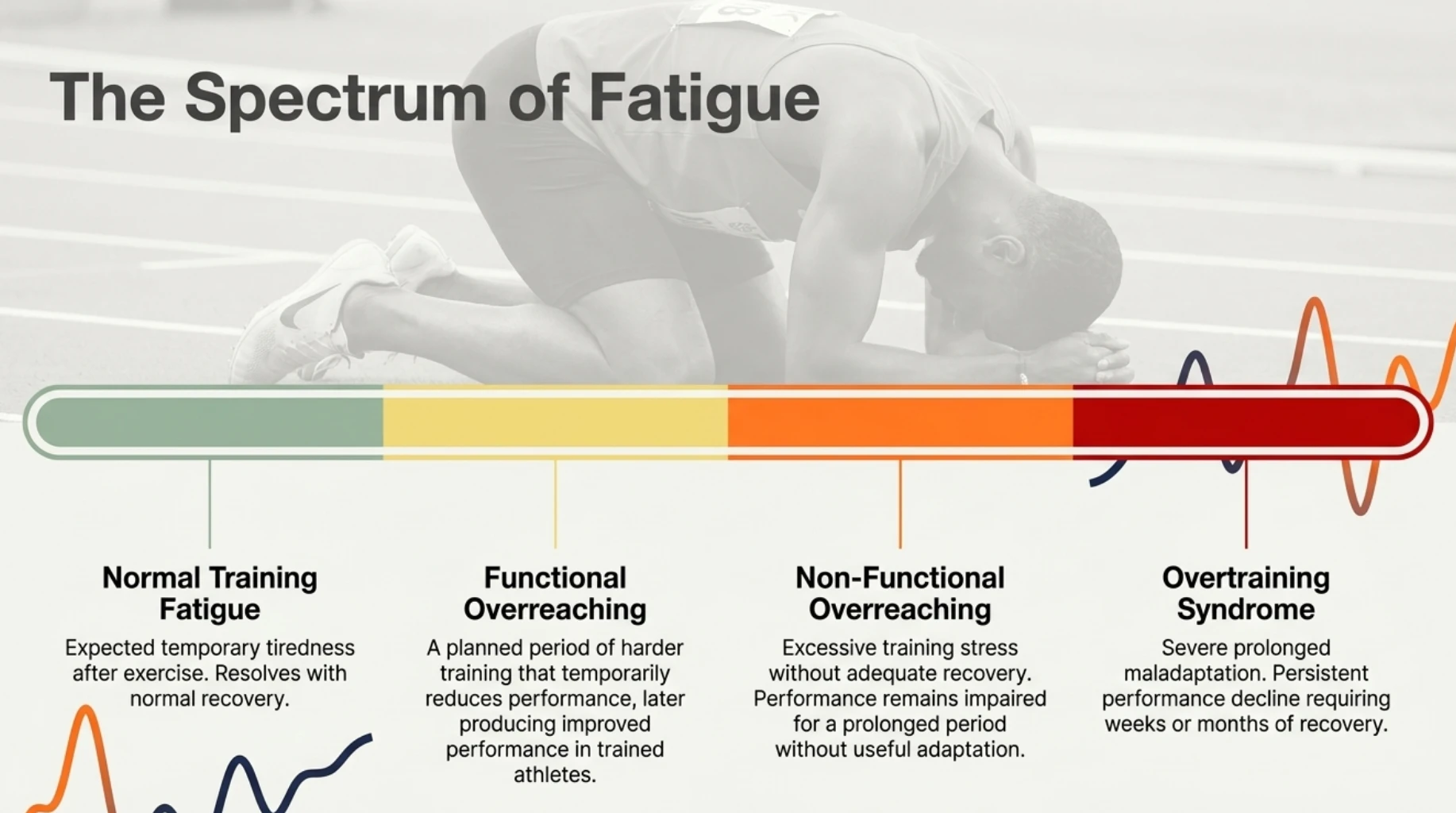
There is a spectrum of training fatigue.
Normal Fatigue vs Overreaching vs Overtraining
| Condition | What It Means | Typical Pattern |
|---|---|---|
| Normal training fatigue | Expected temporary tiredness after exercise | Usually resolves with normal recovery |
| Functional overreaching | A planned period of harder training that temporarily reduces performance | Recovery can subsequently produce improved performance in trained athletes |
| Non-functional overreaching | Excessive training stress without adequate recovery | Performance may remain impaired for a prolonged period without useful adaptation |
| Overtraining syndrome | Severe prolonged maladaptation associated with persistent performance decline | Recovery may take many weeks or months |
Most recreational exercisers who feel tired do not have true overtraining syndrome.
More commonly, they have accumulated fatigue, inadequate sleep, insufficient food intake, excessive training volume or poor programme design.
Do You Need a Rest Day If Your Performance Is Improving?
Not necessarily because of one arbitrary weekly rule.
If you are:
- Progressing in strength.
- Sleeping well.
- Feeling energetic.
- Maintaining enthusiasm for training.
- Free from persistent pain.
- Recovering well between sessions.
then your current training-recovery balance may be working well.
The purpose of recovery is not to accumulate the maximum number of rest days.
It is to support sustainable training.
Can You Exercise Seven Days a Week?
Yes, depending on what you mean by exercise.
A person might walk every day while performing resistance training three times per week.
Another person might alternate strength training, cycling, swimming and easy recovery activity.
Neither person is necessarily performing seven hard workouts.
This distinction matters.
Training frequency and training intensity are not the same thing.
You can be physically active every day without placing the body under high training stress every day.
Hard Days and Easy Days
One useful strategy is to vary training stress across the week.
Instead of making every workout hard, alternate more demanding sessions with easier sessions or recovery days.
This can be particularly useful for people combining strength and cardiovascular exercise.
| Day | Example Activity | Training Demand |
|---|---|---|
| Monday | Full-body resistance training | High |
| Tuesday | Brisk walking | Low to moderate |
| Wednesday | Resistance training | High |
| Thursday | Easy walking and mobility | Low |
| Friday | Resistance training | High |
| Saturday | Moderate aerobic exercise | Moderate |
| Sunday | Rest or easy recreational activity | Very low |
This is only an example.
The ideal weekly structure depends on the individual and the training goal.
Rest Days for Beginners
Beginners often need more recovery from unfamiliar exercise than they expect.
This is partly because the body has not yet adapted to the movement or training volume.
A new resistance-training programme can therefore produce considerable soreness even when the workout does not appear particularly difficult.
For many beginners, two or three full-body strength sessions per week provide plenty of opportunity to improve while leaving recovery time between sessions.
There is usually no need to begin with six demanding gym sessions per week.
Training volume can increase gradually as fitness and recovery capacity improve.
Rest Days for Experienced Lifters
Experienced lifters may train more frequently because they can distribute their workload differently.
Instead of performing a full-body workout every day, they may use:
- Upper-body and lower-body splits.
- Push and pull sessions.
- Different muscle groups on different days.
- Heavy and lighter sessions.
This allows one area of the body to recover while another is trained.
However, experienced lifters can still accumulate systemic fatigue.
A training split does not make recovery irrelevant.
Rest Days From Exercise After 40
People sometimes assume that turning 40 means they suddenly need long periods of rest between workouts.
That is an exaggeration.
Many adults can train effectively well beyond 40, 50, 60 and later life.
However, recovery deserves increasing attention because several factors may change with age:
- Muscle recovery may become somewhat slower.
- Tendons may tolerate sudden load increases less well.
- Sleep may become less consistent.
- Joint problems may become more common.
- Work and family stress may remain high.
- Muscle mass becomes increasingly important to preserve.
The solution is not to avoid challenging exercise.
It is to programme challenging exercise intelligently.
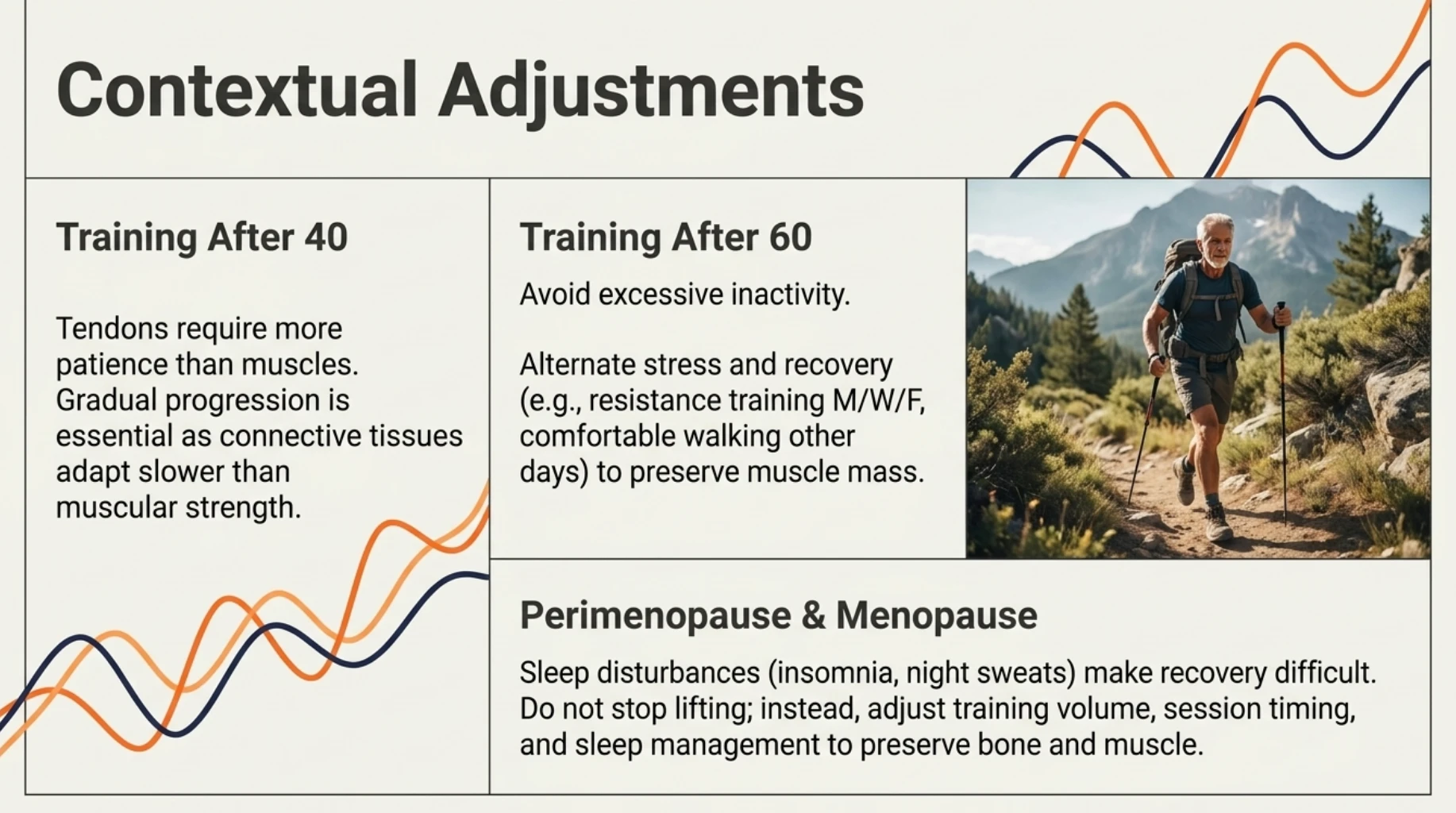
Why Tendons May Need More Patience Than Muscles
Muscles can become stronger relatively quickly when someone begins resistance training.
That can create an interesting problem.
You may feel strong enough to increase the weight rapidly, but tendons and other connective tissues may not adapt at exactly the same rate.
Sudden increases in:
- Weight.
- Training volume.
- Running distance.
- Jumping.
- Exercise frequency.
can therefore create problems even when your muscles feel capable.
Gradual progression is one of the simplest forms of injury-risk management.
Rest Days From Exercise After 50 and 60
Recovery remains important later in life, but so does avoiding excessive inactivity.
Older adults benefit from maintaining regular:
- Resistance training.
- Aerobic activity.
- Walking.
- Balance work.
- Mobility where needed.
The programme should therefore alternate stress and recovery rather than replacing exercise with prolonged rest.
For example, an older adult might perform resistance training on Monday, Wednesday and Friday while walking comfortably on most other days.
That provides both training stimulus and recovery.
Rest Days for Women
Women do not require a fundamentally different concept of recovery.
The same major principles apply:
Training load must be balanced against sleep, nutrition, fitness, stress and individual recovery.
However, life stage can influence the context.
During perimenopause and menopause, changes in sleep, body composition, bone health and muscle mass can make good programme design particularly valuable.
Resistance training remains important rather than something that should be reduced simply because recovery sometimes feels different.
Should You Rest During Your Period?
There is no universal requirement to stop exercising during menstruation.
Many women can continue their normal exercise programme.
Others may prefer to reduce training intensity when symptoms such as significant cramps, fatigue or heavy bleeding are present.
The decision should be symptom-based rather than dictated by a blanket rule that menstruation requires complete rest.
Rest Days During Perimenopause and Menopause
Sleep disturbance can become particularly relevant during the menopausal transition.
If hot flushes, night sweats or insomnia repeatedly reduce sleep quality, recovery from demanding training may become more difficult.
The answer is not necessarily to stop resistance training.
Instead, it may be useful to adjust:
- Training volume.
- Workout intensity.
- Session timing.
- Weekly distribution.
- Nutrition.
- Sleep management.
Maintaining muscle and bone remains particularly important during this stage of life.
Rest Days From Exercise During a Calorie Deficit
Recovery deserves additional attention during weight loss.
A calorie deficit intentionally provides less energy than the body is using.
If the deficit becomes very large while training volume is simultaneously increased, fatigue can accumulate quickly.
Warning signs may include:
- Progressive loss of training performance.
- Persistent tiredness.
- Excessive hunger.
- Poor sleep.
- Irritability.
- Reduced motivation.
More cardio is not always the solution to slower-than-expected weight loss.
Sometimes the programme already contains more training than the person can comfortably recover from.
Recovery During Medical Weight Loss
People losing substantial amounts of weight through medically supervised obesity treatment should pay particular attention to muscle preservation.
A reduced appetite can make it easier to eat too little protein and total energy.
If demanding exercise is then added without adequate nutrition, recovery may become more difficult.
The priorities should include:
- Appropriate resistance training.
- Adequate dietary protein.
- Gradual training progression.
- Adequate hydration.
- Sufficient sleep.
- Avoiding unnecessarily excessive exercise volume.
The goal of weight loss should not simply be a lower scale number.
Preserving muscle and physical function matters.
Rest Days and Diabetes
Regular physical activity is extremely valuable for people with type 2 diabetes.
This does not mean that every day needs to contain a demanding workout.
Resistance training may be scheduled several times per week while walking and general physical activity continue on other days.
In fact, frequent low-intensity movement can be useful even on recovery days because prolonged sedentary periods are undesirable for metabolic health.
A rest day from the gym should not automatically become a day spent sitting for 14 hours.
Can Blood Sugar Change After Hard Exercise?
Yes.
Exercise does not always cause an immediate fall in glucose.
High-intensity exercise can temporarily increase glucose in some people because stress hormones stimulate glucose release.
Exercise can also influence insulin sensitivity for hours afterwards.
People using insulin or medicines associated with hypoglycaemia may need to consider exercise intensity, meal timing and medication when planning training and recovery.
Recovery strategies should therefore be individualised rather than based entirely on generic fitness advice.
Rest Days and High Blood Pressure
Regular exercise is an important component of blood-pressure management.
Most people with well-managed hypertension do not need unusually long rest periods simply because they have high blood pressure.
However, symptoms matter.
Exercise should be reassessed when there is:
- Chest discomfort.
- Unexplained severe breathlessness.
- Fainting.
- Marked dizziness.
- New concerning palpitations.
A rest day is not a substitute for evaluating potentially important symptoms.
When a Rest Day Is Not Enough
Sometimes the body needs more than one day away from hard training.
This is particularly true during illness.
Trying to “sweat out” a significant infection through a hard workout is not a good recovery strategy.
Fever, systemic illness, substantial weakness, dehydration, vomiting or diarrhoea are reasonable reasons to pause demanding exercise.
Training can be resumed progressively as recovery occurs.
Should You Exercise With a Cold?
Mild upper-respiratory symptoms do not always require complete inactivity, but intensity may need to be reduced.
When symptoms are systemic—such as fever, significant body aches, marked fatigue or chest symptoms—rest becomes more appropriate.
Exercise should not be used as a test of toughness during illness.
Rest Days After Poor Sleep
One poor night of sleep does not automatically mean you must cancel every workout.
But training may need modification if you feel unusually fatigued.
Options include:
- Reducing resistance.
- Reducing the number of sets.
- Replacing intervals with easier cardio.
- Taking an active-recovery day.
- Taking complete rest when fatigue is substantial.
The bigger concern is chronic sleep deprivation rather than one isolated bad night.
Does Resting Heart Rate Tell You Whether You Are Recovered?
Resting heart rate can provide useful information when tracked consistently, but it should not be used as a stand-alone recovery test.
A higher-than-usual resting heart rate can occur with:
- Training fatigue.
- Illness.
- Dehydration.
- Poor sleep.
- Alcohol.
- Psychological stress.
- Heat exposure.
Trends are generally more useful than a single measurement.
Combine heart-rate information with how you feel and how you are performing.
Can HRV Tell You When to Take a Rest Day?
Heart rate variability, or HRV, has become popular through smartwatches and fitness trackers.
HRV can provide information about autonomic nervous system activity and may contribute to recovery monitoring.
But it should not be interpreted as a simple green-light/red-light system.
HRV varies substantially between individuals and can be affected by sleep, illness, alcohol, psychological stress, training and many other factors.
Your personal trend is usually more meaningful than comparing your number with someone else’s.
Do Fitness Watches Know When You Need Rest?
Fitness trackers can provide useful estimates of training load, sleep, heart rate and recovery.
But their recovery scores are algorithmic estimates—not direct measurements of whether every muscle, tendon and physiological system has completely recovered.
A device can contribute information.
It should not replace common sense.
If your watch says you are fully recovered but your knee is painful and swollen, the knee deserves more attention than the score.
Should You Stretch on Rest Days?
You can, if stretching is useful for your mobility goals or simply feels good.
But stretching is not mandatory for muscle recovery.
It should also not be used aggressively on an acutely injured or severely painful muscle.
Gentle mobility work can be a reasonable component of active recovery.
Do Massage and Foam Rolling Speed Recovery?
Massage and foam rolling can help some people feel less sore or improve their perception of recovery.
They may therefore be useful tools.
But they are secondary to the fundamentals.
No recovery device can compensate for:
- Chronic sleep deprivation.
- Inadequate nutrition.
- Severe dehydration.
- Excessive training volume.
- Poor programme design.
If the basics are wrong, adding more recovery gadgets is unlikely to solve the underlying problem.
Cold Baths, Ice Baths and Recovery
Cold-water immersion can reduce perceptions of soreness after demanding exercise and may be useful when rapid recovery is important, such as during competitions or closely spaced sporting events.
However, routinely using aggressive cold-water immersion immediately after every resistance-training session may not always be desirable when maximising muscular adaptation is the primary goal.
This is another example where a recovery technique should be matched to the objective rather than assumed to be universally beneficial.
What About Saunas?
Saunas may be relaxing and have interesting cardiovascular effects, but they should not be treated as a replacement for rest, hydration, nutrition or sleep.
Heat exposure also creates additional physiological stress.
Someone who is already dehydrated after a long workout should be particularly careful about adding prolonged heat exposure without appropriate fluid replacement.
Alcohol and Exercise Recovery
Alcohol is sometimes overlooked when people discuss recovery.
Large amounts of alcohol after exercise can interfere with several aspects of recovery, including hydration, sleep quality and muscle protein metabolism.
A person who trains hard, drinks heavily at night and sleeps poorly cannot expect a supplement the following morning to fully compensate.
Do You Need Supplements for Recovery?
Most recreational exercisers do not require a large collection of recovery supplements.
The foundations remain:
- Adequate total food intake.
- Adequate protein.
- Appropriate carbohydrate intake for training demands.
- Hydration.
- Sleep.
- Sensible programme design.
Supplements may have specific uses, but they should be built on top of these fundamentals rather than replacing them.
When Should You Take a Complete Rest Day?
A complete break from structured exercise can be reasonable when you have:
- Significant accumulated fatigue.
- Severe muscle soreness.
- An acute illness with systemic symptoms.
- Marked sleep deprivation.
- An acute injury requiring unloading.
- Several consecutive days of demanding training.
- A clear persistent decline in exercise performance.
Sometimes the most productive workout is the one you deliberately do not perform.
When Is Active Recovery More Appropriate?
Active recovery may be suitable when you feel generally well but want to reduce training stress.
For example, after a demanding resistance session, the following day might include:
- 20–40 minutes of easy walking.
- Gentle mobility work.
- Comfortable recreational cycling.
- Normal daily physical activity.
The activity should leave you feeling similar or better afterwards—not exhausted.
Rest Days From Exercise Should Match the Training
| Situation | Possible Recovery Strategy |
|---|---|
| Beginner after full-body strength training | Easy walking or a non-strength day before the next demanding full-body session |
| Experienced lifter | Train another muscle group or use a lower-stress session |
| After high-intensity intervals | Easy aerobic activity or rest depending on fatigue |
| After an easy walk | No special recovery day is usually necessary |
| During significant illness | Pause demanding exercise and prioritise recovery |
| After poor sleep with marked fatigue | Reduce training demand or take a recovery day |
| Persistent performance decline | Review training load, sleep, nutrition and overall health rather than simply pushing harder |
The important principle is simple:
Rest days from exercise should respond to the stress created by your training, not to an arbitrary belief that more exercise is always better.
How to Build Rest Days Into a Good Fitness Plan
A good exercise programme should not treat recovery as something that happens only when you become exhausted.
Recovery should be built into the programme from the beginning.
The simplest way to do this is to balance demanding sessions with easier training or rest days from exercise.
This does not require a complicated schedule.
For most recreational exercisers, the programme should answer four basic questions:
- How many genuinely hard workouts am I doing each week?
- Am I training the same muscles hard on consecutive days?
- Am I sleeping and eating well enough to support this training?
- Is my performance stable or improving rather than progressively declining?
If these factors are well managed, recovery usually becomes much easier.
A Simple Weekly Exercise and Recovery Plan
Someone exercising primarily for general health, metabolic fitness, muscle preservation and healthy ageing does not need seven demanding workouts per week.
A balanced week could look something like this:
| Day | Example Activity | Recovery Consideration |
|---|---|---|
| Monday | Full-body resistance training | Challenging training day |
| Tuesday | Brisk walking or moderate cardio | Lower muscular training stress |
| Wednesday | Full-body resistance training | Second challenging strength session |
| Thursday | Easy walking and mobility | Active recovery |
| Friday | Full-body resistance training | Third strength session |
| Saturday | Moderate cardio or recreational activity | Adjust intensity according to fatigue |
| Sunday | Rest or comfortable walking | Low training stress |
This is only an example.
Someone else might strength train twice per week, while an experienced trainee may use four or five resistance sessions divided across different muscle groups.
The important point is that hard and easy days are deliberately distributed rather than allowing every day to become another maximal workout.
Rest Days From Exercise for Someone Training Three Days a Week
Three resistance-training sessions per week can be highly effective for many adults.
A Monday-Wednesday-Friday structure naturally creates recovery time between sessions.
The remaining days do not have to be sedentary.
Walking, normal daily activity and appropriate aerobic exercise can continue.
This structure is particularly practical for beginners because it provides repeated strength-training exposure without requiring daily gym attendance.
What If You Train Four or Five Days a Week?
More frequent resistance training can also work well when the workload is distributed appropriately.
For example, an upper-body/lower-body programme can allow one region to recover while another is being trained.
| Day | Example |
|---|---|
| Monday | Upper-body resistance training |
| Tuesday | Lower-body resistance training |
| Wednesday | Active recovery or moderate cardio |
| Thursday | Upper-body resistance training |
| Friday | Lower-body resistance training |
| Saturday | Walking or recreational activity |
| Sunday | Rest or active recovery |
Again, the exact schedule matters less than the relationship between training stress and recovery capacity.
Can You Walk on Rest Days?
Absolutely.
For most people, walking is one of the best activities to continue on a recovery day.
An easy walk creates much less physiological stress than a demanding resistance or interval session.
It also helps prevent a common mistake: interpreting a rest day as permission to remain almost completely sedentary.
This distinction is particularly relevant for people with obesity, prediabetes, type 2 diabetes or sedentary desk jobs.
A day away from the gym can still include:
- Normal daily steps.
- A short walk after meals.
- Light household activity.
- Gentle mobility exercises.
Recovery from structured training and maintaining everyday movement are compatible goals.
Can You Do 10,000 Steps on a Rest Day?
For someone already accustomed to that level of walking, it may be completely reasonable.
But step counts should also be interpreted according to the individual.
If 10,000 steps represents normal daily activity, it may create little additional fatigue.
If someone normally performs 3,000 steps and suddenly walks 10,000–15,000 while calling it a recovery day, the situation is different.
Recovery depends on the relative workload—not the label attached to the activity.
What Should You Eat on Rest Days?
Another common mistake is dramatically reducing food intake on days without a workout.
Your body is still recovering on these days.
Muscle repair, tissue remodelling and other physiological processes continue after the exercise session has ended.
Your total calorie requirement may be somewhat lower if activity is reduced, but this does not mean the body suddenly stops needing protein, vitamins, minerals and adequate nutrition.
Should You Eat Less Protein on Rest Days?
Usually there is no good reason to dramatically reduce protein intake simply because you did not train that day.
Muscle protein remodelling continues during recovery.
A more useful strategy is to maintain adequate daily protein intake and distribute protein-containing foods across meals.
Think of protein as part of your daily nutrition rather than something needed only immediately after exercise.
Do You Need a Protein Shake on a Rest Day?
Not necessarily.
A protein shake is simply a convenient way to consume protein.
If you obtain sufficient protein from regular meals, there is no requirement to drink a shake because it is a recovery day.
Similarly, if meeting protein requirements through food is difficult, a protein supplement can still be useful on a non-training day.
The important factor is overall dietary intake.
Should You Eat Carbohydrates on Rest Days?
Yes, carbohydrates do not need to disappear simply because you are resting.
Carbohydrate requirements vary according to overall activity, training volume and metabolic goals.
Someone completing large endurance-training volumes may require substantially more carbohydrate than someone performing a few moderate gym sessions each week.
Food intake should match the complete programme rather than following rigid rules such as “no carbohydrates on rest days.”
Rest Days and Creatine
If you use creatine regularly, it is generally taken consistently rather than only on workout days.
Creatine works by increasing muscle creatine stores over time.
It is therefore not necessary to stop taking it simply because you have a rest day from exercise.
Consistency matters more than precise timing around a particular workout.
Common Myths About Rest Days From Exercise
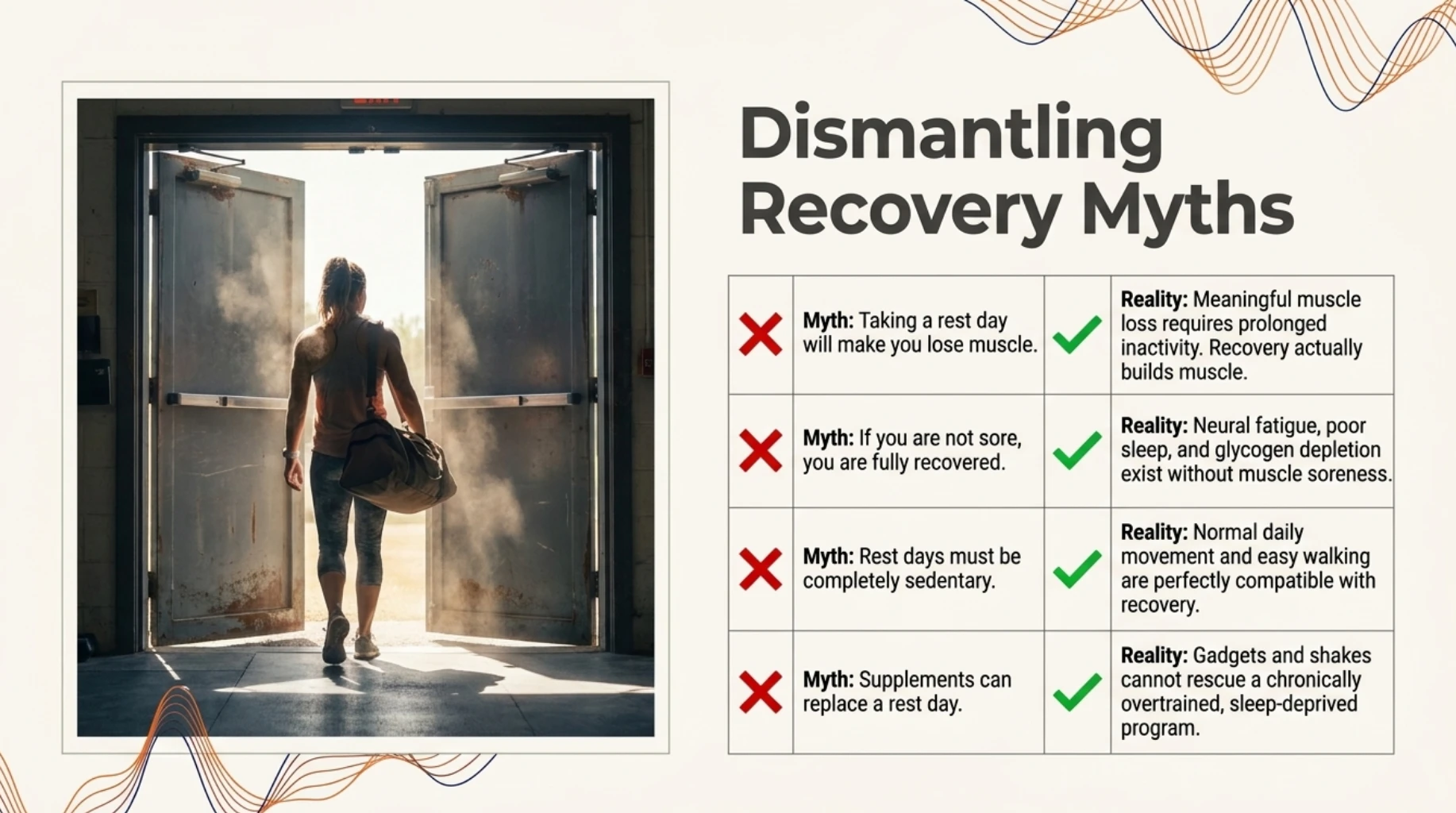
Myth 1: Taking a Rest Day Will Make You Lose Muscle
You do not lose meaningful muscle because you skipped the gym for one day.
Recovery between workouts is part of maintaining and building muscle.
Muscle loss becomes a concern with prolonged inactivity, inadequate nutrition, illness or other sustained factors—not because you took Sunday off.
Myth 2: Serious Athletes Never Take Rest Days
High-level athletes may train very frequently, but their programmes usually manipulate intensity, volume and training type.
Not every session is maximal.
Elite training should also not automatically be copied by recreational exercisers whose sleep, nutrition, work schedules and recovery resources are very different.
Myth 3: If You Are Not Sore, You Are Fully Recovered
Soreness is only one possible sign of training stress.
Neuromuscular fatigue, reduced glycogen availability, poor sleep or general fatigue can exist without significant muscle soreness.
Recovery should therefore not be judged by DOMS alone.
Myth 4: If You Are Sore, You Must Completely Rest
Mild soreness does not automatically require lying down all day.
Easy movement may be completely appropriate.
You may also be able to train another muscle group.
The severity of soreness and its effect on movement and performance matter more than its mere presence.
Myth 5: More Exercise Always Means Faster Weight Loss
Exercise increases energy expenditure, but continuously adding more exercise can also increase fatigue, hunger and the difficulty of maintaining the programme.
Weight management requires a sustainable combination of nutrition, physical activity, resistance training, sleep and behavioural consistency.
Maximum exercise is not automatically the optimal exercise dose.
Myth 6: Rest Days Should Be Completely Sedentary
Usually not.
For most healthy people, normal daily movement and comfortable walking are perfectly compatible with recovery.
A rest day generally means reducing structured training stress—not avoiding all physical movement.
Myth 7: Supplements Can Replace Recovery
No supplement can reliably compensate for excessive training combined with chronic sleep deprivation and inadequate nutrition.
Supplements can play specific roles, but they sit below the fundamentals of recovery.
Myth 8: Pain Means You Need to Push Through It
Exercise discomfort and pain are not identical.
Muscle effort during a challenging set is expected.
Sharp, sudden or progressively worsening pain should not automatically be ignored in the name of discipline.
Persistent pain deserves appropriate assessment.
Rest Day or Training Day? A Practical Decision Guide
| How You Feel | Possible Approach |
|---|---|
| Energetic, normal performance, no significant soreness | Continue the planned training session |
| Mild muscle soreness but otherwise well | Train another muscle group, reduce intensity or continue easy activity |
| General fatigue after several hard sessions | Consider active recovery or a rest day |
| Very poor sleep and marked fatigue | Reduce training demand or take a recovery day |
| Severe muscle soreness affecting normal movement | Avoid another hard session involving the affected muscles |
| Sharp or worsening joint pain | Stop aggravating activity and assess the cause |
| Fever or significant systemic illness | Rest from demanding exercise |
| Persistent unexplained performance decline | Review training, sleep, nutrition, stress and possible medical factors |
When Fatigue May Not Be From Exercise
This is an important distinction.
Persistent tiredness should not automatically be blamed on overtraining.
Several medical and lifestyle factors can produce fatigue, including:
- Anaemia.
- Iron deficiency.
- Vitamin B12 deficiency.
- Thyroid disorders.
- Sleep apnoea.
- Chronic sleep deprivation.
- Infection.
- Depression or significant psychological stress.
- Very low calorie intake.
- Certain medicines.
If reducing training and improving recovery do not improve persistent fatigue, the underlying cause may need medical evaluation.
Exercise Recovery After 40: Think Beyond Soreness
From midlife onward, exercise becomes increasingly important for preserving muscle, bone, cardiovascular fitness and metabolic health.
This is precisely why recovery matters.
The goal should not be to train less simply because you are getting older.
The goal should be to train consistently enough to stimulate adaptation while managing:
- Sleep.
- Joint health.
- Tendon loading.
- Nutrition.
- Work stress.
- Training progression.
A well-recovered 55-year-old following a structured strength programme may progress better than a poorly recovered 35-year-old performing random high-intensity workouts every day.
Rest Days From Exercise and Healthy Ageing
Healthy ageing requires both activity and recovery.
Too little activity contributes to loss of muscle, cardiovascular fitness and physical function.
Too much poorly managed training can produce persistent fatigue, pain and difficulty maintaining exercise.
The sustainable middle ground is regular progressive exercise combined with enough recovery to continue that exercise for years.
That long-term perspective matters far more than completing a perfect seven-day fitness challenge.
Frequently Asked Questions About Rest Days From Exercise
How Many Rest Days Should I Take Per Week?
There is no universal number. Many recreational exercisers do well with one or more days without demanding training each week, but recovery requirements depend on exercise intensity, volume, fitness, sleep, nutrition, age and overall stress.
Do I Need a Rest Day After Every Workout?
No. An easy walk does not usually require a full recovery day. Hard resistance training, high-intensity intervals or long endurance sessions create greater recovery demands.
Can I Walk on a Rest Day?
Yes. Easy walking is generally compatible with recovery and can help maintain daily physical activity without creating substantial additional training stress.
Can I Train Every Day?
You can be physically active every day, but performing a demanding workout every day is different. Training intensity, muscle groups and exercise type can be varied throughout the week.
How Long Should Muscles Rest After Weight Training?
Recovery depends on the workout. Allowing roughly a day or more before heavily training the same muscle again is a useful practical approach for many beginners, but there is no exact recovery period that applies to every workout and every person.
Should I Take a Rest Day if I Am Sore?
Mild soreness does not automatically require complete rest. You may perform easy activity or train another muscle group. Severe soreness that substantially affects movement deserves more recovery.
Will I Lose Muscle if I Take Two Days Off?
No. Taking one or two days away from resistance training does not cause meaningful muscle loss in a healthy person. Recovery is part of the process that supports training adaptation.
Should I Eat Protein on Rest Days?
Yes. Protein remains important because muscle repair and remodelling continue between workouts. There is generally no reason to dramatically reduce protein simply because you are not training that day.
Should I Take Creatine on Rest Days?
If you use creatine, it is generally taken consistently, including on rest days, because its effect depends on maintaining muscle creatine stores rather than taking it only immediately around workouts.
Is It Better to Rest Completely or Do Active Recovery?
It depends on the situation. Easy activity can be useful when you feel generally well, while complete rest may be more appropriate during significant fatigue, acute illness or when an injury requires unloading.
How Do I Know if I Am Overtraining?
True overtraining syndrome is uncommon and involves prolonged performance impairment rather than ordinary post-workout tiredness. Persistent decline in performance, fatigue, poor sleep, mood changes and reduced motivation should prompt a review of training and recovery and, when appropriate, medical assessment.
Do Older Adults Need More Rest Days?
Not automatically. Recovery may change with age, but training history, fitness, sleep, nutrition and health matter greatly. Older adults still benefit from regular resistance and aerobic exercise with appropriate progression and recovery.
Rest Days From Exercise: What Matters Most?
| Recovery Factor | Why It Matters |
|---|---|
| Training load | Harder and longer workouts generally create greater recovery demands. |
| Sleep | Supports physical, neurological and metabolic recovery. |
| Protein | Provides amino acids required for muscle protein remodelling. |
| Energy intake | Very large calorie deficits can make recovery more difficult. |
| Carbohydrate | Helps replenish glycogen, particularly after demanding training. |
| Hydration | Replaces exercise-related fluid losses. |
| Training progression | Gradual increases allow muscles and connective tissues time to adapt. |
| Stress management | Recovery capacity is influenced by total life stress, not exercise alone. |
| Active recovery | Allows movement while temporarily reducing structured training stress. |
| Consistency | A sustainable programme produces more long-term benefit than repeated cycles of excessive training and burnout. |
Final Thought
Fitness is not created by the workout alone.
It is created by the repeated cycle of training, recovery and adaptation.
If you train hard but never recover, eventually the quality of your training suffers.
If you rest continuously but never provide a meaningful training stimulus, there is little reason for your body to become stronger.
The goal is balance.
Rest days from exercise are therefore not days outside your fitness plan. When used appropriately, they are part of the fitness plan.
If you want a personalized metabolic assessment and lifestyle strategy, you can book a consultation here:
Book an Appointment