

Overtraining Symptoms: When More Exercise Starts Reducing Your Progress
Exercise is one of the most powerful tools we have for improving health.
Regular physical activity can improve cardiovascular fitness, insulin sensitivity, muscle strength, bone health, body composition, mood and physical function.
But exercise follows an important biological principle:
Your body improves when training stress is followed by adequate recovery.
This means that doing more exercise does not always produce more progress.
If training becomes progressively harder while sleep, nutrition and recovery remain inadequate, fatigue can begin accumulating faster than the body can resolve it.
Initially, you may simply feel tired.
Your legs may feel heavy.
Your usual weights may feel unusually difficult.
Your running pace may slow.
You may start needing more effort to complete workouts that previously felt manageable.
If you respond by pushing even harder, the problem can worsen.
This is where understanding overtraining symptoms becomes important.
However, there is an equally important clarification.
Feeling tired after several difficult workouts does not automatically mean you have overtraining syndrome.
True overtraining syndrome is much more serious and much less common than social-media fitness discussions often suggest.
Most recreational exercisers who say they are “overtrained” are more likely experiencing accumulated fatigue, insufficient recovery, excessive training volume, inadequate calorie intake, poor sleep or short-term overreaching.
Understanding the difference can prevent two opposite mistakes:
- Ignoring persistent fatigue and continuing to push harder.
- Becoming unnecessarily afraid of normal post-exercise tiredness and soreness.
A good fitness programme needs enough stress to create adaptation—but not so much that recovery repeatedly fails to keep up.

What Does Overtraining Actually Mean?
The word “overtraining” is commonly used to describe almost any unpleasant feeling after exercise.
Muscle soreness after squats?
“Overtraining.”
A bad gym session?
“Overtraining.”
Feeling tired after running?
“Overtraining.”
That is not an accurate use of the term.
Exercise naturally produces fatigue.
A challenging workout is supposed to temporarily reduce your ability to repeat the same performance immediately.
The important question is how quickly you recover and whether your performance subsequently returns or improves.
True overtraining syndrome involves a prolonged imbalance between training stress and recovery, accompanied by a persistent decline in performance that cannot be explained simply by a few hard sessions.
Training Stress Is Not the Enemy
Training stress is necessary for improvement.
If you always perform exercise that is extremely easy, your body receives little reason to become stronger or fitter.
Resistance training challenges muscles.
Running challenges the cardiovascular and musculoskeletal systems.
High-intensity intervals create substantial metabolic and cardiorespiratory stress.
After appropriate recovery, the body adapts.
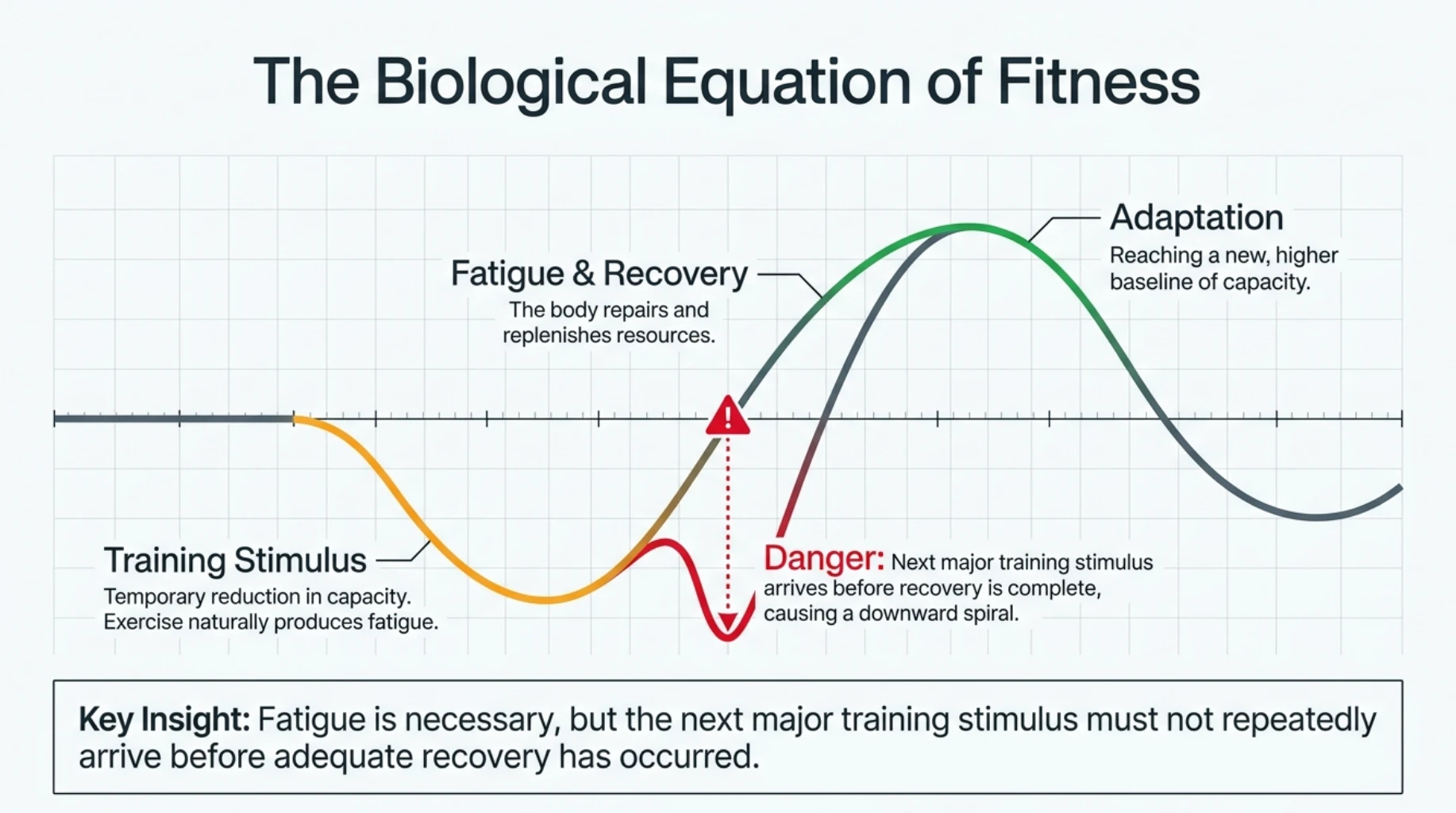
This basic cycle can be represented as:
Training stimulus → fatigue → recovery → adaptation → improved capacity.
The problem begins when the next major training stimulus repeatedly arrives before adequate recovery has occurred.
Fatigue then starts accumulating.
Normal Training Fatigue vs Overtraining Symptoms
Some fatigue after exercise is completely normal.
You might feel:
- Temporarily tired.
- Mildly sore.
- Hungry.
- Less energetic later in the day.
- Slightly weaker immediately after a demanding workout.
These experiences alone do not indicate overtraining.
The pattern becomes more concerning when symptoms persist, performance continues declining and adequate short-term rest does not restore your usual capacity.
| Feature | Normal Training Fatigue | Possible Excessive Training Stress |
|---|---|---|
| Performance | Temporarily reduced after hard exercise | Repeated decline across multiple sessions |
| Energy | Tired after workout but recovers | Persistent fatigue despite usual recovery |
| Muscle soreness | Usually settles over several days | Persistent or unusually frequent soreness |
| Motivation | Generally remains intact | Persistent loss of enthusiasm for training |
| Sleep | Usually unaffected or may improve | May become disturbed in some people |
| Recovery | Normal rest restores performance | Usual recovery becomes insufficient |
Overtraining Exists on a Spectrum
It is more useful to think about excessive training stress as a spectrum rather than a switch that suddenly changes from “normal” to “overtrained.”
The spectrum includes:
- Normal exercise fatigue.
- Functional overreaching.
- Non-functional overreaching.
- Overtraining syndrome.
These are not interchangeable terms.

What Is Functional Overreaching?
Functional overreaching is a short period of deliberately increased training stress that temporarily reduces performance.
This strategy is sometimes used in competitive sport.
An athlete may perform a particularly demanding block of training, become temporarily fatigued and then reduce training to allow recovery.
After sufficient recovery, performance may improve.
In other words, the temporary fatigue was part of a planned training strategy.
This approach is generally more relevant to trained athletes than to people exercising primarily for general health or weight management.
What Is Non-Functional Overreaching?
Non-functional overreaching occurs when excessive training stress produces a more prolonged reduction in performance without a useful training benefit.
Instead of recovering quickly and becoming stronger or fitter, the person remains fatigued and performance remains impaired.
Recovery can take considerably longer.
This is a warning that the balance between training and recovery has moved in the wrong direction.
What Is Overtraining Syndrome?
Overtraining syndrome is the more severe end of the spectrum.
It is associated with prolonged performance impairment accompanied by broader physical and psychological symptoms.
Recovery can take many weeks or even months.
Importantly, there is no single blood test, smartwatch reading or symptom that independently proves someone has overtraining syndrome.
Other causes of persistent fatigue and poor performance must also be considered.
| Training State | Performance Effect | General Recovery Pattern |
|---|---|---|
| Normal fatigue | Short-term reduction | Usually resolves relatively quickly |
| Functional overreaching | Temporary planned reduction | Recovery followed by potential improvement |
| Non-functional overreaching | More prolonged impairment | Recovery takes substantially longer |
| Overtraining syndrome | Persistent substantial decline | May require many weeks or months |
What Are the Most Common Overtraining Symptoms?
There is no single universal symptom pattern.
Different people may experience different combinations of physical, performance-related and psychological changes.
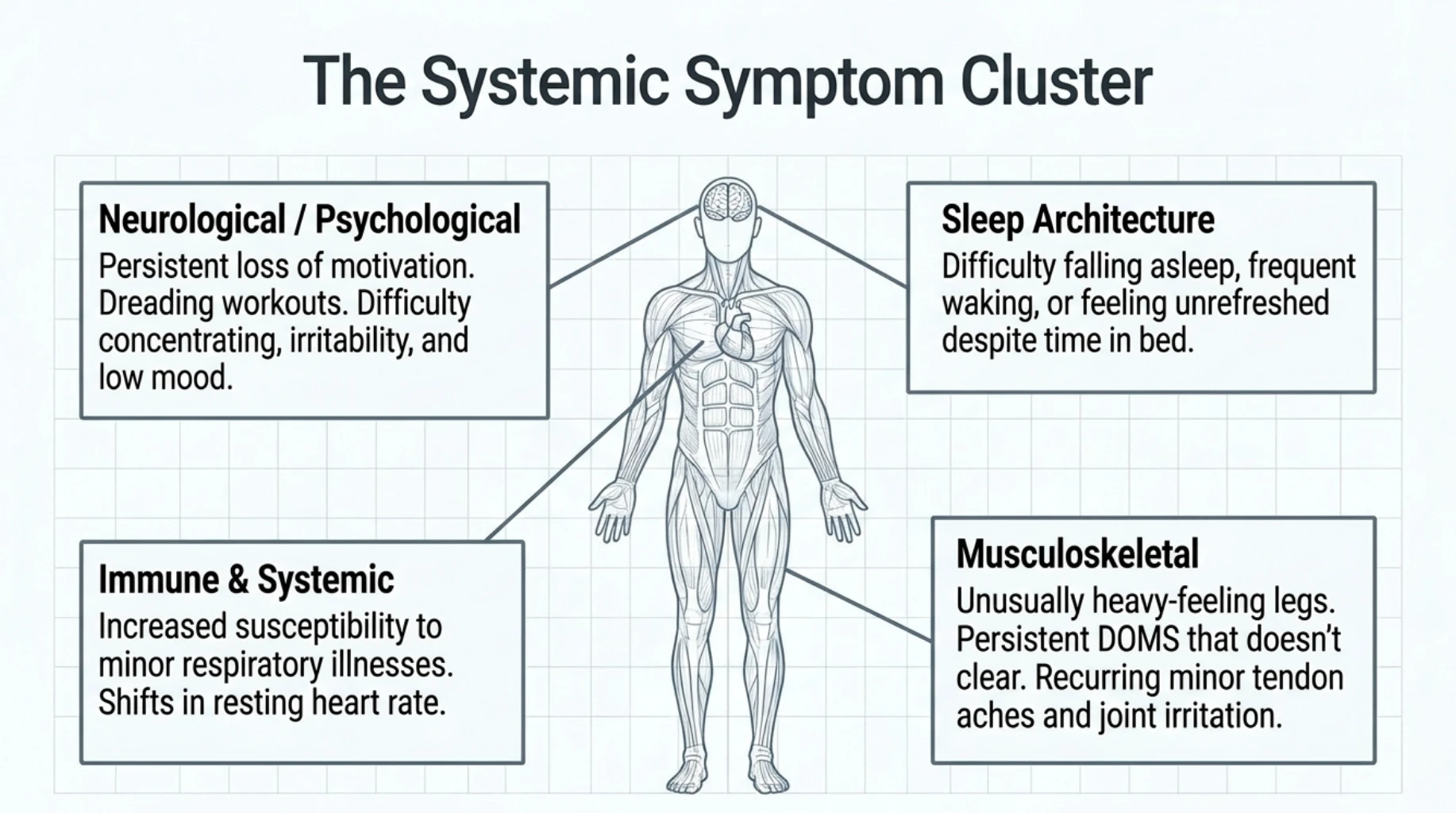
The most useful clue is often not one symptom but a persistent cluster of changes occurring alongside declining performance.
Possible overtraining symptoms can include:
- Persistent fatigue.
- Declining exercise performance.
- Reduced strength.
- Unusually heavy-feeling legs.
- Persistent muscle soreness.
- Reduced motivation to exercise.
- Sleep disturbance.
- Irritability or mood changes.
- Difficulty concentrating.
- Repeated minor illnesses.
- Persistent aches and pains.
- Changes in resting heart rate in some individuals.
None of these symptoms is specific to overtraining.
That point is extremely important.
Iron deficiency, anaemia, thyroid disease, sleep apnoea, inadequate calorie intake, infections and several other conditions can produce a similar picture.
Overtraining Symptom 1: Your Performance Keeps Declining
Persistent loss of performance is one of the most important warning signs.
Everyone has occasional bad workouts.
You may sleep poorly, have a stressful day or simply feel less energetic.
That is normal.
The pattern becomes more significant when performance repeatedly declines despite continued effort.
You might notice:
- Your normal running pace feels increasingly difficult.
- You cannot lift weights that were previously manageable.
- You need longer rest periods between sets.
- Your cycling power decreases.
- Your usual workout takes substantially more effort.
If your instinct is to respond by adding even more exercise, you may deepen the fatigue.
Overtraining Symptom 2: Persistent Fatigue
Training-related fatigue should usually improve with appropriate recovery.
Persistent fatigue is different.
You may wake up tired.
Normal daily activities may feel harder.
You may struggle to find energy for workouts that you previously enjoyed.
The fatigue may extend beyond exercise into work and everyday life.
However, persistent fatigue is also one of the least specific overtraining symptoms.
Before blaming exercise alone, other causes need consideration.
Overtraining Symptom 3: Your Usual Weights Feel Unusually Heavy
Suppose you normally perform a particular exercise comfortably with a certain weight.
Suddenly that same weight feels substantially heavier.
This can happen occasionally without concern.
But if it occurs repeatedly across several sessions, it may indicate accumulated fatigue.
Strength performance can be influenced by:
- Previous training.
- Sleep.
- Food intake.
- Hydration.
- Illness.
- Psychological stress.
The important feature is the trend rather than one isolated workout.
Overtraining Symptom 4: Persistent Muscle Soreness
Delayed-onset muscle soreness is common after unfamiliar or particularly demanding exercise.
It is especially noticeable when a programme includes movements that strongly load muscles while they are lengthening.
Normal DOMS generally improves with time.
Persistent soreness after almost every session may suggest that:
- Training volume is too high.
- Progression is too aggressive.
- Recovery between sessions is inadequate.
- Exercise selection is creating excessive muscle damage.
But soreness alone does not diagnose overtraining syndrome.
Overtraining Symptom 5: You Stop Looking Forward to Training
Motivation naturally fluctuates.
No one is excited about every workout.
But a persistent change in motivation can be informative.
Someone who previously enjoyed exercise may begin to dread every session.
Training may feel mentally exhausting before it even begins.
This can accompany excessive training stress, although work pressure, depression, anxiety, poor sleep and other factors can produce similar changes.
The complete context matters.
Overtraining Symptom 6: Sleep Starts Getting Worse
Exercise generally supports healthy sleep.
However, very high training stress combined with inadequate recovery can be associated with sleep disturbance in some athletes and exercisers.
You may experience:
- Difficulty falling asleep.
- Frequent waking.
- Restless sleep.
- Feeling unrefreshed in the morning.
This can create a vicious cycle.
Training stress contributes to poor recovery.
Poor sleep then further reduces recovery capacity.
The next workout feels harder.
The person responds by pushing harder.
Fatigue continues accumulating.
Overtraining Symptom 7: Mood and Irritability Change
Training stress is not experienced only by muscles.
Psychological symptoms can also occur when the overall training burden becomes excessive.
Some people report:
- Irritability.
- Low mood.
- Reduced enthusiasm.
- Difficulty concentrating.
- A feeling of being mentally exhausted.
Again, these symptoms are not specific to exercise.
Mood changes deserve broader evaluation when they are persistent or significant.
Overtraining Symptom 8: Frequent Aches and Minor Injuries
Muscles can adapt relatively quickly to training.
Tendons, joints and other tissues may require more gradual progression.
If training load rises faster than tissue tolerance, small problems can begin accumulating.
You might notice:
- Recurring tendon discomfort.
- Persistent knee pain.
- Shoulder irritation.
- Shin discomfort.
- Foot or ankle pain.
This does not necessarily mean you are systemically overtrained.
It may simply mean that local tissue loading is excessive.
But it is still a sign that training needs adjustment.
Overtraining Symptom 9: You Keep Getting Sick
Regular moderate exercise generally supports overall health.
But prolonged periods of very demanding training, particularly when combined with inadequate sleep, insufficient energy intake or psychological stress, can affect immune function.
Some athletes undergoing heavy training loads report increased susceptibility to minor respiratory illnesses.
Frequent infections should not automatically be blamed on overtraining, however.
Persistent or recurrent illness may require medical assessment.
Overtraining Symptom 10: Your Resting Heart Rate Changes
Some people monitor morning resting heart rate as part of recovery tracking.
A persistent change from your normal baseline can sometimes accompany training fatigue.
But resting heart rate is influenced by many factors, including:
- Sleep.
- Dehydration.
- Heat.
- Alcohol.
- Illness.
- Caffeine.
- Psychological stress.
- Medications.
A single elevated reading therefore does not diagnose overtraining.
Your personal trend is more informative than one isolated number.
Can Heart Rate Variability Detect Overtraining?
Heart rate variability, or HRV, is increasingly available through smartwatches and fitness trackers.
HRV reflects variation in the time interval between heartbeats and provides information related to autonomic nervous system activity.
Tracking your personal HRV trend may contribute useful information about recovery.
However, HRV is not an overtraining blood test.
A low reading on your watch does not automatically mean you should stop exercising.
Similarly, a normal HRV score does not prove that every muscle, tendon and physiological system has fully recovered.
Wearable data should be interpreted alongside symptoms and actual exercise performance.
Why Smartwatch Recovery Scores Can Be Misleading
Modern watches may provide scores labelled:
- Recovery.
- Readiness.
- Body battery.
- Training status.
- Training load.
These tools can be useful for identifying trends.
But the score is generated by an algorithm using selected physiological measurements.
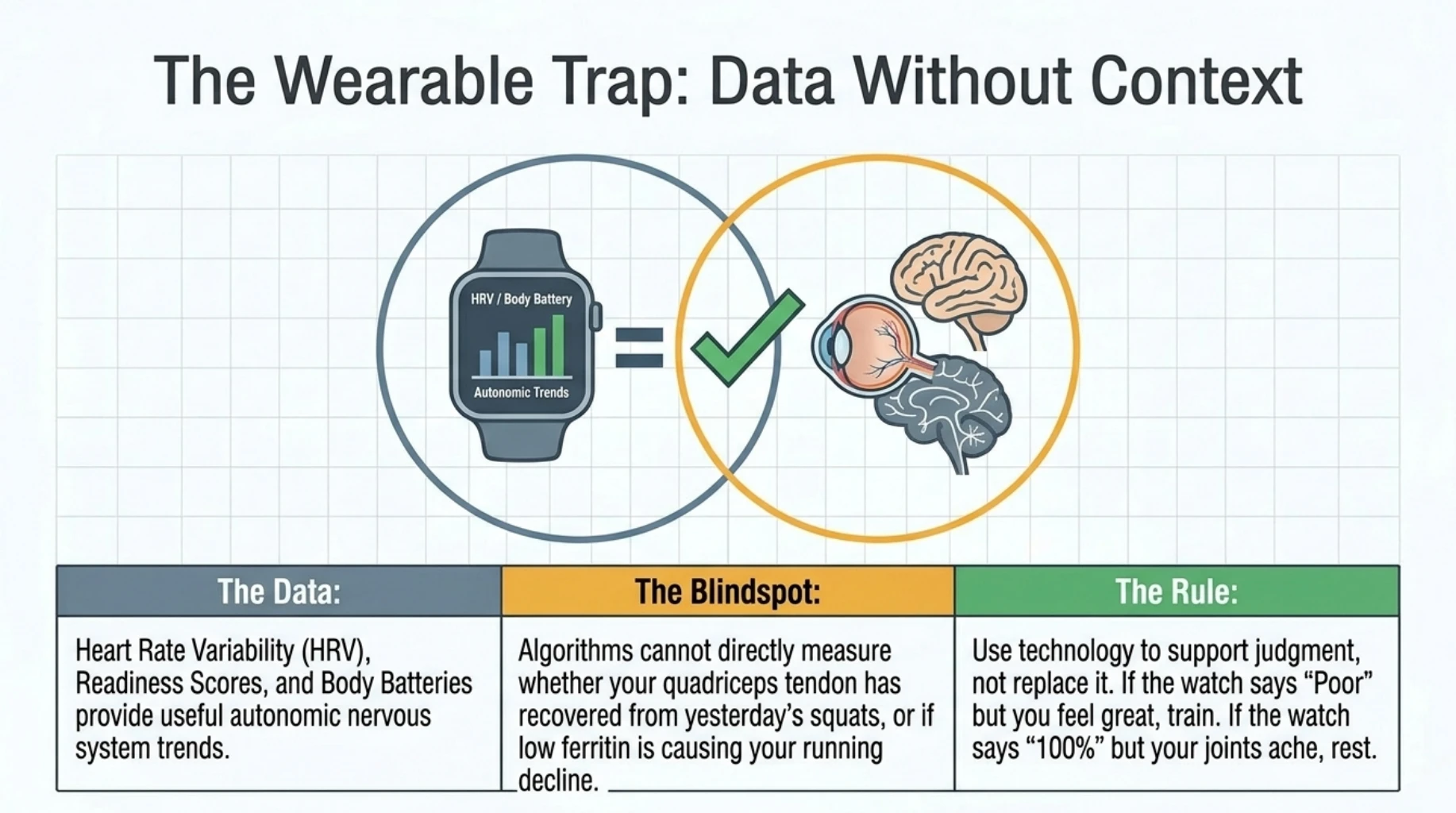
The watch cannot directly measure whether your quadriceps tendon has recovered from yesterday’s workout or whether low ferritin is causing your declining running performance.
Use wearable technology as additional information—not as the sole authority over your body.
Why Overtraining Symptoms May Actually Be Under-Recovery
Sometimes the exercise programme itself is reasonable.
The real problem is everything happening around it.
Consider two people performing exactly the same four workouts each week.
One:
- Sleeps 7–8 hours.
- Eats enough protein.
- Consumes adequate calories.
- Has manageable work stress.
- Takes easier days between demanding sessions.
The other:
- Sleeps five hours.
- Is following an aggressive crash diet.
- Has a highly stressful job.
- Drinks alcohol frequently.
- Adds extra cardio every evening.
The training programme may look identical on paper.
The recovery capacity is not.
This is why the term under-recovery is sometimes more useful when thinking about excessive exercise fatigue.
Sleep Deprivation Can Look Like Overtraining
Chronic sleep restriction can reduce exercise performance, impair concentration, affect mood and make workouts feel more difficult.
If someone is training six days per week while consistently sleeping only four or five hours, adding another recovery supplement is unlikely to solve the main problem.
Sleep should be treated as a fundamental part of the training programme.
For many recreational exercisers, improving sleep may provide more benefit than adding another workout.
Not Eating Enough Can Produce Overtraining-Like Symptoms
Energy availability matters.
If someone substantially increases exercise while simultaneously restricting calories, the body may not have enough energy to support both training and normal physiological functions optimally.
This becomes particularly important in:
- Endurance athletes.
- People following aggressive weight-loss diets.
- People performing very high training volumes.
- Individuals intentionally maintaining very low body fat.
Persistent fatigue in these situations should not automatically be solved by adding caffeine and continuing to push harder.
Relative Energy Deficiency in Sport Is Not the Same as Overtraining
Relative Energy Deficiency in Sport, often called RED-S, occurs when energy intake is insufficient relative to the demands of exercise and normal physiological function.
It can affect both women and men.
Possible consequences can involve:
- Exercise performance.
- Bone health.
- Hormonal function.
- Immune function.
- Metabolic health.
- Reproductive function.
RED-S and excessive training can overlap, but they are not identical conditions.
This distinction becomes particularly important when someone is combining heavy exercise with substantial dietary restriction.

Overtraining Symptoms During Weight Loss
People trying to lose weight are particularly vulnerable to doing too much at once.
A common pattern is:
Eat less + increase steps + start running + start strength training + add HIIT.
Each intervention may be reasonable individually.
But combining all of them aggressively from the first week can produce a large increase in total stress.
The person may initially lose weight rapidly and feel highly motivated.
Then fatigue begins accumulating.
Gym performance declines.
Hunger increases.
Sleep worsens.
Daily movement outside exercise may decrease because the person is exhausted.
Eventually the programme becomes difficult to sustain.
A successful weight-loss programme should therefore use enough exercise to improve health, fitness and muscle preservation without turning exercise into punishment.
More Exercise Can Sometimes Produce Less Progress
This is the central lesson.
Progress does not depend only on how much work you perform.
It depends on how much useful training you can repeatedly perform and recover from.
| Training Situation | Likely Result |
|---|---|
| Too little training | Insufficient stimulus for optimal adaptation |
| Appropriate training + recovery | Progressive improvement in fitness and performance |
| Temporary planned overload + recovery | May improve performance in trained individuals |
| Repeated excessive training + inadequate recovery | Accumulating fatigue and declining training quality |
| Prolonged severe imbalance | Risk of non-functional overreaching or, less commonly, overtraining syndrome |
The goal of a good fitness plan is therefore not to discover how much exercise your body can tolerate before it breaks down.
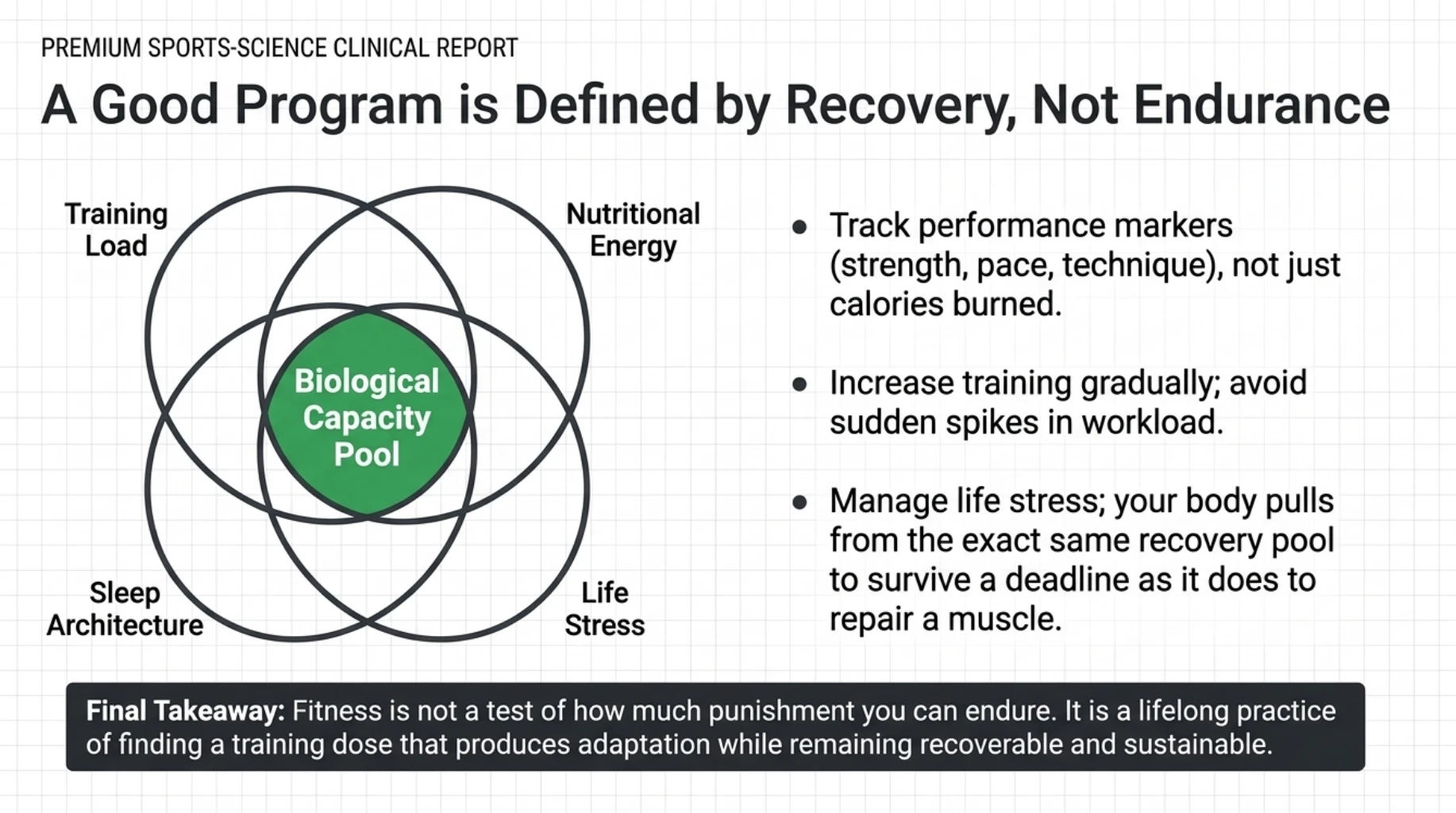
The goal is to find a training dose that produces adaptation while remaining recoverable and sustainable.
How Much Exercise Is Too Much?
There is no universal number of workouts, kilometres, sets or training hours that automatically becomes “too much.”
The same training programme can be appropriate for one person and excessive for another.
An experienced endurance athlete may tolerate a training volume that would overwhelm a beginner. Similarly, someone sleeping well and eating adequately may recover from a programme that becomes unsustainable during severe calorie restriction or chronic sleep deprivation.
The more useful question is:
Is your current training load greater than your current capacity to recover from it?
That capacity changes over time.
Work pressure, illness, travel, poor sleep, dieting and emotional stress can temporarily reduce how much exercise you tolerate well.
This is why a programme that worked perfectly three months ago may occasionally need adjustment.
Training Volume, Intensity and Frequency All Matter
Exercise stress is determined by more than how many days you train.
Three variables are particularly important:
- Volume: how much total work you perform.
- Intensity: how demanding that work is.
- Frequency: how often you train.
Increasing one of these may be manageable.
Increasing all three simultaneously can create a much larger jump in training stress.
For example, someone might go from three moderate workouts per week to six workouts while simultaneously increasing the weights and adding more sets.
That is not one progression.
It is several progressions occurring at once.
Why Sudden Training Increases Cause Problems
The human body adapts remarkably well when loading increases progressively.
Problems often appear when enthusiasm increases faster than tissue adaptation.
This frequently happens after:
- Joining a new gym.
- Starting a weight-loss challenge.
- Preparing suddenly for a race.
- Returning to exercise after a long break.
- Starting high-intensity interval training.
- Following an advanced online workout programme.
Your cardiovascular fitness may sometimes improve faster than the tolerance of your tendons, bones and other tissues.
You may therefore feel capable of doing more while certain structures are still adapting.
Gradual progression remains one of the most important principles of sustainable exercise.
Overtraining Symptoms in Strength Training
Resistance training creates both local muscular fatigue and broader training stress.
Someone performing too much resistance training may notice:
- Declining strength across several workouts.
- Reduced repetition performance.
- Unusually heavy-feeling weights.
- Persistent muscle soreness.
- Loss of explosiveness.
- Persistent joint or tendon discomfort.
- Reduced motivation.
- Difficulty completing normal training volume.
But again, one poor strength session does not mean you are overtrained.
Performance naturally fluctuates.
The trend over time matters more.
Can You Lift Weights Every Day?
Potentially, depending on how the programme is structured.
Training seven days does not necessarily mean training the same muscles hard seven days in a row.
An experienced lifter may alternate:
- Upper and lower body.
- Different movement patterns.
- Heavy and lighter sessions.
- High-volume and lower-volume days.
This distributes training stress.
However, simply dividing the body into different muscle groups does not eliminate systemic fatigue.
If every session is long, demanding and performed close to failure, total recovery requirements can still become substantial.
Training to Failure and Recovery
Training to muscular failure means continuing a set until another repetition cannot be completed with appropriate technique.
This technique can be used selectively, but it is not necessary to take every set of every exercise to complete failure.
Repeated failure training can substantially increase fatigue.
For many recreational lifters, stopping with a small number of good-quality repetitions still possible can provide an effective training stimulus while making the programme easier to recover from.
This becomes particularly relevant when training frequency or weekly volume is already high.
Overtraining Symptoms in Runners
Endurance athletes may experience excessive training stress differently from strength trainees.
A runner might notice:
- Usual pace requiring greater effort.
- Heavy legs.
- Slower race or training times.
- Reduced ability to complete intervals.
- Persistent fatigue between runs.
- Recurring tendon, shin, knee or foot problems.
- Reduced enthusiasm for running.
Running also creates repeated mechanical loading.
This means increasing mileage too quickly can cause local overuse injuries even without true systemic overtraining syndrome.
Overtraining Symptoms in People Doing HIIT
High-intensity interval training can provide substantial fitness benefits in relatively little time.
But the term “HIIT” has become so popular that some people try to make almost every workout high intensity.
If Monday is HIIT, Tuesday is a hard circuit, Wednesday is sprint training and Thursday is another maximal workout, the programme contains very little true low-intensity training.
High-intensity sessions should be hard precisely because not every session needs to be hard.
A balanced programme generally contains different intensities.
Overtraining Symptoms in Cyclists and Endurance Athletes
High-volume endurance training can create large recovery demands even when individual sessions do not produce significant muscle soreness.
This is important because soreness is a poor measure of total fatigue.
An endurance athlete can have relatively little DOMS while still experiencing:
- Reduced power output.
- Higher perceived effort.
- Persistent tiredness.
- Reduced training quality.
- Sleep or mood disturbance.
“My muscles are not sore” does not necessarily mean “I am completely recovered.”
Can Too Much Cardio Reduce Muscle Gain?
Cardiovascular exercise and resistance training can coexist successfully.
You do not have to choose between having cardiovascular fitness and building muscle.
However, very large amounts of endurance exercise can create additional fatigue and energy demands.
If someone combines high-volume cardio with demanding resistance training, insufficient food and inadequate recovery, strength and muscle-building progress may suffer.
The solution is usually not to eliminate cardio.
It is to balance the total programme according to the person’s goals.
Overtraining Symptoms or Just DOMS?
Delayed-onset muscle soreness is one of the most common sources of confusion.
DOMS usually appears after unfamiliar or unusually demanding exercise and may become more noticeable over the following day or two.
It does not mean the body is entering overtraining syndrome.
| Feature | Typical DOMS | Accumulated Training Fatigue |
|---|---|---|
| Main symptom | Local muscle soreness | Broader fatigue and reduced performance |
| Trigger | Often unfamiliar or unusually demanding exercise | Repeated imbalance between training and recovery |
| Performance | May temporarily be affected in sore muscles | Can decline repeatedly across sessions |
| Duration | Usually improves over several days | May persist if training stress remains excessive |
| Meaning | Does not by itself indicate overtraining | May indicate the programme requires adjustment |
Overtraining Symptoms or an Injury?
Another important distinction is between systemic fatigue and a local injury.
Overtraining-type fatigue may make the whole programme feel harder.
An injury may instead produce a specific recurring symptom during particular movements.
Warning signs that deserve attention include:
- Sharp pain.
- Persistent swelling.
- Joint instability.
- Pain that progressively worsens during training.
- Loss of normal movement.
- Pain that significantly affects normal daily activity.
Taking a single rest day and then repeatedly aggravating the same problem is not an effective injury-management strategy.
Overtraining Symptoms or Iron Deficiency?
This is particularly important in endurance athletes and menstruating women.
Iron deficiency can produce:
- Fatigue.
- Reduced exercise tolerance.
- Breathlessness on exertion.
- Poor endurance.
- Difficulty maintaining previous training performance.
Iron stores can become low even before haemoglobin falls enough to meet criteria for anaemia.
Someone with persistent unexplained exercise intolerance should therefore not automatically assume the solution is simply more rest.
Clinical context and appropriate testing may be necessary.
Overtraining Symptoms or Anaemia?
Anaemia can significantly impair exercise capacity because haemoglobin is required to transport oxygen.
Symptoms may include:
- Fatigue.
- Reduced stamina.
- Shortness of breath on exertion.
- Palpitations.
- Dizziness.
- Weakness.
These can easily be mistaken for poor fitness or excessive training.
If performance has deteriorated without a clear explanation, especially when symptoms extend beyond exercise, medical causes should be considered.
Overtraining Symptoms or Thyroid Problems?
Thyroid disorders can also affect exercise performance.
Hypothyroidism may be associated with fatigue, sluggishness, muscle symptoms and reduced exercise tolerance.
Hyperthyroidism may produce palpitations, heat intolerance, muscle weakness and unexplained weight changes.
Neither should be diagnosed from exercise symptoms alone.
The point is that persistent fatigue has a broad differential diagnosis.
Overtraining Symptoms or Vitamin B12 Deficiency?
Vitamin B12 deficiency can cause fatigue and, in some people, neurological symptoms such as tingling, numbness or balance problems.
It may occur with anaemia but can also present before severe haematological abnormalities develop.
People with dietary risk factors, gastrointestinal disorders or medicines that can affect vitamin B12 status may require assessment when compatible symptoms are present.
Overtraining Symptoms or Vitamin D Deficiency?
Low vitamin D status is common in many populations and can coexist with muscle weakness or musculoskeletal symptoms.
But nonspecific fatigue should not automatically be attributed to vitamin D deficiency either.
Persistent symptoms should be evaluated in context rather than treating one laboratory value as the explanation for every problem.
Overtraining Symptoms or Sleep Apnoea?
Sleep apnoea is an important but sometimes overlooked cause of poor recovery.
Someone may spend seven or eight hours in bed yet wake feeling unrefreshed because sleep quality is repeatedly disrupted by breathing abnormalities.
Possible clues include:
- Loud snoring.
- Witnessed pauses in breathing.
- Morning headaches.
- Excessive daytime sleepiness.
- Unrefreshing sleep.
- Difficulty concentrating.
Adding more rest days will not correct untreated sleep apnoea.
Overtraining Symptoms or Too Few Calories?
Very low calorie intake deserves special attention because it is common among people simultaneously trying to improve fitness and lose weight.
Imagine someone who reduces food intake substantially and then starts:
- Five gym sessions.
- Daily cardio.
- 10,000–15,000 steps.
- Weekend sports.
They may initially believe that faster weight loss means the programme is working better.
But the combination of high expenditure and low intake may eventually impair recovery.
Persistent fatigue, declining performance, excessive hunger and loss of training quality should prompt a reassessment.
Can GLP-1 Weight Loss Affect Exercise Recovery?
People using GLP-1-based obesity medicines may experience substantial appetite suppression.
This can be helpful for weight management, but it may also make adequate nutrition more difficult if food intake becomes very low.
A person may unintentionally consume insufficient:
- Protein.
- Total calories.
- Fluids.
- Micronutrient-rich foods.
If that person simultaneously begins a demanding exercise programme, fatigue may become more noticeable.
This should not automatically be labelled an adverse effect of exercise or “overtraining.”
Training volume, hydration, dietary intake, rate of weight loss and other medical factors should be considered together.
Why Muscle Preservation Matters During Weight Loss
When body weight falls, not all lost weight necessarily comes from body fat.
Some lean tissue can also be lost.
Resistance training and adequate protein therefore become important during weight reduction.
But this creates a balance.
You need enough resistance training to provide a muscle-preserving stimulus.
You do not need so much exercise that you become chronically exhausted and unable to recover.
The best weight-loss exercise programme is not necessarily the one that burns the greatest possible number of calories.
It is the one that improves health and fitness, supports muscle preservation and remains sustainable.
Overtraining and Menstrual Changes
Menstrual changes in highly active women should not simply be dismissed as proof that training is “working.”
Irregular or absent menstrual cycles can occur when exercise demands are combined with inadequate energy availability and hormonal disruption.
This can have implications beyond reproduction, including bone health.
Persistent menstrual disturbance deserves appropriate assessment rather than simply adding more rest days while maintaining severe dietary restriction.
Overtraining, Testosterone and Male Athletes
Men are not protected from the effects of inadequate energy availability.
High training loads combined with insufficient calorie intake can affect hormonal and metabolic function in male athletes as well.
Symptoms such as persistent fatigue, reduced performance and other changes should therefore be assessed in the context of total training and nutrition rather than assuming that low energy availability is exclusively a female issue.
How Psychological Stress Affects Exercise Recovery
Your body does not experience exercise in isolation from the rest of your life.
Consider a demanding week involving:
- Long working hours.
- Poor sleep.
- Family stress.
- Frequent travel.
- Irregular meals.
Your workout may be identical to the previous week, but your total stress burden is different.
This is one reason rigid training programmes sometimes fail.
The programme assumes that recovery capacity never changes.
Real life does not work that way.
Do You Need a Deload Week?
A deload is a planned temporary reduction in training stress.
It may involve reducing:
- Weight.
- Number of sets.
- Training frequency.
- Training intensity.
- Some combination of these.
Deloads are commonly used by experienced strength athletes, although not everyone needs a rigid deload every fourth or sixth week.
Some people naturally adjust training when fatigue rises.
Others benefit from planned lighter periods.
The purpose is not to become detrained.
It is to dissipate accumulated fatigue while maintaining enough activity to preserve training rhythm.
Deload vs Complete Rest
| Feature | Deload | Complete Rest |
|---|---|---|
| Exercise | Continues at reduced training stress | Structured training temporarily stops |
| Purpose | Reduce accumulated fatigue while maintaining practice | Allow greater recovery when necessary |
| Useful for | Planned fatigue management | Significant fatigue, illness or circumstances requiring rest |
| Movement | Training movements often continue | Normal daily activity may still continue |
Should You Take a Week Off From Exercise?
Sometimes.
A short break from demanding exercise does not erase months or years of fitness.
A temporary reduction in training may be appropriate during:
- Significant accumulated fatigue.
- Acute illness.
- Travel.
- Periods of unusually poor sleep.
- Recovery from an injury.
- Major life stress.
People who fear losing all their progress from a few days of reduced training often continue exercising when recovery would be more productive.
Fitness is not lost overnight.

What Should You Do When Overtraining Symptoms Appear?
The first response should not automatically be “push through it.”
Start by reviewing the complete picture.
| Question | What to Review |
|---|---|
| Has training increased recently? | Frequency, intensity, sets, mileage, steps or HIIT sessions |
| Has performance changed? | Strength, pace, power, endurance and perceived effort |
| How is sleep? | Duration, quality and consistency |
| Are you eating enough? | Total energy intake, protein and carbohydrate relative to training |
| Are you losing weight rapidly? | Consider whether the calorie deficit is unnecessarily aggressive |
| How is life stress? | Work, family, travel and psychological stress |
| Are there medical symptoms? | Breathlessness, palpitations, dizziness, persistent fatigue or other unexplained symptoms |
| Is there persistent local pain? | Consider injury or excessive local tissue loading |
Often, the answer is not to stop exercising permanently.
The answer is to temporarily reduce the training stress that is creating the problem and address whatever is limiting recovery.
How to Reduce Training Load Without Losing Progress
If accumulated fatigue is developing, training can be modified rather than abandoned.
Options include:
- Reducing the number of sets.
- Using lighter resistance temporarily.
- Reducing running or cycling volume.
- Replacing HIIT with easy aerobic activity.
- Adding an additional recovery day.
- Training farther from muscular failure.
- Shortening workout duration.
Which variable should change depends on what created the fatigue.
Why Doing Nothing Is Not Always the Best Recovery Strategy
If there is no acute illness or injury requiring rest, complete inactivity is not necessarily needed.
Easy walking, gentle cycling or other comfortable movement can maintain activity while dramatically reducing training stress.
The key is to resist turning the “recovery workout” into another hard workout.
If you finish active recovery exhausted, it probably was not recovery.
How Long Does Recovery From Excessive Training Take?
There is no single recovery period because the severity of the problem varies enormously.
Ordinary accumulated fatigue may improve after a few easier days.
More substantial non-functional overreaching may require a considerably longer period.
True overtraining syndrome can take many weeks or months to resolve.
This is another reason not to label every difficult week as overtraining syndrome.
The duration and magnitude of performance impairment matter.
Should You Use Caffeine to Push Through Fatigue?
Caffeine can improve alertness and exercise performance in many people.
But it can also temporarily mask perceived fatigue.
If someone repeatedly needs increasing amounts of caffeine simply to complete normal workouts, the underlying reason for the fatigue deserves attention.
Caffeine can also worsen sleep when consumed too late in the day, potentially creating another cycle:
Fatigue → more caffeine → poorer sleep → poorer recovery → more fatigue.
A stimulant can improve how awake you feel without necessarily correcting why you are tired.
When Overtraining Symptoms Need Medical Assessment
Persistent exercise fatigue should not automatically be managed by changing the workout indefinitely.
Medical evaluation becomes particularly important when declining exercise tolerance is accompanied by symptoms such as:
- Chest pain or pressure.
- Unexplained significant breathlessness.
- Fainting or near-fainting.
- Persistent or concerning palpitations.
- Unexplained rapid heart rate.
- Unexplained weight loss.
- Persistent fever.
- Marked weakness.
- Dark urine after unusually severe muscle pain or exertion.
- Persistent fatigue despite reducing training and improving recovery.
These symptoms should not simply be labelled “overtraining.”
They may indicate a different medical problem requiring assessment.
Why Persistent Fatigue Deserves a Wider View
If someone tells me, “Doctor, I think I am overtraining because I am tired all the time,” the exercise programme is only one part of the history I would want to understand.
I would also want to know:
- How much are they sleeping?
- How much are they eating?
- Are they intentionally losing weight?
- Has their training recently increased?
- Do they snore or wake unrefreshed?
- Are there symptoms suggesting anaemia or iron deficiency?
- Are there thyroid-related symptoms?
- Are there palpitations, dizziness or unusual breathlessness?
- Has their actual exercise performance declined?
This broader approach matters because overtraining symptoms can overlap with several nutritional, metabolic, sleep-related and medical conditions.
The correct solution depends on identifying what is actually driving the poor recovery.
How to Recover When Training Has Become Too Much
When overtraining symptoms or persistent under-recovery begin to appear, the solution is rarely to stop exercising forever.
The immediate objective is to reduce the mismatch between training stress and recovery capacity.
For someone with ordinary accumulated fatigue, this may require only a few easier days and better sleep.
For someone with substantial non-functional overreaching, recovery may take considerably longer.
And when symptoms are persistent, severe or accompanied by medical warning signs, the priority shifts from adjusting the workout to determining whether another health problem is present.
A practical recovery strategy therefore begins with identifying the likely cause.
Step 1: Stop Trying to Fix Fatigue With More Exercise
This sounds obvious, but it is one of the most common mistakes.
A person notices that their fitness has stopped improving and assumes they need to train harder.
They add another cardio session.
They increase their steps.
They add extra sets after resistance training.
The result is more fatigue rather than more adaptation.
If performance has been consistently declining while training volume is high, temporarily reducing exercise may be more productive than adding another workout.
Step 2: Reduce Training Stress
You do not necessarily have to eliminate all exercise.
Training stress can be reduced in several ways.
| Training Variable | Possible Adjustment |
|---|---|
| Training frequency | Temporarily perform fewer demanding sessions each week |
| Training volume | Reduce sets, repetitions, mileage or workout duration |
| Resistance | Temporarily use lighter loads |
| Effort | Stop sets farther from muscular failure |
| HIIT | Replace some high-intensity sessions with easy aerobic activity |
| Long endurance sessions | Temporarily reduce distance or duration |
| Weekly schedule | Add one or more recovery days where needed |
The goal is to allow fatigue to decrease without unnecessarily abandoning physical activity.
Step 3: Prioritise Sleep
Sleep should be one of the first areas examined when exercise recovery deteriorates.
A beautifully designed training programme cannot compensate fully for chronic sleep deprivation.
Good sleep habits include:
- Maintaining reasonably consistent sleep and wake times.
- Allowing sufficient time in bed.
- Limiting caffeine late in the day.
- Avoiding repeated late-night training if it clearly disrupts your sleep.
- Reducing unnecessary screen stimulation close to bedtime where it affects sleep.
- Addressing persistent snoring, witnessed apnoeas or excessive daytime sleepiness.
If you repeatedly wake unrefreshed despite spending adequate time in bed, simply scheduling another rest day may not address the underlying problem.
Step 4: Make Sure You Are Eating Enough
Recovery requires energy.
This does not mean everyone needs to eat in a calorie surplus.
People with excess body fat can successfully lose weight while exercising.
However, an unnecessarily severe calorie deficit combined with high training volume can make recovery increasingly difficult.
If fatigue develops during weight loss, review:
- The size of the calorie deficit.
- The rate of weight loss.
- Protein intake.
- Carbohydrate intake relative to exercise demands.
- Micronutrient adequacy.
- Hydration.
The solution should not automatically be “eat more,” but nutrition should be assessed as carefully as the training programme.
Step 5: Keep Protein Intake Adequate
Resistance training increases the importance of providing adequate dietary protein to support muscle repair and remodelling.
This is particularly relevant during calorie restriction, when preserving lean tissue becomes an important objective.
Useful protein sources may include:
- Eggs.
- Milk, curd and paneer.
- Fish and lean meat where consumed.
- Soya and tofu.
- Dal and legumes.
- Protein supplements where they provide practical convenience.
Protein supplements are optional.
A supplement does not compensate for an excessive training programme, but adequate total protein remains an important component of recovery.
Step 6: Do Not Fear Carbohydrates When Training Hard
Carbohydrate availability becomes increasingly relevant as exercise volume and intensity increase.
Muscle glycogen is an important fuel source during many demanding forms of exercise.
People who perform substantial endurance exercise, repeated intervals or high-volume training may struggle if carbohydrate intake is unnecessarily restricted.
This does not mean every recreational exerciser requires a high-carbohydrate sports diet.
It means carbohydrate intake should be appropriate for the amount and type of exercise being performed.
Step 7: Restore Hydration
Dehydration can make exercise feel harder and can contribute to fatigue, headache and reduced performance.
Fluid requirements vary considerably according to:
- Climate.
- Exercise duration.
- Intensity.
- Sweat rate.
- Body size.
- Clothing.
Long workouts in hot and humid conditions can also produce meaningful electrolyte losses.
Recovery therefore includes restoring fluids and, where appropriate, electrolytes rather than simply waiting until the next workout.
Step 8: Manage Stress Outside the Gym
Training is only one source of stress.
A demanding workout may be easy to recover from during a relaxed week and much harder during a week involving poor sleep, travel, deadlines and family stress.
A flexible programme recognises this.
Reducing exercise intensity temporarily during an unusually stressful period is not a sign of weakness.
It can be sensible training management.
How Do You Know When You Are Ready to Train Hard Again?
Do not rely on a single sign.
Look for a broader return towards your normal baseline.
Useful signs include:
- Energy improving.
- Normal enthusiasm for training returning.
- Muscle soreness resolving.
- Sleep improving.
- Normal daily activities feeling easier.
- Training performance beginning to recover.
Then increase training progressively rather than immediately returning to the exact workload that created the problem.
Returning to Exercise After Excessive Training Fatigue
One common mistake is taking several days off and then immediately repeating the previous maximum workload.
If the programme was contributing to the problem, reproducing it exactly may simply restart the same cycle.
A more sensible return could involve:
| Phase | Possible Approach |
|---|---|
| Initial recovery | Rest or easy physical activity according to symptoms |
| Return to training | Resume with reduced volume and moderate effort |
| Assessment | Observe energy, soreness and performance over several sessions |
| Progression | Gradually restore volume or intensity |
| Long-term prevention | Avoid recreating the same excessive workload and inadequate recovery pattern |
How to Prevent Overtraining Symptoms
Prevention is much easier than recovering from prolonged excessive fatigue.
The basic strategy is to increase training progressively while monitoring whether the body is adapting.
Several principles help.
Increase Training Gradually
Avoid simultaneously doubling workout frequency, adding large amounts of cardio and substantially increasing resistance-training volume.
Give your body time to adapt.
Do Not Make Every Workout Hard
A sustainable programme contains variation.
Some sessions can be challenging.
Others should be easier.
This is especially important for people who enjoy HIIT, running or high-volume resistance training.
Allow Recovery Between Demanding Sessions
The same muscle groups do not need maximal training every day.
Similarly, repeated all-out interval sessions can create unnecessary fatigue when easier aerobic training could provide useful fitness benefits with a lower recovery cost.
Keep Rest Days in Perspective
A rest day does not necessarily mean lying in bed.
Normal walking and low-intensity activity can usually continue when appropriate.
The objective is to reduce training stress—not to become completely sedentary.
Track Performance, Not Just Calories Burned
Many people judge workout quality by the number of calories displayed on a watch or cardio machine.
This can encourage the belief that more calories burned always means a better session.
But fitness progress can also be assessed through:
- Increasing strength.
- Improving exercise technique.
- Improving running or cycling performance.
- Better cardiovascular fitness.
- Improved walking capacity.
- Improved physical function.
- Better consistency.
If your calorie expenditure is rising while every meaningful performance measure is deteriorating, simply burning more calories may not represent progress.
Use a Training Log to Identify Patterns
A simple training log can be surprisingly useful.
You do not need sophisticated software.
Record:
- Exercise performed.
- Sets and repetitions.
- Weights used.
- Running or cycling distance and pace.
- How difficult the session felt.
- Any significant pain or unusual fatigue.
Over several weeks, patterns become easier to identify.
If performance consistently falls while perceived effort rises, recovery deserves attention.
Rate of Perceived Exertion Can Be Useful
Rate of perceived exertion, commonly called RPE, is a simple way to describe how difficult exercise feels.
You do not need laboratory equipment to notice that a workout that normally feels moderate suddenly feels extremely difficult.
A single unusually high RPE may mean little.
A persistent pattern of higher effort at the same workload can be more informative.
Do Not Let Your Smartwatch Control Your Training
Wearable devices can help track:
- Heart rate.
- Sleep estimates.
- Training load.
- Steps.
- HRV trends.
These measurements can add useful context.
But your watch does not know everything about your health.
If a device gives you a poor recovery score but you feel excellent and perform normally, one number should not automatically cancel the workout.
Likewise, if the watch gives you a perfect readiness score while you feel ill, exhausted or injured, the algorithm should not persuade you to perform a maximal session.
Use technology to support judgement—not replace it.
Common Mistakes That Lead to Overtraining-Like Symptoms
Mistake 1: Starting Too Hard
Motivation is often highest at the beginning of a fitness programme.
That is precisely when people are most likely to do too much.
Fitness improves through repeated training over months and years, not through destroying yourself during the first two weeks.
Mistake 2: Adding Exercise Every Time Weight Loss Slows
Body weight does not fall linearly.
When the scale stops changing for a few days, adding another hour of cardio is rarely the first adjustment that should be made.
Look at the longer-term weight trend, dietary adherence, activity and overall programme before dramatically increasing exercise.
Mistake 3: Believing Every Workout Must Leave You Exhausted
Exhaustion is not a measure of exercise quality.
A workout can be productive without leaving you unable to function for the rest of the day.
The goal is adaptation, not punishment.
Mistake 4: Doing HIIT Every Day
High-intensity training is useful partly because it creates a strong physiological stimulus.
Turning every workout into maximal intervals can unnecessarily increase fatigue.
Easy and moderate aerobic exercise also have important roles.
Mistake 5: Training Through Persistent Pain
Discomfort from muscular effort is different from persistent joint, tendon or bone pain.
Repeatedly aggravating a painful structure can turn a manageable problem into a longer interruption.
Mistake 6: Using Caffeine Instead of Sleep
Caffeine can improve alertness.
It cannot replace the biological functions of adequate sleep.
If stimulants are repeatedly required simply to feel capable of exercising, investigate why baseline energy has become so poor.
Mistake 7: Crash Dieting While Training Hard
Trying to maximise calorie restriction and exercise simultaneously can create a substantial recovery challenge.
This is particularly relevant when rapid weight loss is accompanied by declining strength, poor sleep, persistent fatigue or menstrual disturbance.
Mistake 8: Copying an Athlete’s Programme
Professional athletes may train multiple times per day.
But training is often their occupation.
Their programmes may include structured recovery, coaching, nutrition support and years of conditioning.
A person working a long office day, sleeping six hours and exercising recreationally should not assume that copying an elite athlete’s training volume will produce elite results.
Overtraining Symptoms After 40
Adults over 40 should not become afraid of demanding exercise.
Resistance training and cardiovascular exercise become increasingly important for maintaining muscle, bone, metabolic health and physical function.
However, recovery deserves attention.
A programme should account for:
- Training history.
- Joint and tendon health.
- Sleep quality.
- Work stress.
- Medical conditions.
- Nutrition.
- Previous injuries.
The objective is not to train gently forever.
It is to progress intelligently.
Overtraining Symptoms After 50 and 60
Older adults can make substantial improvements in strength and fitness.
Age does not eliminate the ability to adapt to exercise.
But suddenly increasing exercise after years of inactivity can create unnecessary soreness and musculoskeletal problems.
A better approach is to build gradually:
movement → regular exercise → progressive resistance → increasing fitness.
This allows muscles, tendons, joints and cardiovascular capacity to adapt over time.
When More Exercise Is Not Better for Diabetes
Exercise is a powerful tool for improving glucose metabolism and overall health in people with type 2 diabetes.
But the principle remains the same: more is not automatically better.
A balanced programme can combine:
- Resistance training.
- Aerobic activity.
- Walking.
- Reduced prolonged sitting.
- Adequate recovery.
There is no metabolic prize for repeatedly exercising to exhaustion.
Consistency is more valuable than a programme so aggressive that it cannot be sustained.
When to Stop Exercise and Seek Medical Attention
Not every symptom during exercise is a recovery problem.
Stop exercising and seek appropriate medical evaluation if exercise is associated with concerning symptoms such as:
- Chest pain or pressure.
- Fainting.
- Severe or unexplained breathlessness.
- Persistent significant palpitations with symptoms.
- New neurological symptoms.
- Severe weakness.
- Significant injury.
- Dark urine associated with severe muscle pain or swelling after intense exercise.
Do not assume these are simply overtraining symptoms.
Frequently Asked Questions About Overtraining Symptoms
What Are the First Signs of Overtraining?
Early excessive-training symptoms may include persistent fatigue, declining performance, unusually difficult workouts, reduced motivation, persistent soreness and poor recovery. These findings are not specific, so sleep, nutrition, illness and other medical causes should also be considered.
How Do I Know if I Am Overtraining or Just Tired?
Normal training fatigue generally improves with appropriate recovery. A persistent decline in performance accompanied by broader symptoms over a prolonged period is more concerning than simply feeling tired after several difficult workouts.
Can Overtraining Cause Muscle Weakness?
Accumulated fatigue can temporarily reduce strength and make normal training loads feel more difficult. Persistent unexplained weakness, however, should not automatically be attributed to exercise.
Can Overtraining Affect Sleep?
Excessive training stress can be associated with disturbed sleep in some people. Poor sleep can then further impair recovery, creating a cycle of increasing fatigue.
Can Overtraining Increase Resting Heart Rate?
Changes in resting heart rate can occur during periods of training stress, but heart rate is influenced by many other factors including dehydration, illness, heat, caffeine, alcohol and psychological stress. One reading cannot diagnose overtraining.
Can Overtraining Lower HRV?
Training stress can influence HRV, but HRV varies for many reasons. Personal trends may contribute useful recovery information, but a low HRV reading does not diagnose overtraining syndrome.
How Long Does It Take to Recover From Overtraining?
It depends on what is actually occurring. Ordinary accumulated fatigue may improve after several easier days. More substantial non-functional overreaching can take much longer, while true overtraining syndrome may require many weeks or months of recovery.
Should I Stop Exercising Completely if I Feel Overtrained?
Not always. Mild accumulated fatigue may respond to reduced volume, lower intensity or additional recovery days. Significant illness, injury or severe persistent symptoms may require complete rest and appropriate assessment.
Can Too Much Exercise Stop Muscle Growth?
Very high training volume combined with inadequate recovery, nutrition or sleep can reduce training quality and interfere with strength and muscle-building progress. More sets are useful only when they contribute productive, recoverable training.
Can Too Much Cardio Cause Overtraining?
Yes, very high endurance-training loads can contribute to excessive fatigue when recovery is inadequate. But normal amounts of cardiovascular exercise can coexist successfully with resistance training.
Can Dieting Make Overtraining Symptoms Worse?
A large calorie deficit reduces available energy and may make demanding training harder to recover from. The combination of severe dietary restriction and rapidly increasing exercise deserves particular caution.
Can Overtraining Cause Weight Gain?
Short-term scale changes can occur for many reasons, including fluid balance, glycogen, food intake and inflammation after hard training. A temporary increase on the scale should not be interpreted as proof that overtraining has caused body-fat gain.
Can Overtraining Cause Frequent Colds?
Periods of very heavy training combined with inadequate recovery may influence immune function, but recurrent infections have many possible causes. Frequent or persistent illness should not automatically be blamed on exercise.
Is One Rest Day a Week Enough?
There is no universal requirement. Recovery depends on training intensity, volume, fitness, sleep, nutrition and the way sessions are distributed. Some people can be physically active daily while alternating hard and easy sessions.
Overtraining Symptoms: A Practical Checklist
| What You Notice | What to Consider |
|---|---|
| One unusually difficult workout | Often normal; review sleep, nutrition and recent activity |
| Muscle soreness after a new exercise | Likely DOMS rather than overtraining syndrome |
| Several workouts with declining performance | Review accumulated training fatigue and recovery |
| Persistent fatigue plus aggressive dieting | Review energy availability and nutritional adequacy |
| Fatigue plus poor sleep or loud snoring | Sleep quality and possible sleep disorder deserve consideration |
| Reduced endurance plus breathlessness or dizziness | Consider medical causes rather than assuming overtraining |
| Persistent local joint or tendon pain | Review local training load and possible injury |
| Performance improves after lighter training | Accumulated fatigue may have been contributing |
| Persistent major decline despite adequate recovery | Further assessment may be appropriate |
Overtraining Symptoms: What Matters Most?
| Factor | Key Message |
|---|---|
| Performance | Persistent decline is more informative than ordinary post-workout tiredness |
| Training load | Volume, intensity and frequency all contribute to total stress |
| Sleep | Chronic poor sleep can substantially impair recovery |
| Nutrition | Adequate energy, protein and appropriate carbohydrate intake support recovery |
| Weight loss | Aggressive calorie restriction can reduce recovery capacity |
| Rest | Easier days can allow fatigue to dissipate without abandoning activity |
| Wearables | Useful for trends but cannot diagnose overtraining syndrome |
| Medical conditions | Iron deficiency, anaemia, thyroid disease, sleep disorders and other conditions can mimic exercise-related fatigue |
| Progression | Training should increase gradually rather than through sudden large jumps |
| Consistency | Sustainable training usually produces better long-term results than repeated cycles of excessive exercise and exhaustion |
Final Thought
If every workout must be harder than the previous one, every day must contain exercise and every sign of fatigue must be ignored, training eventually stops being progressive.
It simply becomes exhausting.
A good exercise programme is not defined by how much work you can force yourself to do. It is defined by how effectively you can train, recover, adapt and continue progressing over time.
If you want a personalized metabolic assessment and lifestyle strategy, you can book a consultation here:
Book an Appointment