

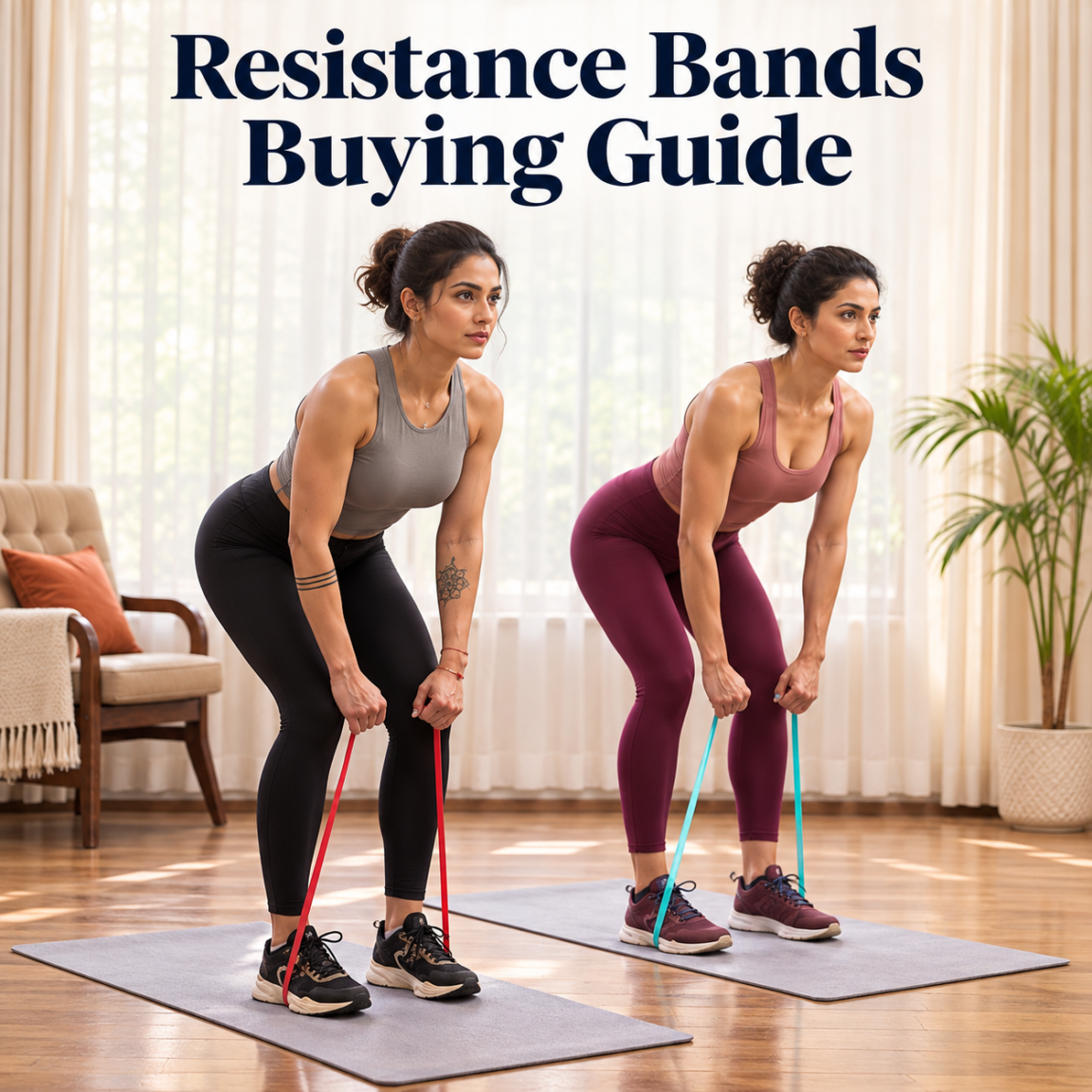
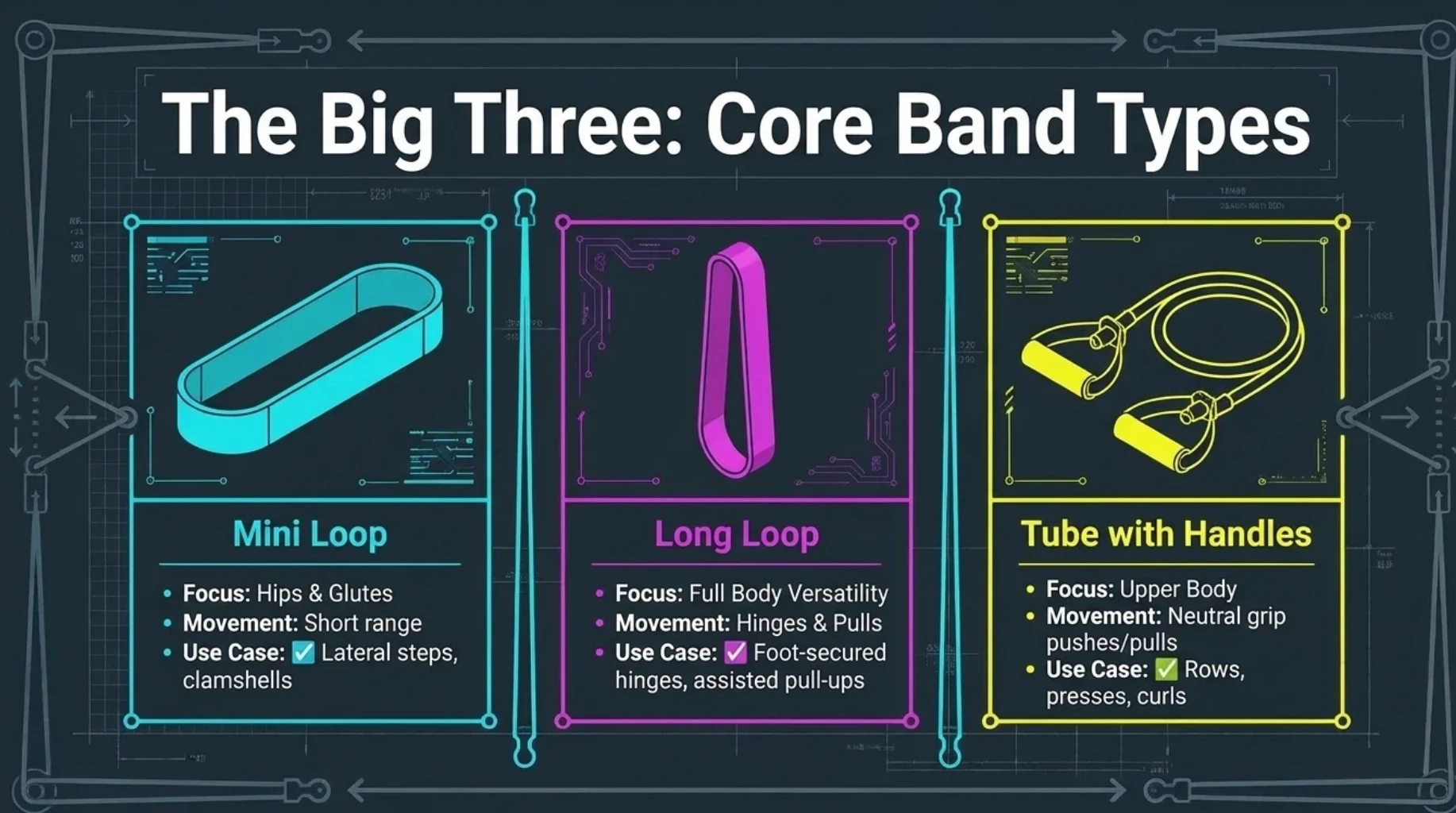
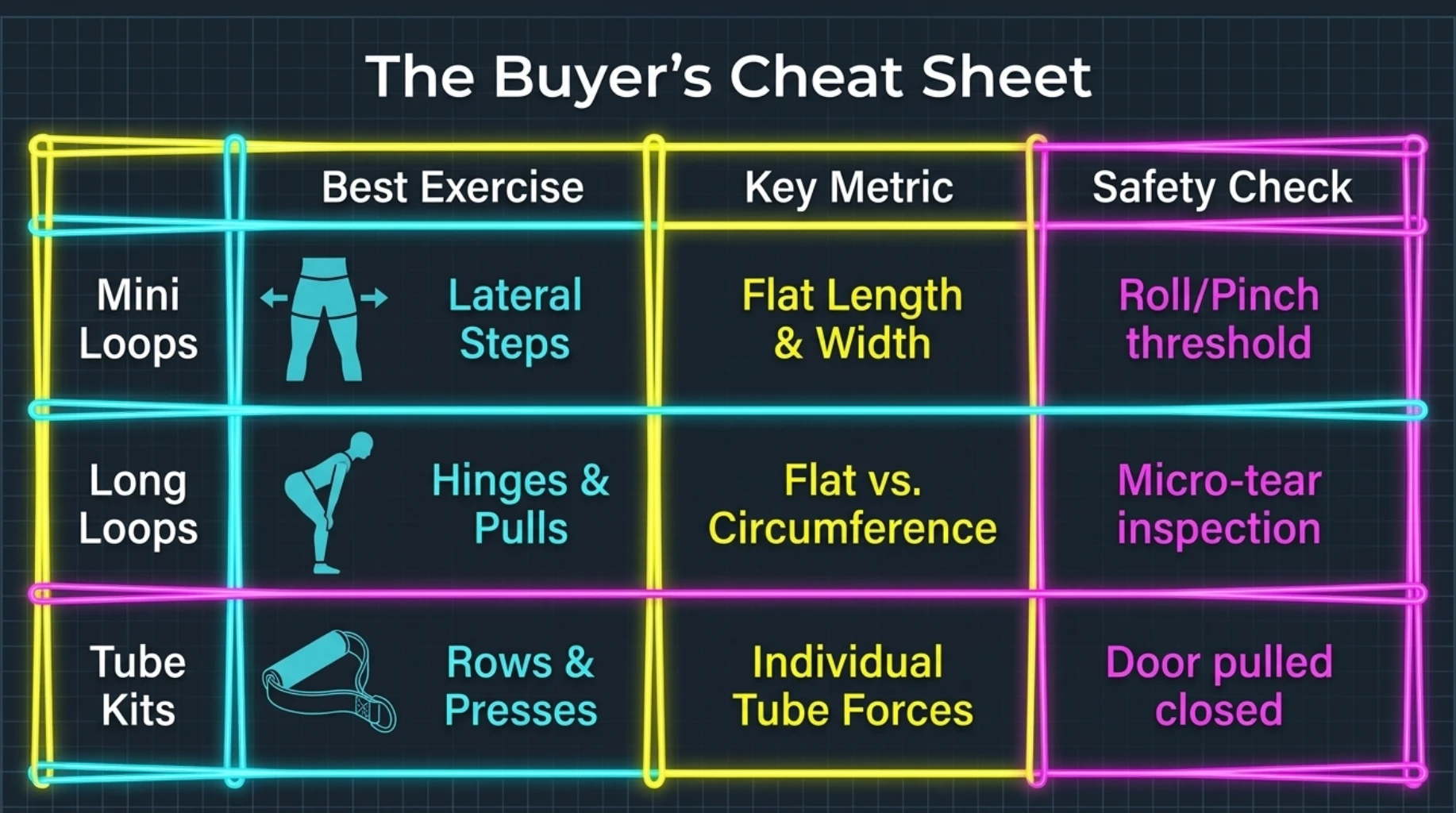
Choose a mini loop if your main exercises are lateral steps, clamshells and other short-range hip movements. Choose a long loop if you want a compact, handle-free band for exercises such as hinges or assisted pull-ups. Choose tube bands with handles if your home workout revolves around rows, presses and curls and you prefer a neutral grip. If a door anchor is part of that plan, check the door and the manufacturer’s setup instructions before buying the kit.
Those three categories are often mixed together in online listings. A “loop band set” could mean fabric hip bands that fit around your thighs or long rubber loops you can hold in your hands. A tube kit marketed as “150 lb” may be quoting the total of several bands measured near the end of their stretch. This resistance bands buying guide explains what research can tell you, how to compare the products on an Indian marketplace and how to tell whether the first band you buy will actually work for your exercises.
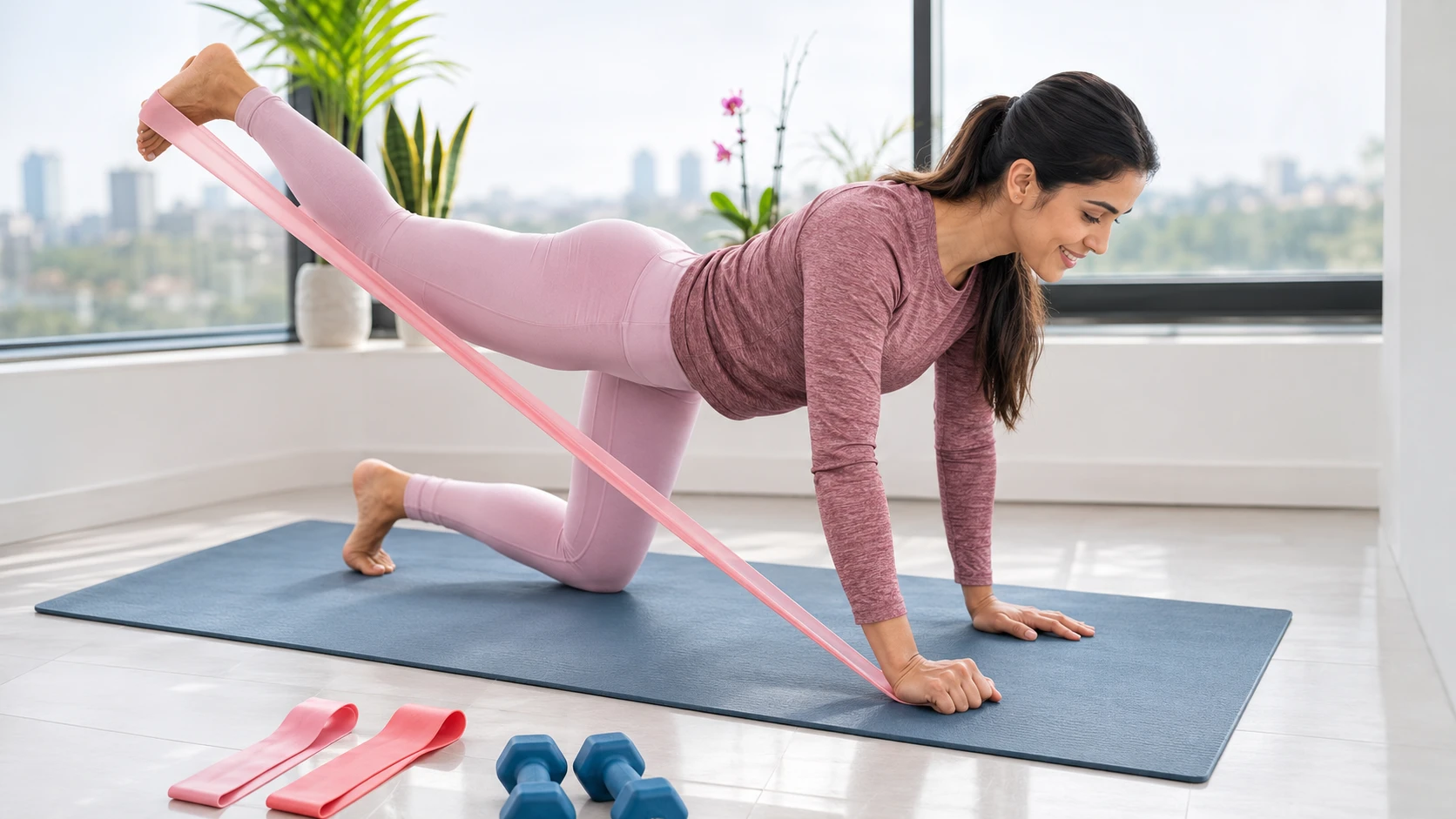
Loop bands vs tube bands at a glance
| Band type | Where it fits | What to verify before buying |
|---|---|---|
| Mini loop | Lateral steps, clamshells and short-range hip work | Unstretched flat length, width, material and whether the lightest band fits your starting position |
| Long closed loop | Foot-secured hinges, some presses and pulls, assisted pull-ups with a compatible bar | Flat length versus circumference, grip comfort, permitted stretch and resistance at stated lengths |
| Tube with handles | Rows, presses and curls. Some kits support ankle straps or rated anchors | Individual tube specs, compatible attachments, permitted configurations and whether you can buy replacement parts |
Pick the exercise you most want to do and picture the start and finish positions. If your legs are already wider than the mini loop’s comfortable working range, a thick fabric band can restrict the movement. If you want to do standing rows and the tube is slack with your arms extended, a high printed resistance may make little difference over the first part of the pull. Fit and working length affect the session from the first rep.
What research says about training with resistance bands
The American College of Sports Medicine’s 2026 position stand on resistance training found that elastic-band training can improve strength and muscle size in healthy adults. It also found strength benefits from home-based resistance training. The position stand synthesised reviews across many forms of training. It supports progressive resistance exercise with bands as an option. It did not test the relative durability or effectiveness of specific mini loops, long loops or handle tubes sold online.
A 2024 review of nine studies with 477 older participants found improvements in some measures of physical function after elastic-band training, including chair-stand and timed mobility tests. Results differed substantially across studies, so the average improvement is a poor prediction for any individual. The review supports elastic exercise as a workable approach in the populations studied. An older adult choosing equipment for balance limitations, pain or rehabilitation should take the planned exercise list to their physiotherapist so band length and resistance match the programme.
What matters in practice is the training stimulus you can achieve consistently. If you can perform a controlled push, pull or hinge, make the set sufficiently challenging and gradually progress, the band is doing its job. The shape, length and attachments determine whether the equipment makes that process easier. A strong band that shortens your squat or causes you to twist to finish a row gives you less usable progression than a lighter band that lets you repeat the movement cleanly.
Mini loops, long loops and tubes solve different problems
Mini loops for hips and short-range movements
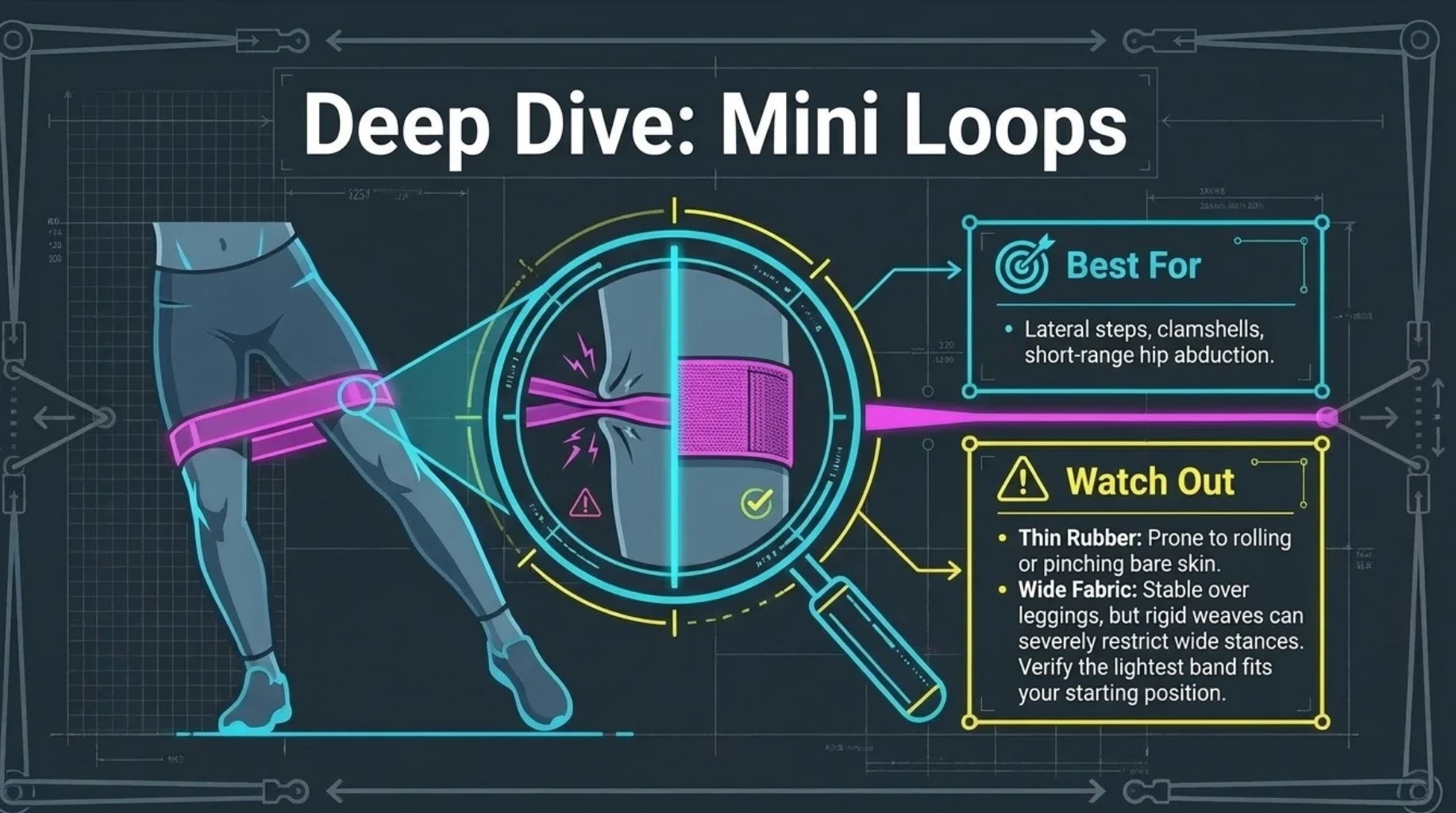
A mini loop is a short flat ring that generally sits around the thighs, lower legs or forearms, depending on the exercise. Small amounts of movement can add considerable tension when the loop is already stretched. For a beginner doing lateral steps, a light mini loop above the knees is a sensible starting option. The band should let you step and return under control without narrowing your natural stance or dragging the trailing foot. Position and difficulty change when it moves farther down the leg, so compare bands from the same placement.
Thin rubber mini loops take little space in a travel bag and often come in several grades. They can roll or pinch depending on your clothing, the band’s width and your movement. Woven fabric loops are typically wider and may feel more stable over leggings. Some have limited give or substantial tension at the starting position. Fabric products may contain elastic or latex components inside the weave. If you need to avoid natural rubber latex, check the full material description and ask the maker about the thread or core.
Choose mini loops if your home programme lists hip abduction, lateral walks or other short-range exercises and those are the gaps in your current equipment. A mini loop can add lateral resistance to a bodyweight squat by pulling the knees toward each other. Its usual placement around the thighs does little to add vertical load for standing up. If your goal is to make the whole squat harder, your programme may call for a long band, a dumbbell or a different squat variation.
Long loops for versatile loading with few accessories
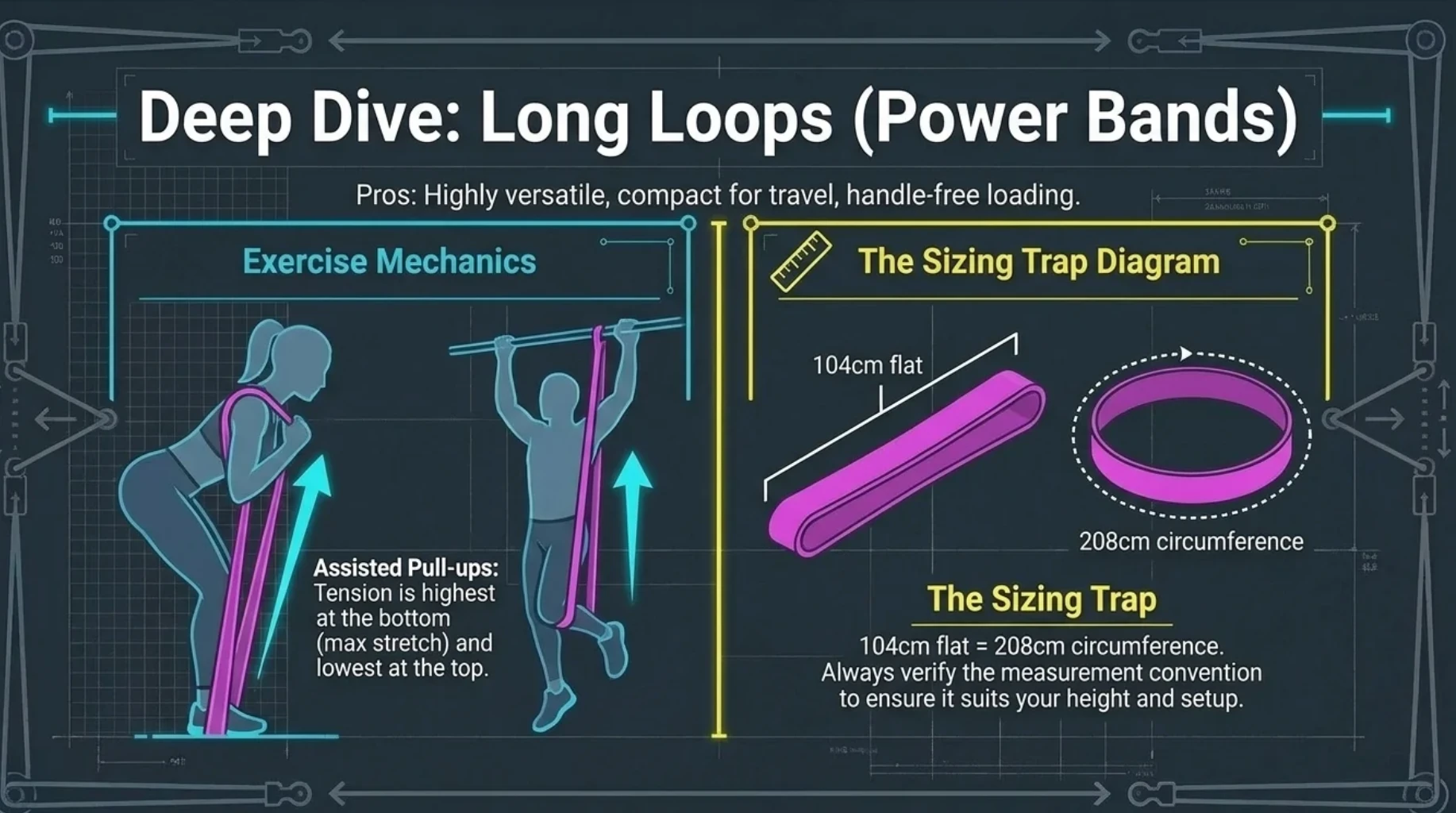
A long loop, sometimes sold as a power band, is a continuous ring large enough for standing exercises. If the design supports it, you can stand on it for a hinge or hold it in both hands for a controlled pull-apart. A pull-up setup requires a correctly installed bar that can handle your body weight and a band the manufacturer permits for that exercise. Long loops are compact when packed and create several setups with one piece.
Watch the dimensions. One seller might describe a band as 104 cm laid flat while another calls an equivalent loop 208 cm around. The two figures describe the same approximate size when the unstretched ring is flattened. Confirm the measurement convention and verify the band is suitable for your height and intended exercise. Standing on the same band with a wider stance changes the slack and the peak stretch. Using a doubled configuration also changes how it loads. Follow the manual’s configurations and extension limits.
Test hand comfort at light resistance. A wide band can press against the edges of the hand in curls or rows. If grip discomfort ends the set before the working muscles tire, try a lighter or narrower loop, a compatible grip accessory, or tubes with purpose-built handles. For assisted pull-ups, a stronger loop provides more help, especially near the bottom where it is stretched furthest. Progress toward unassisted reps by moving to a suitable lighter band as control and strength improve.
Tube bands for rows, presses and comfortable grip
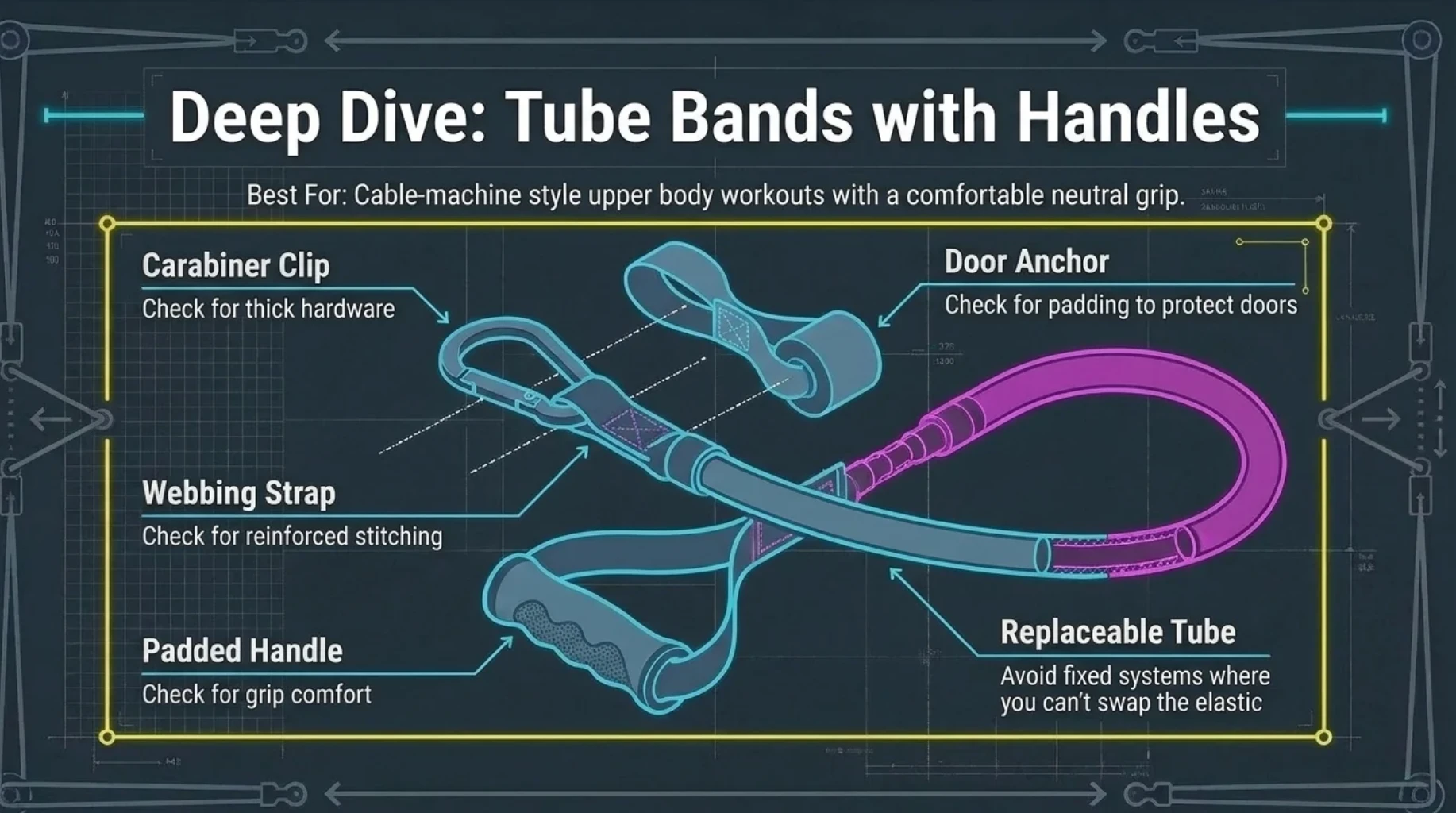
A tube is a length of elastic cord with handles permanently attached or clipped on. It can feel more natural for someone used to cable machines, especially for neutral-grip rows, chest presses and curls. Clip-on sets let you change the tube while keeping the same handles. Some kits permit two or more tubes on the same assembly. Load limits apply to the assembly, including the handles, clips and anchor where used. Verify the permitted combinations for the whole system.
Look closely at the connections. Product photos should show how the tube joins the strap, what the clip closes onto and what stops the anchor moving through the door gap. Handles should feel secure when you pull lightly with the wrist in a comfortable position. A padded door anchor is an accessory, and the door still has to meet the manufacturer’s requirements. A loose frame, a damaged door or a door that someone else can open makes it sensible to choose a different exercise or setup.
A tube kit can be a good first purchase when you want an upper-body routine with easier hand positioning. Light tubes are particularly useful if there is a big strength difference between your row and your shoulder exercises. Check whether the kit includes a genuinely easy option and whether you can buy a replacement tube without replacing the handles and anchor.
How to read resistance ratings in kilograms and pounds
A dumbbell marked 5 kg tells you its mass. A band marked “5–15 kg” may be expressing expected tension as a kilogram-force equivalent across an unstated range of stretch. As an elastic band extends, tension generally rises. The pull direction and the distance of that line of pull from your joint also affect how demanding the exercise feels. The same band can therefore feel light when you start a movement and much harder as you finish. A tube marked “10 kg” cannot be assumed to feel like a 10 kg dumbbell through a full curl.
Check the baseline. Suppose a straight tube has 100 cm of working elastic when relaxed. At 150 cm it has elongated by 50%. At 200 cm it has elongated by 100%. Some charts describe the latter as “200% of resting length.” Confirm whether a chart is showing percentage elongation or percentage of original length, and whether the handles are included in the original measurement. Use the manufacturer’s own reference points when comparing its models.
Ask for the individual forces. A listing that states “light to heavy” can help you sequence a single kit. Cross-brand comparison needs the measured force and extension, and ideally the test configuration. Two bands with identical colours may have different starting tension, thickness and working lengths. A kit’s combined rating can tell you little about how its lightest band feels. Ask the seller for the force of each tube at a named elongation and whether the published value applies to one strand or the assembled configuration.
Compare at the same part of the exercise. Suppose one product’s 10 kg label is quoted at 100% elongation and another’s 10 kg at 200%. The labels describe different conditions. If your row only stretches the band by about 60%, those numbers leave you without a direct comparison. You can still buy a product with transparent dimensions, a useful light-to-medium range and a clear defects policy. Use your own repeatable setup to track progress rather than assigning a dumbbell weight to the band.
How to choose band strength for your first home workout
Start with a resistance that allows a comfortable, controlled range of motion. Try a short practice set with the light option first. If the last few repeats feel challenging and you could still perform another two or three clean reps, you have a workable starting load. If you must throw your shoulders back or lose control on the return, reduce the resistance or reconsider the setup. If no band in the kit feels easy enough for your weakest intended exercise, look for a lighter option before relying on the kit for that movement.
For someone learning a basic full-body routine, two sessions a week on separate days are a practical starting schedule. Use easy practice repetitions to check the setup, then try one or two sets of roughly 8–15 controlled repetitions for suitable exercises. Your exercise choices might cover standing up from a chair or a squat, a hip hinge, a push and a pull. Start with body weight for movements that are already challenging. If you have limitations, post-operative restrictions or a rehabilitation plan, ask for individual exercise and equipment guidance. The ACSM’s 2026 resistance training update emphasises consistency and training the major muscle groups.
Record the exercise, band model or colour within the set, body position, anchor height if used, and completed reps. When you can consistently do the upper end of your rep range with the same position and good control, progress one variable at a time. You could move up one small band grade or follow the manufacturer’s instructions to change the starting tension while staying within its stretch limit. Recheck alignment, control and available range whenever you change the setup. A printed load number is useful only when you know how it relates to the setup you repeat.
Here is a buying example. A beginner wants hinges, standing curls and lateral walks. They can choose one light long loop to try the hinge and curl, then add a mini loop if their programme uses lateral walks. If they instead want standing rows and chest presses several times a week, handles may be more valuable than a large number of mini-loop grades. A person already comfortable with heavier strength work can check how much resistance the band provides near the start of a squat or hinge and consider whether another weight would provide a better progression step.
What to check on an Indian online listing
Compare the usable pieces, including replacements
Count the pieces that actually change your training choices. A carry pouch, printed leaflet and two handles can make a kit sound larger without adding another level of resistance. Compare the number of usable resistance steps, the band lengths, the handles or anchor you need and the cost of replacing the parts you will wear out. A kit with fewer levels and separately available tubes may be a better purchase than a larger kit with a steep jump between the two lightest tubes.
Check what the warranty covers and how to report a defect. A marketplace return label may apply only to damaged or incorrect items. Read the conditions before opening or testing the product. In review photos, look for the version, dimensions and attachment details of the exact set you intend to order. Reviews for several products can sit on the same product page, so a reassuring photo of a thick clip may belong to a different bundle.
Verify that the setup fits your home
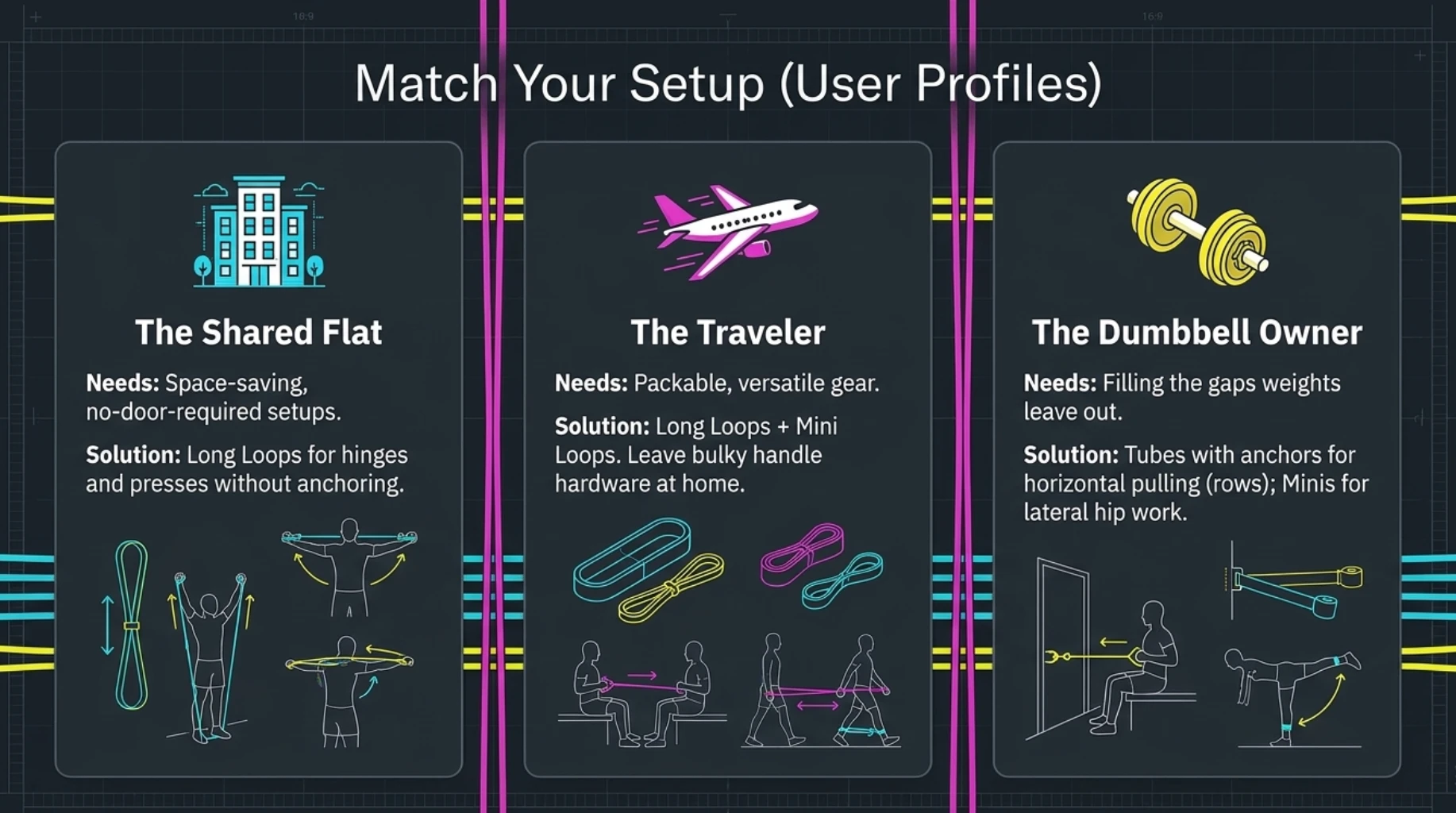
In a small flat, measure enough clear space for your arms, the full reach of the band and a step back from the attachment point. Move a dining chair, drying rack or coffee table out of the way. On smooth tile, check that your footwear and position stay stable for any foot-secured exercise permitted by the manual. When the only available door is often used by other family members, favour exercises that can be set up without that door, or arrange to keep the training area clear for the session.
If you want to travel with the band, check its packed size and carry the manual or save a copy on your phone. A long loop supports plenty of standing exercises in a room without compatible anchor points. A tube can offer a better grip, provided the setup you need can be reproduced with the relevant accessories. You can also build a routine around a combination of bodyweight exercises and one light band rather than packing every band grade.
Ask four questions before you order
- What is the unstretched length, how was it measured, and is the band the right size for my first exercise?
- What does each rating mean, at what stretch was it measured, and what is the maximum permitted elongation?
- Which handles, clips, footwear or anchors does the maker specify for the movements I intend to do?
- Can I return a damaged item or order a replacement band or accessory for this specific model?
Safe setup, inspection and storage
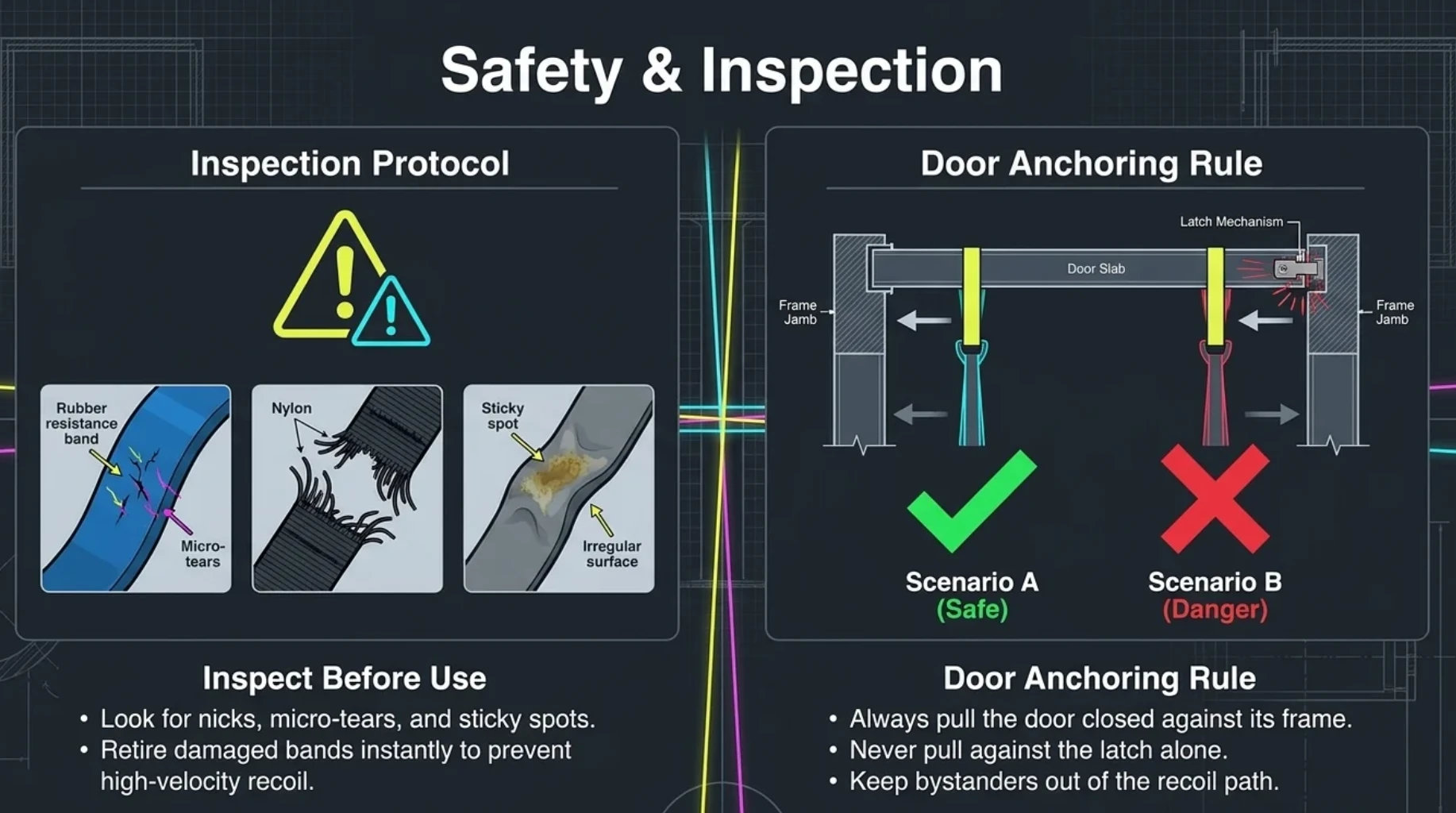
Elastic bands store energy when stretched. If an attachment fails or an end slips, the band can recoil. A published case series on elastic exercise bands documented serious eye injuries following recoil. It describes injuries seen at one practice and cannot estimate how often they occur. The takeaway is to plan for where the band could travel if an attachment failed and keep your face and anyone nearby out of its likely path.
Inspect the full band and hardware in good light before each use. Look for nicks, tears, unusual thinning, brittle or sticky areas, exposed elastic, loose seams, frayed straps and clips that fail to close. Retire damaged parts. Avoid rough edges and follow the maker’s maximum extension limit and cleaning instructions. Store the equipment out of sunlight and away from sharp objects. Keep it inaccessible to small children and pets. For a fabric loop, check whether the maker allows washing and how it should dry before storage.
If you use a door anchor, follow the exact manual for your model, including placement, door type and direction of pull. Set it up so the pull keeps the door closed, and prevent anyone opening it while you train. After setting up each exercise, start with gentle tension to confirm that the attachment and your footing stay secure. A chair, door handle, balcony railing or unfamiliar fitting may move under load or damage the band. Use only attachments the maker specifies. If you cannot set those up correctly, change the exercise.
When you stop a set, bring the band back to a low-tension position before stepping out, releasing a handle or removing an attachment. Keep the return controlled during the set as well. If the band strikes an eye and you develop blurred vision, pain, bleeding or new floaters, seek urgent eye assessment. A recoil incident is also a reason to inspect the setup and replace any damaged part before training again.
Three buying scenarios and how to test the fit
The first-time buyer in a shared flat
You already walk regularly and want to start training your legs and upper body at home. The living room door opens into a common passage and other people use it throughout the day. Start by writing down the exercises you can practise without attaching anything to the door. A chair sit-to-stand and a wall push-up need no bands. A suitable long loop can provide extra resistance for a foot-secured hinge, if the product instructions support it. If you mainly want upper-body pulling with comfortable handles, look for a tube with a manufacturer-approved setup you can reproduce in the space you have. A door attachment adds little value when you can rarely use it.
In this scenario, the useful purchase may be a single band with a nearby lighter or heavier option available separately. Try your first session before committing to a large set. Write down whether the band stayed secure, how much space the setup required and how long it took to put away. If setting it up means rearranging the room each time, a simpler exercise variation may be easier to keep doing.
The gym user who wants to train while travelling
Your regular routine includes a row, a chest press and a hinge. You want enough resistance to train in a small hotel room. Decide ahead of time which movements can be done with an approved foot-secured or hand-held setup and which would need a fixed point. A long loop packs flat and provides a handle-free option. Two adjacent resistance grades can help if your hinge needs more resistance than your upper-body work. A tube with padded handles may be easier to grip, although the required anchors and accessories take up some of the space you save by leaving weights at home.
Compare your travel sessions by recording reps and perceived effort. A band row can train the same broad movement pattern as a cable row, but the tension changes across the rep and the joint angles may differ. Use a familiar range and steady return. If you can only reach a challenging effort by leaning back or stepping so far away that you approach the maximum elongation, use a different band or replace the movement.
The buyer who already owns a pair of dumbbells
Look for what the weights leave out. If your dumbbells work well for split squats, curls and presses, use them for those exercises and consider a mini loop for lateral work or a tube for a comfortable horizontal pull with a suitable anchor. If your weights are too light for a hinge, verify that your intended long-loop setup gives usable tension low in the movement before buying. A thicker band can make the last part much harder even when the initial stretch stays modest. Check how that feels compared with the loading you want.
How to inspect a new set when it arrives
Compare the band size, resistance grade, materials and hardware with the order. Lay the bands next to each other to check the advertised working lengths. Inspect each connection before attaching anything. Read the instructions, find the maximum stretch and confirm the approved ways to secure the band. If two tubes share one set of handles, check whether the handles attach cleanly to both and whether the maker permits combining them.
With a permitted setup, take up slack gradually and try a few easy repetitions. Ask three questions at the start and finish of the movement. Can I keep my footing and grip? Do I feel tension where I need it? Can I return smoothly without the band pulling me out of position? If the answer changes when you shorten the range or alter your stance, record that before deciding whether you need the next resistance grade. Report any visible defects using the seller’s documented process and keep the order details for replacements.
Frequently asked questions
Which resistance band should a beginner buy first?
For a general home programme, consider a light long loop or a light tube with handles. For short-range hip exercises, choose a light mini loop. Check which style your exercise requires. Prioritise a band you can use across a controlled range and a clear route to the next resistance level.
Can you build muscle with resistance bands alone?
Elastic-band training can increase muscle size, according to the 2026 ACSM position stand. Results still depend on effort, progression and consistency. Over time, some exercises may outgrow the load you can achieve with your bands. Change to a stronger band or another resistance option if your current setup limits meaningful progression.
Do fabric loops last longer than rubber loops?
Durability varies with the model, stitching, elastic core, use and care. Fabric may feel better on the skin and sit flat for certain movements. Rubber can offer a different stretch range and a more compact pack size. Compare product construction and replacement support for the specific items you are considering.
Does a heavier pull-up band make the exercise harder?
In a properly set up assisted pull-up, a higher-tension band generally gives you more help. It stretches most at the bottom and usually provides less assistance near the top. If you mean a band attached to resist a movement, higher tension can make that exercise harder. Ask how the band is being used before comparing the labels.
What is the best value resistance band set?
Choose a set that covers the exercises you will do, gives you a light enough starting option and offers a sensible next step. Compare the useful pieces and recurring replacement costs in rupees. Consider the price of the compatible anchor or handles if you need them. Buy a larger kit when you can name what the extra pieces add to your training.
References
- American College of Sports Medicine. Resistance Training Prescription for Muscle Function, Hypertrophy, and Physical Performance in Healthy Adults: An Overview of Reviews. 2026.
- Effects of elastic band training on body composition and physical performance in older people: A systematic review with meta-analysis. Experimental Gerontology. 2024.
- Ng CC, et al. Ocular Injuries Associated With Elastic Exercise Bands. Retinal Cases & Brief Reports. 2022.
