

By Dr. Pankaj Kumar, General & Lifestyle Physician
If you want to choose whey protein in India, start with three numbers on the back of the pack: net weight, grams of powder per serving and grams of protein in that serving. Then check who sold it and whether you can find a lab report for the batch. These checks can change your decision. A jar that costs ₹1,799 can be more expensive per 25 g of protein than a pouch priced at ₹2,199. A powder advertised as “25 g protein” can deliver less protein per gram of powder than one that says “24 g”. The serving sizes explain the apparent contradiction.
This guide walks you through a purchase from the online listing to the sealed pack on your doorstep. It explains how to read an Indian label, what a certificate of analysis can tell you, and how to put concentrate, isolate and blends on the same price basis. The prices below are worked examples in rupees. Use your own checkout price and the nutrition panel for the exact flavour and size you intend to buy.

Do you need whey protein in the first place?
Whey is one of the protein fractions in milk. A powder can make it easier to add protein when a meal is small, you have limited cooking time, or you train and struggle to reach a suitable intake from food. A common example is a person who has chai and toast before commuting, eats a light canteen lunch and trains after work. A shake may solve one predictable gap. Plain curd, milk, paneer, eggs if you eat them, or a meal with dal and soy can also contribute, with different combinations of calories, cost and convenience.
A 2022 systematic review of randomized trials found that increasing protein intake produced a small additional gain in lean body mass in healthy adults doing resistance training. The evidence was stronger for the combination with training than for increased protein alone. The analysis addressed total protein intake across several approaches. It cannot tell you whether a particular Indian whey isolate is better than a specific concentrate, or whether someone already meeting their needs would benefit from another scoop. [1]
Estimate what you usually eat over a few representative days. Include the milk in your coffee, the curd in your thali, the actual amount of dal solids, and any soy, paneer, eggs, fish or meat you eat. Suppose you and your dietitian have set a target of 95 g per day and you routinely get 75 g. A product that reliably supplies around 20 g of protein can close that illustrative gap. Shopping for a powder that declares 30 g per scoop may simply lead you to buy larger servings than you need.
How to choose whey protein in India by reading the label
Compare protein concentration using grams, not scoops
First find the serving weight in grams. Then find how many grams of protein the nutrition panel assigns to it. Divide the protein by the serving weight and multiply by 100. A powder with 24 g protein in a 30 g serving provides 80 g protein per 100 g of powder. A product with 25 g protein in a 40 g serving provides 62.5 g per 100 g. The second scoop contains one extra gram of protein because it contains ten extra grams of powder. What else those grams contain depends on the ingredient list and nutrition panel.
If the panel already gives protein per 100 g, use that value directly. Check whether a claim refers to dry powder or to a shake prepared with milk. Milk adds its own protein, lactose and energy. An online listing that displays prepared-shake values can therefore give a misleading comparison with another listing for dry powder. Compare matching dry-powder figures. At home, weigh a level scoop once if precise tracking matters. The weight can vary with how tightly the powder packs or how generously you heap it.

Read the first ingredients and the nutrition panel together
For plain whey, look for whey protein concentrate, whey protein isolate, hydrolysed whey protein or a clearly described combination. Ingredients generally appear in descending order by weight, subject to applicable labelling rules. A blend can contain several proteins, and the order alone cannot tell you their exact proportions. A product may also use skimmed milk powder, casein or soy protein. Check what you are choosing if you specifically want whey, avoid soy, or are comparing how a product fits your diet. [2]
Chocolate and coffee flavours often contain cocoa, flavourings or sweeteners. Lecithin may be used to help the powder mix, and gums can change texture. If you have symptoms with one product, record the serving size, what you mixed it with and which extras it contained. A shake mixed with milk, a large serving, or tolerance to an added ingredient can all affect that experience. “No added sugar” leaves room for naturally occurring sugars such as lactose. Likewise, “zero sugar” alone provides too little information to conclude that a product is lactose-free. Use a specific lactose declaration or ask the manufacturer for the amount if tolerance is an important reason for your purchase.
Read the carbohydrates, total sugars, added sugars, fat and energy alongside protein. A powder intended as a mass gainer may provide a lot of carbohydrate and energy in a large serving. That formulation can be intentional. It belongs in a different comparison if your aim is to increase protein while keeping other calories relatively low. Look for a serving that fits what you actually plan to eat, especially if you prepare your shake with milk, banana, dates or peanut butter.
Check traceability details on the Indian pack
Look for the FSSAI logo and licence number, manufacturer or packer details as applicable, lot or batch identification and the relevant date declarations. For imported packs, look for country-of-origin and importer information. Check the milk allergen declaration, as well as any others relevant to you. FSSAI publishes the labelling rules and amendments. Treat a licence number as one traceability check. Batch-specific protein and contaminant claims need separate evidence. [2]
Ask for recent photos of the exact variant when marketplace images look outdated. On a shared product page, check which seller will fulfil the order and appear on the invoice.
Take a photo of the batch code and keep the invoice until you have checked the product. Inspect the closure and inner seal in light of that brand’s packaging instructions. If the seal appears compromised or the batch/date print looks altered, stop and contact the seller or brand with photographs. Where the manufacturer offers an authenticity code, use its official website or app. That checks the code in the brand’s system. A matching batch report and a traceable seller still provide different kinds of information.

Whey concentrate, isolate and hydrolysate compared
Compare the nutrition panel for the finished powder, since flavours, sweeteners and added ingredients can change the numbers. The type of whey is useful when it addresses an actual need, such as getting more protein in a smaller volume or reducing lactose exposure. The label cannot predict whether you will like the taste or tolerate the product, which matters if you intend to take it regularly.
| Type | What matters on the label | When it may suit you |
|---|---|---|
| Whey protein concentrate | Protein per 100 g, serving weight, carbohydrate and any lactose declaration. | Often a reasonable first comparison when you tolerate dairy and the verified cost per gram is lower. |
| Whey protein isolate | Actual finished-product protein concentration and lactose information. A chocolate isolate and an unflavoured isolate may differ. | Useful when you need a more protein-dense powder or a lower-lactose option and can justify the price. |
| Hydrolysed whey | The whey source, declared protein and any other ingredients. Hydrolysis breaks some protein into smaller peptides. | Compare taste, tolerance, purpose and price. The word “hydrolysed” alone gives little basis for expecting better results from your workouts. |
| Whey blend | The protein sources and their order, along with final protein per 100 g. | Can be good value if transparent, well tolerated and backed by credible testing. |
| Gainer or mixed dairy powder | Serving size, carbohydrate, calories and the sources of protein. | May suit someone deliberately buying additional energy. Compare alongside products serving the same purpose. |
Lactose intolerance and milk allergy require different decisions. Someone with lactose intolerance may tolerate a lower-lactose product or a smaller serving, depending on their threshold. Whey is milk protein, so people with a milk-protein allergy should avoid whey concentrate, isolate and ordinary sports hydrolysates. A lactose-free label addresses the milk sugar. It provides no assurance for someone allergic to milk proteins. [3]

What independent whey protein tests in India found
The first Citizens Protein Project, published in 2024, analysed 36 protein supplements sold in India and found that some measured protein values differed from label declarations. Its 2025 follow-up tested 34 whey-containing powders, grouped by the researchers as 18 medical-pharmaceutical and 16 nutraceutical products. It examined protein, amino acids, sugars and multiple contaminant classes. Discrepancies between labels and measurements, and unusual amino acid findings, were more frequent in one study group than the other. Some products in these groups had very different intended uses and compositions. A powder formulated for extra calories or clinical nutrition should be judged against its intended purpose and the accuracy of its own label. [4,5]
These were laboratory studies of selected market samples. They can show a mismatch or a contaminant finding in the tested samples. They do not establish how often the same results occur across all flavours, manufacturing runs or sellers in India, or what long-term health outcomes consumers experienced. Treat the results as evidence for asking better questions, rather than as a permanent buying list. If a social media post names a brand, check which exact product, flavour, batch and date the underlying report refers to. The batch you can buy today may differ.
How to read a whey protein lab report or certificate of analysis
Match the report to a product and batch
Start with the name, flavour and batch code. A vanilla isolate report cannot answer whether a chocolate blend has the same protein or contaminant profile. Next look at the laboratory name, report number, and sample receipt and issue dates. Read the sample description carefully. A document for whey isolate as a raw material concerns that ingredient. A finished-product report concerns the powder as sold, including flavourings and other additions. If all you have is a photo of a green tick, ask for the full report before relying on it.
Use NABL’s accredited laboratory directory to confirm the accreditation number, address, validity and scope of an Indian testing lab. Open the actual scope and see whether the relevant test and sample category are covered. A laboratory can be accredited for some methods while offering other methods outside its scope. Accreditation relates to the laboratory’s competence for listed activities. It does not certify an entire supplement brand or establish that the laboratory independently bought the sample. [6]
Find out who supplied the sample if the report says so. A manufacturer can pay a competent third-party laboratory to test a batch, which provides relevant evidence when the details are clear. An independent organization that purchases a sealed pack through normal retail channels answers a different question about what was available to buyers. Sampling matters in both cases. One sample rarely captures all variation within or across batches. A brand with accessible reports over several months offers more information about consistency than a single old report.
Put label and measured protein on the same basis
For example, imagine a label declares 24 g of protein per 30 g serving, equivalent to 80 g per 100 g. A lab measures 75 g per 100 g of the powder as sold. Multiplying 75 by 30 and dividing by 100 gives 22.5 g measured protein per serving. The difference is 1.5 g per serving, or 6.25% below the label claim relative to 24 g. Check that both numbers refer to the same product and use the same reporting basis. A result on a dry-matter basis removes moisture from the denominator. A value for the powder as sold includes it.
Read the method, unit and reported measurement uncertainty if available. Small differences can reflect rounding and analytical variation, among other factors. A study’s cut-off for classifying discrepancies is a research convention unless it corresponds to the applicable regulatory standard. Avoid turning arbitrary percentage differences into an accusation. If a result looks important, ask the laboratory or manufacturer to explain the basis, uncertainty and acceptance criterion.
Understand what an amino acid panel adds
Common protein methods such as Kjeldahl and Dumas estimate protein from measured nitrogen using a conversion factor. They are useful routine methods. A nitrogen-based result alone cannot identify the source of all measured nitrogen or establish that it came from intact whey protein. Free amino acids and other nitrogen-containing ingredients can contribute. The phrase “amino spiking” is often used when extra nitrogen-containing compounds are suspected of inflating the apparent protein. Declared fortification and deliberate misrepresentation are different conclusions, and neither can be inferred from a single unexplained number. [4,5]
Look for an amino acid profile when a product makes specific whey purity claims or has added free-form amino acids. A profile can show whether the pattern resembles the claimed protein source, and a targeted test may help distinguish free compounds from the amino acids present in the protein. Ask what the lab measured and how it prepared the sample. A total amino acid profile commonly involves breaking the proteins down first, so it may not distinguish the free and protein-bound fractions on its own. Also check whether the figures are expressed per serving, per 100 g of powder or per 100 g of protein. A big leucine or BCAA number on the front does not tell you how much intact whey you are buying. [5]
Suppose the ingredient list includes added taurine or glycine. You can compare it with a simpler formula if your goal is to buy whey protein specifically. A label may also list BCAAs as naturally present in the whey. Those amino acids are already part of the protein and should not be added a second time when comparing the grams of protein you expect from the scoop.

Read contaminant results in context
A given report may test for lead, cadmium, arsenic or mercury. It may also include microbiological tests or selected mycotoxins and pesticides. Read which analytes are listed, the method, the units and the reporting limits. If a substance was not included, that report gives you no result for it. Where arsenic matters, the relevant standard and interpretation may depend on whether the test reports total arsenic or a specific form. A broad stamp such as “heavy metals passed” is less informative than the individual numbers and the limits used.
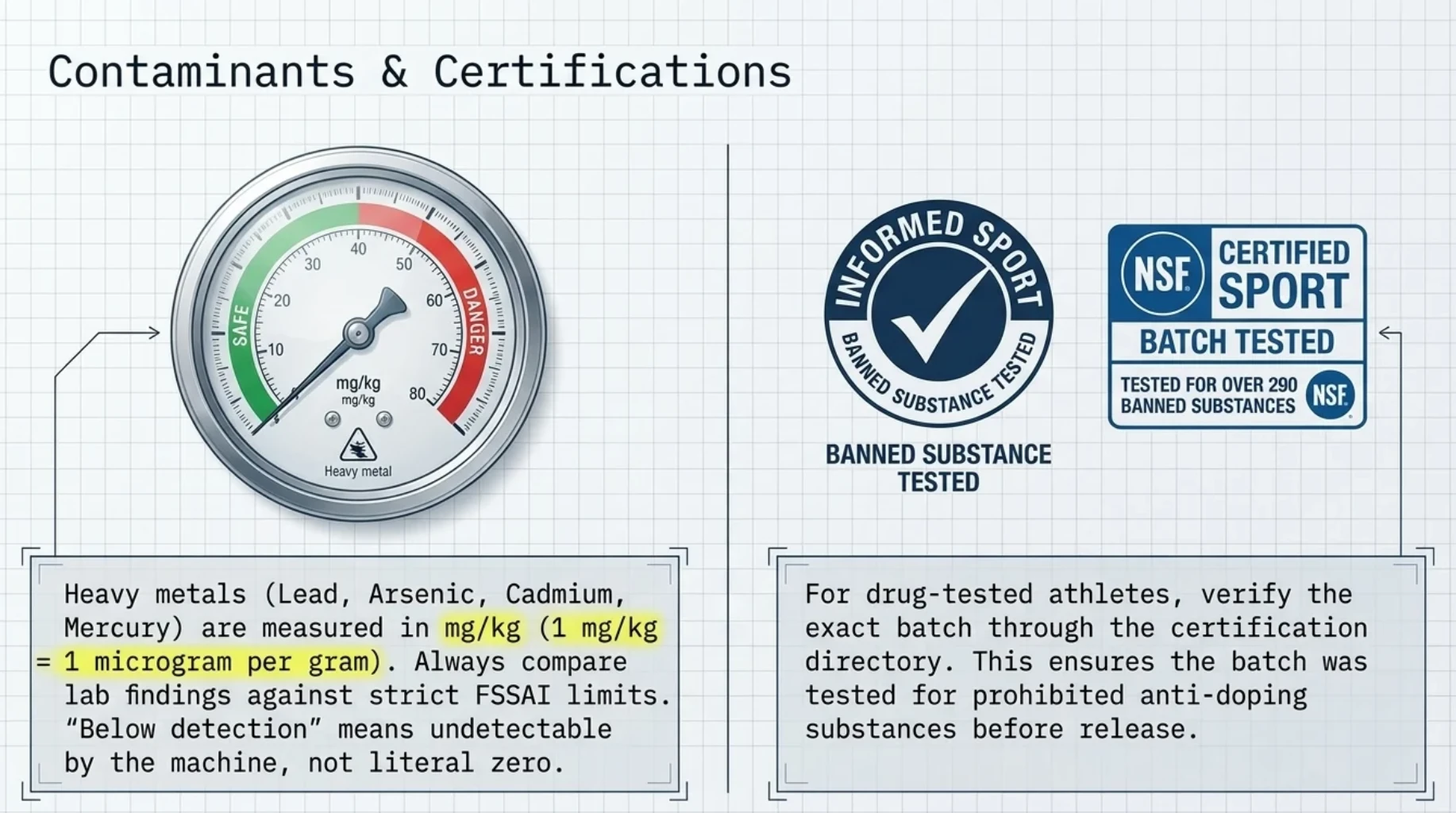
For a simple unit conversion, 1 mg/kg equals 1 microgram per gram of powder. A hypothetical result of 0.10 mg/kg therefore corresponds to 3 micrograms in a 30 g serving. That calculation gives the estimated amount per serving. It does not resolve regulatory compliance or individual risk on its own. Compare the finding with the applicable Indian limit for that product category and analyte, and consider the intended use and frequency of consumption. A result below the detection or quantification limit tells you what the method can report at that level. It cannot prove that the amount is literally zero. [7]
Drug-tested athletes should also verify the exact product and batch through a relevant sport certification directory. Informed Sport says it tests each certified batch for prohibited substances before release and offers a batch lookup. NSF Certified for Sport also has a searchable directory. Check the current listing, and ask your sport federation which programme it recognizes. A sport certification check and a full assessment of nutrition or contaminants answer different questions. Certification reduces risk within its test scope. [8,9]
How to calculate whey protein cost per serving in India
Use the actual checkout price, including delivery and any discount available to you. Take the net weight and nutrition numbers from the same pack. First calculate servings by dividing net powder weight by grams of powder per serving. The advertised serving count may be rounded. Then divide the price by that serving count to find the cost per label serving.
For a fair comparison across products, bring both prices to the same quantity of protein. A 25 g benchmark works well for simple arithmetic. It is a comparison unit rather than a recommendation about how much you should take. If you need 20 g, substitute 20 in the formula. If you plan to use one and a half scoops, weigh the amount of powder or scale from the serving weight on the label.
- Protein fraction = grams of protein per serving ÷ grams of powder per serving.
- Total protein in the pack = net powder weight in grams × protein fraction.
- Cost per label serving = checkout price ÷ (net powder weight ÷ serving weight).
- Cost per 25 g of protein = checkout price × 25 ÷ total grams of protein in the pack.
These are hypothetical prices. The second and third packs each say “25 g protein”, but the weights and prices differ. The cost of a scoop also hides the difference between the two ways of buying 25 g of protein.
| Example pack | Net weight and checkout price | Label serving | Protein per 100 g | Cost per label serving | Cost per 25 g of protein |
|---|---|---|---|---|---|
| A · Concentrate | 1,000 g at ₹2,199 | 24 g in 30 g | 80 g | ₹65.97 | ₹68.72 |
| B · Blend | 800 g at ₹1,799 | 25 g in 40 g | 62.5 g | ₹89.95 | ₹89.95 |
| C · Isolate | 1,000 g at ₹2,799 | 25 g in 29 g | 86.2 g | ₹81.17 | ₹81.17 |
Pack A contains an estimated 800 g of protein from the label. Dividing ₹2,199 by 800 and multiplying by 25 gives ₹68.72. Pack B contains 500 g of protein. It costs less to buy upfront, but it costs ₹21.23 more per 25 g of protein. Pack C asks for a premium of about ₹12.45 per 25 g over Pack A. You can decide whether its actual lactose level, concentration or tolerability justifies the extra cost. Over 30 equal 25 g portions, that difference is about ₹374 at these example prices.
If there is a comparable batch result, repeat the calculation using measured protein. With Pack A at ₹2,199 and an illustrative batch result of 75 g per 100 g as sold, a 1 kg pack contains about 750 g measured protein. The cost per 25 g becomes ₹73.30. Label-based and lab-based estimates should be clearly identified so you can see which assumption you used.
Count wastage and frequency before committing to a large pack. If you use powder only on the two days you work late, a small pouch may last long enough. Calculate the cost of what you are likely to consume before expiry, taking into account the manufacturer’s instructions after opening. If a powder tastes too sweet or causes recurring digestive symptoms, unused servings can wipe out the bulk discount. Compare sealed sample packs where available, using the larger pack’s actual price only once you know you’ll use it.
A practical buying decision from listing to delivery
Start your shortlist with two powders that suit your purpose. Save a picture of each product’s ingredients, nutrition panel and size. Enter the checkout price in the calculation above. Next look for batch testing and seller traceability. If an online seller cannot tell you the batch before shipping, ask whether the brand makes recent finished-product reports easy to find and whether you can return an unopened pack if the batch or importer information cannot be verified.
For a budget-conscious first purchase, compare a basic concentrate with a straightforward whey blend. Buy from a traceable seller and make the decision after comparing protein per 100 g and cost per 25 g. If you tolerate dairy and two products have comparably useful reports, a verified concentrate at a lower cost can be the sensible option. A premium imported tub with uncertain sourcing can leave you with more unanswered questions even if its nutrition panel looks better.
For blood glucose management, use the total carbohydrate in the prepared drink. A scoop in water and the same scoop blended with milk and fruit give very different totals.
For someone training under anti-doping rules, do the certification check before opening the pack. Match the product and batch on the current directory, then keep the invoice, batch photo and certification record. If you cannot verify the batch, select a product you can verify or use food sources to meet your intake. [8,9]
When the order arrives, compare the physical pack with the listing. If the ingredients or serving sizes differ, use the delivered pack to run the calculation again.

When to get individual advice before adding whey
If you have known chronic kidney disease or a prescribed protein restriction, ask your clinician or renal dietitian how a supplement fits your total daily intake. KDIGO’s 2024 guidance suggests about 0.8 g/kg/day for adults with CKD stages G3–G5 and advises avoiding high protein intake above 1.3 g/kg/day in adults with CKD at risk of progression. Dialysis, undernutrition and other clinical situations can change the plan. A general gym protein target should not replace renal nutrition advice. [10]
If a supplement has been prescribed for recovery from illness, weight loss due to poor appetite, or another medical reason, ask the prescribing team before swapping it for a sports whey. Products can differ in total energy, vitamins and minerals, carbohydrate, texture and how they are intended to be used. Someone looking to close a small protein gap after exercise is making a different purchase from someone who needs extra energy and nutrition in a limited volume.
Frequently asked questions about choosing whey protein
Is a 25 g protein scoop always better than a 24 g scoop?
Compare both the declared protein and the weight of powder in each serving. A 24 g serving of protein from 30 g of powder is more concentrated than 25 g from 40 g of powder. Whether that matters depends on your budget, serving size, dietary needs and what makes up the rest of the powder.
Does an FSSAI number mean the brand’s protein claim was independently verified?
An on-pack FSSAI licence number helps identify the relevant food business. To assess a protein claim, look for a finished-product report that matches the batch, compare results on the same basis and check the lab’s scope. You may need to contact the manufacturer if the report is missing a method or sample description. [2,6]
Can I prove purity at home by mixing whey in water?
No. Foam, clumps, settling and taste depend on the formula, water temperature, stirring and storage. They do not quantify protein or establish whether contaminants are present. If a new tub mixes differently, check the recipe and batch, contact the brand and rely on a suitable lab report for composition.
Is imported whey better than Indian whey?
Country of origin gives you traceability information. Evaluate the actual product, the seller, its finished-powder label and the batch evidence. A well-documented product from either source can make the shortlist. When choosing an imported product, also check the importer and how the brand supports authenticity verification in India.
Is unflavoured whey automatically higher in protein?
It may be more concentrated than another flavour from the same range if it contains fewer other ingredients. Read the actual panel for both products. A flavour you enjoy and finish may offer better value than one you avoid. Use measured protein and checkout price when sufficient batch information exists.
Should I use whey immediately after a workout?
Use the timing that makes it easy to meet your daily needs alongside regular training. A shake can be convenient after your workout or at another time when meals fall short. The main comparison in this guide is what you get from the powder and what it costs. A workout timer does not change either quantity. [1]
References and verification tools
- Nunes EA, et al. Systematic review and meta-analysis of protein intake to support muscle mass and function in healthy adults. Journal of Cachexia, Sarcopenia and Muscle. 2022.
- Food Safety and Standards Authority of India. Food Safety and Standards (Labelling and Display) Regulations, 2020, and subsequent amendments.
- National Institute of Diabetes and Digestive and Kidney Diseases. Definition and facts for lactose intolerance.
- Philips CA, et al. Citizens Protein Project, analysis of protein supplements sold in India. Medicine. 2024.
- Philips CA, et al. The Citizens Protein Project 2, analysis of whey protein supplements in India. Medicine. 2025.
- National Accreditation Board for Testing and Calibration Laboratories. Accredited laboratory directory and scope verification.
- Food Safety and Standards Authority of India. Contaminants, Toxins and Residues Regulations, consolidated text. 2026.
- Informed Sport. Certification and batch-testing programme.
- NSF Certified for Sport. Certified products and lot search.
- KDIGO. Executive summary of the 2024 Clinical Practice Guideline for the Evaluation and Management of Chronic Kidney Disease.
Medical note. This guide provides general information. Individual protein needs and supplement choices depend on your health, diet and training.

