


A treadmill advertised as “4 HP” can turn out to have a 2 HP motor with a separate 4 HP peak claim. A machine advertised as “compact” may fit between your bed and the wall when folded, yet leave too little room behind the belt when open. And a long motor warranty may still leave you paying for a failed controller, a worn walking belt, or a technician’s visit. Each of these surprises can be avoided by asking for a different piece of information before you pay.
This treadmill buying guide for Indian homes follows the order that makes shortlisting easier. Start with the people using the machine and their expected sessions. Compare the stated motor rating and usable belt dimensions. Measure the room and delivery route. Then ask the service team what they can do at your pin code. Manufacturer manuals and support pages are used here to illustrate how specifications and policies vary. The named models are examples of how to read documents, and their availability and terms may vary by market or seller.
Start with the hardest session your household actually plans to do
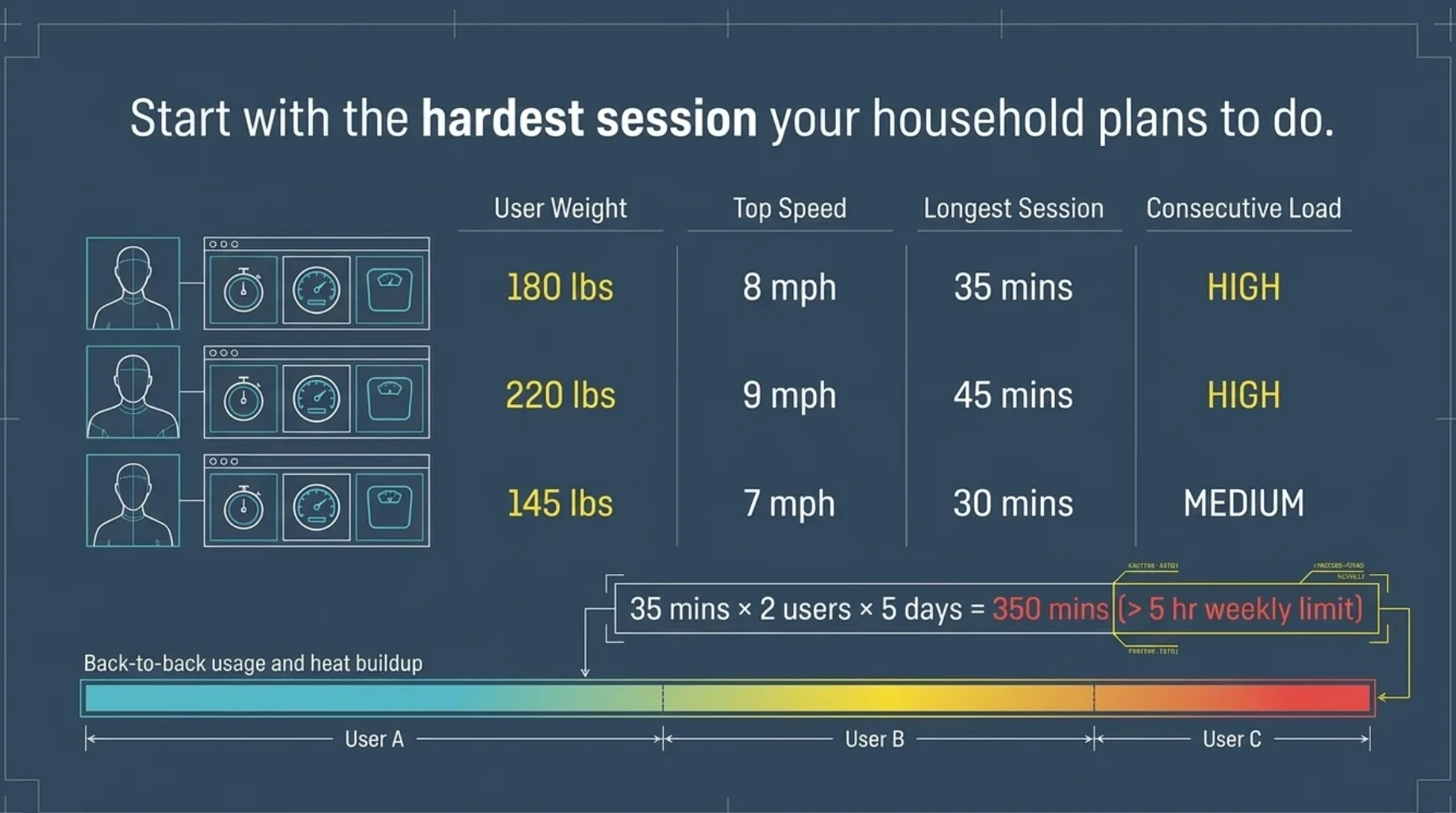
Write down who will use the treadmill, their approximate weight, the speed they expect to use, the longest single session, and how often two users will follow each other. Include incline if it is part of the plan. A 25-minute flat walk before breakfast is a different requirement from a 45-minute brisk incline walk followed immediately by another person’s jog. Even if both workouts fit within the same advertised speed range, the two-user schedule asks more of the machine over time.
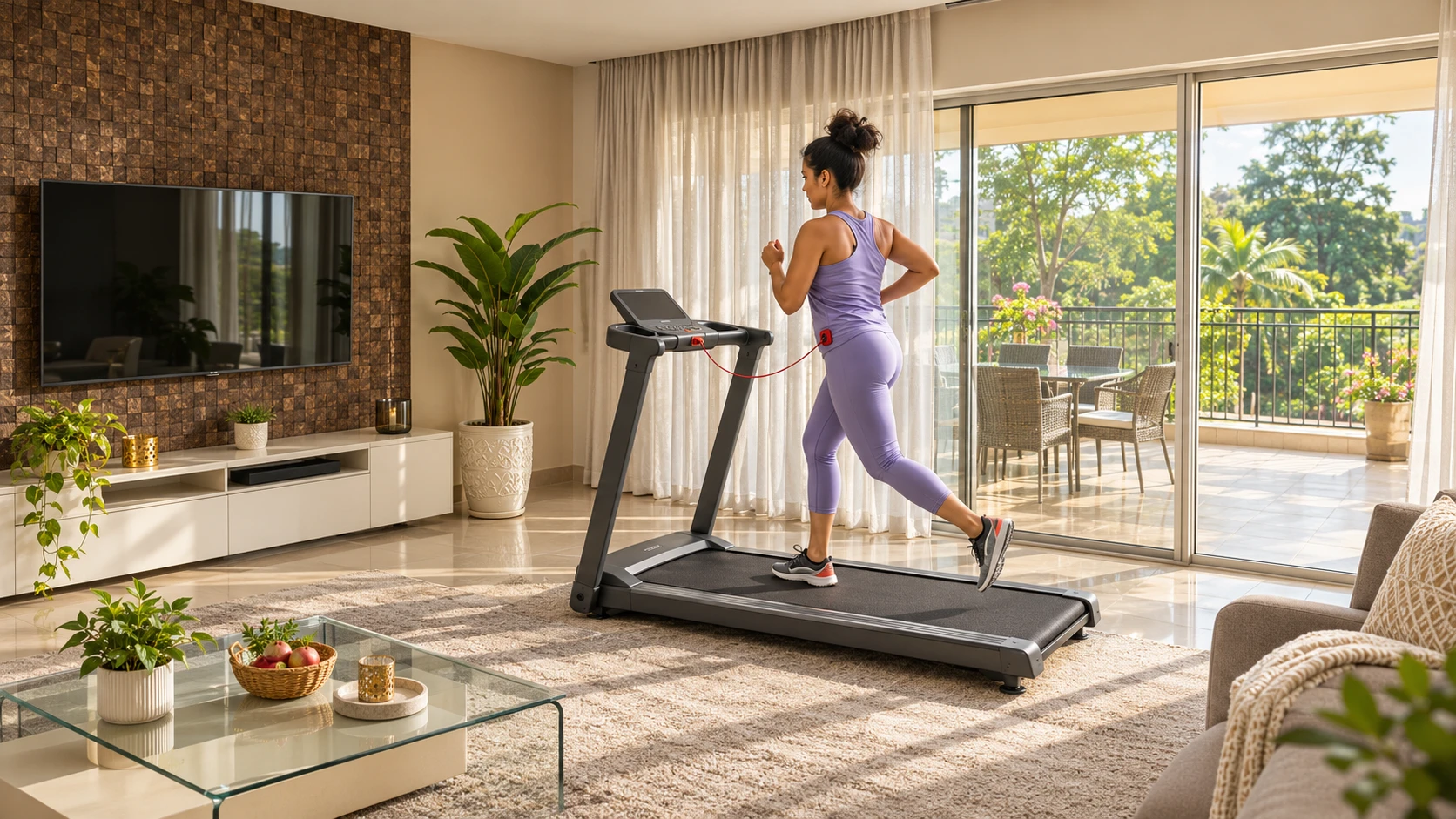
Walking pads and full-size treadmills can suit different rooms. A walking pad may appeal if you need to put the machine away after a short, easy walk. Some models have small decks, a low speed ceiling, or limited hand support. Verify the actual operating modes and whether speed changes if the rail is folded. If somebody wants to jog, look for explicit manufacturer approval for jogging on that exact model. A low step-up, a stable handrail, and an easy-to-reach stop control can be more important than the top speed for a person who walks slowly or feels unsure stepping onto a moving belt.
For a regular runner, write down a familiar pace in minutes per kilometre and convert it using 60 divided by the pace in minutes. A 6-minute kilometre is 10 km/h. A 5-minute kilometre is 12 km/h. Short intervals can be faster than the average pace shown by a running watch. That distinction matters when buying. In a demo, seek steady operation at the paces you plan to use, with room to move and easy access to the controls. You can leave the maximum speed on the spec sheet untested.
Treadmill motor power explained in plain language
What are continuous HP and peak HP?
Horsepower is a unit of power. A mechanical horsepower is approximately 746 watts. Continuous horsepower, when it is meaningfully specified, refers to a power output the motor is rated to sustain under stated conditions. Peak horsepower describes a higher figure that can be reached briefly under a particular test or condition. The duration, temperature, and measurement method may be missing from a retail listing. Even two products that show “continuous HP” may have been rated under different conditions.
PowerMax, for example, describes its TDA-240M with both a 2.0 HP figure and a 4 HP peak claim. Its specifications also list a 126 × 43 cm running surface. The headline horsepower doesn’t tell you the belt dimensions, how long the machine can run at a given use level, or what support you will receive. Ask the seller to show the continuous rating if the maker publishes it, the maximum session length or rest period if specified, and any differences between permitted walking, jogging and running use. PowerMax TDA-240M specifications.
Remember that motor output, treadmill input and electricity consumption answer different questions. Converting a 2 HP mechanical rating to about 1.49 kW does not establish how many units of electricity a normal workout will use. Wall consumption varies with the machine, workload, electrical losses and how long you use it. Use the treadmill’s electrical label and local manual to check installation requirements. Treat a fixed cost-per-hour estimate based only on a peak-HP sticker with caution.
Check session limits and behaviour under load
A motor works with a controller, rollers, bearings, belt and deck. Friction at the belt and deck can change as parts wear or maintenance is missed. A working showroom display tells you the console powers up. To learn how the machine feels in use, walk or jog at your intended pace and watch for a belt that hesitates under each foot strike, an uneven sensation, a scraping sound, or movement of the console or handrails. A short trial can reveal immediate discomfort or a setup problem. For longer sessions and back-to-back use, get the manufacturer’s written conditions.
Ask what “home use” means for your model. A product can have a weekly usage allowance, an individual session limit, or both. The Decathlon UK T900D support page, for example, describes the unit for up to five hours per week. That figure illustrates how a model may be rated and should be checked against the exact unit sold in India. To see why it matters, two people doing 35 minutes each on five days accumulate 350 minutes, or 5 hours 50 minutes, in a week. The family has already exceeded a five-hour weekly allowance even though each individual session sounds ordinary. Decathlon T900D specifications and support.
Read the weight limit alongside the use conditions. If someone weighs close to the published maximum, ask whether that limit also applies at their intended speed and incline, and whether the manufacturer advises additional margin for running. Some manufacturers publish their own margin on particular models. Use the applicable written guidance and keep every user within the permitted limits. There is limited value in an online formula that assigns one horsepower number to everyone of the same weight.

How to choose treadmill belt size for walking, jogging or running
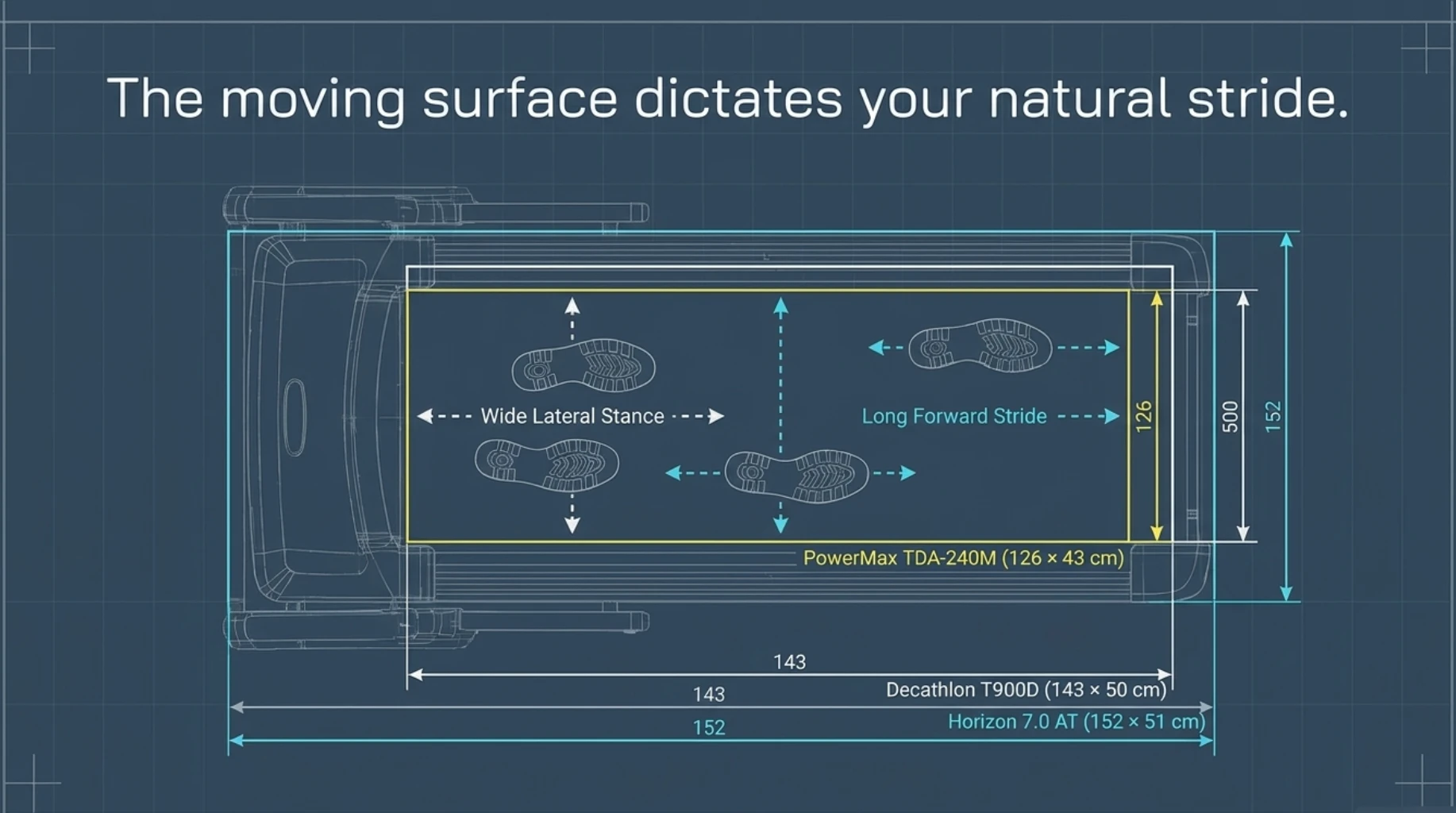
Ask for the usable moving surface, written as length × width. Overall length includes components such as the motor hood. Overall width includes rails or framing. Those dimensions help plan delivery and room fit, while the moving surface tells you how much foot-placement room you have. Confirm which dimension is which. A listing written as 50 × 143 cm and another written as 143 × 50 cm may describe the same orientation. An inch is 2.54 cm, so a nominal 60 × 20 inch surface is about 152 × 51 cm.
Length matters when your stride changes with speed or you naturally move a little forward and back during a workout. Width matters if you land farther apart, wear wide shoes, or drift laterally as you tire. A tall user who takes short steps may be comfortable on a deck that feels cramped to a shorter user with a longer stride. If possible, try the machine in your regular training shoes. After a slow start, find your ordinary position at the intended pace. You should be able to move naturally without repeatedly watching your feet or nearing the motor cover, side rails, or back edge.
For scale, the PowerMax TDA-240M listing shows approximately 126 × 43 cm. The Decathlon T900D support page shows 143 × 50 cm, and the Horizon 7.0 AT manual lists about 152 × 51 cm. The first and second examples differ by 17 cm in length and 7 cm in width, enough to be visible if you mark both rectangles on the floor. These examples are useful landmarks, not validated minimum sizes for any height, gait, or speed. Measure the exact model and assess it with the intended user. PowerMax specifications. Decathlon support. Horizon owner’s manual.
Compare the specifications that affect the way you will use it
| Planned use | What to check first | What to try or ask |
|---|---|---|
| Short flat walks | Comfortable deck, low start speed, storage routine | Check step-up height, start and stop, and whether you can move the unit as planned. |
| Brisk walks with incline | Usable incline range, clearance at full incline, permitted session length | Try the pace and grade you would actually hold. Check control reach when walking. |
| Jogging and steady running | Belt fit at pace, stable frame, written running and weight limits | Use familiar running shoes. Check foot placement, belt feel and cadence changes. |
| Several household users | Combined usage, permitted rest intervals and local repair access | Quote your longest back-to-back schedule and ask whether it is within the intended use. |
Incline, cushioning and the limits of an online demo
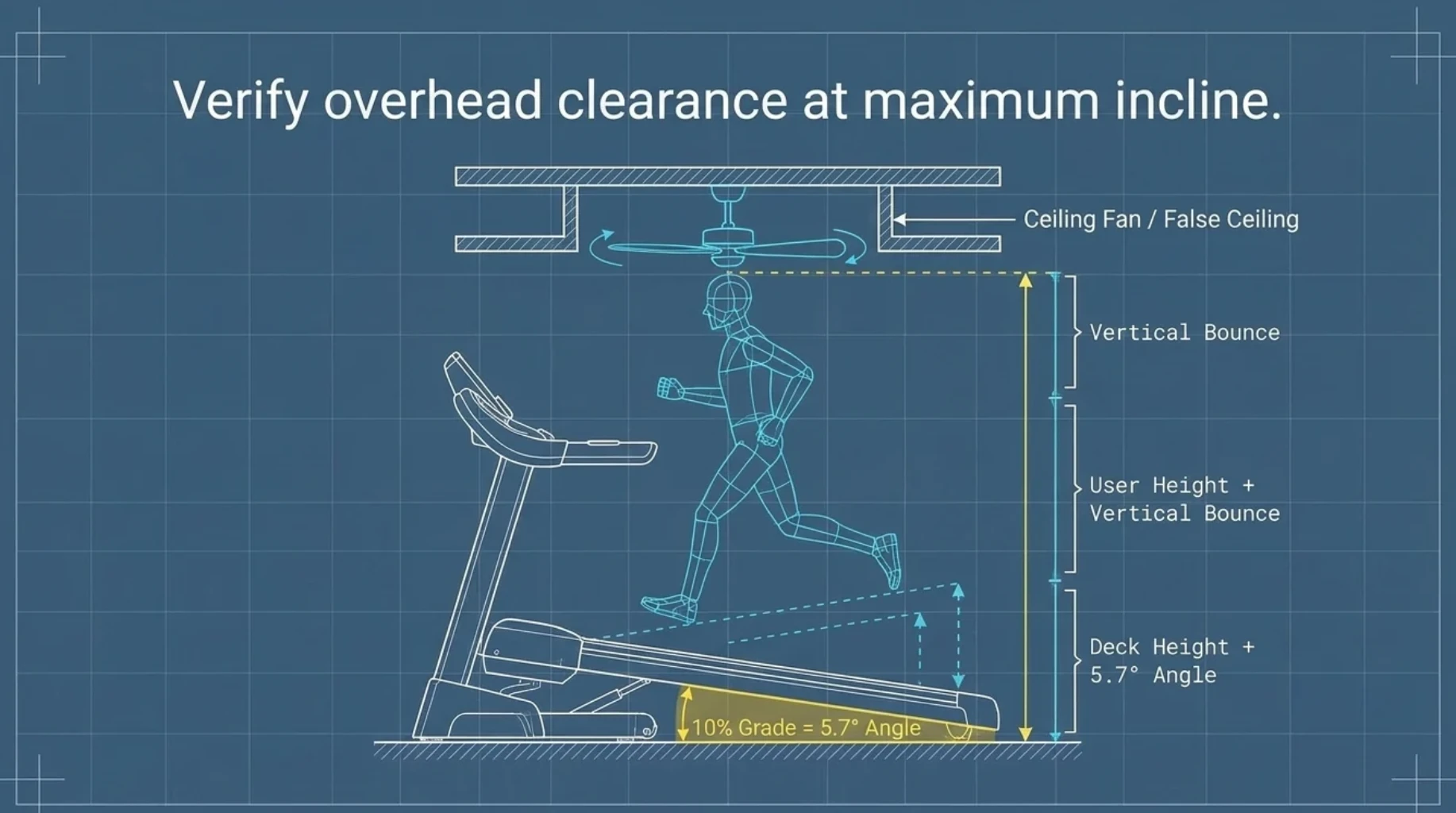
Ask whether incline is manual or motorised. A manual system may require stopping and getting off before changing the position. On a motorised model, try changing the grade and note whether the buttons are easy to reach. A 10% grade corresponds to a rise of 10 units over 100 units of horizontal distance, about 5.7 degrees. A listing that gives only “15 levels” leaves the maximum grade unclear. Compare grade in percent where possible, and ask what grade corresponds to each setting you expect to use.
Deck cushioning can change how the machine feels. Layer counts and brand names generally do not give you a common comparison of stiffness or clinical benefit. A systematic review of treadmill and overground walking in healthy adults found differences in some physiological, perceived and mechanical measures. That research helps explain why indoor and outdoor sessions can feel different. It does not establish that a specific deck design prevents knee injury or suits every person with joint pain. Use a demo to judge comfort and control and give claims about injury prevention the level of scrutiny you would give any health claim. Vickery-Howe and colleagues, systematic review and meta-analysis.
Will the treadmill fit your flat once it is open?
Measure the machine, the clearance and the delivery route
Use masking tape to mark the unfolded footprint and the clear zones in the owner’s manual. For illustration, the Horizon 7.0 AT manual calls for a rear clear zone at least 2 metres long and at least as wide as the treadmill. It also specifies front space and describes side access. If a hypothetical machine is 1.8 m long and its manual asks for 2 m behind and 0.3 m in front, the room needs 4.1 m along that axis. Measure from furniture, bedframes and other actual obstructions. Find the instructions for your own model before using these example distances in a layout. Horizon 7.0 AT owner’s manual.
Check overhead clearance with the treadmill raised to the highest incline you intend to use. Include the sole of the user’s shoes, the raised running surface beneath their feet and the movement of their head during exercise. In Indian flats, a ceiling fan, light fixture, beam or low false ceiling can determine where the machine can go. The tape layout also shows whether anyone will have to walk through the space behind the belt to reach a door or balcony while the treadmill is in use.
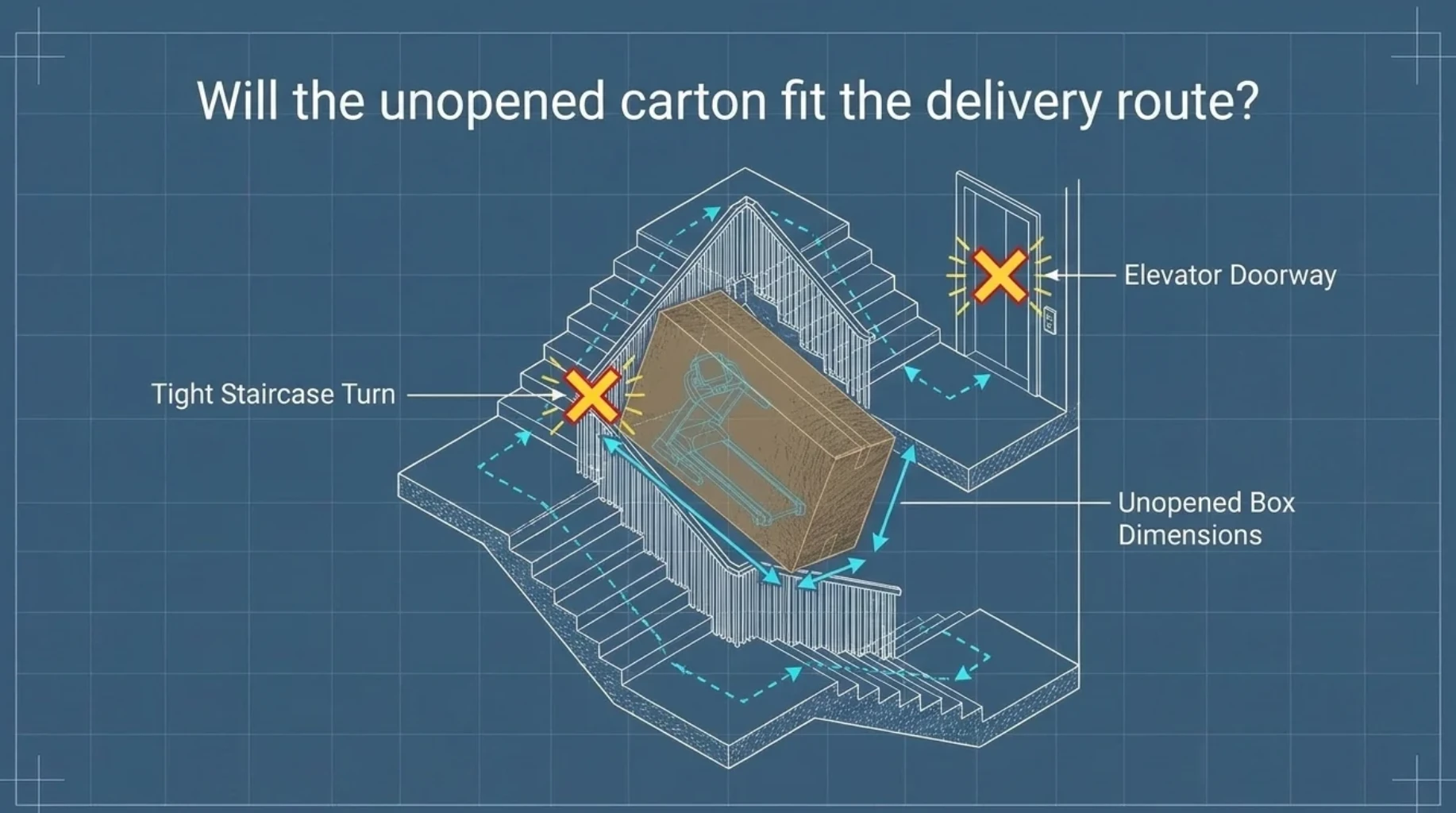
Ask for the carton dimensions and weight as well as assembled dimensions. Measure the lift doorway and interior, the flat entrance and tight staircase turns. A machine may fit through a doorway edge-on once unpacked, while the unopened carton is too large to turn at the landing. Verify who carries it upstairs, whether unpacking outside the flat is allowed, and what the charge is if the lift cannot be used. If you will fold or move the machine between sessions, try the folding release and lock yourself. A wheeled unit still needs clearance around the wheels, enough space to turn and a storage position allowed by the manual.
Plan for noise, power and shared space
Listen separately for belt or motor noise and for foot strikes transmitted through the frame. A retailer’s video of a treadmill running empty provides little information about how a runner’s steps will sound in the flat below. If quiet operation matters, ask to demo the machine at your actual walk or jog, and ask how the seller measures any quoted decibel figure. A suitable firm mat may protect flooring and help with some vibration. Its effect depends on the mat, floor, machine and pace. Keep the frame level and stable and the vents clear.
Request the local model’s input rating, plug details and instructions for earthing or a dedicated circuit if required. An imported unit may be designed for a different voltage or supply frequency. A plug adaptor does not convert either. If the socket or circuit is uncertain, show the electrical label and manual to a qualified electrician. Follow the maker’s instructions on extension leads, stabilisers and backup power. In a building where supply switches to an inverter or generator during a cut, ask the manufacturer what equipment and changeover conditions the model supports before counting on uninterrupted use.
Reserve the working area for one user at a time and keep children and pets out of it during use. Attach the safety-key clip as instructed and store the key out of children’s reach when the machine is off. An obstruction behind the belt matters even in a room with no children. A 2023 US Consumer Product Safety Commission notice about a rear-guard repair for the recalled Peloton Tread+ illustrates the risk of rear entrapment on that particular model. ISO 20957-6 describes treadmill-specific safety requirements and test methods. If a seller cites the standard, ask which edition applies and what documentation covers the exact model. CPSC rear-guard notice. ISO 20957-6.
Check treadmill service at your pin code before comparing warranties
Find out who will fix the machine, and what the visit costs
Contact the brand’s service desk with the exact model, seller name and six-digit pin code. Ask whether someone can diagnose and repair it at home, who appoints the technician, and what a visit would cost in and out of warranty. A brand might ship across India while sending a technician only from a nearby city. An address inside a metro area can still have different logistics from one in its outskirts. Keep a copy of the answer and confirm whether a house move changes the terms.
Ask separately about the motor, motor controller board, console, incline mechanism, belt, deck, rollers, frame, labour and travel. Motor cover may last longer than cover for the other parts. Normal wear, incorrect installation, use outside the manual and power problems can affect a claim depending on the contract. One published PowerMax India policy illustrates the detail to look for. It ties labour coverage to authorised service under the relevant terms and notes that longer service travel can incur charges. That example gives you questions to ask about your purchase. The written model and seller terms determine the coverage you are offered. PowerMax India warranty policy.
Ask how the company handles the first few days if the treadmill arrives damaged or won’t run correctly after assembly. Identify who collects a faulty unit, whether you need an installation report, and how long the delivery or replacement window lasts. Where an online marketplace and third-party seller are involved, find out which organisation provides installation, warranty service, and a replacement after delivery damage. Save the model number, invoice, and any serial-number registration. If authorised assembly is a condition, arrange it before the return deadline becomes a problem.
Price the repair you are most likely to care about
Request current part-plus-labour estimates for a running belt and a controller board, and ask whether the deck and incline motor are stocked locally or ordered after diagnosis. These quotes are useful even if the parts never fail. They tell you where the equipment can be repaired, whether the service desk can identify your model, and what lead time to expect. If a technician can carry a board to your home, the inconvenience is different from having to transport the whole treadmill to a workshop. Ask about pickup and reinstallation if workshop service is possible.
Make a small ownership-cost comparison in rupees. Suppose Model A is ₹31,000, with ₹1,500 for upstairs delivery, ₹1,000 for authorised installation and ₹1,200 for a suitable mat. The setup total is ₹34,700. Suppose Model B is ₹35,000 including upstairs delivery and authorised installation, plus the same ₹1,200 mat. Its setup cost is ₹36,200. The ₹4,000 headline difference becomes ₹1,500, before accounting for repair and service terms. The figures are illustrative. Enter written quotes from your shortlist, and keep possible future repairs separate from guaranteed upfront charges.
Check installation and maintenance while you can still raise a delivery claim
At installation, have the technician show you the nameplate, emergency stop, folding lock, levelling and normal operation of the speed and incline controls. Confirm the running belt tracks correctly, check that the handrails are firm, and try a supervised walk within your comfort level if the installer says the machine is ready. Make a note of any scraping, jolts, error codes, or shipping damage. Keep the carton as long as the seller’s stated return terms require, and save the job sheet with your invoice.
Use the lubricant and schedule in the exact manual. The T900D support page gives a distance-based schedule and names its recommended lubricant. Other designs can call for different care. Keep the moving surface, surrounding rails and vents clean as the manufacturer directs. Avoid assuming that a slipping or drifting belt only needs tightening. An overtightened belt can contribute to wear, and a similar symptom can come from a setup or mechanical issue. Ask authorised support if the cause is unclear or the manual assigns adjustment to a technician. Decathlon maintenance guidance.
Ask to be shown where the distance or hours counter is, if your unit has one. Write the date and counter reading when routine work is completed. A household with several users can reach a distance-based service interval earlier than someone who walks occasionally. A basic care record can help you explain the issue when you call support. Keep the safety key and manual where adult users can find them, and make sure everyone who uses the machine knows the normal start, stop and storage routine.
How the shortlist changes for three Indian households
A one-bedroom flat with a single morning walker
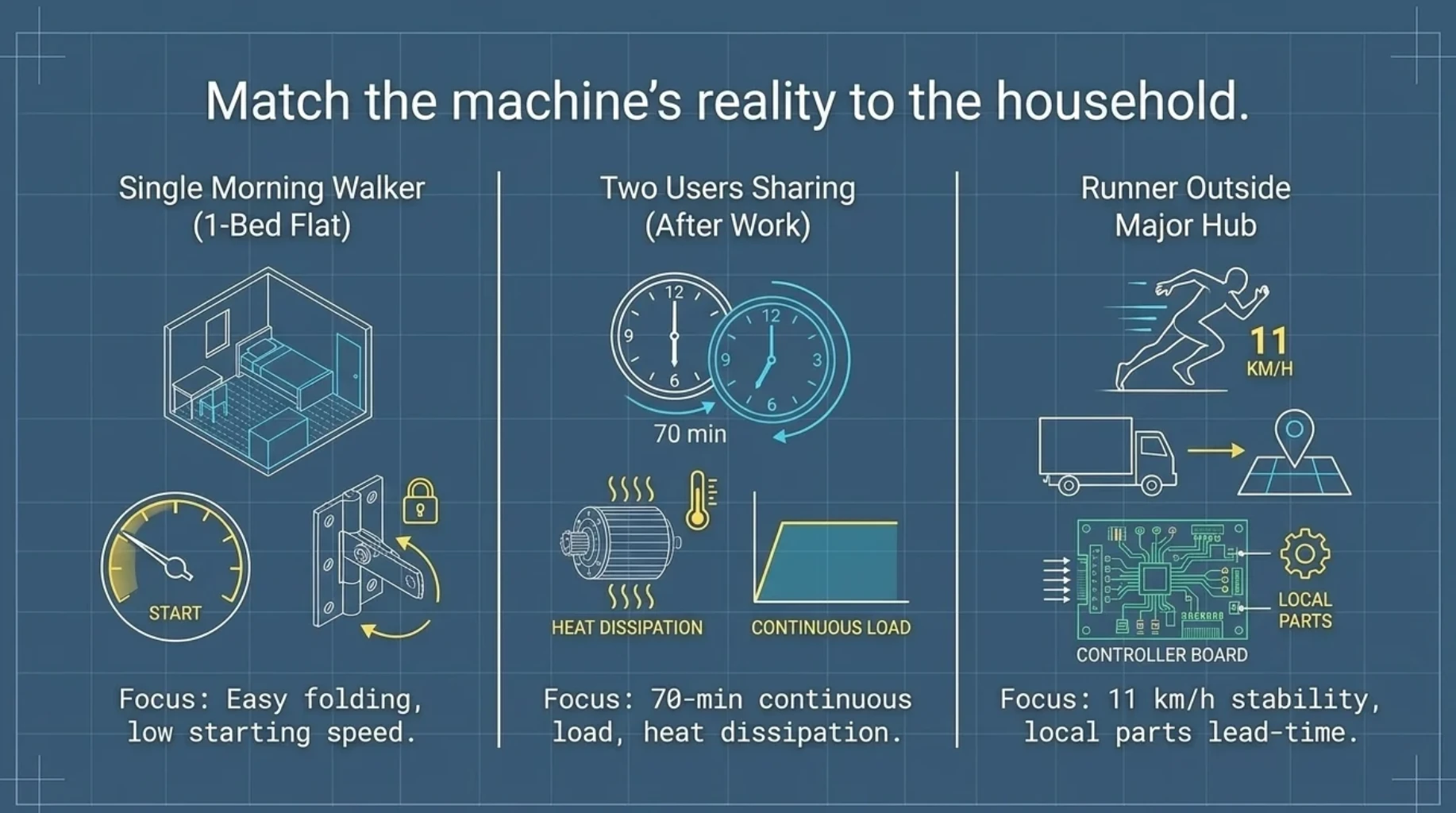
One person wants to walk for 25 minutes before work, then clear the room. The decisive checks are the lowest controllable speed, whether the person can get on and off comfortably, and whether the machine can be moved and stored as described in the manual. Set a timer during the demo and see how long setup and folding actually take. If there is no permitted operating position with rear clearance, the fact that the machine can slide beneath the bed afterwards does little for this room.
Two users sharing a machine after work
One person does 40 minutes of incline walking and the other jogs for 30 minutes. The seller answers “yes” when asked whether the machine can jog, but the family still needs to ask about 70 minutes of consecutive use, including time at incline. They should test both workouts at their respective speeds, with each user checking belt fit and control reach. If the manual requires a break between sessions, the family can decide whether that break fits their evening routine before paying.
A runner outside a major service hub
A runner wants steady sessions at 11 km/h and has enough room for either of two models. Both feel comfortable at that pace. One service team confirms it can diagnose the unit at home and gives an estimated lead time for a controller board. The other offers a longer motor warranty but asks the buyer to bring the unit to a workshop in another city. For this runner, the repair route may determine how long the machine is out of action. Compare the answers in writing, including whether the workshop will arrange safe transport and who pays for it.
In all three cases, ask for the model identifier in the written quote. A familiar series name can appear on different versions, with different belt sizes or controls. Match the quote, manual and invoice before accepting a substitution at delivery.
Treadmill buying questions Indian households often ask
Is a 2 HP treadmill enough for home use?
It can be suitable for a household whose workout fits the machine’s intended use. Check what the 2 HP represents, the longest permitted session, the user limit and the suitability for running or incline work. For two people who exercise consecutively most days, confirm the combined use and rest interval in writing.
Is a bigger belt worth paying for if I only walk?
Compare the two decks at your own speed. Extra width can matter if your stance is wide or you tend to drift. A larger deck can also mean a heavier machine that is harder to move. Choose the amount of room that lets you walk naturally while still fitting the room and its required clear zones.
Should I pay extra for auto incline?
Auto incline is useful when you plan to vary the grade during a session and want to do so from the console. A flat-walking household can prioritise the belt, steady low speed and access to service. If you expect to use incline, test the grade transition and ask whether the incline assembly has separate warranty coverage.
What if I am buying a second-hand treadmill?
Check the exact model and serial number, the availability of parts, the safety key, the folding lock, and whether any warranty transfers. Ask for service records and arrange a test at your intended speed before agreeing to transport. Add dismantling, delivery and reassembly to the price, and ask the manufacturer or relevant regulator whether the exact model has a safety notice or recall.
Which questions should I send before ordering online?
“We plan to use model ___ at pin code ___. The heaviest user weighs ___ kg. Our longest single workout is ___ minutes, and our busiest day involves ___ minutes with ___ minutes between users. We plan to walk, jog or run at up to ___ km/h with up to ___% incline. Please share the exact manual, unfolded and carton dimensions, usable belt dimensions, motor and session ratings, delivery and installation terms, and coverage and costs for service at this address.”
Compare the answers side by side. The one that fits your intended session, leaves the required room when installed, and can be repaired at your address is the stronger candidate. A written answer to those three questions is worth getting before you pay.
Sources
- PowerMax Fitness India, TDA-240M model specifications.
- PowerMax Fitness India, domestic treadmill warranty policy.
- Decathlon, Domyos T900D model support and maintenance.
- Horizon Fitness, 7.0 AT owner’s manual.
- International Organization for Standardization, ISO 20957-6:2021.
- US Consumer Product Safety Commission, Tread+ rear-guard repair announcement, 2023.
- Vickery-Howe DM et al. Physiological, perceptual, and biomechanical differences between treadmill and overground walking in healthy adults. Published online 2024.
