

Cardio Before or After Weights: Which Order Better Matches Your Goal?
If you combine cardio and strength training in the same workout, one question appears again and again:
Should you do cardio before or after weights?
The answer depends on what you are trying to achieve.
If your main goal is strength or muscle gain, resistance training usually deserves priority. If your main goal is endurance performance, cardio may make more sense first. If you are exercising for general health, metabolic health, or fat loss, the exact order often matters much less than doing both consistently and at an appropriate total volume.
This is important because many people treat exercise order as if there is one universally correct sequence.
There is not.
The better question is:
Which part of your workout matters most for your current goal?
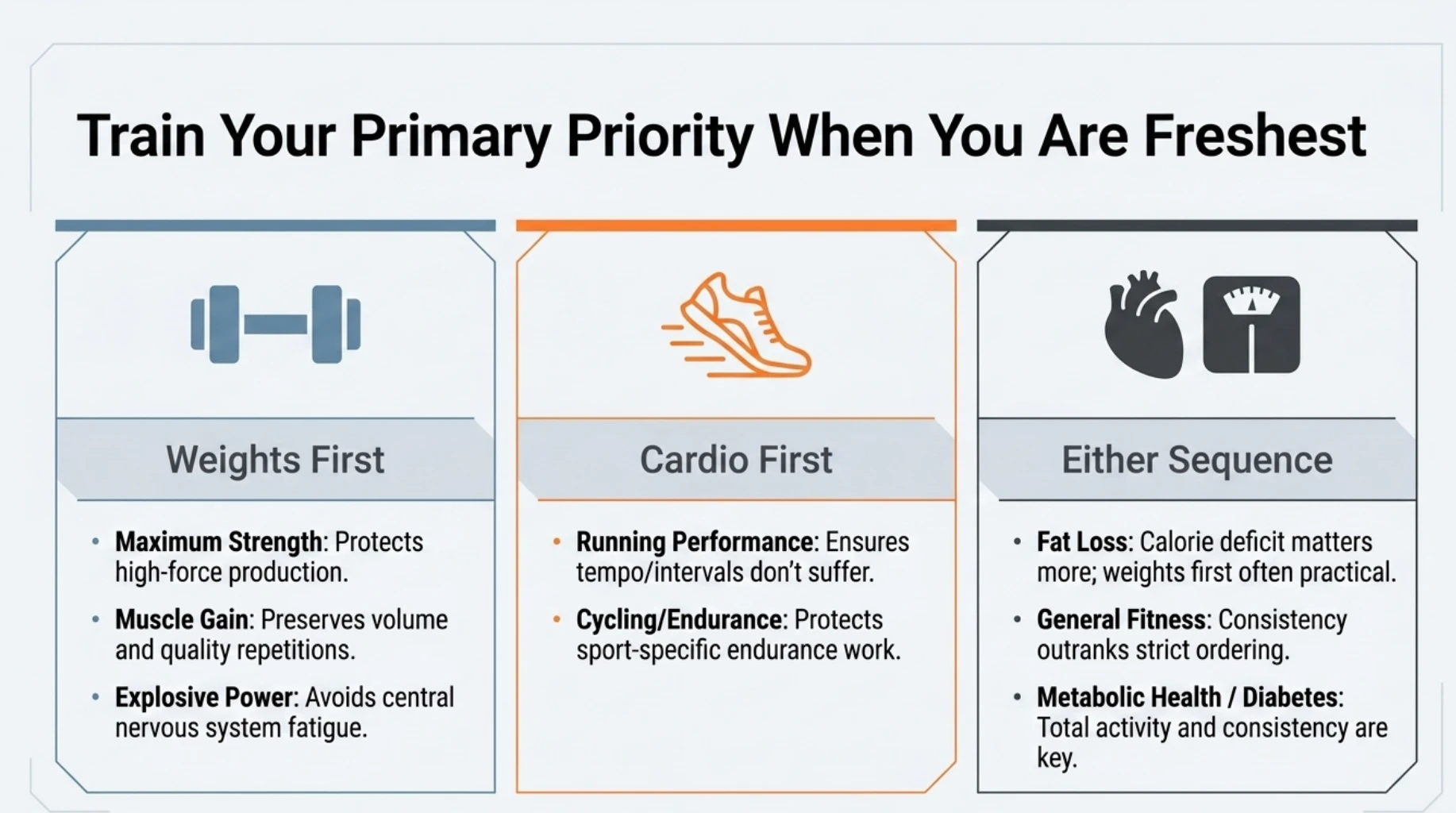
That part should usually be performed when you are freshest.
Cardio Before or After Weights: Why Exercise Order Matters
Both cardio and resistance training create fatigue.
If you perform one demanding form of exercise first, the quality of the second part of the workout may be reduced.
For example, a hard run before heavy squats may leave your legs tired before your strength work begins.
On the other hand, a demanding lower-body strength session before a fast run may reduce running speed, comfort, and endurance performance.
This is why the question of cardio before or after weights is best answered according to training priority rather than by following a rigid rule.

Fatigue Changes the Quality of What Comes Second
When you are fresh, you can usually produce more force, maintain better technique, and tolerate higher training quality.
As fatigue accumulates, several things may change:
- Your lifting load may decrease.
- Your running pace may slow.
- Your perceived effort may increase.
- Technique may become less consistent.
- You may complete fewer repetitions or sets.
- The total quality of the second training component may fall.
This does not mean the second part of the session becomes useless.
It simply means the activity you perform first is often better protected from fatigue.
The Simplest Rule: Train Your Priority First
If one adaptation matters more than the others, prioritise that activity at the beginning of the session.
A simple framework is:
| Primary Goal | Usually Prioritise |
|---|---|
| Maximum strength | Weights first |
| Muscle gain | Usually weights first |
| Running performance | Cardio first |
| Cycling or endurance performance | Cardio first |
| Fat loss | Either; weights first is often practical |
| General fitness | Either |
| Diabetes and metabolic health | Either; consistency matters more |
| Explosive athletic performance | Usually weights/power first or separate sessions |
This table should be treated as a practical guide, not a law.
Your weekly schedule, training intensity, recovery, and personal preferences still matter.
If Your Goal Is Strength, Do Weights Before Cardio
If increasing maximal strength is your main priority, doing resistance training first is usually the most practical option.
Strength training depends heavily on your ability to produce force with good technique.
A demanding cardio session beforehand can reduce performance, especially when the same muscles are heavily involved.
For example:
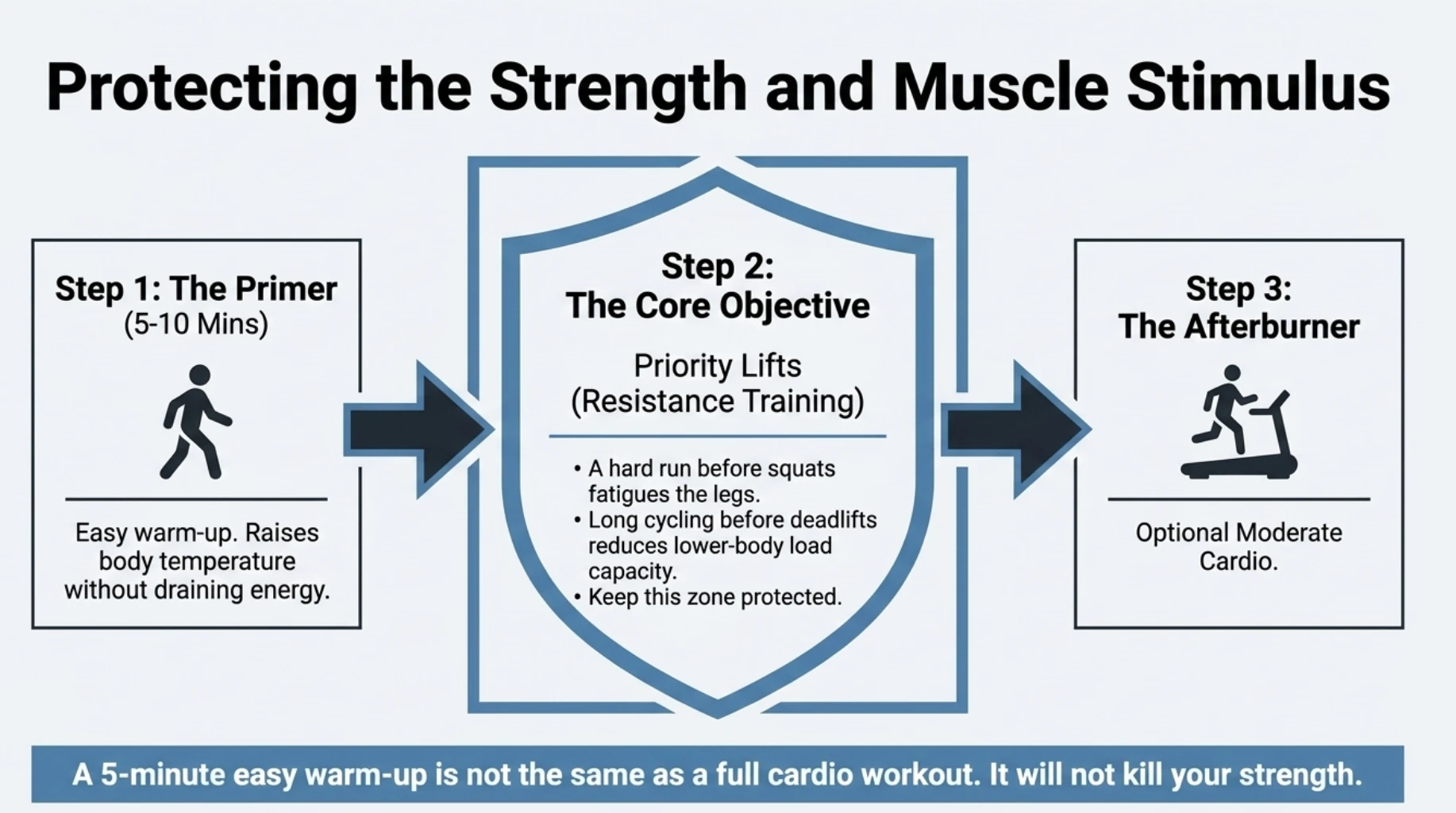
- A hard run before squats may fatigue the legs.
- Long cycling before deadlifts may reduce lower-body performance.
- High-intensity intervals before heavy lifting can make the entire strength session feel harder.
If strength is your main goal, it makes sense to perform your important lifts while you are relatively fresh.
What About a Short Cardio Warm-Up?
This is where people often become unnecessarily worried.
A short, easy warm-up before strength training is not the same as performing a full cardio workout first.
Five to ten minutes of easy walking, cycling, rowing, or another gentle activity can help raise body temperature and prepare you for the session.
The potential problem is not light warm-up activity.
The concern is fatiguing cardio before your priority lifts.
Strength-Focused Workout Example
A simple strength-focused session might look like:
5–10 minutes easy warm-up → resistance training → optional moderate cardio
This sequence protects the quality of the strength component while still allowing aerobic work in the same session.
If Your Goal Is Muscle Gain, Weights Usually Come First
For muscle gain, resistance training provides the primary stimulus.
This does not mean cardio must be avoided.
Aerobic exercise can support cardiovascular fitness, work capacity, insulin sensitivity, and general health.
The practical issue is whether too much cardio performed first leaves you too fatigued to train your target muscles effectively.
If muscle gain is the priority, you generally want to preserve:
- Training load.
- Number of quality repetitions.
- Exercise technique.
- Total useful resistance-training volume.
For that reason, weights usually make sense first.
Does Cardio Kill Muscle Gains?
No.
The idea that cardio automatically prevents muscle growth is an oversimplification.
Many people successfully improve both cardiovascular fitness and muscle mass while combining aerobic and resistance training.
The problem is more likely to occur when training volume becomes excessive, recovery is poor, calorie intake is too low, or the cardio substantially interferes with the quality of resistance training.
So the more accurate message is:
Cardio does not automatically kill gains, but poorly programmed cardio can make muscle-focused training harder to perform well.
If Your Goal Is Endurance, Cardio May Come First
If you are training for a running event, cycling event, long-distance race, or another endurance goal, the important cardio session deserves priority.
This is especially true for:
- Tempo runs.
- Intervals.
- Long runs.
- Hard cycling sessions.
- Sport-specific endurance work.
If you perform a heavy leg workout immediately beforehand, your endurance session may be slower and feel disproportionately difficult.
For an endurance-focused athlete, that can reduce the quality of the training that matters most.
Runner Who Also Strength Trains: Example
If running is the main goal, one option is:
Priority run → strength training later
Another option is to separate the sessions:
Morning: running
Evening: resistance training
Or perform strength training on a different day.
The exact schedule depends on training experience and recovery capacity.
Cardio Before or After Weights for Fat Loss?
This is one of the most misunderstood parts of the discussion.
Many people believe that cardio must be performed at a particular time in the workout to maximise fat loss.
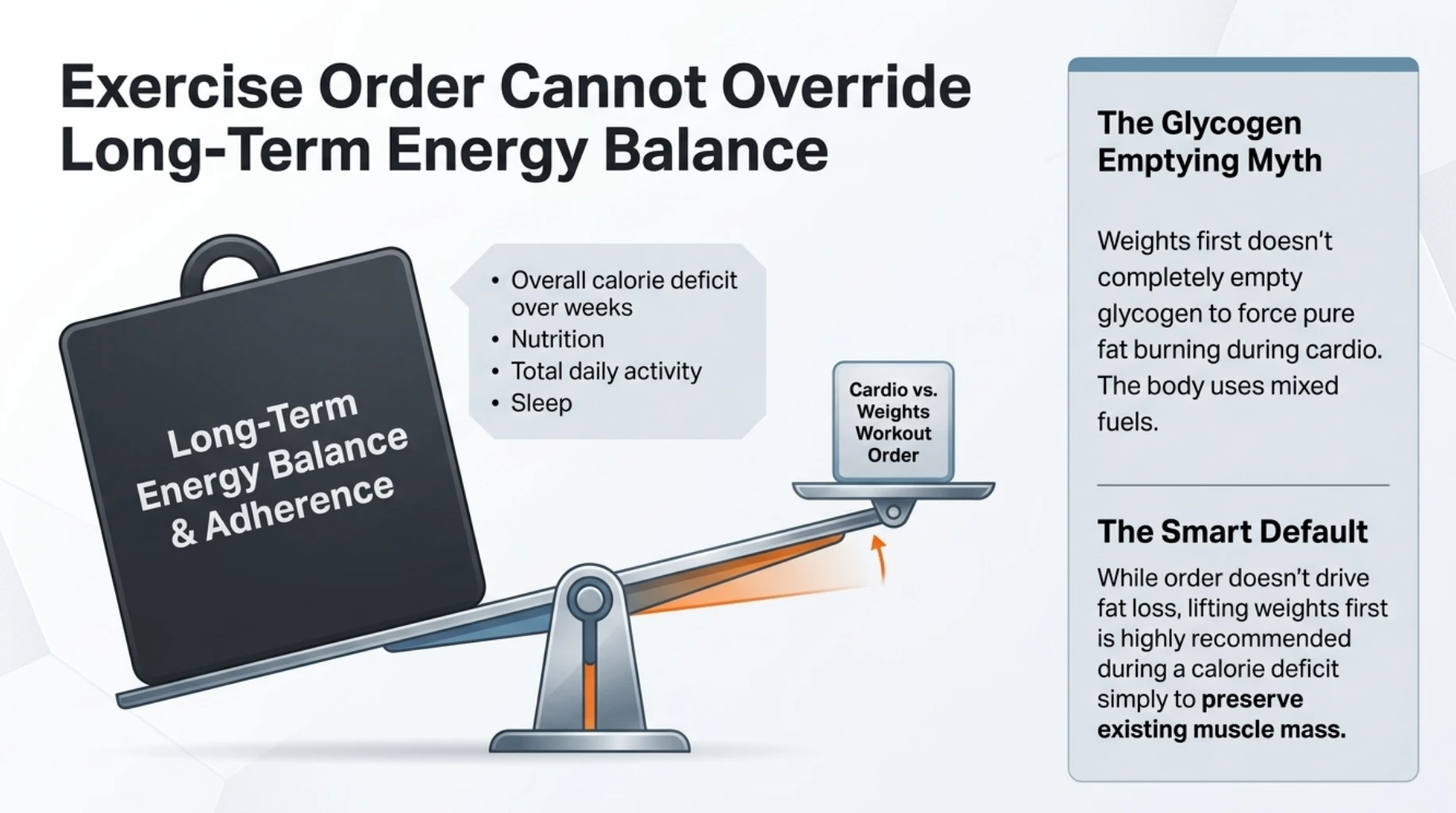
In reality, long-term fat loss depends primarily on maintaining an appropriate calorie deficit over time.
The order of cardio and weights does not override overall energy balance.
Does Cardio First Burn More Body Fat?
Not in a way that guarantees greater long-term fat loss.
Your body uses a mixture of carbohydrate and fat as fuel, and that mixture changes according to intensity, recent meals, fitness level, and other factors.
Burning a higher proportion of fat during one part of a workout does not automatically mean you will lose more body fat over the following weeks.
Fat loss depends on the overall energy balance across days and weeks.
Does Weights First Empty Glycogen So Cardio Burns Only Fat?
This is another common claim.
Resistance training does use muscle glycogen, but glycogen is not normally “completely empty” after an ordinary strength workout.
And even if fat oxidation increases during the cardio portion, this does not automatically produce greater body-fat loss unless overall energy balance supports it.
Why Weights First Can Still Be Useful During Fat Loss
Although workout order does not create a special fat-loss shortcut, resistance training often deserves priority during a calorie deficit.
Why?
Because one of the main goals during weight loss should be to preserve as much muscle as possible.
That means protecting the quality of resistance training can be valuable.
A practical fat-loss session might therefore be:
Warm-up → weights → moderate cardio
But this is not mandatory.
If doing cardio first makes you more consistent and does not meaningfully reduce your strength training quality, that order can also work.
Cardio Before or After Weights for General Fitness?
If your goal is simply to improve general health, there is usually no need to become obsessive about exercise order.
Both resistance training and aerobic exercise offer important but different benefits.
Resistance training supports:
- Muscle strength.
- Muscle mass.
- Bone health.
- Physical function.
- Metabolic health.
Aerobic exercise supports:
- Cardiorespiratory fitness.
- Blood pressure control.
- Endurance.
- Metabolic health.
- Cardiovascular health.
For general fitness, the best order is often simply the one that allows you to complete both consistently.
Cardio Before or After Weights for Diabetes and Blood Sugar?
For people with diabetes or prediabetes, both aerobic and resistance exercise can be valuable.
Resistance training can improve muscle function and increase the amount of metabolically active tissue available to take up glucose.
Aerobic activity can improve cardiovascular fitness and insulin sensitivity.
The exact order is usually less important than performing both regularly.
However, some people need additional considerations because exercise can interact with:
- Insulin.
- Sulfonylureas and other glucose-lowering medicines.
- Meal timing.
- Exercise intensity.
- Risk of hypoglycaemia.
- Diabetic complications.
Someone taking medication that can lower blood glucose should not select exercise order purely from a gym rule without considering individual glucose response and treatment.
Post-Meal Activity May Matter More Than Workout Order
For glucose management, short periods of walking after meals can sometimes be particularly useful.
This means that a person focused on metabolic health may benefit from thinking beyond the single question of cardio before or after weights.
Total activity across the day, resistance training, aerobic fitness, meal timing, and reduced sedentary time may all matter.
Does Cardio Interfere With Strength and Muscle Gain?
This is often called the concurrent training interference effect.
Concurrent training simply means combining resistance and endurance exercise within the same overall programme.
In practice, many people can improve both strength and aerobic fitness at the same time.
The potential interference becomes more relevant when:
- Endurance training volume is very high.
- Both sessions are extremely demanding.
- The same muscle groups are repeatedly fatigued.
- Recovery between sessions is inadequate.
- Calorie intake is insufficient.
- Sleep is poor.
- Explosive strength or athletic power is a major goal.
For an ordinary recreational exerciser, this should not become a reason to avoid cardio.
The better solution is usually smarter programming.
Is It Better to Separate Cardio and Weights?
Sometimes yes, especially when both parts of the programme are demanding.
If you are trying to improve strength, muscle mass, and endurance at the same time, separating cardio and resistance training can help reduce the amount of fatigue carried from one session into the next.
This becomes more relevant when:
- You perform high-volume endurance training.
- You lift heavy weights several times per week.
- You are training for performance rather than general health.
- Your legs are repeatedly fatigued before key sessions.
- You are struggling to recover between workouts.
For example, you might schedule:
Morning: cardio
Evening: weights
Or:
Monday: weights
Tuesday: cardio
There is no requirement to separate them by an entire day in every case.
For many recreational exercisers, simply leaving several hours between demanding sessions can improve training quality.
Do Cardio and Weights Need to Be Separated by 24 Hours?
No.
This is another example of turning a useful programming idea into an unnecessary rule.
The amount of separation required depends on the intensity and volume of each session.
A 20-minute easy walk does not create the same recovery demand as a hard interval run.
Similarly, a light upper-body workout does not create the same lower-body fatigue as heavy squats and deadlifts.
The more demanding the sessions are, the more useful additional recovery may become.
Cardio Before or After Weights on Leg Day?
Leg day is where exercise order often matters most.
Running, cycling, stair climbing, rowing, squats, lunges, and deadlifts can all place substantial demand on the lower body.
If your main goal is lower-body strength or muscle gain, doing hard cardio immediately before your leg workout may reduce training quality.
A better approach may be:
Easy warm-up → leg training → optional easy or moderate cardio
Alternatively, perform the cardio later in the day or on another day.
What If Cardio Is Your Main Goal?
Then reverse the priority.
If you are preparing for a race or trying to improve cycling performance, your important endurance session may deserve to come before leg strength work.
The principle remains the same:
Protect the session that matters most.
Cardio Before or After Weights on Upper-Body Day?
Exercise order may be less important when the two activities use different muscle groups to a greater extent.
For example, moderate cycling followed by an upper-body resistance session may interfere less than hard cycling followed by heavy squats.
This is one reason why the question of cardio before or after weights cannot be answered only by looking at the clock.
The specific exercises matter too.
Does Running Interfere With Muscle Gain More Than Cycling?
You may have heard that running is more likely than cycling to interfere with muscle and strength gains.
There are plausible reasons for this.
Running involves repeated impact and eccentric muscle loading, particularly through the lower body, whereas cycling is generally lower impact.
However, the practical effect depends heavily on:
- How much running you do.
- How intense it is.
- Your training experience.
- How well you recover.
- Your resistance-training programme.
- Your calorie and protein intake.
An easy 20-minute jog is very different from high-mileage marathon training.
So it is too simplistic to say that running automatically destroys muscle while cycling does not.
Cardio Before or After Weights for People Over 40?
For adults over 40, the answer still depends on the primary goal.
However, preserving muscle and strength becomes increasingly important with age.
Ageing is commonly accompanied by gradual losses in muscle mass, strength, and cardiorespiratory fitness unless these systems are regularly challenged.
This means an ideal programme often includes both resistance training and aerobic activity rather than choosing one exclusively.
If muscle preservation and strength are priorities, weights first is often a sensible default.
A practical session may look like:
Easy warm-up → resistance training → moderate cardio
But if someone is primarily training for endurance, cardiovascular performance may still come first.
Why Strength Training Deserves Attention After 40
Cardio provides important cardiovascular benefits, but it is not a complete replacement for resistance training.
Strength training helps preserve:
- Muscle mass.
- Bone loading.
- Strength.
- Balance and function.
- Ability to perform everyday activities.
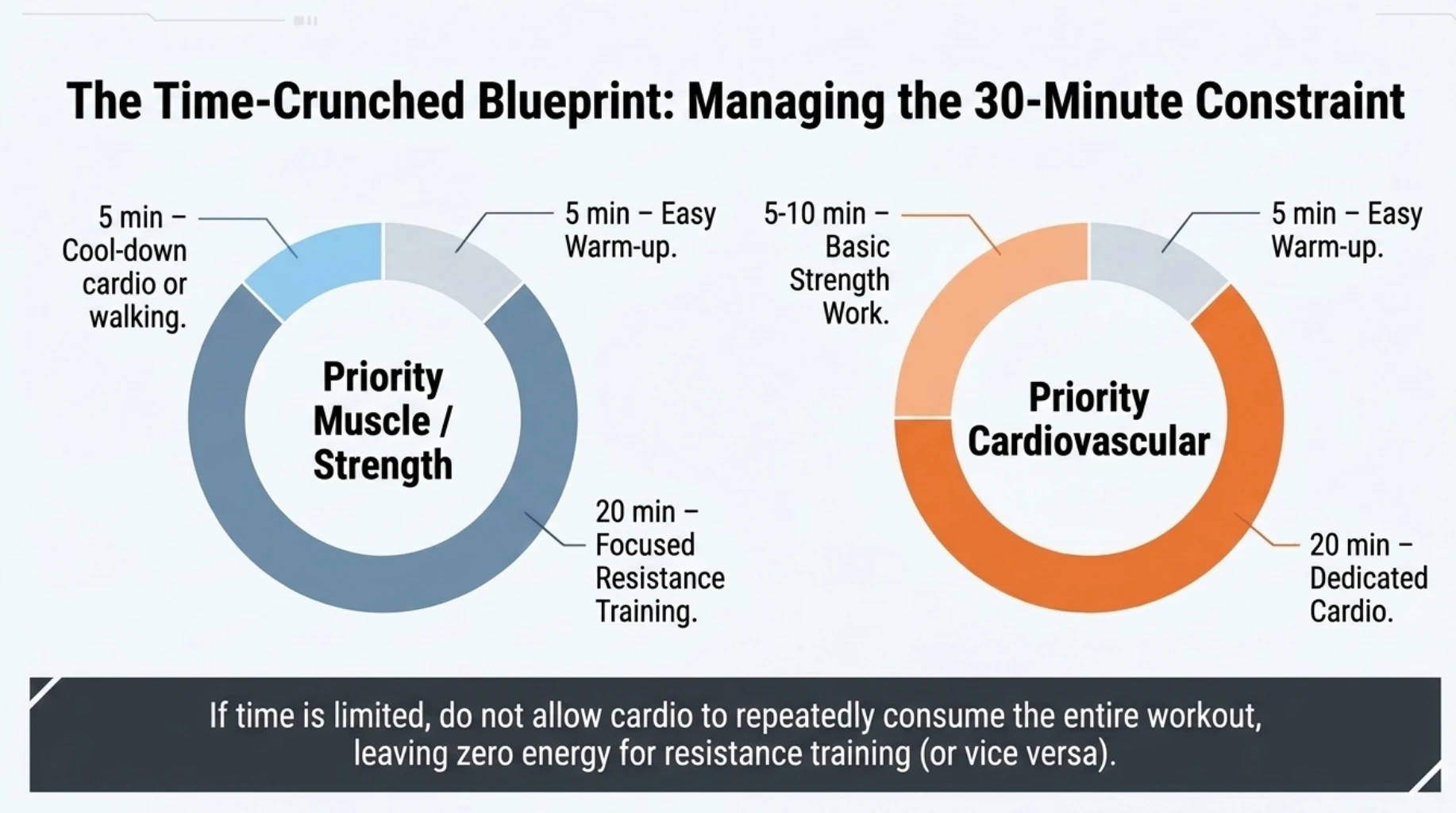
So if time is limited, do not allow cardio to repeatedly consume the entire workout and leave no time or energy for resistance training.
Cardio Before or After Weights for Women?
There is no separate universal rule for women.
The same principle applies:
Prioritise the exercise most closely connected with your goal.
A woman training primarily for muscle and strength will usually benefit from protecting the resistance-training portion of the session.
A woman training for a half-marathon may reasonably prioritise running.
Exercise order should not be determined simply by sex.
Training goal, recovery, menstrual symptoms where relevant, energy intake, sleep, and total programme design matter more.
Cardio Before or After Weights During Menopause?
During perimenopause and after menopause, both cardiovascular exercise and resistance training can be valuable.
Resistance training becomes particularly important because muscle mass, strength, and body composition can change during midlife.
Cardio remains important for cardiovascular fitness, blood pressure, endurance, and metabolic health.
For women whose priority is preserving muscle and strength, weights first is often a useful default.
The main objective should be to include both consistently rather than treating one as optional.
Cardio Before or After Weights for Belly Fat?
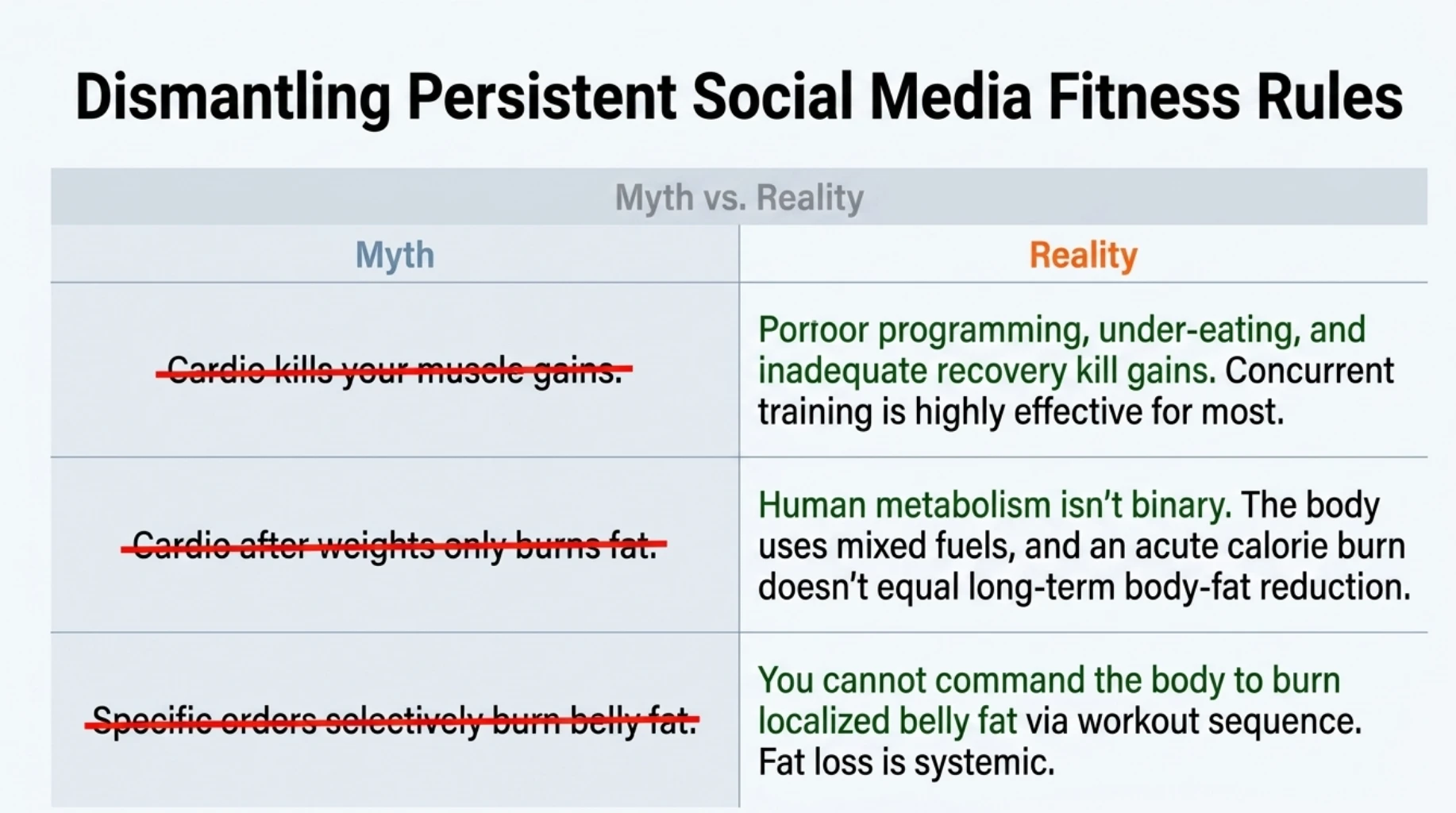
There is no special exercise order that selectively removes abdominal fat.
You cannot tell the body:
“Use belly fat first because I did weights before cardio.”
Reduction in abdominal fat occurs as part of overall changes in energy balance and body composition.
Both resistance training and aerobic exercise can support this process.
Resistance training helps preserve or build muscle, while cardio can increase energy expenditure and improve cardiorespiratory fitness.
Diet, total activity, sleep, and long-term adherence remain important.
Does Cardio After Weights Increase the Afterburn Effect?
The so-called afterburn effect refers to elevated oxygen consumption and energy expenditure after exercise.
It is real, but it is often exaggerated in fitness marketing.
High-intensity and demanding exercise can increase post-exercise energy expenditure, but the total calorie effect is generally much smaller than many advertisements imply.
You should not choose exercise order primarily because you expect a huge post-workout calorie burn.
Can You Do Cardio and Weights Every Day?
Some people can perform some form of both almost daily, but that does not mean every session should be hard.
Recovery depends on total training stress.
For example, someone might combine:
- Strength training three days per week.
- Moderate cardio several days per week.
- Easy walking on most days.
This is very different from doing heavy resistance training plus hard intervals seven days per week.
More exercise is not automatically better if recovery and performance continue to decline.
How Much Cardio Should You Do After Weights?
There is no single ideal duration.
The amount depends on your weekly aerobic goal, fitness level, and the intensity of the cardio.
For some people, 15–30 minutes of moderate cardio after resistance training fits well.
Others may perform longer sessions on separate days.
What matters is the total programme rather than forcing every aerobic minute into the same workout.
What Intensity of Cardio Is Best After Weights?
If resistance training is your priority, lower-to-moderate intensity cardio is often easier to combine immediately afterwards than a second highly demanding workout.
Examples might include:
- Brisk walking.
- Easy cycling.
- Incline treadmill walking.
- Moderate cross-trainer exercise.
Hard intervals can still be included in a programme, but they may be better scheduled separately if they are reducing strength performance or recovery.
What If You Only Have 30 Minutes?
When time is limited, exercise order becomes a practical decision.
Ask which adaptation you most need.
If strength and muscle are your priority:
5-minute warm-up → 20 minutes resistance training → 5 minutes cardio or walking
If cardiovascular fitness is the priority:
5-minute warm-up → 20 minutes cardio → 5–10 minutes basic strength work
If general health is the goal, alternating priorities across the week can work well.
For example:
- Monday: weights first.
- Wednesday: cardio first.
- Friday: weights first.
This prevents one form of exercise from always receiving the best energy.
What If You Hate Doing Cardio After Weights?
Adherence matters.
A theoretically perfect sequence is not helpful if you consistently skip the second half of the workout.
If you know you will never complete cardio after resistance training, several alternatives exist:
- Do cardio first on selected days.
- Separate the sessions.
- Perform cardio on non-lifting days.
- Use walking or cycling as transport where practical.
- Alternate which modality comes first.
A programme that you actually follow will usually outperform an ideal programme that exists only on paper.
Cardio Before or After Weights: Practical Examples by Goal
Goal 1: Muscle Gain
Warm-up → resistance training → optional easy-to-moderate cardio
The objective is to protect training quality and resistance-training volume.
Goal 2: Maximum Strength
Warm-up → heavy strength work → accessory exercises → optional cardio
Hard endurance training may be better separated from important strength sessions.
Goal 3: Fat Loss
Warm-up → weights → cardio
is a useful default if preserving muscle is a priority, but the reverse order can also work if it improves adherence.
The calorie deficit remains more important than the sequence.
Goal 4: Running Performance
Priority running session → strength later or on another day
Easy runs may be more flexible.
Goal 5: General Health
Either order
Choose according to preference, schedule, and the activity you are most likely to neglect.
Goal 6: Diabetes and Metabolic Health
Either order
The bigger priorities are regular resistance exercise, adequate aerobic activity, less sedentary time, and appropriate glucose monitoring when needed.
How to Decide Your Own Cardio and Weights Order
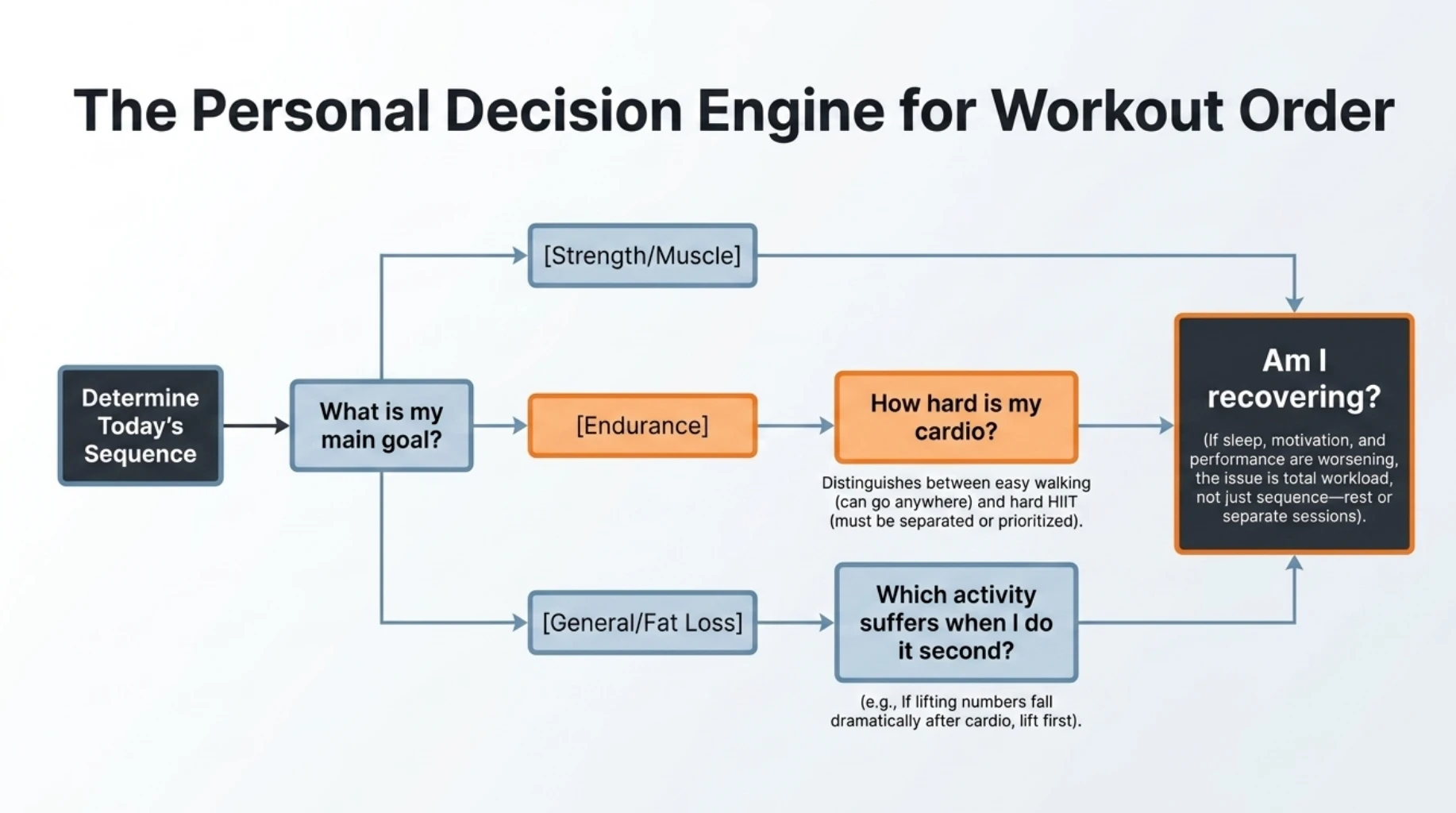
Instead of copying someone else’s programme, answer four questions.
1. What Is My Main Goal?
Strength, muscle, running performance, general health, and fat loss do not all require the same priority.
2. Which Activity Suffers When I Do It Second?
If your lifting numbers fall dramatically after cardio, consider lifting first.
If your key running sessions are consistently poor after lifting, consider cardio first or separating the sessions.
3. How Hard Is My Cardio?
Easy walking and hard interval training are not equivalent.
4. Am I Recovering?
If performance, sleep, motivation, and energy are progressively worsening, the issue may be total workload rather than exercise order alone.
The Best Order May Change Across the Week
You do not need to choose one sequence for the rest of your life.
A balanced weekly programme might prioritise weights on some days and cardio on others.
For example:
| Day | Training Priority |
|---|---|
| Monday | Weights first + short cardio |
| Tuesday | Cardio only |
| Wednesday | Weights first |
| Thursday | Easy walking or recovery |
| Friday | Weights first + moderate cardio |
| Saturday | Longer cardio session |
| Sunday | Recovery or light activity |
This is only an example, but it demonstrates an important principle.
The question of cardio before or after weights does not have to be solved inside every individual workout.
Your weekly programme matters too.
Common Myths About Cardio Before or After Weights
Exercise order attracts many confident claims, particularly on social media. Some contain a small amount of physiology but are then stretched into rules that do not match what happens over weeks and months of training.
Myth 1: Cardio Before Weights Always Burns More Fat
Your body does not determine long-term fat loss from which exercise you performed first.
Cardio may use a different proportion of fat and carbohydrate depending on intensity and what you have eaten, but greater fat oxidation during one workout does not automatically translate into greater loss of body fat.
For fat loss, sustained energy balance, total activity, resistance training, nutrition, and adherence matter far more.
Myth 2: Cardio After Weights Burns Only Fat
This claim usually comes from the idea that resistance training completely empties muscle glycogen and forces the body to use only stored fat during subsequent cardio.
Human metabolism is not that binary.
Your body normally uses a mixture of fuels, and resistance training does not necessarily deplete all available glycogen.
Cardio after weights can certainly be useful, but not because it unlocks a special fat-burning state.
Myth 3: Cardio Kills Your Gains
Cardio and muscle gain are not mutually exclusive.
Concurrent training can improve cardiovascular fitness while resistance training builds strength and muscle.
The bigger concern is programming.
Very high endurance-training volumes, inadequate recovery, insufficient calorie or protein intake, and repeatedly performing exhausting cardio before important resistance sessions can make muscle-focused training more difficult.
That is very different from saying that everyone who lifts weights should avoid cardio.
Myth 4: Everyone Should Always Lift Before Cardio
If you are primarily a runner, cyclist, swimmer, or endurance athlete, this rule makes little sense.
Your priority endurance session may deserve your best energy.
The more useful principle is:
Do your highest-priority training while fatigue is lowest.
Myth 5: Ten Minutes of Cardio Before Lifting Reduces Muscle Growth
A short easy warm-up should not be confused with a demanding aerobic workout.
Gentle walking, cycling, rowing, or similar movement can be part of an effective warm-up.
The concern is accumulating enough fatigue beforehand to compromise the resistance session.
Myth 6: Cardio and Weights Must Always Be Done on Different Days
No.
Many people can successfully perform both during the same session.
Separating them becomes more useful when both training components are demanding or when performance in the second session is repeatedly compromised.
Myth 7: You Cannot Build Strength and Endurance at the Same Time
You can.
The body is capable of adapting to both resistance and aerobic training.
The challenge becomes greater when someone is trying to maximise both simultaneously at a very high level.
For most people exercising for health, body composition, or recreational fitness, combining both is entirely realistic.
Does Exercise Order Matter More for Beginners or Advanced Athletes?
For beginners, the debate over cardio before or after weights can easily become more complicated than necessary.
A previously inactive person can often make substantial improvements in strength and cardiovascular fitness simply by exercising consistently.
The priorities should initially be:
- Learning correct exercise technique.
- Building consistency.
- Increasing activity gradually.
- Avoiding excessive soreness and injury.
- Developing both aerobic and muscular fitness.
For an advanced athlete, relatively small differences in training quality can become more important.
A competitive powerlifter may carefully protect heavy lifting sessions. A marathon runner may organise strength work around key runs. An athlete requiring explosive power may need even more deliberate separation of demanding endurance and power sessions.
The more specialised the goal, the more important programming details become.
Should Beginners Do Cardio Before or After Weights?
If a beginner has no specialised performance goal, either order can work.
However, learning resistance exercises while relatively fresh can be useful because fatigue may make technique harder to maintain.
A practical beginner session might be:
5–10 minutes easy warm-up → basic resistance exercises → 15–20 minutes comfortable cardio
As fitness improves, the programme can become more individualised.
What About Fasted Cardio Before Weights?
Fasted cardio is sometimes promoted as a superior way to lose body fat because fat oxidation during the session may be higher under some conditions.
But once again, acute fuel use and long-term fat loss are not the same thing.
If fasted cardio reduces your energy, makes resistance training worse, or causes you to shorten the workout, it may offer little practical advantage.
There is no requirement to perform cardio in a fasted state to lose body fat.
People using glucose-lowering medication should be particularly cautious about adopting fasting-plus-exercise strategies without considering their individual risk of hypoglycaemia.
Should You Eat Between Cardio and Weights?
If both are short and performed consecutively, most recreational exercisers do not need to stop midway through the workout for a meal.
The situation changes when sessions are long, highly demanding, or separated by several hours.
Then nutrition between sessions can help support the second workout and recovery.
Depending on the individual and training demands, this may include:
- Fluids.
- Carbohydrate.
- Protein.
- Electrolytes when substantial sweating has occurred.
The need should be based on the overall training programme rather than assuming that everyone requires a sports drink or supplement.
Does Protein Timing Change If You Do Cardio After Weights?
You do not need to rush to consume a protein shake between the final repetition of your strength workout and the first minute of cardio.
Daily protein intake and adequate protein distribution across meals are generally more important than trying to hit an extremely narrow post-workout window.
If you are performing a prolonged combined session or will not eat for several hours afterwards, planning nutrition around training becomes more relevant.
For muscle preservation or gain, ensure that your overall diet provides adequate energy and protein rather than focusing only on minute-by-minute timing.
What About Cardio Before or After Weights for Older Adults?
Older adults benefit from both aerobic and resistance exercise.
The best sequence should reflect individual priorities, physical capacity, medical conditions, balance, and exercise experience.
If maintaining muscle, strength, and independence is a major goal, performing resistance exercises before fatiguing cardio may be useful.
However, someone with a particular cardiovascular or endurance goal may reasonably organise the session differently.
Most importantly, older adults should not allow arguments about exercise order to prevent them from doing either form of training.
Cardio Before or After Weights: Frequently Asked Questions
Is It Better to Do Cardio Before or After Weights?
It depends on your main goal. If strength or muscle gain is the priority, weights first is usually a sensible choice. If endurance performance is the priority, cardio may come first. For general health, either sequence can work.
Should I Do Cardio Before or After Weights for Fat Loss?
Either can support fat loss. Exercise order does not override the need for an appropriate long-term calorie balance. Weights first can be a useful default when preserving muscle during weight loss is important.
Should I Do Cardio Before or After Weights to Build Muscle?
Resistance training usually deserves priority if muscle growth is your main goal. Performing demanding cardio first may create fatigue that reduces the quality of your resistance workout.
Should I Do Cardio Before or After Weights for Belly Fat?
There is no special sequence that selectively burns belly fat. Reducing abdominal fat requires broader improvements in body composition and energy balance. Both resistance training and aerobic exercise can contribute.
Does Cardio After Weights Burn More Fat?
Fuel use during exercise can vary depending on exercise intensity, glycogen availability, nutrition, and other factors. Even if fat oxidation is higher during a particular session, this does not guarantee greater long-term body-fat loss.
Will Cardio Before Weights Reduce My Strength?
Demanding cardio can temporarily reduce subsequent strength performance, particularly when it heavily fatigues the same muscles. A short easy cardio warm-up is different and is unlikely to create the same problem.
How Long Should I Wait Between Cardio and Weights?
You do not necessarily need to wait at all if both can be performed effectively in the same workout. If both sessions are demanding and performance is important, separating them by several hours or placing them on different days can be useful.
Can I Run and Lift Weights on the Same Day?
Yes. Many people successfully combine running and resistance training. If running performance is your priority, perform the important run first or separate the sessions. If strength and muscle are the priority, protect the quality of the resistance session.
Is Walking After Weights Good?
Yes. Comfortable walking after resistance training can be an easy way to accumulate additional aerobic activity without creating the fatigue associated with a hard cardio session.
Can I Do HIIT After Weight Training?
You can, but combining two demanding forms of training in one session creates substantial fatigue. If HIIT quality, strength progression, or recovery begins to suffer, separating the sessions may be more appropriate.
Should People With Diabetes Do Cardio or Weights First?
There is no universal sequence required for everyone with diabetes. Both resistance and aerobic exercise can support metabolic health. Medication, glucose response, meals, exercise intensity, hypoglycaemia risk, cardiovascular status, and diabetes-related complications may influence individual exercise planning.
When Exercise Order Is Not the Real Problem
Sometimes people spend considerable time deciding between cardio before or after weights when a much larger problem is limiting their progress.
Examples include:
- Training inconsistently.
- Sleeping five hours per night.
- Eating insufficient protein.
- Using an excessively restrictive diet.
- Doing too much high-intensity exercise.
- Never progressively challenging the muscles.
- Spending most of the remaining day sitting.
- Frequently skipping workouts.
Changing whether you cycle before or after lifting will not compensate for a poorly designed overall programme.
Cardio Before or After Weights: A Simple Decision Guide
| If This Is Your Main Goal | Try This First | Why |
|---|---|---|
| Build maximum strength | Weights | Protect force production and lifting quality |
| Build muscle | Weights | Protect resistance-training volume and performance |
| Improve running performance | Running/cardio | Perform priority endurance work while fresh |
| Improve cycling endurance | Cycling/cardio | Protect the quality of sport-specific training |
| Lose body fat | Either | Long-term energy balance and adherence matter more |
| Preserve muscle while losing weight | Usually weights | Helps prioritise the muscle-preserving training stimulus |
| Improve general health | Either | Consistency with both is the bigger priority |
| Improve metabolic health | Either | Total aerobic and resistance activity matters more than a rigid sequence |
| Improve explosive performance | Power/weights or separate sessions | Fatigue can interfere with high-quality explosive work |
When Should You Get Medical Advice Before Increasing Exercise?
For most healthy adults, deciding whether to perform cardio or resistance training first is a fitness-programming question rather than a medical problem.
However, exercise should be individualised when significant medical conditions or symptoms are present.
Medical assessment may be appropriate if exercise produces:
- Chest pain or pressure.
- Fainting or near-fainting.
- Unexplained severe breathlessness.
- New significant palpitations.
- Marked dizziness.
- A substantial unexplained decline in exercise tolerance.
People with established cardiovascular disease, significant diabetes-related complications, serious respiratory disease, or other conditions affecting exercise safety may also need individualised recommendations.
Final Thought
The debate over cardio before or after weights matters far less than many people think. The body responds to the overall training programme repeated over weeks, months, and years. Choose an order that protects your main goal—but do not let the search for a perfect sequence stop you from developing both strength and cardiovascular fitness.
If you want a personalized metabolic assessment and lifestyle strategy, you can book a consultation here:
Book an Appointment