
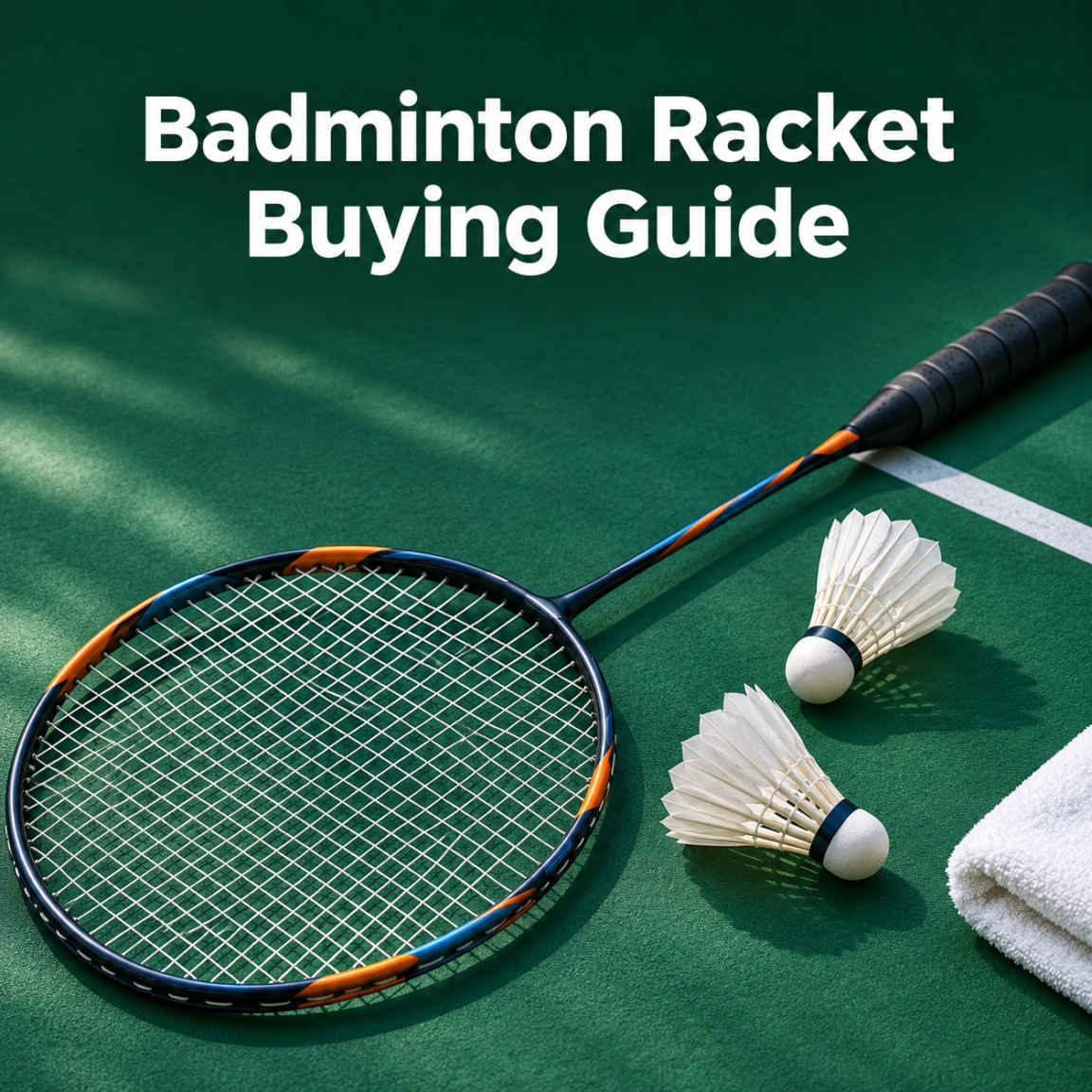
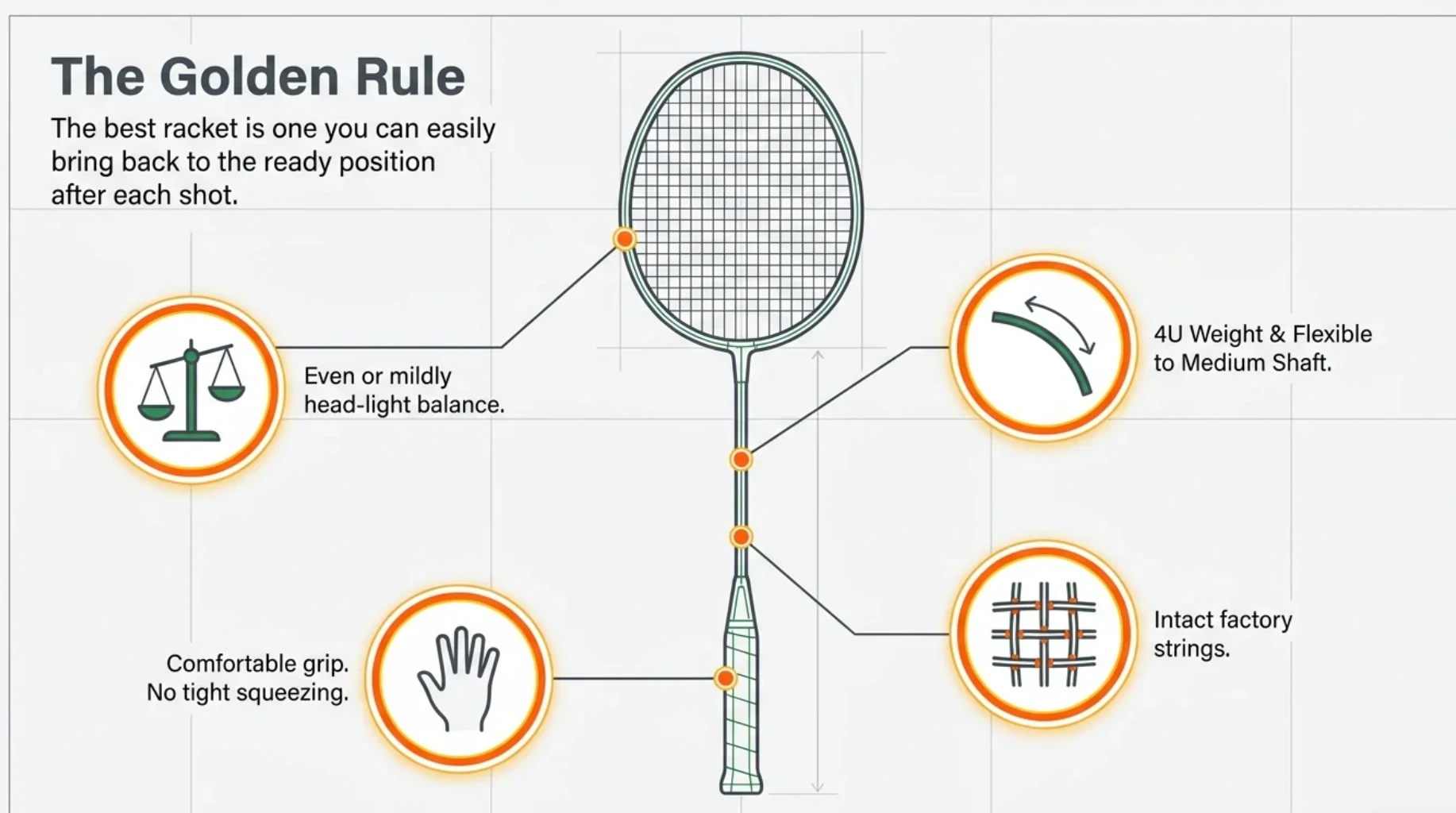
The best first badminton racket is one you can bring back to the ready position after each shot. That sounds obvious until you compare two rackets marked 4U and discover that one feels quick at the net while the other is noticeably harder to turn. The weight printed on the frame describes only part of the difference. Where the weight sits, how the handle fits your hand and what the strings feel like all affect how easy the racket is to use.
If you are shopping in India for your first regular indoor-court racket, start by trying a 4U model with an even or mildly head-light balance, a flexible to medium shaft and a handle you can hold without squeezing. A factory-strung example can be a sensible first purchase if the strings and grommets are in good condition. If you play casually outdoors a few times a month, a basic pre-strung racket might be enough. If you already have a coach or play twice a week, compare two candidates on drives, lifts and clears before you pay.
This badminton racket buying guide for beginners in India explains how to make that comparison, including what 4U and G5 actually mean, when a head-heavy frame is worth trying, how one overgrip changes the feel, and what to ask an Indian retailer before ordering. The specifications below illustrate how to read a listing. They are not a ranking of brands or a promise of better performance.
Badminton racket buying guide for beginners in India: the quick shortlist
| Specification | What to try first | What to check before paying |
|---|---|---|
| Weight | A 4U racket is a useful starting point for regular adult beginners. | Confirm the exact variant and whether the quoted weight includes strings and grip. |
| Balance | Even or mildly head-light if your priority is easy recovery and fast changes of direction. | Try a few drives and lifts. The labels alone do not tell you the swingweight. |
| Grip | A circumference that lets you relax your fingers and shift to a backhand grip. | Compare handles as sold and allow for any overgrip you intend to add. |
| Shaft | Flexible to medium as a first comparison. | Use a few clears and blocks to judge timing and feel. Flex labels are brand-specific. |
| Strings | Intact factory strings or a conservative first restring within the maker’s range. | Check whether strings are included and whether a local stringer can service the frame. |
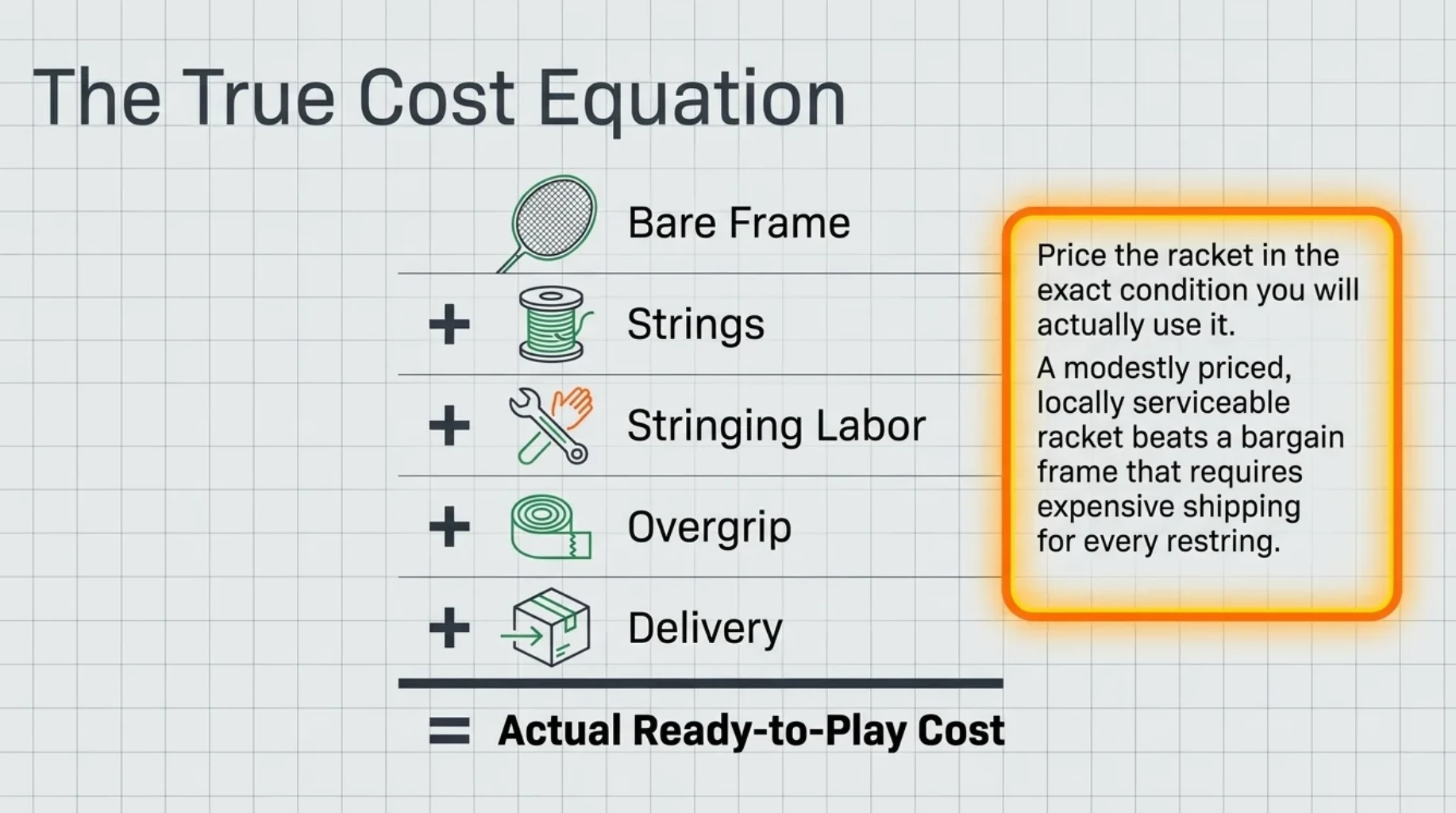
| Cost | Price the racket in the condition you will actually use it. | Include grip, strings, labour and delivery, and check the seller’s return terms. |
Treat the table as a shortlist, not a fit test. A lighter racket can feel awkward if the head pulls your swing late. A slightly heavier racket may feel fine if it balances close to your hand. Once you find two candidates you can move comfortably, spend time comparing the handles and string setups before deciding whether an extra feature is worth paying for.
1. Racket weight: what 3U, 4U and 5U mean
On Yonex specifications, 3U is about 88 g on average, 4U about 83 g and 5U about 78 g in models using those labels. Treat these as nominal maker figures, not the weight of every individual racket in playing condition. Other companies may publish grams directly or use different codes. When a listing offers several choices, look at the weight printed next to the colour, grip size or SKU you are actually about to order.
Strings add mass around the head. An overgrip adds mass around the handle. A racket measured with both can weigh more than the manufacturer’s nominal figure without anything being wrong. Ask how the measurement was taken when a shop and product page show different weights. Comparing one actual strung racket with another model’s catalogue weight is unlikely to tell you which will feel lighter on court.
When 3U, 4U or 5U is worth trying
Start with 4U if you are an adult taking weekly coaching, learning mixed singles and doubles, or buying one racket to cover several situations. Use it as a reference point. If a slightly heavier model feels more stable on off-centre blocks and you still recover easily for the next shot, the extra weight may suit you. If you play mostly fast doubles and can hit your clears comfortably, a lighter version is worth comparing for quick reactions.
Be cautious about buying the lightest model automatically. A very light frame may be easy to pick up yet feel less predictable to a particular player when contact moves away from the centre. A beginner compensating for short clears may also start swinging harder with a light racket, even when late contact or footwork is the bigger issue. Borrow a comparable model before changing several specifications at once. It is much easier to notice whether the weight helped when balance, grip and string feel are broadly similar.
How to compare ready-to-play weight
If you have a scale that can measure in grams, weigh the racket with its strings, grip and any wrap that you actually play with. Remove the cover and packaging. Record the exact model and setup. When you buy a second racket later, those notes are more useful than trying to remember how the first one felt on a good day. If you compare two rackets at a shop, ask whether either is unstrung and whether one has already been fitted with an overgrip.
2. Balance: why two 4U rackets can feel different
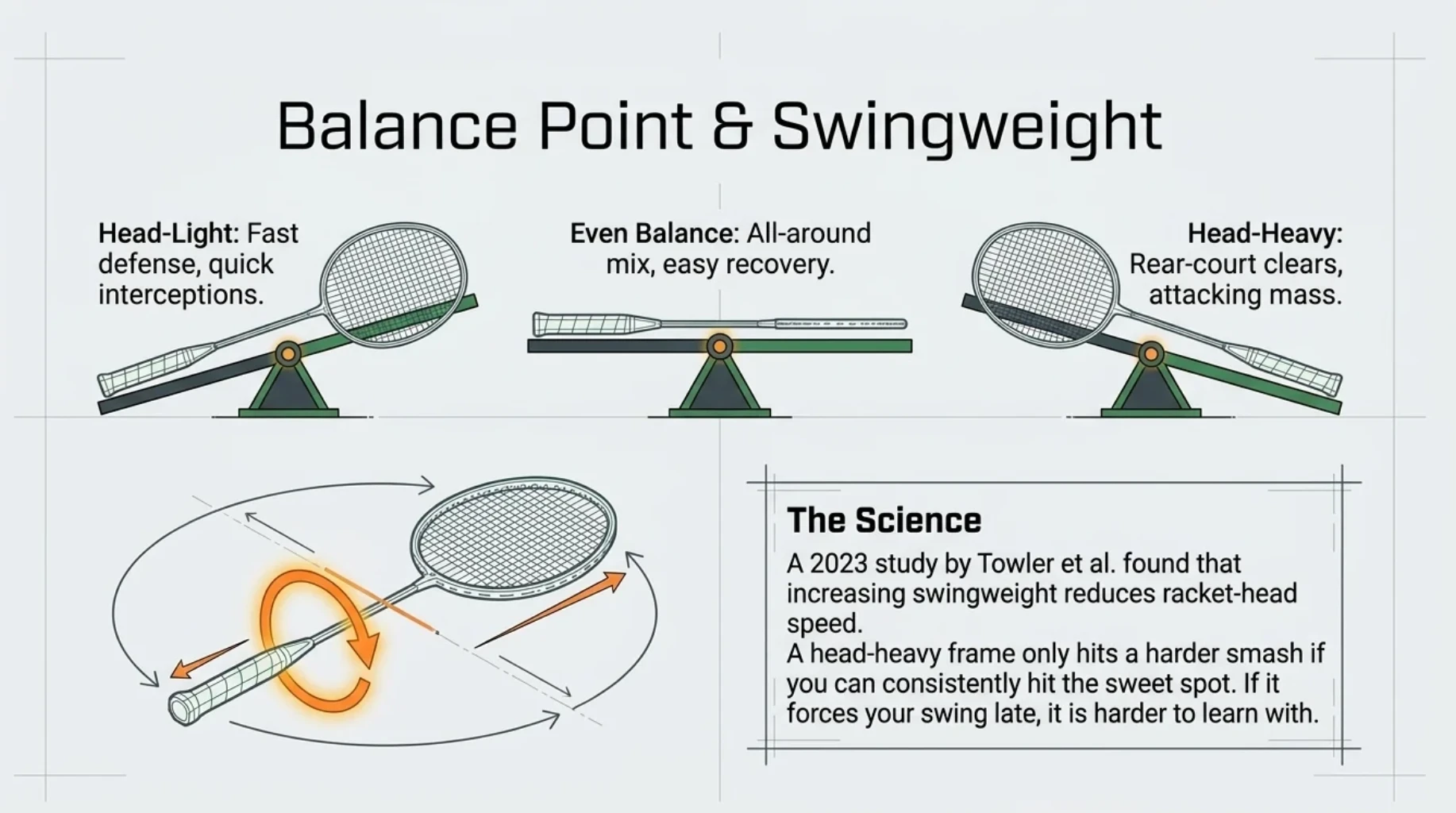
A head-heavy racket has its balance point farther from the butt of the handle than a comparable head-light racket. An even-balance model tends to sit between them. Those descriptions help you compare models within a range, but there is no universal shopping cut-off that makes every brand’s “even” feel the same. Length, total mass, strings and the grip fitted to the handle can all affect the comparison.
If a seller gives a balance point in millimetres, ask whether it was measured strung, where the measurement begins, and whether the handle has an additional wrap. At home you can support the racket horizontally on a narrow rounded surface, find the point where it balances and measure from the butt end. That gives you a rough comparison of two rackets in the same setup. It does not directly measure how much effort it takes to accelerate the head.
Balance point and swingweight answer different questions
Swingweight measures resistance to rotation about a defined axis near the handle. Distribution matters. Two rackets can have the same total mass and balance point while placing that mass differently along the frame. Mass placed farther from the axis generally has a larger effect on rotational resistance. That is why a racket that feels light when held still can feel slow through a drive. It is also why adding an overgrip can move the static balance point toward your hand without removing any of the mass in the head.
Most beginner listings do not publish measured swingweight. A court test is an effective substitute for the buying decision. In particular, watch how quickly you can stop the swing and prepare for a shot on the other side. A long practice swing with no shuttle may exaggerate how pleasant a heavier head feels. Short drives and rapid follow-up shots expose a different demand.
What a badminton smash study actually found
A 2023 Scientific Reports study by Towler, Mitchell and King tested five swingweight conditions in forehand smashes by 20 experienced players. Increasing swingweight reduced racket-head speed on average, but shuttle speed did not correspondingly fall in that experiment. The researchers also observed a shift in where the players made contact on the stringbed as racket properties changed. The experiment measured a particular stroke in experienced players, so it cannot tell us which racket a beginner will find easier for net play, a late backhand or a full hour of doubles.
The practical implication is to be sceptical of simple sales claims that a faster-swinging racket always produces a faster shuttle or that a head-heavy racket guarantees a harder smash. Instead, compare how often you hit the shuttle cleanly with the frame. If the shot of the day flies fast but the next five arrive late or off centre, that setup may be harder to learn with.
Choose balance for what you play most often
Head-light: Worth trying if most of your sessions involve doubles drives, blocks and quick interceptions. You can test whether the head returns easily to a ready position after a short swing. A head-light label alone says little about whether the handle fits you or whether the total racket is comfortably light.
Even balance: A practical first comparison if you alternate singles drills with doubles games and want one racket. Look for a model that lets you reach the rear court with a smooth clear and still change sides during a flat rally. If you find two even balance models, keep the one that responds better when your grip is relaxed and your swing is compact.
Head-heavy: Worth trying when rear-court clears and attacking play make up a substantial share of your game and you enjoy the sense of mass through contact. As a first trial, look for a moderate version. Compare repeated overheads and defensive returns in the same session. A strong first smash tells you less than whether you stay on time when the rally speeds up.
3. Grip size: fit the handle after choosing the weight
Grip codes describe handle size within a manufacturer’s system. For example, Yonex lists some versions of its Astrox 77 Play as 4U G5 or G6. The 4U is the weight class; the G code is the handle size. G6 is smaller than G5 in that system. Do not assume a different maker uses identical codes or circumferences. The actual feel also depends on bevel shape, the factory wrap and how much it has compressed with use.
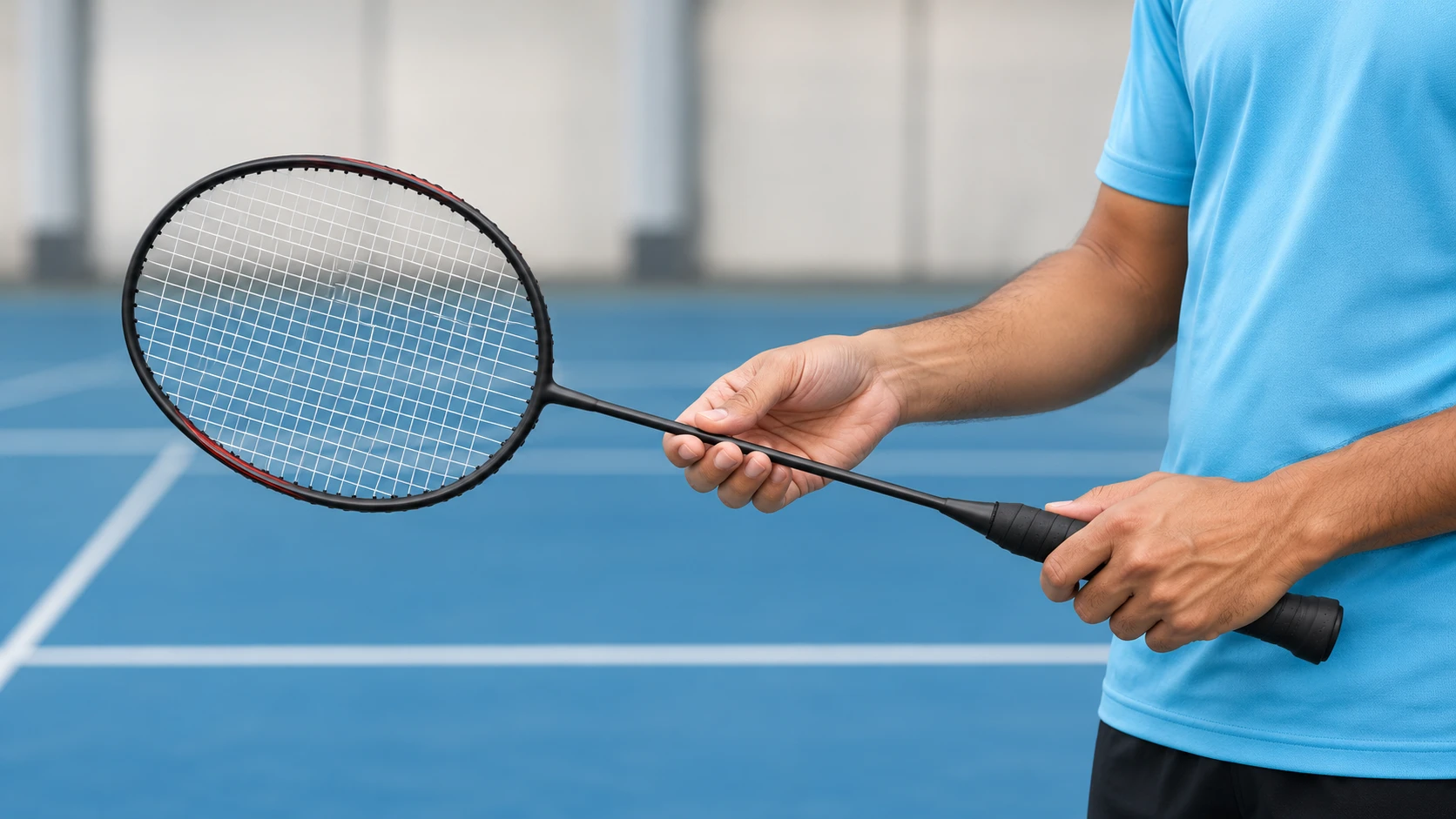
Try a basic forehand grip with the handle held as though you were shaking hands with it. Let the fingers rest rather than closing a tight fist. Then switch to a basic thumb-supported backhand grip. You should be able to move your fingers around the bevels without the racket feeling as if it will fall. If you feel you must squeeze hard to stop the handle turning, check whether the grip is too thin, worn or slippery. If you cannot move your fingers around it easily, try a thinner setup before buying.
Replacement grip, overgrip and towel grip
A replacement grip normally takes the place of the existing wrap, whereas a thin overgrip can be fitted over it for texture or a small change in circumference. A towel grip may suit a player whose hands sweat heavily, but thickness and how the grip feels when damp vary. If you choose an overgrip, first try a single layer. A thick overlap round every turn can obscure the bevels and make the final handle considerably larger than the one you tried at the shop.
If you fall between two grip sizes, the smaller handle may give you room to build up one thin layer, provided you can hold it comfortably as supplied. Removing or thinning a grip can be less convenient, and return policies may treat a used or modified racket differently. Check before wrapping a racket you might return. Once you have settled on a fit, replace the wrap when it loses traction rather than automatically adding another layer.
4. Shaft flex, frame material and head shape
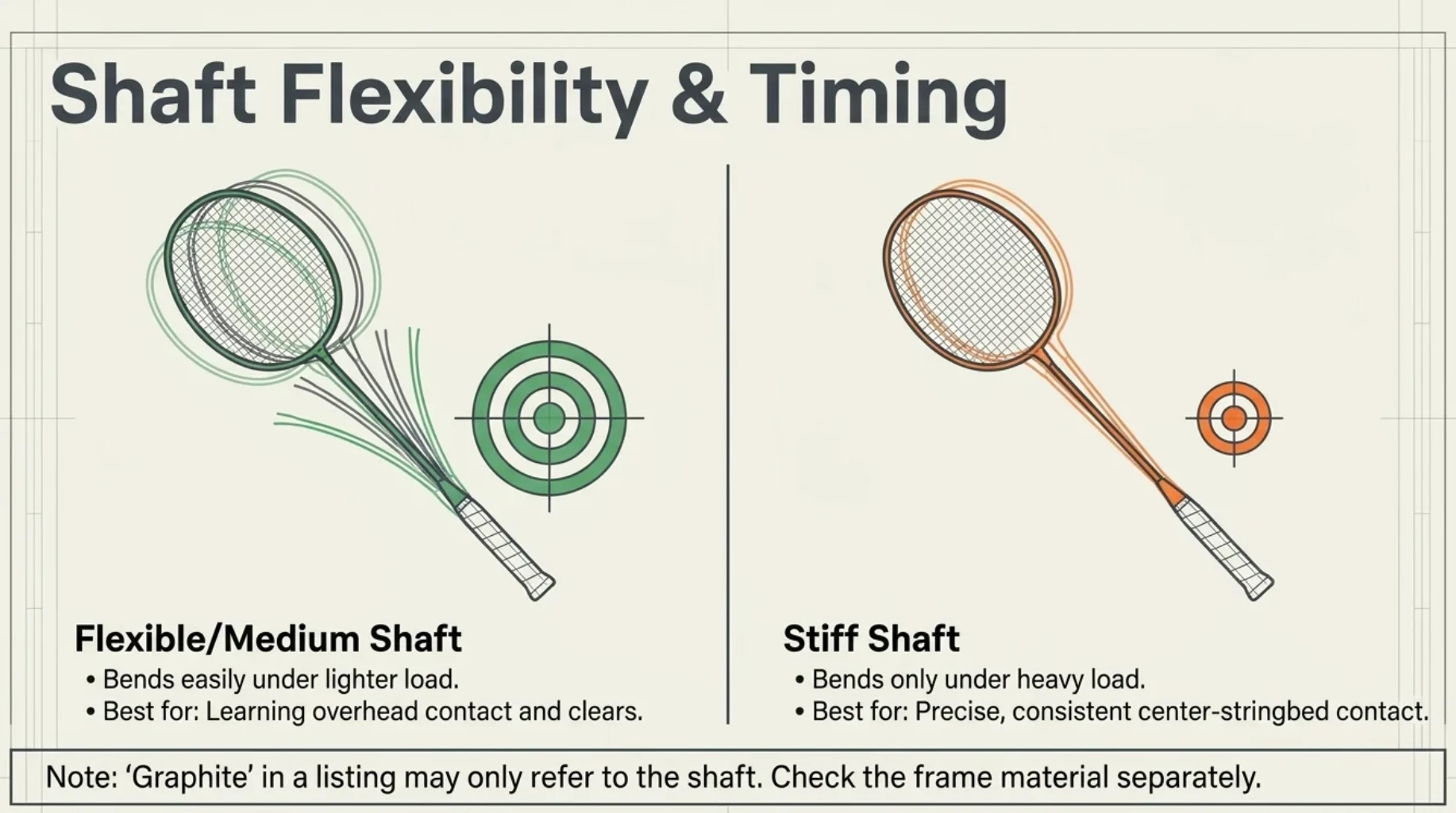
A flexible shaft bends more under a given load than a stiffer shaft in a comparable design. This can change the timing and feel of the stroke. A flexible or medium shaft is a useful place to start when learning overhead contact and clears. A stiff shaft may feel direct to some players, but buying one for its “advanced” label makes little sense if you rarely find the centre of the stringbed. Labels such as medium and hi-flex describe a maker’s own scale. A smooth shot on court is better evidence of fit than a cross-brand comparison of adjectives.
Entry-level rackets can use steel, aluminium or a mix of materials. A graphite frame and shaft can be useful when you want a lighter setup or a wider range of designs. Read the frame and shaft lines separately. A listing that says graphite may mean only the shaft uses it. Neither material tells you whether the finished racket is comfortable, and the material name alone does not establish allowable string tension. Use the manufacturer’s specification for the exact model.
An isometric head has a squarer outline than a traditional oval. Manufacturers often design these frames to make useful contact easier over a wider part of the stringbed. Shape is one aspect of the setup, and the way a racket plays also depends on string pattern, tension and where you strike the shuttle. BWF rules limit the overall frame to 680 mm in length and 230 mm in width. Those dimensions explain what the rules permit. They do not prescribe an ideal size, weight or balance for learning.
5. String tension: do not shop by the maximum number
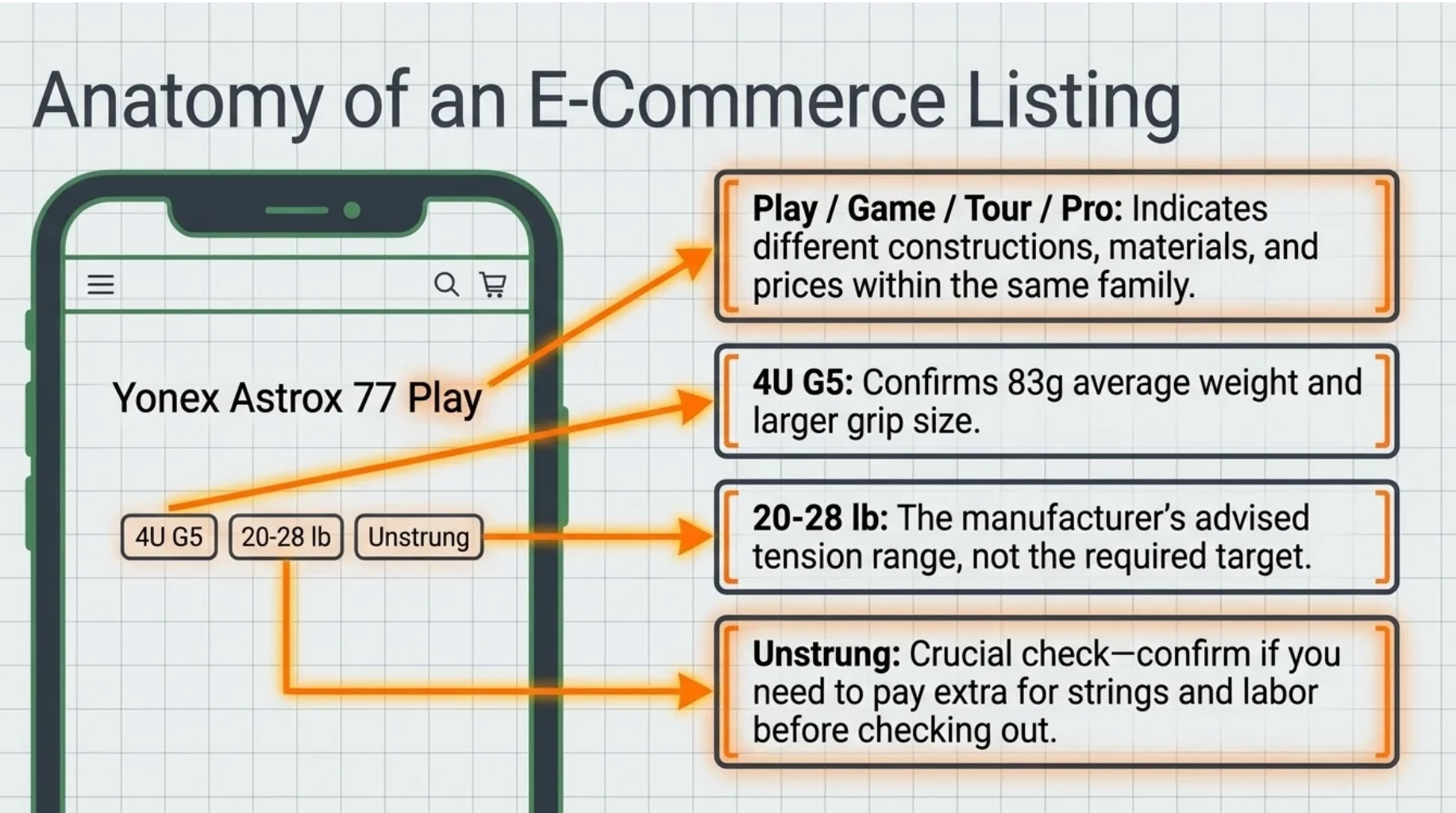
Badminton string tension is usually listed in pounds. A figure such as 20–28 lb describes a manufacturer’s advised range for a particular racket variant. It does not say what the factory strings are currently at, and it does not make 28 lb the target. Ask whether the racket arrives strung, whether the maker specifies a recommended range and whether the seller’s “maximum tension” is supported by the manufacturer’s documentation.
When replacing strings for the first time, a setting toward the lower end of the model’s recommended range is a sensible conversation to have with a local stringer. For a racket rated 20–28 lb, you might discuss a starting point around 20–22 lb. Use a different starting point if the frame’s specification calls for one. A lower setting can feel more forgiving when you miss the centre. Player timing, string material, restring quality and time since stringing also affect feel. A number alone does not make two rackets equivalent.
A 2023 study of badminton strings combined experiments with computer simulation to examine how string properties and applied tension influenced measured outcomes. Those test conditions are useful for understanding the interaction between strings and shuttle. They cannot establish a universal tension that gives every beginner maximum power or best control during a match. Use the manufacturer’s range as a boundary and your repeatable on-court contact as the practical test.
When factory strings are enough
If you are learning how to serve, clear and return, intact factory strings let you get on court and establish a baseline. Check for broken strings, significant fraying and visible damage around the grommets. Ask if the seller will replace a defective setup before delivery. When you eventually restring, record the string model, tension and date. Change one variable at a time if you want to understand what helped. After a switch, compare similar drills with the same shuttle before drawing conclusions.
Find a shop that strings badminton rackets and can follow the maker’s pattern, inspect grommets and work within the rated tension. Ask for the total charge including labour and whether the quote includes the string. The ability to maintain the frame matters if you expect to use it weekly. A modestly priced racket you can service close to home may be more practical than a bargain that has to be shipped away every time it needs attention.
What to buy for different playing situations in India
Occasional outdoor games with family or friends
Prioritise price, intact strings and a secure grip. A basic adult pre-strung model makes sense if the game is an occasional activity and the racket will be shared. For example, Decathlon India lists the Perfly BR 100 as a basic adult racket, with an MRP of ₹599 on the listing checked for this article. Selling prices can change. Compare the final cart total and what is included. If you mostly play outdoors, wind can dominate shuttle flight; a new frame will not make an outdoor clear behave like one in a still hall.
Weekly coaching or pay-and-play indoor sessions
Start with a shortlist of two or three 4U options from sellers who can identify the exact model and grip size. Ask whether you can borrow a demo racket from the coach or play a few shots with a club member’s spare. An evenly balanced setup gives you a reference before you try a lighter head or more weight through the swing. If the total budget is tight, price a pre-strung model, one spare overgrip and any shuttle or court costs together rather than spending everything on the bare frame.
Fast doubles after a few months of practice
Compare a mildly head-light 4U with your usual racket. Test alternating forehand and backhand drives, then check whether the candidate can still produce a clear with your ordinary stroke. Only then try a 5U version if available. If the lighter option improves recovery but leaves you struggling to control the shuttle on off-centre blocks, give both setups another trial with comparable grip and string condition. Avoid assuming the first light racket you try represents all light rackets.
Rear-court play or a preference for more weight through contact
Try a moderately head-heavy 4U beside an even-balance racket. Compare several clears, then finish with a short defensive drill. This tells you whether the extra head presence remains comfortable after repeated overheads. A coach who can see your contact point and footwork may identify a technique issue that looks like insufficient racket power. A short lesson or a second trial can save you from replacing the racket when the equipment was only one part of the problem.
Junior players and smaller hands
Use the player’s reach, coordination and ability to hold and recover the racket as the starting point. A junior-length racket may be worth trying with a coach, especially if a full-length frame repeatedly pulls the player out of position. A small grip on an adult racket and a junior-length racket solve different problems. If the athlete can borrow both, compare serving, controlled swings and comfortable recovery rather than choosing by age on the packaging.
How to read a real product listing before ordering
The Yonex Astrox 77 Play is a useful example of how specifications fit together. The manufacturer lists a graphite frame and shaft, a hi-flex shaft, 4U nominal weight averaging 83 g, G5 and G6 grip options, and a stringing range of 20–28 lb for the stated version. The Arcsaber 7 Play also carries a 4U average of 83 g and G5/G6 options in its global specification. That overlap is a reason to compare their actual handling. It does not tell you how the rackets will feel with different strings or grips. The global page also does not tell you which grip a particular Indian seller has in stock.
Check the exact item code and full model name in the listing. A model family can contain Play, Game, Tour and Pro versions with different constructions, grip options and prices. Colour is a poor identifier by itself. Ask the seller for the chosen variant, whether it includes factory strings or shop stringing, and whether a cover is included if you need one. In a marketplace listing with several sellers, check the name on the current offer, not just the reviews attached to a shared product page.
For an online purchase, confirm the invoice, warranty route and what happens if the frame arrives cracked or the wrong variant turns up. Check whether applying an overgrip, removing protective wrap or ordering custom stringing changes the return terms. Keep the photos of the label and packaging until you have checked the order. Compare the same SKU and setup across sellers before treating a discount as meaningful. If a listing is unusually vague, ask for a clear picture of the exact racket specification rather than relying on a generic product image.
A ten-minute racket test before paying
- Check the ready position. Hold the handle loosely and make compact forehand and backhand motions. Watch how easily the head stops and returns to position.
- Hit a few serves and net shots. See whether you can change grip and move the head in small increments without a tight squeeze.
- Play alternating drives. Ask a partner to feed left and right. Record how often you meet the shuttle in front of you and how quickly you are ready again.
- Compare repeated clears. Use the same type of shuttle and similar feeds. Compare a set of ordinary shots rather than the single longest one.
- Check the handle after a few minutes. Notice whether it has become slippery, whether the bevels are still easy to find and whether your hand feels unnecessarily tense.
If possible, alternate the rackets midway through the drill so fatigue and warming up do not always affect the same one. Ask the person feeding whether your returns changed in consistency, depth or timing. Write three short notes: whether you could switch grips, whether clears came without forcing the swing, and whether you recovered for the next shot. If you could only test in a shop with no shuttle, keep the trial short, avoid swinging near others and put more weight on a return policy or a chance to borrow a court demo.

Frequently asked questions
What is the best racket weight for a beginner?
A 4U model, about 83 g on the Yonex scale, is a useful starting point for many adults because it gives you a reference before comparing heavier and lighter alternatives. Judge it with the strings and grip fitted. A large difference in balance can change handling more than you expect from the weight number alone. If the 4U you tried pulls your swing late, compare another balance before assuming you need 5U.
Is head-heavy or head-light better for beginners?
An even or mildly head-light frame is a practical first trial if you are learning a range of shots and want easy recovery. A moderate head-heavy model is also worth trying if you spend more time in the rear court and the head feels manageable through repeated clears. Test both using the same grip thickness and similar strings where possible.
Should I use a G5 or G6 grip?
Both are small options in the Yonex system, with G6 the smaller of the two. Try the handle with the wrap you intend to use and see whether you can move from forehand to backhand without squeezing. If you want extra traction, compare with one thin overgrip before buying a second racket based on the same printed size.
Do I need an expensive racket or custom strings to start?
An intact factory-strung racket with a comfortable handle is usually enough to begin. Good value depends on how often you will play and what it costs to keep the racket usable. A city player with a nearby stringer may prefer a serviceable graphite frame. Someone who plays a handful of family games a year may get better value from a straightforward pre-strung model.
Do feather and nylon shuttles matter when testing?
Use the shuttle you usually play with and keep it the same for both candidates. Shuttle construction and speed affect flight and feel. Comparing a fresh feather shuttle with a worn nylon one can make the racket seem responsible for a difference caused elsewhere. If your club uses both, do the main comparison with its usual training shuttle.
Which badminton racket should you buy first?
Shortlist two rackets you can afford after including strings, grip and delivery. For regular indoor play, start with a 4U, even or mildly head-light frame and a grip you can change comfortably. For occasional recreation, an inexpensive pre-strung racket can be a better match. Choose the frame you can use for repeated clean hits and quick recovery, and keep the exact model and setup on your invoice. Those details will help you buy a spare or explain what you want when the racket next needs strings.
Sources
- Towler H, Mitchell SR, King MA. Effects of racket moment of inertia on racket head speed, impact location and shuttlecock speed during the badminton smash. Scientific Reports, 2023.
- Experimental and Computer Simulation Studies on Badminton Racquet Strings, 2023.
- Badminton World Federation. Laws of Badminton, section 4, racket specifications.
- Yonex 2026 badminton equipment catalogue.
- Yonex Astrox 77 Play specifications and Arcsaber 7 Play specifications.
- Decathlon India. Perfly Adult Badminton Racket BR 100 product listing.