

Losing Inches but Not Weight: 7 Reasons the Scale May Hide Your Progress
“My clothes are becoming loose and my waist has reduced, but my weight has barely changed. Am I actually making progress?”
This is one of the most common concerns people experience while trying to lose weight.
You may have improved your diet, started walking regularly, added strength training, and become more physically active. Your waist measurement is decreasing, your clothes fit better, and perhaps you even look leaner in the mirror. Yet when you step on the weighing scale, the number appears almost unchanged.
If you are losing inches but not weight, this does not automatically mean your weight-loss programme has stopped working.
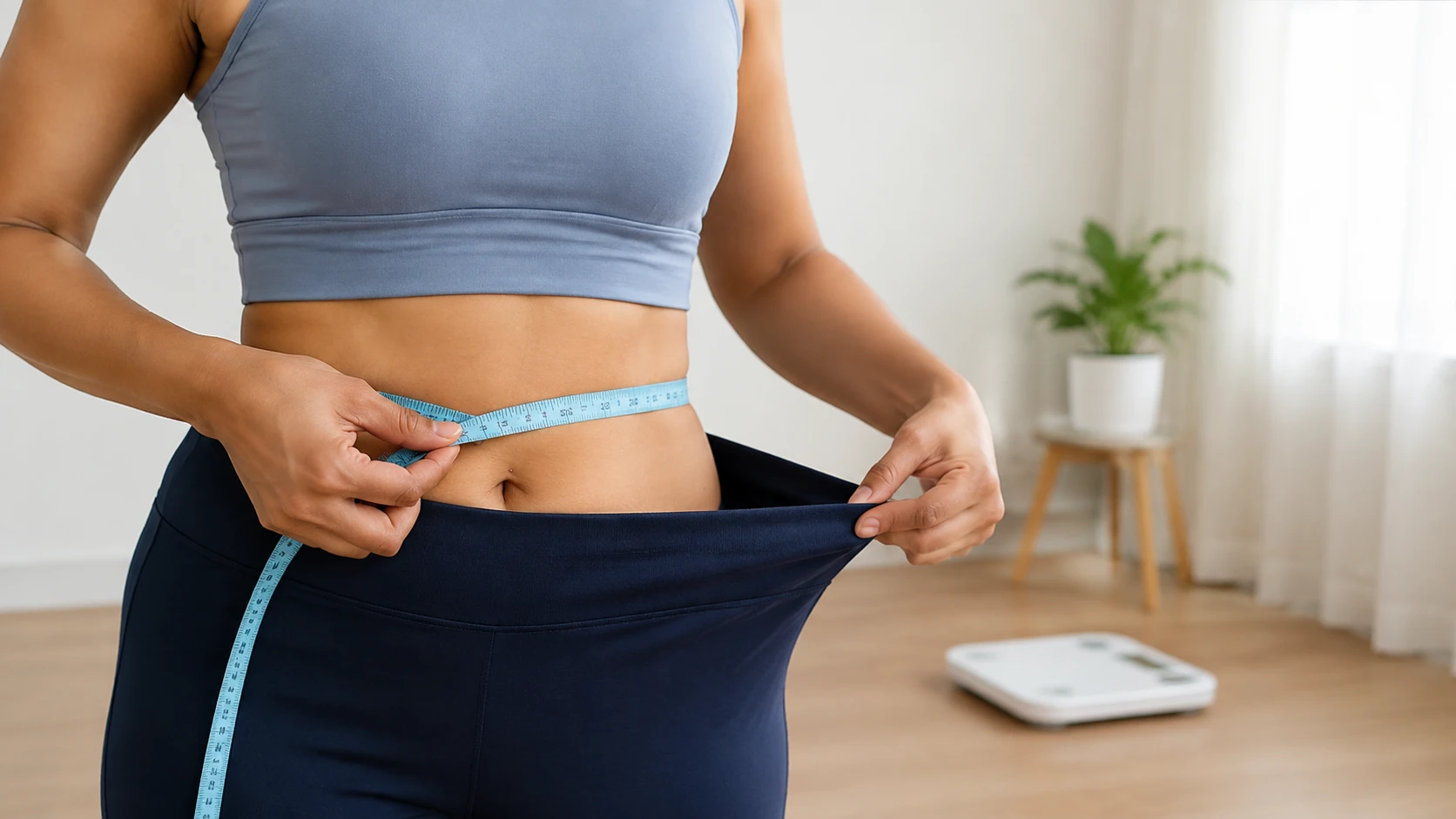
The weighing scale measures your total body weight. It cannot tell you how much of that weight comes from body fat, muscle, water, glycogen, bone, or the contents of your digestive system.
As a result, significant changes in body composition can occur even when total body weight changes very little.
In some situations, losing inches but not weight can actually indicate positive body recomposition—particularly when body fat is decreasing while muscle mass is being maintained or increased.
However, it is equally important not to assume that every weight plateau represents body recomposition. Understanding what is happening requires looking beyond a single number on the scale.
This article explains seven common reasons you may be losing inches but not weight, how to distinguish genuine progress from a weight-loss plateau, and which measurements provide a more complete picture of your metabolic health.
What Does Losing Inches but Not Weight Actually Mean?
When people talk about losing weight, they usually mean losing body fat.
But these two things are not identical.
Your total body weight includes:
- Body fat.
- Skeletal muscle.
- Body water.
- Glycogen stored in the muscles and liver.
- Bone and other tissues.
- Food and fluid within the digestive system.
Changes in any of these components can influence the number displayed on your weighing scale.
For example, you could lose one kilogram of body fat while gaining some muscle and retaining additional water. Your waist may become smaller even though your total weight changes very little.
This is one reason losing inches but not weight should not automatically be interpreted as failure.
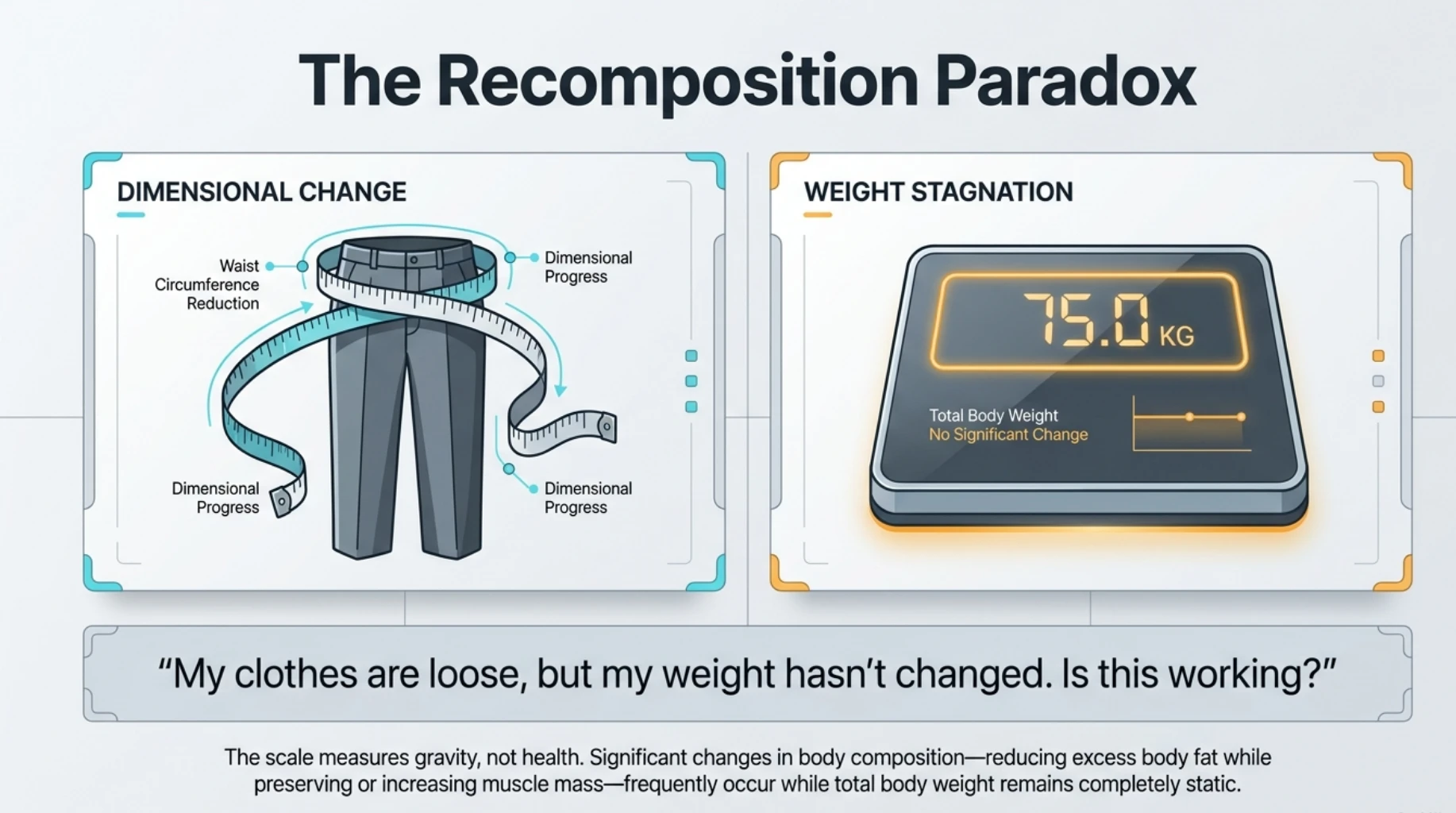
Losing Inches but Not Weight Can Reflect Body Recomposition
Body recomposition refers to an improvement in the proportion of fat and lean tissue within the body.
Instead of focusing exclusively on reducing total body weight, the goal becomes reducing excess body fat while preserving or increasing muscle mass.
This distinction is particularly important for people who perform resistance training.
Imagine two people who both weigh 75 kg. One has a relatively high percentage of body fat and low muscle mass, while the other has more muscle and less body fat.
The number on the weighing scale may be identical, but their body composition, waist circumference, strength, and metabolic health can be very different.
Therefore, losing inches but not weight may sometimes represent a favourable change that the scale simply cannot detect.
Why Losing Inches but Not Weight Can Still Be Progress
Waist circumference provides information that total body weight cannot.
Abdominal fat, particularly visceral fat stored around internal organs, is associated with insulin resistance, type 2 diabetes, fatty liver disease, high blood pressure, and cardiovascular risk.
A reduction in waist circumference can therefore be meaningful even when total weight loss is modest.
If you are losing inches but not weight, other positive changes may include:
- Looser clothing.
- Improved strength.
- Better exercise tolerance.
- Reduced waist circumference.
- Improved fitness.
- Better blood sugar or lipid measurements.
- Greater energy during everyday activities.
None of these improvements is fully represented by a bathroom scale.
Reason #1: Losing Inches but Not Weight May Mean You Are Losing Body Fat
The most encouraging explanation is that your body fat is decreasing even though total body weight is changing slowly.
Fat occupies more volume than the same weight of muscle because muscle tissue is denser.
Therefore, reducing body fat can make your waist, hips, thighs, or arms smaller without producing an equally dramatic change on the scale.
This is particularly noticeable when fat loss occurs gradually.
Someone may lose only a modest amount of total weight over several weeks while experiencing a clear improvement in clothing fit and waist circumference.
If you are consistently losing inches but not weight, fat loss may therefore be occurring beneath what appears to be a frustratingly stable scale reading.
How to Tell Whether Losing Inches but Not Weight Is Fat Loss
No single home measurement can perfectly determine body-fat change, but several trends together can provide useful information.
Look for:
- A progressively smaller waist measurement.
- Clothes fitting more loosely around the abdomen.
- Visible changes in body shape over several weeks.
- Stable or improving physical strength.
- A gradual downward trend in weight even if day-to-day readings fluctuate.
When several of these occur together, the likelihood of genuine improvement in body composition is greater.
Reason #2: You May Be Gaining or Preserving Muscle
If you recently started resistance training, your muscles are receiving a new stimulus.
Over time, appropriate strength training combined with adequate protein and recovery can help build muscle tissue. Even when significant muscle gain does not occur, resistance training can help preserve lean mass while you lose body fat.
This matters because traditional weight-loss programmes that focus only on calorie restriction may reduce both fat and muscle.
A better goal is usually to lose excess body fat while protecting functional muscle.
As a result, people performing resistance training may sometimes experience losing inches but not weight because favourable changes in body composition partially offset changes on the scale.
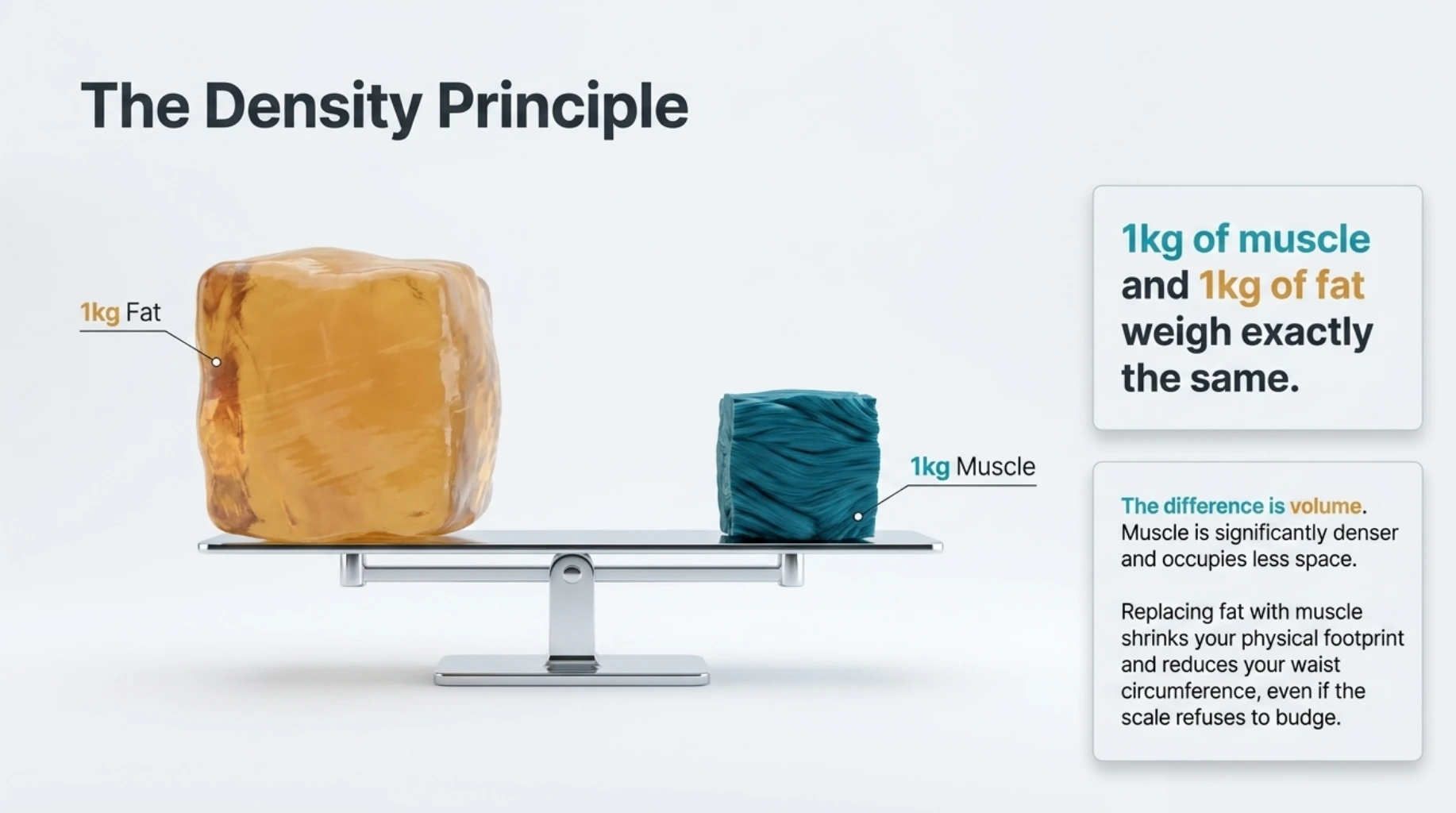
Does Muscle Really Weigh More Than Fat?
You may have heard the statement, “muscle weighs more than fat.”
Technically, this is misleading.
One kilogram of muscle weighs exactly the same as one kilogram of fat.
The important difference is density.
Muscle is denser and occupies less space than the same weight of fat.
Therefore, a person can become physically smaller while maintaining a similar body weight if some fat mass is replaced by or lost while muscle is maintained or gained.
This helps explain why losing inches but not weight may occur during a well-designed resistance-training programme.
Reason #3: Water Retention May Be Hiding Your Fat Loss
Body water can change considerably from one day to another.
You may be losing body fat while temporary water retention keeps the weighing scale unchanged—or even slightly higher.
Factors that influence fluid balance include:
- High sodium intake.
- Higher carbohydrate intake.
- Menstrual-cycle changes.
- New or intense exercise.
- Travel.
- Changes in hydration.
- Some medications and medical conditions.
Because water is relatively heavy, even a modest change in fluid balance can temporarily hide several days of fat loss.
This is why interpreting progress from a single weigh-in can be misleading.
Losing Inches but Not Weight After a High-Salt Meal
A restaurant meal, takeaway food, packaged snacks, sauces, pickles, and other sodium-rich foods may temporarily increase water retention.
You may wake up the next morning one kilogram or more heavier despite having gained virtually no meaningful amount of body fat overnight.
The opposite can also occur when water levels fall.
This is why daily scale changes should not automatically be interpreted as changes in body fat.
If you are losing inches but not weight, look at trends over several weeks rather than allowing one high reading to determine whether your programme is working.
Reason #4: Starting Exercise Can Temporarily Increase Scale Weight
It seems contradictory: you begin exercising specifically to lose weight, yet the weighing scale suddenly stops moving.
This can happen, particularly during the first few weeks of a new training programme.
Resistance training and unfamiliar exercise create temporary stress within muscle tissue. As muscles recover and adapt, local inflammation and changes in fluid storage may temporarily increase body water.
At the same time, muscles may begin storing more glycogen to support future activity.
These changes can temporarily mask fat loss on the weighing scale.
Therefore, losing inches but not weight shortly after beginning a new exercise programme does not necessarily mean the exercise is ineffective.
Why Losing Inches but Not Weight Is Common After Starting Strength Training
Strength training can create several changes simultaneously.
You may be:
- Losing some body fat.
- Preserving existing muscle.
- Gradually building muscle.
- Storing more muscle glycogen.
- Temporarily retaining water during recovery.
The weighing scale combines all these components into one number.
Your waist measurement, clothing fit, strength progression, and longer-term weight trend therefore provide valuable additional information.
This is why people who begin resistance training should avoid judging their progress solely by daily scale readings.
Reason #5: Glycogen Stores Can Affect Your Body Weight
Another overlooked reason for losing inches but not weight is a change in glycogen storage.
Glycogen is the stored form of carbohydrate found mainly in skeletal muscle and the liver. Your body uses these reserves to support physical activity and maintain normal glucose availability between meals.
When you begin exercising regularly—particularly resistance training or moderate-to-high-intensity activity—your muscles may adapt by storing and using glycogen more effectively.
Importantly, glycogen is stored together with water. Therefore, changes in muscle glycogen can influence scale weight even when body fat is decreasing.
This does not mean carbohydrates are causing fat gain. It simply illustrates why the number on the weighing scale represents much more than body fat alone.
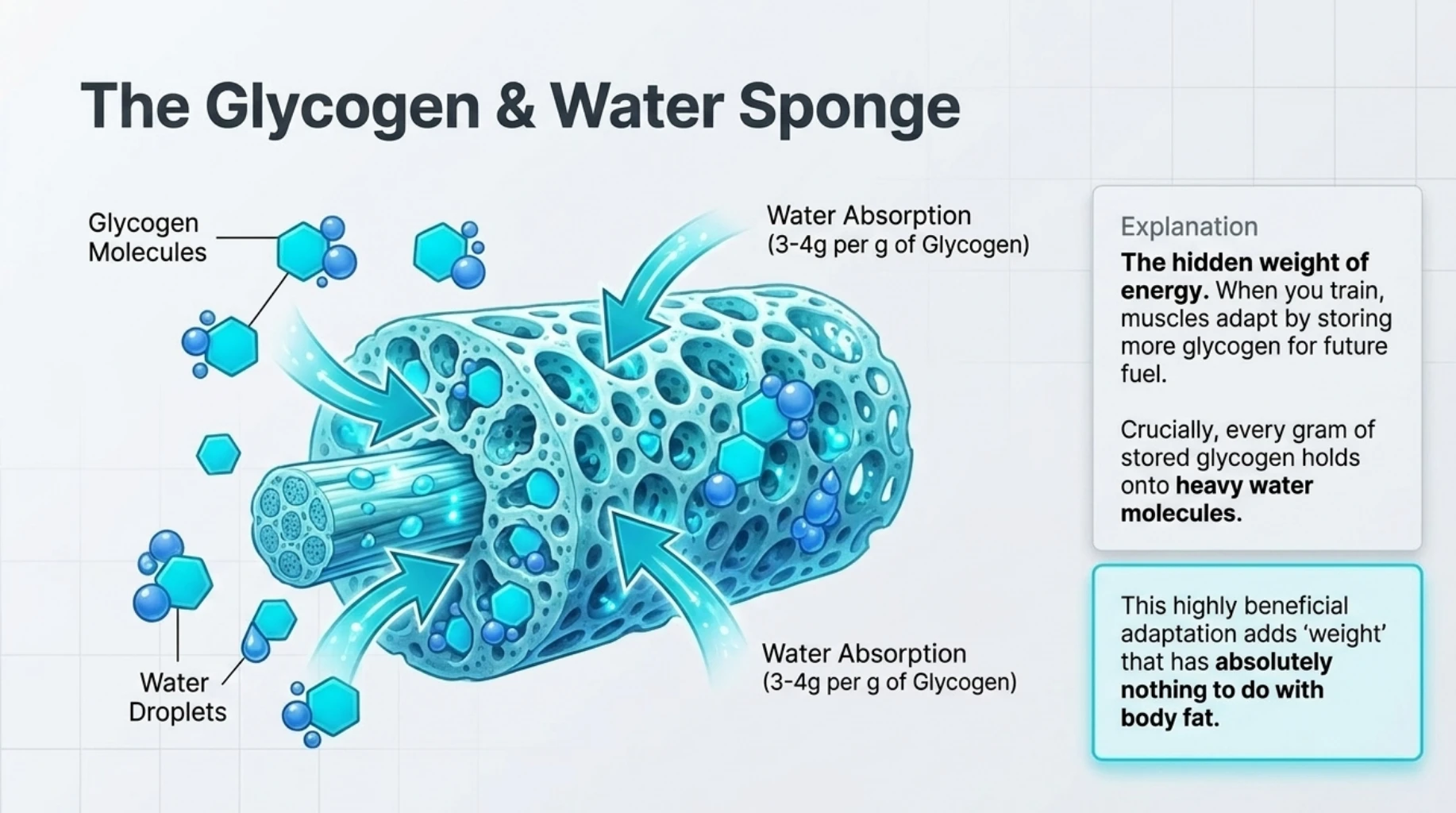
Why Glycogen Can Explain Losing Inches but Not Weight
When glycogen stores increase, additional water is stored alongside them. This can temporarily increase body weight or reduce the amount of weight loss visible on the scale.
Conversely, rapidly reducing carbohydrate intake can deplete glycogen and its associated water, producing an impressive early drop in body weight.
That initial decline should not automatically be interpreted as equivalent fat loss.
This explains why some restrictive diets produce dramatic scale changes during the first week, while a more sustainable programme may show slower weight reduction despite genuine improvement in body composition.
If you are losing inches but not weight, glycogen and water changes may therefore be contributing to the apparent discrepancy.
Reason #6: Hormonal and Menstrual Changes Can Mask Weight Loss
For women, body weight may fluctuate significantly across the menstrual cycle.
Changes in ovarian hormones can influence fluid balance, appetite, gastrointestinal function, and perceived bloating. Some women therefore notice a temporary increase in body weight around certain phases of their cycle.
This increase is usually related largely to fluid and other short-term physiological changes rather than sudden accumulation of body fat.
A woman may therefore be genuinely losing inches but not weight during a particular week because hormonal water retention temporarily masks the underlying fat-loss trend.
Losing Inches but Not Weight During Perimenopause
Perimenopause can make scale interpretation even more complicated.
During the menopausal transition, hormonal fluctuations may influence body-fat distribution, sleep, appetite, physical activity, and fluid balance.
At the same time, age-related muscle loss can gradually change body composition.
This is why women in their forties and fifties may benefit from monitoring waist circumference, strength, activity levels, and longer-term weight trends rather than relying exclusively on a single scale number.
Resistance training, adequate protein intake, regular physical activity, sleep, and sustainable nutrition become particularly important during this stage.
Reason #7: Daily Scale Fluctuations May Be Hiding the Longer-Term Trend
Body weight is surprisingly dynamic.
It can fluctuate from one day to another even when body fat has barely changed.
Short-term changes may result from:
- Water intake.
- Sodium consumption.
- Carbohydrate intake.
- Menstrual-cycle changes.
- Bowel movements.
- Food remaining in the digestive system.
- Exercise-related fluid shifts.
- Alcohol consumption.
- Travel and disrupted sleep.
Because of these variables, comparing Monday morning’s weight with Tuesday morning’s weight tells you very little about actual fat loss.
If you are losing inches but not weight, the longer-term trend matters much more than individual readings.
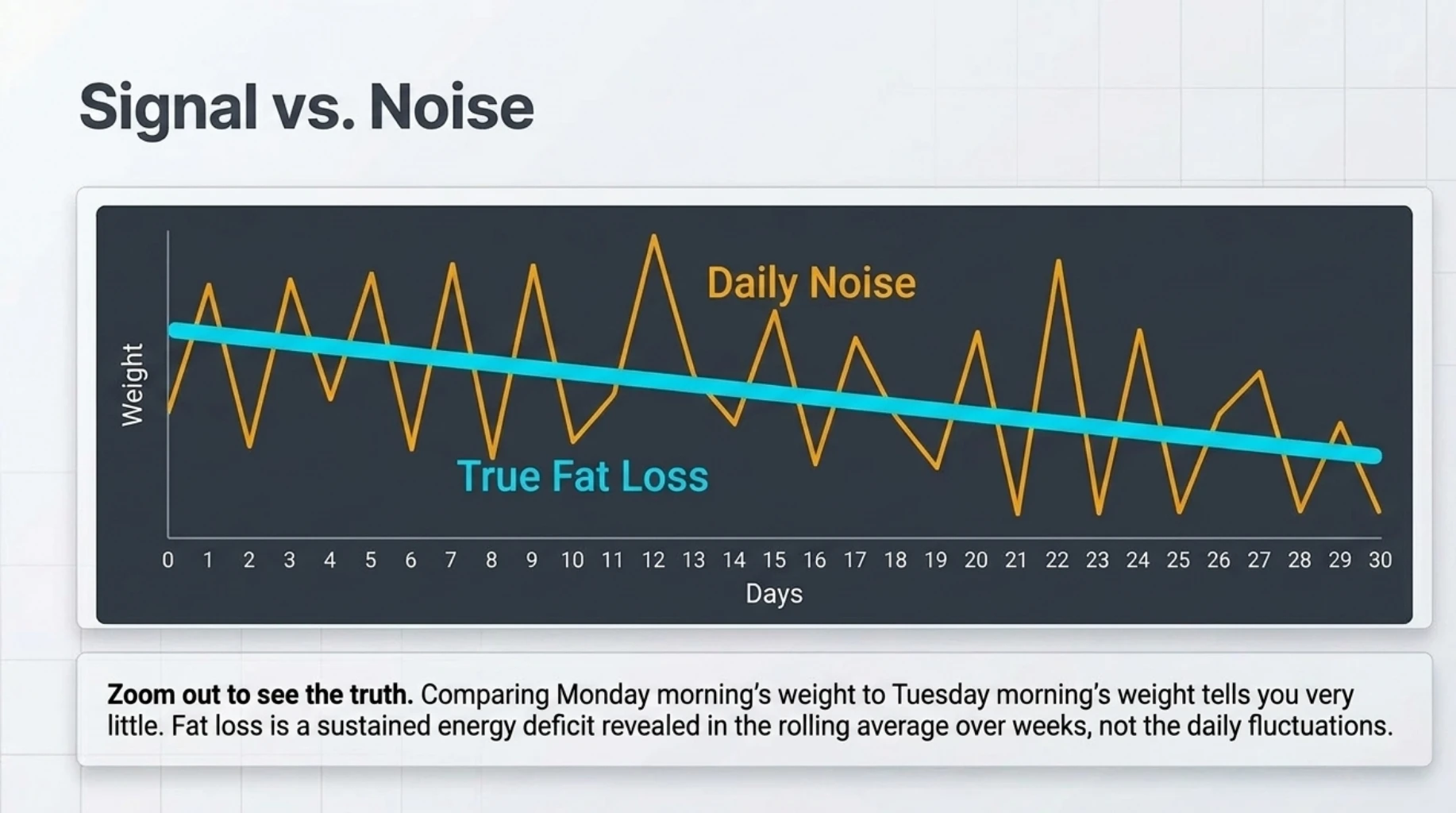
Why Weekly Trends Matter More Than Individual Weigh-Ins
Suppose your weight over seven mornings is:
- Monday: 80.2 kg
- Tuesday: 79.8 kg
- Wednesday: 80.4 kg
- Thursday: 79.9 kg
- Friday: 80.1 kg
- Saturday: 79.6 kg
- Sunday: 79.8 kg
Looking at individual readings may create the impression that your weight is moving randomly.
But when measurements are collected consistently and compared over several weeks, the underlying trend becomes easier to identify.
This approach prevents normal water fluctuations from being mistaken for failure.
How to Track Progress When Losing Inches but Not Weight
If body weight is your only measure of progress, you are seeing only one part of the picture.
A more complete approach combines several measurements.
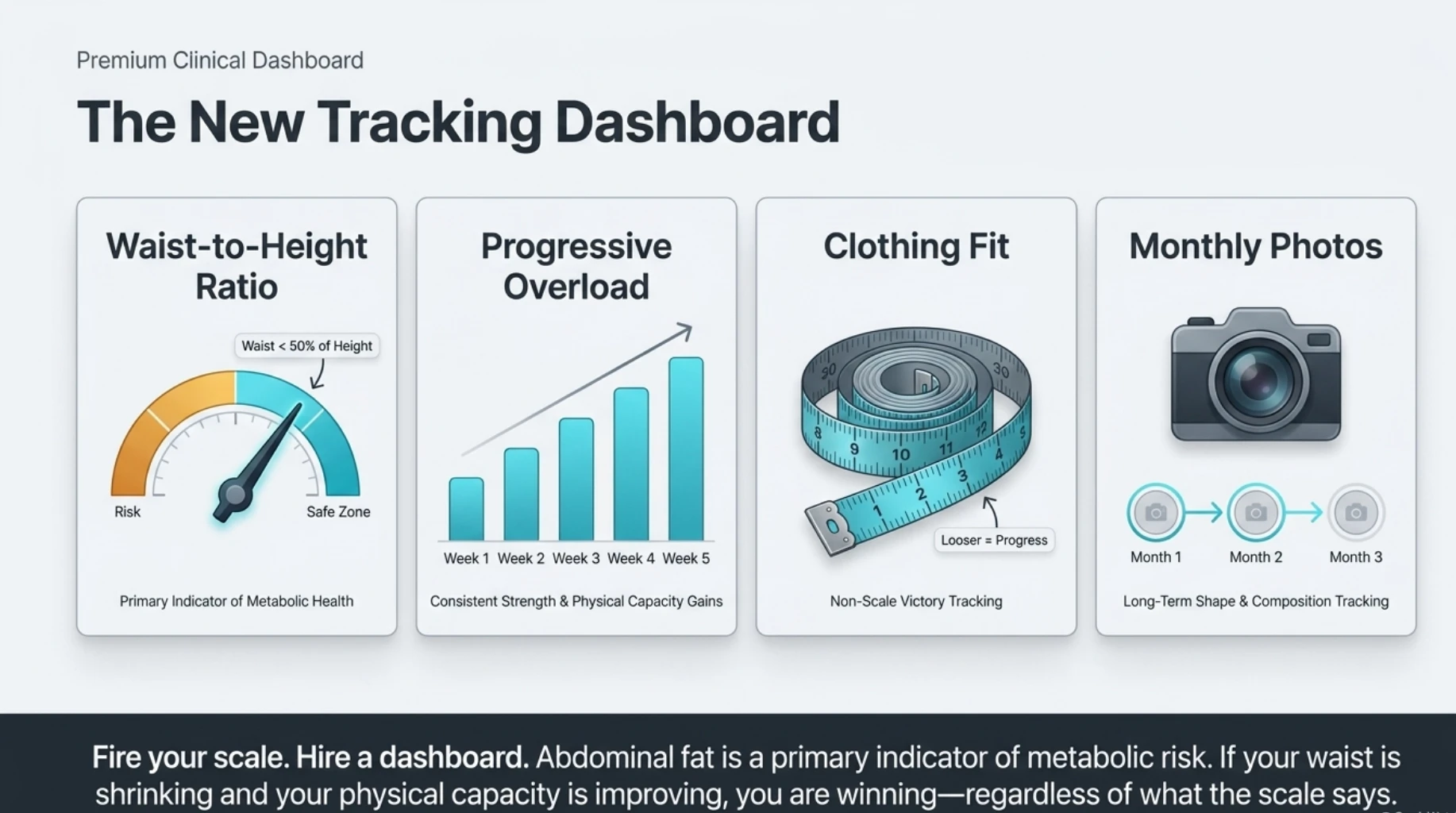
1. Measure Your Waist Circumference
Waist circumference is particularly useful because abdominal fat is closely associated with metabolic risk.
Measure your waist under similar conditions each time, using the same anatomical landmark and measurement technique.
A progressively decreasing waist circumference while weight remains relatively stable may provide useful evidence that body composition is improving.
2. Consider Your Waist-to-Height Ratio
Waist-to-height ratio provides additional information about central adiposity.
It is calculated by dividing waist circumference by height using the same units.
As a simple population-level screening message, keeping waist circumference below approximately half of height is often used as a practical target, although individual risk assessment should consider other clinical factors as well.
For someone losing inches but not weight, an improving waist-to-height ratio may provide information that BMI or scale weight alone cannot capture.
3. Pay Attention to How Your Clothes Fit
Clothing is not a medical measurement, but it can provide useful practical feedback.
If trousers become looser around the waist while body weight remains stable, your body dimensions have clearly changed.
Rather than checking clothing fit every day, compare it over several weeks.
4. Track Your Strength
Progress is not always visible in kilograms or centimetres.
If you can gradually:
- Lift heavier resistance.
- Perform more repetitions.
- Climb stairs more comfortably.
- Carry groceries more easily.
- Walk farther without fatigue.
your physical capacity is improving.
This becomes particularly important when losing inches but not weight occurs alongside resistance training.
5. Use Progress Photographs Carefully
Some people find periodic photographs helpful for recognising gradual changes that are difficult to notice in the mirror every day.
If you choose to use photographs, take them under similar lighting, clothing, posture, distance, and time-of-day conditions.
Monthly comparisons are generally more useful than daily photographs.
However, photographs are optional. They should not become a source of obsessive body checking or anxiety.
Is Losing Inches but Not Weight Always a Good Sign?
No.
This is an important distinction.
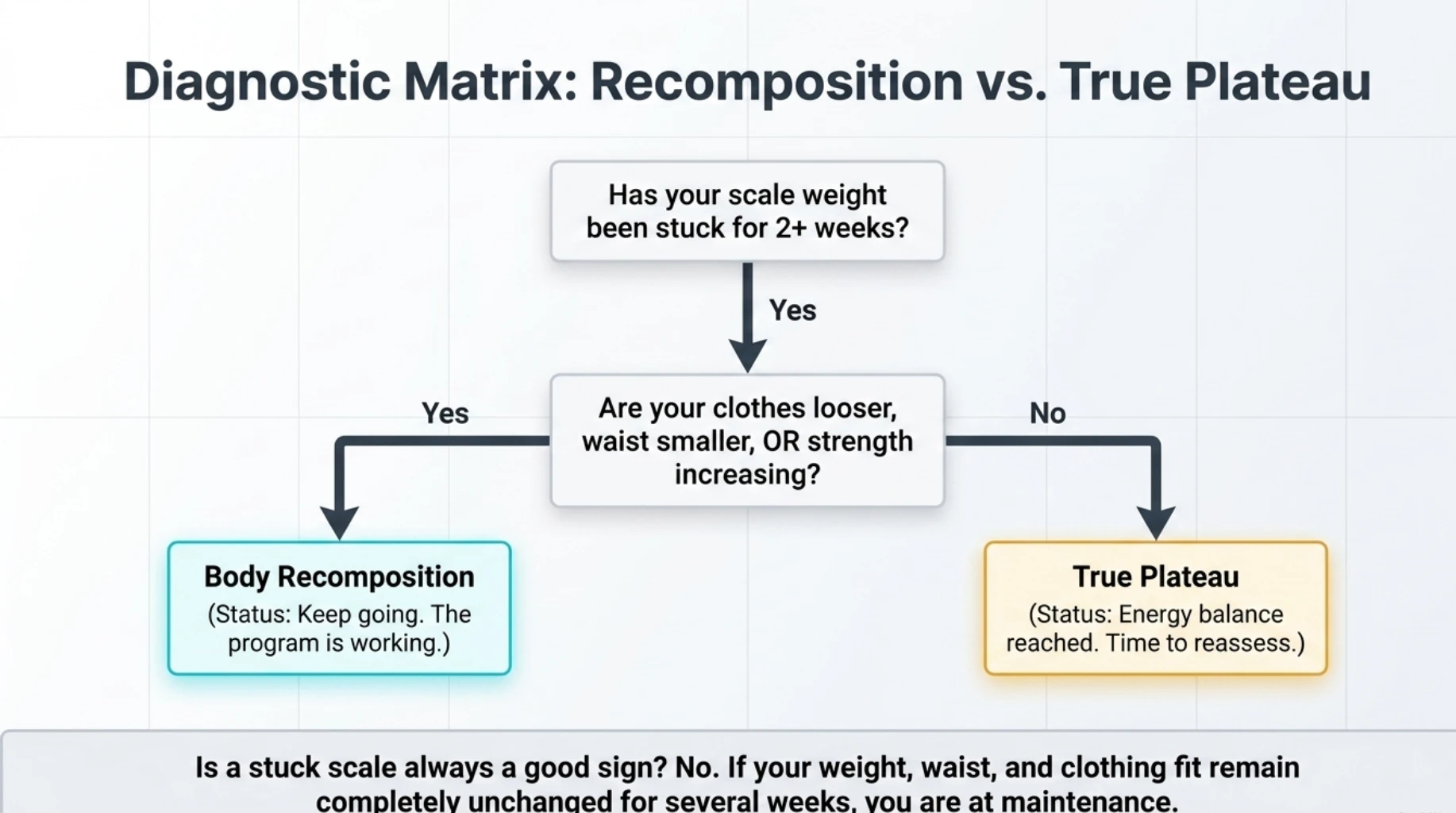
While losing inches but not weight can reflect favourable body recomposition, it should not automatically be used to explain every weight-loss plateau.
If your weight and waist circumference have both remained unchanged for several weeks, and your goal is to reduce excess body fat, your current energy intake may be close to your energy expenditure.
In that situation, the programme may need reassessment.
Factors worth reviewing include:
- Portion sizes.
- Cooking oils.
- Restaurant meals.
- Alcohol.
- Liquid calories.
- Frequent snacking.
- Weekend overeating.
- Reduced daily movement.
- Sleep deprivation.
- Adherence to the overall plan.
The correct response is not necessarily to reduce calories aggressively. Instead, identify where the actual energy imbalance may be occurring.
How Long Should You Wait Before Calling It a Plateau?
A few days without weight loss is not a plateau.
Even one or two weeks can sometimes be influenced by water retention, menstrual-cycle changes, travel, constipation, exercise, or dietary variation.
Look at trends over a meaningful period under reasonably consistent conditions.
If neither weight nor waist measurements are improving over several weeks despite good adherence, it may be reasonable to reassess nutrition, activity, resistance training, sleep, and other relevant factors.
Losing Inches but Not Weight After Starting Resistance Training
This scenario deserves particular attention because many people become discouraged soon after joining a gym.
Resistance training can improve body composition even when weight loss is relatively slow.
It also provides an important advantage during a calorie deficit: helping preserve muscle.
Simply losing the maximum possible number of kilograms is not necessarily the healthiest goal if a substantial portion of that loss comes from lean tissue.
A better outcome is often slower fat loss with greater preservation of muscle mass.
Therefore, someone losing inches but not weight while becoming stronger and seeing a progressive reduction in waist circumference may be achieving a more favourable result than the scale alone suggests.
Why Muscle Preservation Matters During Weight Loss
Skeletal muscle is metabolically and functionally important.
It contributes to:
- Glucose disposal and insulin sensitivity.
- Physical strength.
- Mobility and balance.
- Functional independence.
- Daily energy expenditure.
- Healthy ageing.
Weight-loss strategies based on severe calorie restriction without adequate protein or resistance exercise may increase the amount of lean tissue lost alongside fat.
For this reason, the quality of weight loss matters—not simply the total number of kilograms lost.
A programme that reduces abdominal fat while preserving muscle may provide substantial health benefits even when the weighing scale changes more slowly than expected.
What to Do If You Are Losing Inches but Not Weight
If you are losing inches but not weight, the first response should not automatically be to eat less or exercise more.
Instead, assess the overall direction of your progress.
Ask yourself whether your waist circumference is decreasing, clothes are fitting differently, strength is improving, physical activity has increased, and your longer-term weight trend is moving gradually in the desired direction.
If several of these markers are improving, your programme may be working even if the scale is moving slowly.
Making aggressive changes simply because of a few disappointing weigh-ins can sometimes make an otherwise sustainable programme unnecessarily restrictive.
1. Continue Resistance Training
Resistance training is particularly valuable when the goal is fat loss while preserving muscle.
A balanced programme should train the major muscle groups and gradually become more challenging as your strength improves.
Depending on your fitness level, this may involve:
- Body-weight exercises.
- Resistance bands.
- Weight machines.
- Dumbbells.
- Free-weight exercises.
If you are losing inches but not weight while becoming progressively stronger, do not abandon resistance training simply because it is not producing rapid changes on the scale.
2. Keep Your Protein Intake Adequate
Adequate dietary protein helps support muscle maintenance, particularly during a calorie deficit.
Rather than consuming most of your protein at dinner, distribute meaningful amounts across your main meals.
Useful protein sources include eggs, dairy, paneer, tofu, soy, pulses, chicken, fish, and other foods appropriate to your dietary pattern.
Protein intake should be individualised according to body size, age, activity level, overall health, and goals rather than based on a single recommendation for everyone.
3. Maintain Daily Movement Beyond Your Workout
A one-hour workout represents only a small part of your day.
Walking, climbing stairs, household activities, standing, commuting on foot, and other everyday movements contribute to total daily energy expenditure.
Some people unconsciously become less active after beginning structured exercise because they feel tired or believe their workout has already compensated for prolonged sitting.
Maintaining daily movement is therefore important when trying to improve body composition.
4. Review Your Diet Without Becoming Overly Restrictive
If you are genuinely losing inches but not weight, an immediate aggressive calorie reduction is usually unnecessary.
However, if both weight and waist measurements have stopped improving, reviewing dietary intake may be useful.
Common sources of unnoticed calories include:
- Cooking oil.
- Sugary beverages.
- Alcohol.
- Frequent restaurant meals.
- Large portions of calorie-dense foods.
- Mindless snacking.
- Weekend overeating.
The objective is not to eliminate entire food groups but to identify habits that may be preventing a sustainable calorie deficit.
5. Prioritise Sleep and Recovery
Sleep is frequently overlooked in weight-management programmes.
Insufficient sleep can influence hunger, food choices, energy levels, exercise performance, and spontaneous physical activity.
Poor recovery may also make resistance training less productive.
Therefore, improving sleep should be considered part of a comprehensive body-composition strategy rather than an optional extra.
Common Myths About Losing Inches but Not Weight
Myth 1: No Weight Loss Means No Fat Loss
This is incorrect.
Fat mass can decrease while changes in muscle, glycogen, body water, or gastrointestinal contents temporarily keep total body weight relatively stable.
This is exactly why losing inches but not weight can occur.
However, the opposite is also important: a stable scale should not automatically be labelled body recomposition without supporting evidence such as decreasing waist measurements or improving body composition.
Myth 2: Muscle Weighs More Than Fat
One kilogram of muscle and one kilogram of fat weigh exactly the same.
The difference is volume.
Muscle is denser than fat and therefore occupies less space for the same weight.
A person can consequently become leaner and smaller while experiencing relatively little change in total body weight.
Myth 3: Sweating More Means You Are Losing More Fat
Sweat primarily represents fluid loss used by the body to regulate temperature.
A temporary reduction in body weight after a sweaty workout largely reflects water loss, not an equivalent amount of body-fat loss.
Once fluids are replaced, much of this weight returns.
Fat loss occurs through a sustained energy deficit over time, not simply through sweating.
Myth 4: Daily Weight Gain Means You Gained Body Fat
It is possible for body weight to increase substantially from one morning to the next without meaningful fat gain.
Water retention, sodium intake, carbohydrate intake, bowel contents, menstrual-cycle changes, and exercise recovery can all alter scale weight.
This is why longer-term trends are much more informative than isolated readings.
Myth 5: The Fastest Weight Loss Is Always the Best
Rapid weight loss can look impressive on the scale, but the quality of that weight loss matters.
Very restrictive diets can increase the loss of lean tissue alongside fat and may be difficult to maintain.
A more sustainable programme aims to reduce excess body fat while preserving muscle and supporting nutritional adequacy, physical function, and long-term adherence.
How Often Should You Weigh Yourself?
There is no single weighing frequency that works for everyone.
Some people find regular weighing useful because it helps identify trends. Others become anxious or overly reactive to normal daily fluctuations.
If you weigh frequently, try to standardise the conditions:
- Use the same weighing scale.
- Measure at approximately the same time.
- Morning after using the toilet is often practical.
- Wear similar or minimal clothing.
- Place the scale on a firm, level surface.
More importantly, evaluate the trend rather than reacting emotionally to each individual number.
For someone losing inches but not weight, waist measurements taken periodically may provide additional useful information.
When Losing Inches but Not Weight Needs Medical Evaluation
Most short-term weight fluctuations are completely normal. However, unexplained or unexpected changes in body weight or swelling should not always be attributed to body recomposition.
Consider medical evaluation if weight changes are accompanied by symptoms such as:
- Persistent swelling of the feet or legs.
- Unexplained breathlessness.
- Marked fatigue or weakness.
- Rapid unexplained weight gain.
- Unintentional weight loss.
- Persistent changes in appetite.
- Significant menstrual irregularities.
- Symptoms suggestive of an underlying endocrine or metabolic disorder.
Medical conditions and some medications can influence body weight, fluid balance, appetite, and body composition. These situations require individual assessment rather than simply further restricting calories.
Frequently Asked Questions About Losing Inches but Not Weight
Is Losing Inches but Not Weight a Good Sign?
It can be. If your waist circumference is decreasing, clothing fits more loosely, and strength or fitness is improving, stable weight may reflect favourable changes in body composition.
However, if neither measurements nor weight are changing over several weeks, your programme may need reassessment.
Can You Lose Fat Without Losing Weight?
Yes. Body fat can decrease while muscle, glycogen, or body water increases enough to offset some or all of the change on the scale.
This is particularly possible when resistance training is introduced alongside appropriate nutrition.
Why Am I Losing Inches but Not Weight After Starting the Gym?
New resistance training can temporarily increase muscle water and glycogen storage while also helping preserve or gradually build muscle. These changes may temporarily mask fat loss on the scale.
How Long Can Losing Inches but Not Weight Continue?
There is no fixed duration. Short-term discrepancies between waist measurements and body weight are common because water and glycogen fluctuate.
If waist circumference continues to decrease and other markers improve, progress may still be occurring. If all measurements remain unchanged for several weeks, reassess the programme.
Should I Reduce Calories Further If My Weight Is Not Falling?
Not automatically.
First evaluate your waist measurements, weight trend, adherence, physical activity, training, sleep, and dietary intake. If genuine progress has stopped for a sustained period, a modest adjustment may be appropriate rather than an aggressive calorie reduction.
Final Thought
If your waist is shrinking, your clothes fit better, and you are becoming stronger, the weighing scale may simply be telling an incomplete story. When you are losing inches but not weight, look at the direction of your health—not just one number under your feet.
If you want a personalized metabolic assessment and lifestyle strategy, you can book a consultation here:
Book an Appointment