

Home Blood Pressure Monitor: 9 Features to Check Before You Buy One
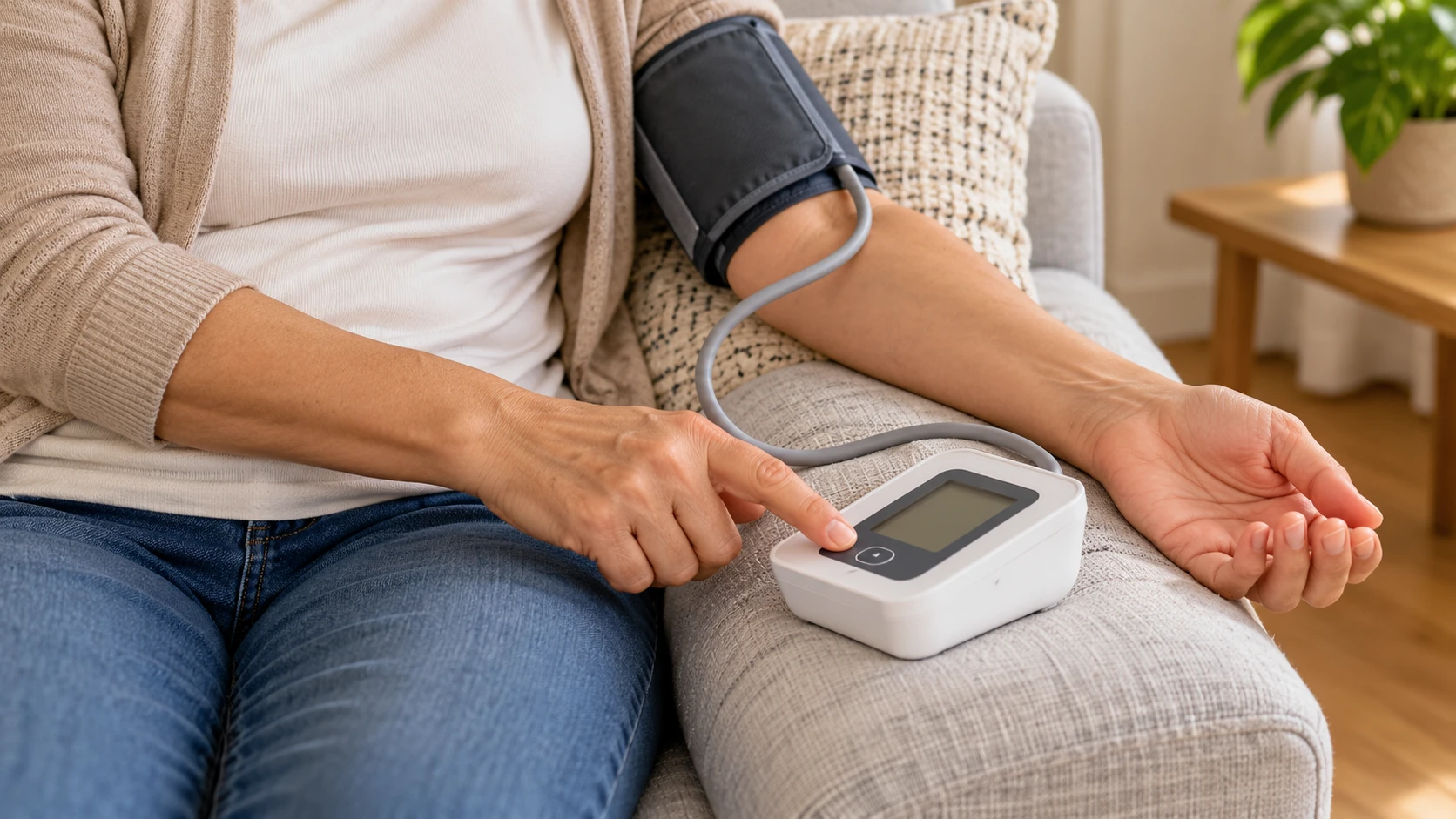
A home blood pressure monitor looks like a relatively simple device.
You put on the cuff, press a button and a few seconds later the screen displays your blood pressure.
So why does choosing one require any thought?
Because not every device sold online or in a pharmacy has necessarily undergone the same level of independent validation, and even a good monitor can produce misleading readings if the cuff does not fit properly.
At the same time, manufacturers increasingly advertise features such as:
- Bluetooth connectivity.
- Mobile apps.
- Large displays.
- Irregular heartbeat alerts.
- Multiple-user memory.
- Voice guidance.
- Automatic averaging.
Some of these can be useful.
But they are not equally important.
If you are choosing a home blood pressure monitor, I would prioritise three things before almost everything else:
Is the device clinically validated?
Does the cuff correctly fit your arm?
Can you use it correctly and consistently?
A simple monitor that gets these basics right can be more useful than an expensive smart monitor filled with features you rarely use.
Why Having a Home Blood Pressure Monitor Can Be Useful
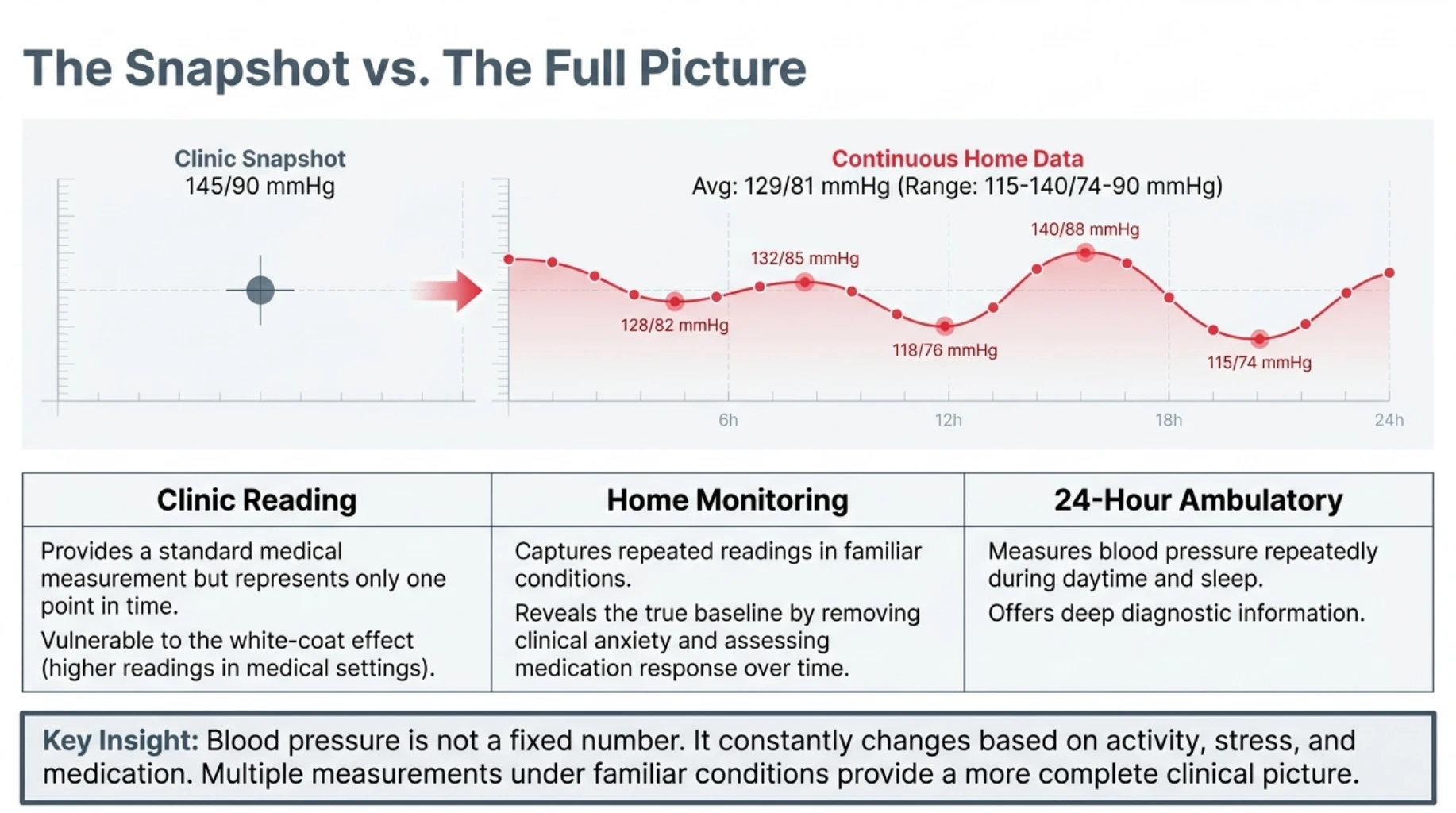
Blood pressure is not a fixed number.
It changes throughout the day according to factors such as:
- Physical activity.
- Stress.
- Sleep.
- Pain.
- Caffeine.
- Medication timing.
- Temperature.
- Illness.
This means one reading taken during a clinic visit does not always represent your usual blood pressure.
Home monitoring allows multiple measurements to be collected under familiar conditions.
That can help provide a more complete picture.
Home Blood Pressure Monitoring vs a Single Clinic Reading
Imagine someone has a blood pressure of 152/92 mmHg during a clinic visit.
Does that automatically establish that their usual blood pressure remains at this level throughout the day?
Not necessarily.
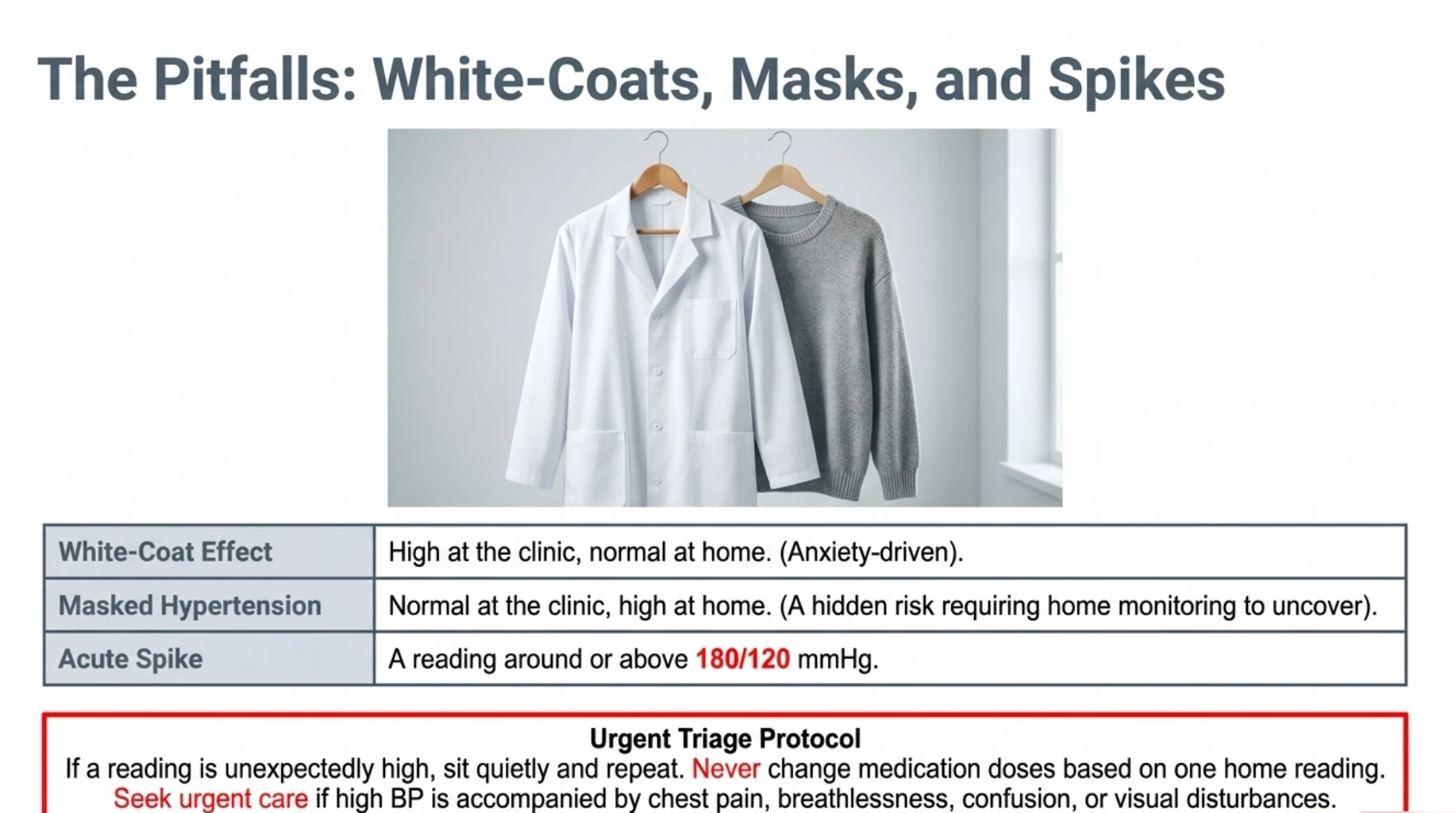
Some people experience higher readings in medical settings, often referred to as a white-coat effect.
Other people may have acceptable readings during a clinic visit but higher readings outside the clinic.
This is one reason out-of-office blood pressure measurements can be valuable.
| Measurement Method | What It Can Add |
|---|---|
| Clinic blood pressure | Provides a standard medical measurement but may represent only one point in time |
| Home blood pressure monitoring | Provides repeated readings in the person’s usual environment |
| 24-hour ambulatory monitoring | Measures blood pressure repeatedly during daytime and sleep and can provide additional diagnostic information |
These methods can complement one another.
Who May Benefit From a Home Blood Pressure Monitor?
Home monitoring can be particularly useful for people who:
- Have hypertension.
- Have borderline or repeatedly elevated clinic readings.
- Have recently started or changed blood-pressure medication.
- Have suspected white-coat hypertension.
- Need to monitor treatment response.
- Have diabetes or other cardiovascular risk factors where blood-pressure control is important.
It can also be useful when a clinician specifically asks for a structured home blood-pressure record.
However, more measurements are not always better.
Checking blood pressure repeatedly throughout the day without a clinical reason can create anxiety and make normal fluctuations appear alarming.
What Type of Home Blood Pressure Monitor Should You Buy?
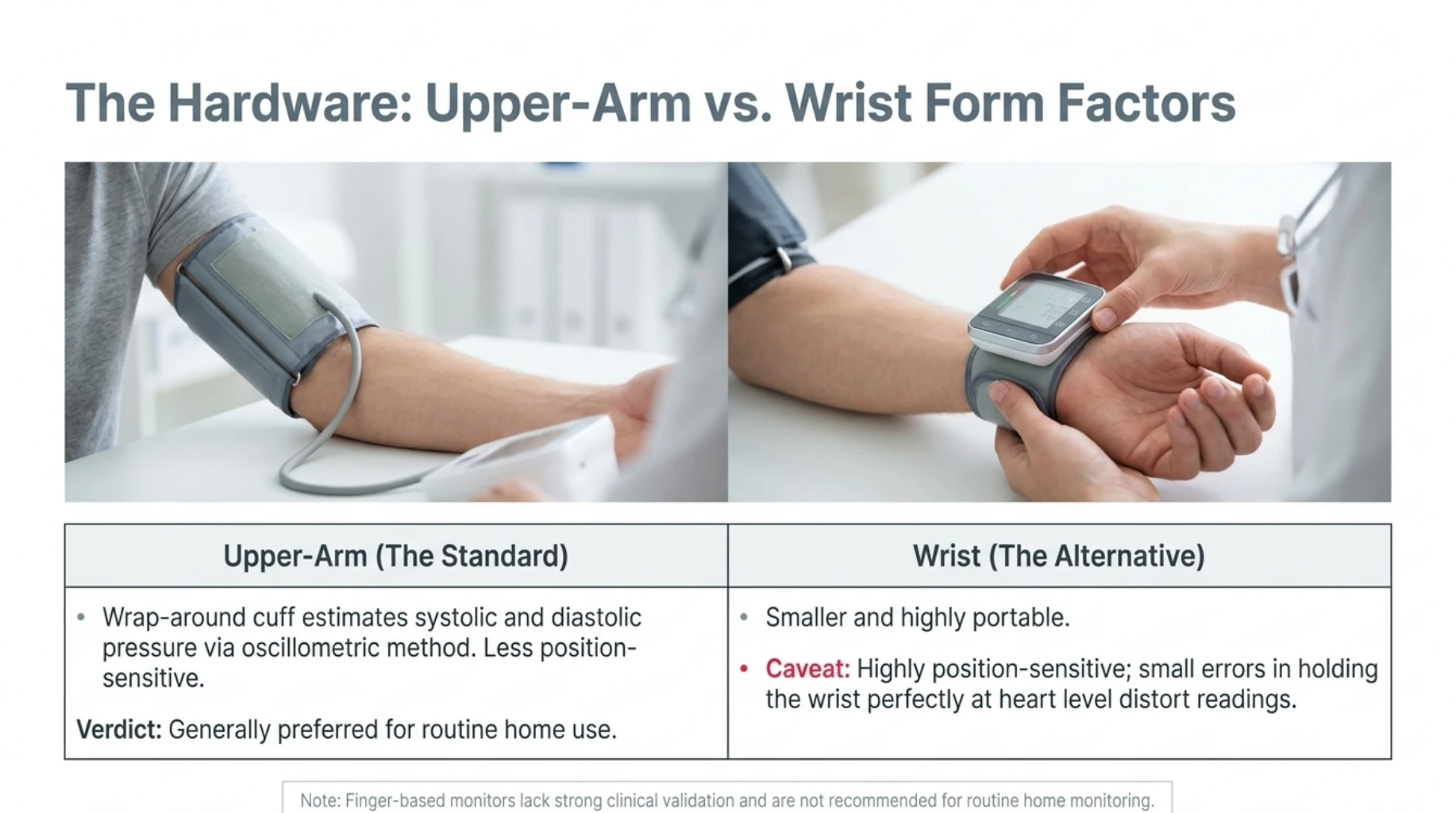
For most adults monitoring blood pressure at home, an automatic upper-arm blood pressure monitor is generally the most practical choice.
The cuff wraps around the upper arm, the machine inflates automatically, and the device estimates systolic and diastolic pressure using an oscillometric method.
This requires much less technical skill than manual blood-pressure measurement with a stethoscope.
Upper-Arm vs Wrist Blood Pressure Monitor
Wrist monitors are smaller and can be convenient.
But correct positioning becomes especially important because the wrist needs to be held at heart level.
Small positioning errors can affect readings.
For routine home use, a validated upper-arm device is generally preferred when an appropriately fitting upper-arm cuff can be used.
| Feature | Upper-Arm Monitor | Wrist Monitor |
|---|---|---|
| Typical choice for routine home monitoring | Generally preferred | Usually considered when upper-arm measurement is impractical |
| Position sensitivity | Important | Particularly important |
| Portability | Moderate | High |
| Cuff fit | Must match upper-arm circumference | Must fit the wrist appropriately |
| Ease while travelling | Good | Often very convenient |
A wrist device should not automatically be considered inaccurate simply because it measures at the wrist.
The more important questions are whether the specific device is validated and whether it is being used correctly.
What About Finger Blood Pressure Monitors?
Finger-based blood pressure devices may appear convenient, but they are generally not my first choice for routine clinical home blood-pressure monitoring.
If you are investing in a device that may influence treatment decisions, choose a method with stronger validation and appropriate clinical acceptance.
For most adults, that brings us back to a validated automatic upper-arm monitor.
Home Blood Pressure Monitor Feature 1: Clinical Validation
This is the first feature I would check.
Do not assume that every machine capable of displaying a blood-pressure number has been adequately validated for accuracy.
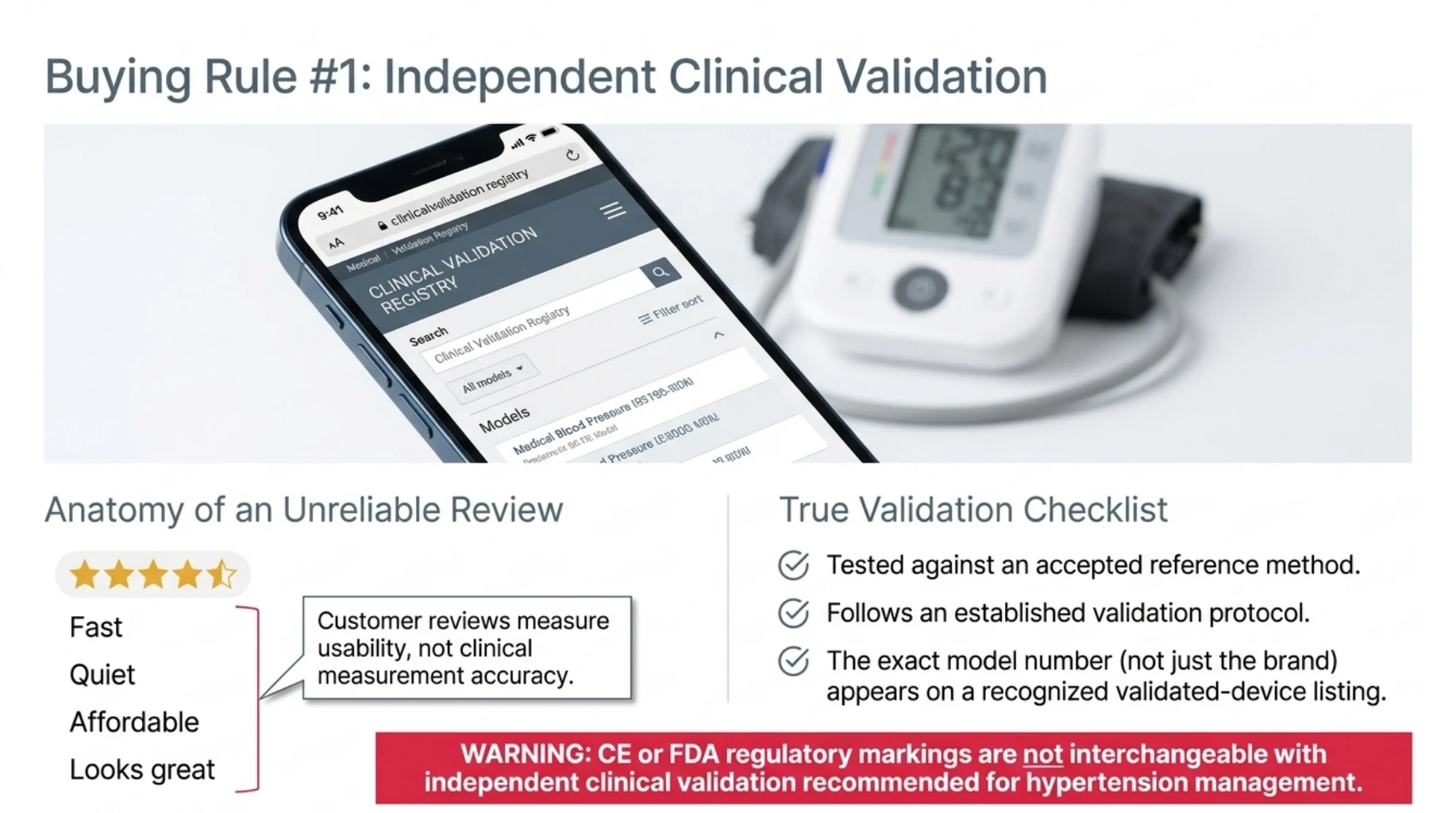
Clinical validation means that the specific device model has been tested against an accepted reference method according to an established validation protocol.
This is different from attractive packaging, customer reviews or a manufacturer’s general claim that the machine is “accurate.”
What Does “Clinically Validated” Actually Mean?
A validation study compares readings from the blood-pressure device with reference measurements obtained under a defined protocol.
The purpose is to determine whether the device’s measurement performance falls within acceptable limits.
This is important because home blood-pressure readings may eventually influence decisions about:
- Whether hypertension is suspected.
- Whether treatment appears effective.
- Whether medication adjustment may need consideration.
- Whether additional evaluation is needed.
You therefore want more than a machine that simply produces repeatable-looking numbers.
CE, FDA or Regulatory Markings Are Not the Same as Independent Validation
Consumers frequently assume that a regulatory marking or approval automatically means a particular blood-pressure device has passed the type of independent clinical validation recommended for hypertension management.
These concepts should not be treated as interchangeable.
When possible, check whether the exact model appears on a recognised validated-device listing or has published evidence of validation according to an accepted protocol.
The exact model matters.
A manufacturer may sell many blood-pressure monitors, and validation of one model should not automatically be assumed to apply to every device sold under the same brand.
Do Online Ratings Tell You Whether a BP Monitor Is Accurate?
No.
A device may have thousands of positive customer reviews because it is:
- Easy to use.
- Attractively designed.
- Fast.
- Quiet.
- Affordable.
Those are useful consumer characteristics.
They do not replace a formal validation study.
Customer reviews can tell you about usability.
They cannot establish clinical measurement accuracy.
Home Blood Pressure Monitor Feature 2: Correct Cuff Size
This is one of the most important—and most frequently overlooked—features.
The cuff needs to fit your upper arm correctly.
A cuff that is too small or too large can contribute to inaccurate readings.
Yet many people choose a monitor without measuring their arm circumference first.
How to Check Your Blood Pressure Cuff Size
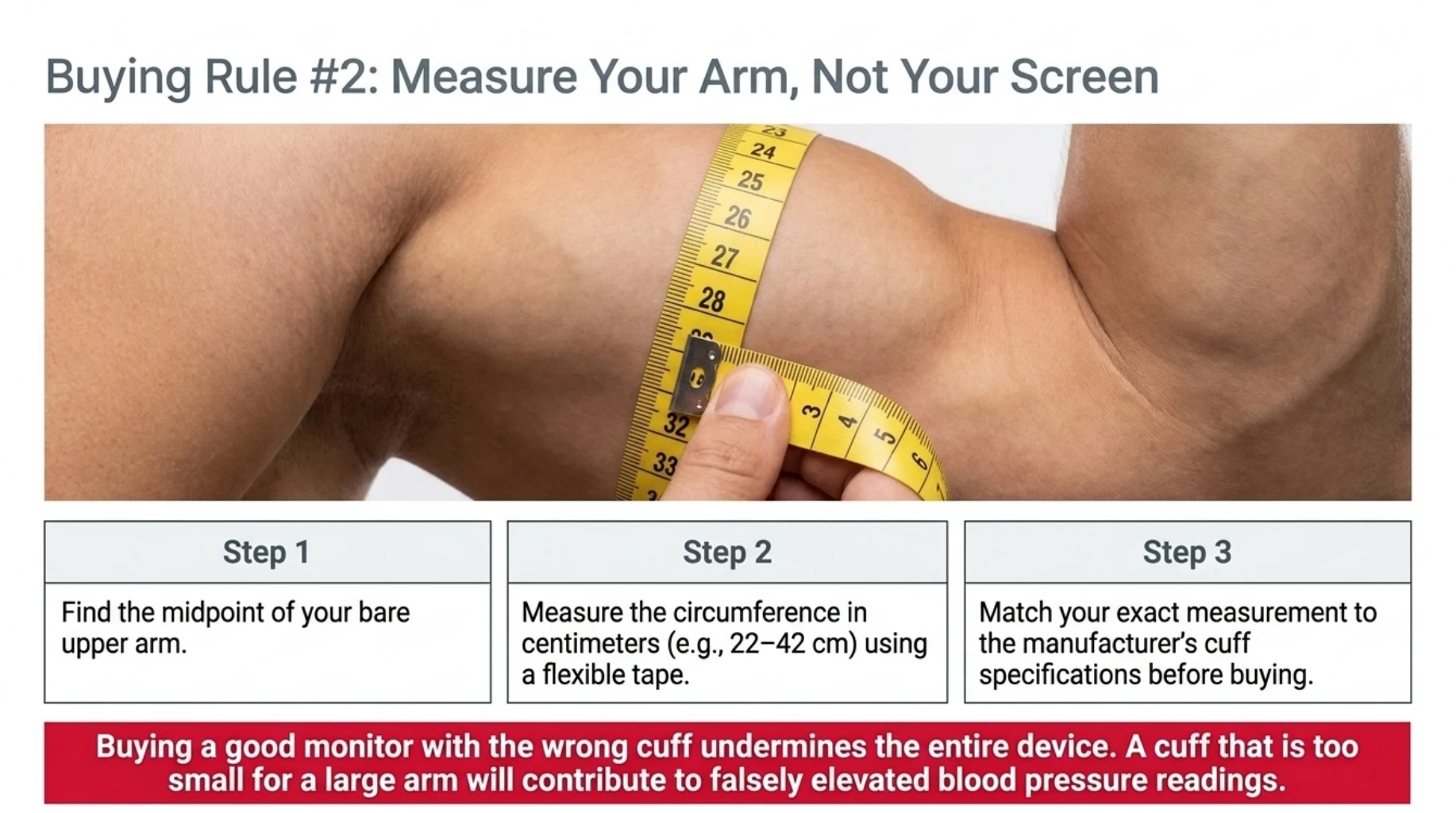
Measure the circumference around the midpoint of your upper arm using a flexible measuring tape.
Then compare that measurement with the cuff range specified by the manufacturer.
For example, a cuff may be designed for an arm circumference such as:
22–42 cm
That does not mean every monitor uses this range.
Always check the specification for the particular cuff supplied with the device.
Why a Cuff That Is Too Small Can Be a Problem
If the bladder and cuff are inappropriate for the arm size, the measurement can be distorted.
A cuff that is too small for a large arm can contribute to falsely elevated blood-pressure readings.
This becomes particularly important in people with obesity or larger upper-arm circumference.
Buying a good monitor with the wrong cuff can undermine the entire purpose of buying the monitor.
What if You Have a Very Large Upper Arm?
Check the available cuff range before purchasing the machine.
Do not assume that a “universal cuff” will necessarily fit every arm.
Some manufacturers provide:
- Standard cuffs.
- Wide-range cuffs.
- Large cuffs.
- Extra-large cuffs for compatible models.
Compatibility matters as well.
Do not attach a random cuff from another device unless the manufacturer confirms that it is compatible with the monitor.
Home Blood Pressure Monitor Feature 3: Automatic Multiple Readings and Averaging
Blood pressure naturally fluctuates from one measurement to the next.
This is why clinical assessment often relies on repeated readings rather than one isolated value.
A useful home monitor may allow two or three readings to be taken sequentially and may calculate an average.
This can make structured home monitoring easier.
Why One Blood Pressure Reading May Mislead You
Imagine your first reading is: 148/88 mmHg
You remain seated quietly and repeat it.
The second reading is: 137/84 mmHg
The third is: 134/82 mmHg
Which one represents your blood pressure?
This illustrates why reacting immediately to the first reading can be misleading.
Repeated measurements performed correctly provide more useful information.
Should You Keep Repeating Until You Get a Lower Number?
No.
That defeats the purpose of monitoring.
Do not take eight readings and record only the lowest one.
Use a consistent measurement protocol and record the requested readings honestly.
Home monitoring is useful only when the data reflect what actually happened.
Home Blood Pressure Monitor Feature 4: Memory for Stored Readings
A memory function may sound less exciting than Bluetooth, but it can be extremely practical.
If your device stores previous readings, you do not have to depend entirely on handwritten notes.
Stored measurements can also make it easier to review patterns during a medical consultation.
Look at:
- How many readings the device stores.
- Whether it records date and time.
- Whether separate users can maintain separate records.
Date and time are particularly useful because a blood-pressure value without knowing when it was measured loses some context.
Home Blood Pressure Monitor Feature 5: Multiple-User Support
If two people in the household will use the same monitor, multiple-user memory can prevent their readings from being mixed together.
Some devices offer separate profiles for two users plus a guest mode.
This is much more useful than having both people’s measurements stored in one combined history.
However, remember the cuff still needs to fit each person.
A monitor can support two electronic profiles while having a cuff that fits only one user’s arm properly.
Home Blood Pressure Monitor Feature 6: Irregular Heartbeat Detection
Many modern automatic monitors display an irregular-heartbeat symbol when pulse irregularity is detected during measurement.
This can be useful as an alert.
But it is important to understand what the symbol does not mean.
It does not automatically diagnose atrial fibrillation or another specific arrhythmia.
Movement, premature beats and other factors can sometimes trigger irregularity alerts.
If the symbol appears repeatedly, particularly when accompanied by palpitations, dizziness or other symptoms, the finding may deserve medical assessment.
Is AFib Detection the Same as Irregular Heartbeat Detection?
No.
Some blood-pressure monitors have algorithms specifically designed and validated to screen for possible atrial fibrillation.
Others simply identify pulse irregularity during the measurement.
These features should not be treated as identical.
| Feature | What It Generally Does |
|---|---|
| Pulse display | Shows the estimated heart rate during the BP measurement |
| Irregular heartbeat indicator | Flags irregular pulse intervals detected during measurement |
| AFib screening feature | Uses a device-specific algorithm intended to identify possible atrial fibrillation |
| ECG | Records cardiac electrical activity and provides different diagnostic information |
A screening alert is not the same as a confirmed rhythm diagnosis.
Home Blood Pressure Monitor Feature 7: Cuff Position and Movement Detection
Some monitors can alert you when the cuff is incorrectly positioned or when excessive body movement occurs during measurement.
This can be particularly useful for someone who is new to home blood-pressure monitoring.
Movement matters because talking, shifting position or tensing the arm can interfere with measurement.
A positioning indicator cannot correct every technique error, but it can reduce some avoidable mistakes.
Why Correct Positioning Matters More Than Many Premium Features
You can buy an expensive connected blood-pressure monitor and still obtain poor readings if you measure incorrectly.
Common errors include:
- Talking during measurement.
- Crossing the legs.
- Leaving the back unsupported.
- Allowing the arm to hang below heart level.
- Placing the cuff over thick clothing.
- Measuring immediately after rushing into the room.
Technique can matter more than Bluetooth.
Home Blood Pressure Monitor Feature 8: Large, Clear Display
A clear screen may seem like a minor convenience, but usability matters.
This is particularly relevant for older adults or people with reduced vision.
A useful display should make it easy to identify:
- Systolic blood pressure.
- Diastolic blood pressure.
- Pulse rate.
- Relevant warning symbols.
Large buttons and simple controls can also make a monitor easier to use independently.
A machine that is technically sophisticated but confusing to operate may be less useful in real life.
Home Blood Pressure Monitor Feature 9: Power Options, Connectivity and Practical Usability
The final category includes several practical features that may determine whether you actually continue using the monitor.
Check whether the device operates using:
- Replaceable batteries.
- A mains adapter.
- USB power.
- A rechargeable internal battery.
If you travel frequently, portability and battery operation may matter.
If the monitor remains on a table at home, a power adapter may be more convenient.
Do You Need Bluetooth in a Home Blood Pressure Monitor?
No.
Bluetooth does not make the blood-pressure measurement itself more accurate.
What it can do is make record keeping easier.
A connected monitor may automatically transfer readings to an app, allowing you to review:
- Daily readings.
- Weekly averages.
- Longer-term trends.
- Morning and evening patterns.
This can be particularly useful for someone who would otherwise forget to maintain a blood-pressure diary.
But if you are comfortable recording readings manually, Bluetooth is optional.
Do You Need a Smartphone App?
Again, no.
An app is useful only if it makes monitoring easier rather than more complicated.
Some people enjoy graphs and automatic records.
Others prefer a notebook containing date, time, blood pressure and pulse.
Both approaches can work.
The quality of the blood-pressure measurement matters more than the sophistication of the graph displaying it.
The 9 Features at a Glance
| No. | Feature | Priority |
|---|---|---|
| 1 | Clinical validation | Essential |
| 2 | Correct cuff size | Essential |
| 3 | Multiple readings and averaging | Very useful |
| 4 | Reading memory with date/time | Very useful |
| 5 | Multiple-user support | Useful when sharing the device |
| 6 | Irregular heartbeat detection | Useful additional feature |
| 7 | Cuff-position and movement detection | Useful for improving measurement technique |
| 8 | Large, clear display | Important for usability |
| 9 | Power options and connectivity | Choose according to personal preference |
Do You Need an Expensive Home Blood Pressure Monitor?
Not necessarily.
Price and measurement quality are not the same thing.
A premium monitor may cost more because it includes:
- Bluetooth.
- A more sophisticated app.
- Multiple profiles.
- A premium display.
- Additional averaging features.
- Advanced rhythm-screening functions.
These may justify the extra cost for some people.
But if a simpler device is independently validated, has the correct upper-arm cuff and stores readings reliably, it may already provide what you need.
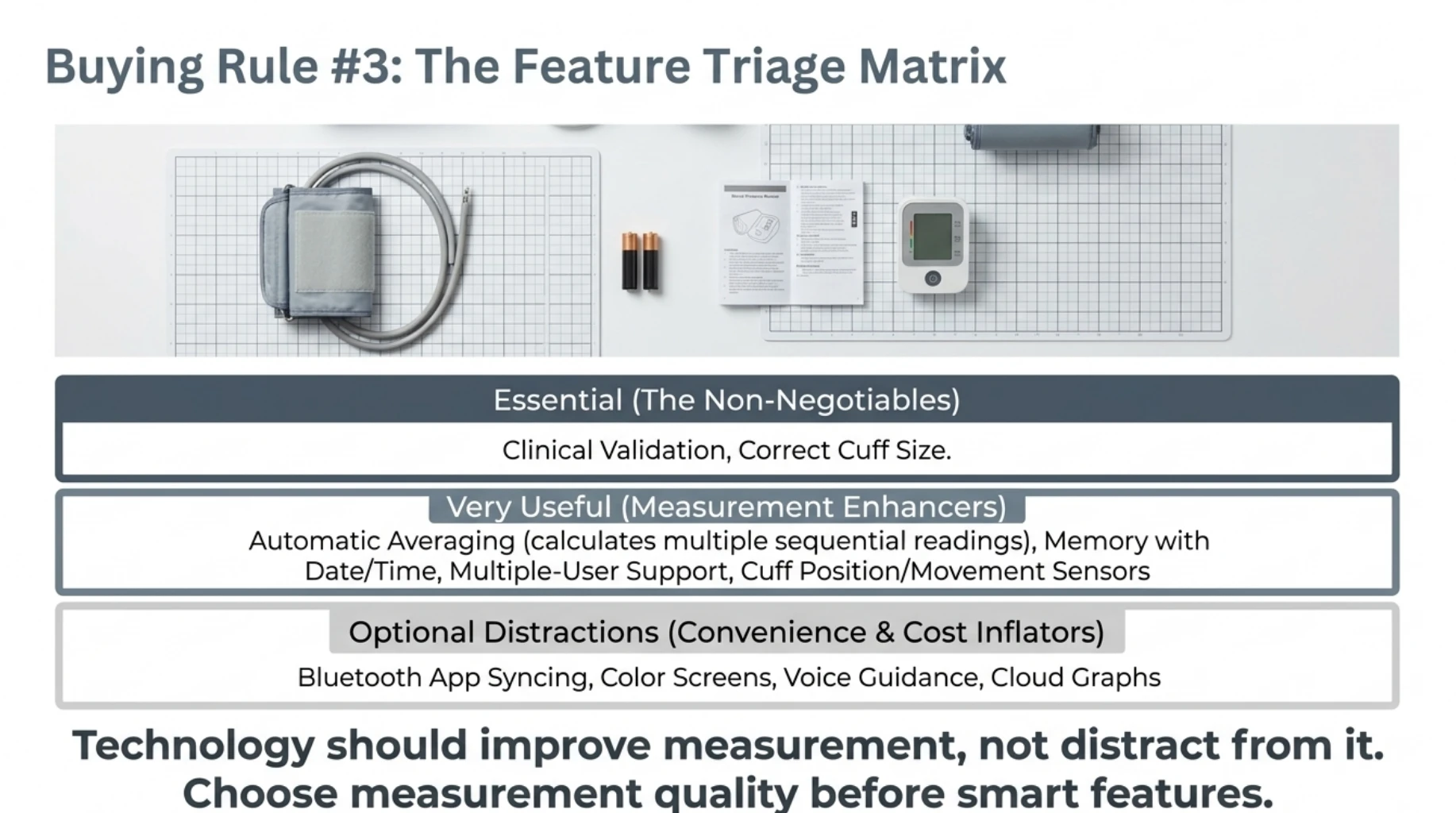
I would choose measurement quality before smart features.
Before Buying a BP Monitor, Measure Your Arm
If there is one practical step people frequently skip, it is this one.
Measure your upper-arm circumference before ordering the monitor.
Then check the manufacturer’s cuff specification.
This becomes especially important if your arm circumference is near the upper or lower end of the advertised cuff range.
Do not buy the monitor first and assume the cuff will fit later.
Should You Take Your New Monitor to Your Doctor?
This can be useful, particularly when you first begin home monitoring or when readings appear very different from clinic measurements.
Your technique can be reviewed, and readings from your device can sometimes be compared with measurements obtained during the visit.
This does not replace formal device validation.
A monitor that happens to produce a similar reading once in a clinic is not thereby scientifically validated.
But checking technique can identify practical problems such as:
- Incorrect cuff placement.
- Wrong cuff size.
- Unsupported arm position.
- Talking during measurement.
- Taking readings without adequate rest.
The Best Home Blood Pressure Monitor Is Not Necessarily the Smartest One
If I had to choose between:
Monitor A: clinically validated, correct cuff size, simple display, no Bluetooth.
and
Monitor B: attractive app, cloud graphs, voice guidance and multiple smart features but uncertain validation.
I would place much greater confidence in Monitor A for blood-pressure monitoring.
Technology should improve measurement.
It should not distract from it.
How to Measure Blood Pressure Correctly at Home
Buying a good home blood pressure monitor is only half the job.
The other half is using it correctly.
A clinically validated monitor with the correct cuff can still produce misleading readings if you measure blood pressure immediately after climbing stairs, while talking, with your legs crossed or with your arm hanging below heart level.
Before worrying about whether your machine is accurate, make sure your measurement technique is accurate.
What to Do Before Measuring Your Blood Pressure
For a planned home blood-pressure reading, prepare before pressing the start button.
Ideally:
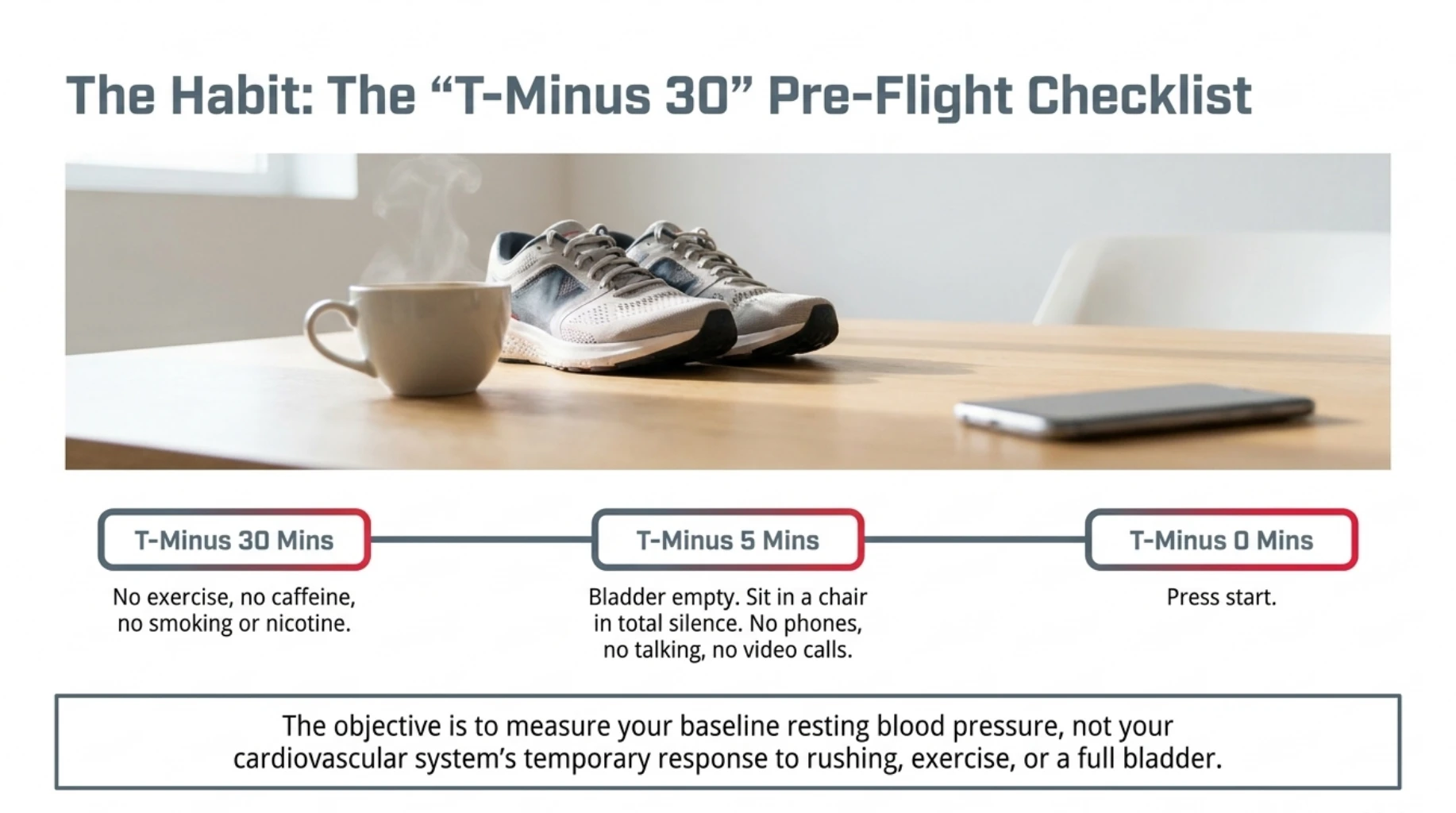
- Avoid exercise for approximately 30 minutes beforehand.
- Avoid smoking or nicotine shortly before measurement.
- Avoid caffeine for approximately 30 minutes beforehand when possible.
- Empty your bladder.
- Sit quietly for about 5 minutes.
- Avoid talking or using your phone during this resting period.
The objective is to measure your resting blood pressure rather than the temporary cardiovascular response to rushing, exercise or stimulation.
Why Five Minutes of Quiet Rest Matters
Imagine arriving home after walking quickly from the car park, climbing two flights of stairs and immediately checking your blood pressure.
Your reading may be considerably different from one obtained after sitting quietly.
That does not necessarily mean the monitor is inconsistent.
You measured your blood pressure under two different physiological conditions.
Standardising the conditions makes readings easier to compare.
Correct Sitting Position for Home Blood Pressure Measurement
Your body position can influence the result.
For routine seated home measurements:
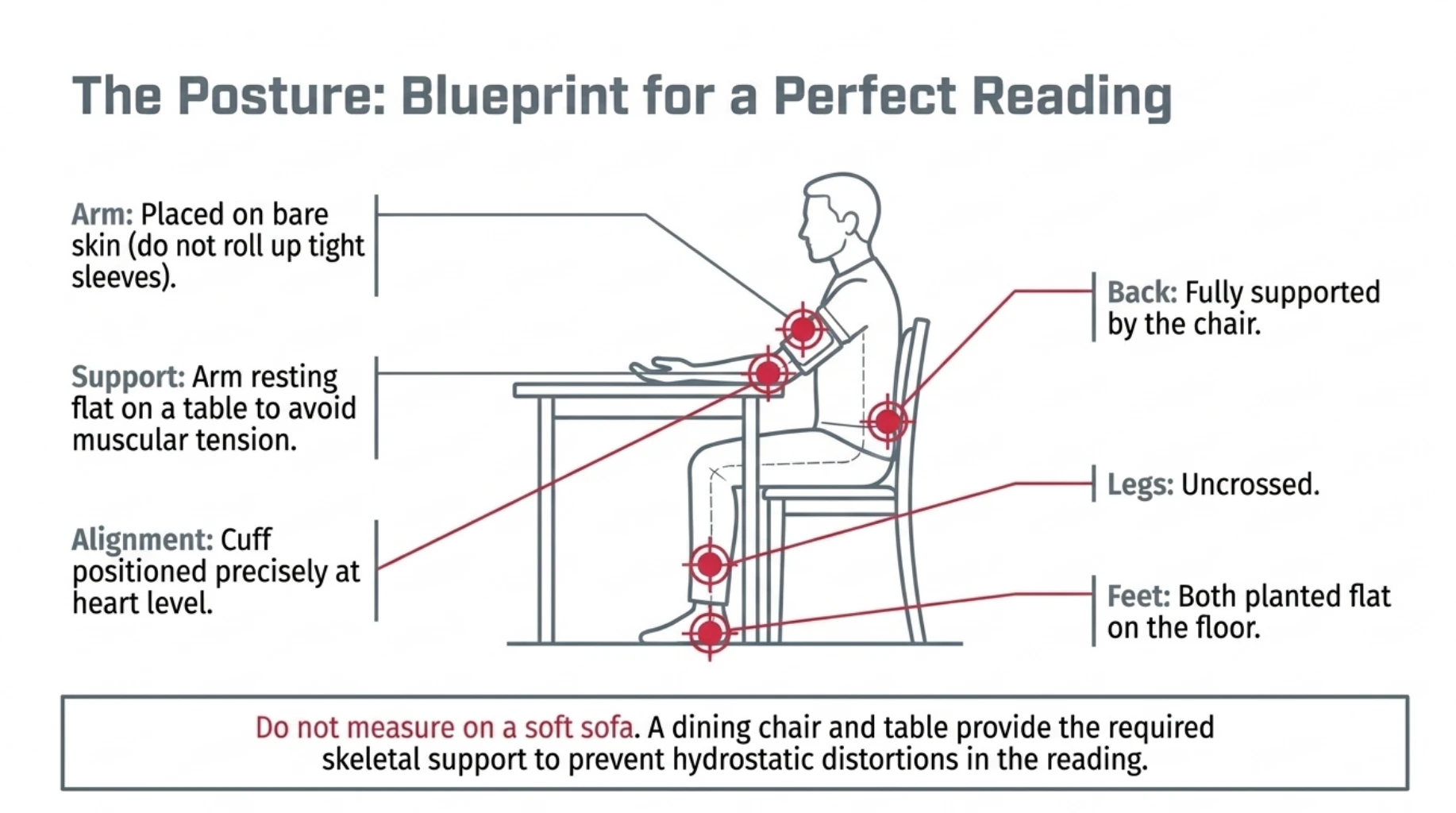
- Sit on a chair with your back supported.
- Keep both feet flat on the floor.
- Do not cross your legs.
- Keep the arm relaxed and supported.
- Position the cuffed upper arm approximately at heart level.
- Remain quiet during the measurement.
A dining chair with a supportive back and a table for the arm is often more suitable than measuring while sitting unsupported on the edge of a bed.
Why Your Arm Should Be Supported
If you hold your arm up using your own muscles, you create muscular tension.
If the arm hangs substantially below heart level, hydrostatic effects can influence the measurement.
The simplest approach is to rest the arm comfortably on a table or other support so the cuff is approximately at heart level.
You should not need to actively hold the arm in position.
Should the Blood Pressure Cuff Go Over Clothing?
For the most consistent measurement, place the cuff on the bare upper arm rather than over clothing.
Do not simply roll a very tight sleeve upwards if doing so constricts the arm.
If necessary, remove or loosen the garment enough to allow proper cuff placement without compression from clothing.
Where Should the Cuff Be Positioned?
Follow the instructions supplied with your specific monitor because cuff designs differ.
Generally, an upper-arm cuff is wrapped snugly around the bare upper arm with its lower edge above the elbow crease.
Many cuffs include an artery-position marker or alignment guide.
The cuff should be secure but not excessively tight before inflation.
If your monitor provides a cuff-wrap or positioning indicator, use it as an additional guide.
Should You Measure Blood Pressure in the Left or Right Arm?
Blood pressure can differ between arms.
During initial assessment, measuring both arms can help identify a consistent difference.
For ongoing home monitoring, clinicians commonly recommend using the arm with the higher reading when a meaningful and reproducible difference has been established.
The important point for trend monitoring is consistency.
Do not measure the left arm one morning and the right arm the next and assume small differences represent a true change in blood pressure.
What if Blood Pressure Is Different in Each Arm?
A small difference between arms can occur.
A persistent substantial difference deserves clinical attention because it can sometimes provide additional cardiovascular information.
Before assuming there is a true difference, repeat the measurements correctly because technique and normal blood-pressure variability can contribute.
If a consistent inter-arm difference remains, discuss it with your clinician rather than simply averaging both arms indefinitely.
Why You Should Not Talk During Blood Pressure Measurement
Talking may seem harmless, but conversation can influence blood pressure.
The measurement period should therefore be quiet.
Avoid:
- Talking to another person.
- Taking a phone call.
- Answering questions.
- Actively participating in a video meeting.
Press the button and remain relaxed until the measurement is complete.
Why Your First Blood Pressure Reading May Be the Highest
This is common.
You may still be settling down during the first measurement.
There can also be some anticipatory tension when you first put on the cuff.
Subsequent readings may therefore be lower.
This is one reason structured home monitoring commonly uses more than one reading per session.
How Many Blood Pressure Readings Should You Take?
For structured home blood-pressure monitoring, a common approach is to obtain two readings during each measurement session, separated by approximately one minute.
Depending on the clinical situation, your clinician may request a different protocol.
Some automatic monitors can perform repeated measurements and calculate an average automatically.
| Approach | Practical Interpretation |
|---|---|
| One isolated reading | Can be useful but is more vulnerable to normal short-term variation |
| Two readings | Provides a better picture during a routine home measurement session |
| Repeated measurements over several days | Much more useful for assessing usual home blood pressure |
| Repeated measurements until a desired low number appears | Not an appropriate monitoring strategy |
How Long Should You Wait Between BP Readings?
Approximately one minute between consecutive readings is commonly used in home-monitoring protocols.
You generally do not need to remove the cuff completely between measurements.
Remain seated, relaxed and quiet.
If your monitor has an automatic averaging mode, follow the manufacturer’s instructions because the machine may control the intervals itself.
Why Can Blood Pressure Change Within Two Minutes?
Blood pressure is continuously regulated rather than fixed at one number.
It responds to:
- Breathing.
- Autonomic nervous system activity.
- Stress.
- Body position.
- Movement.
- Recent physical activity.
This means readings such as 146/88 followed by 138/84 do not automatically indicate that the machine is defective.
Some variation between consecutive readings is expected.
Do Not Keep Measuring Until Your Blood Pressure Becomes Normal
This is an important behavioural mistake.
Someone sees 150/92 and becomes worried.
They repeat the measurement: 145/89.
Again: 141/86.
Again: 136/84.
Then they record only 136/84.
This creates a biased record.
Use a predefined measurement protocol rather than choosing the most reassuring result.
Morning vs Evening Blood Pressure: Which Is Better?
Neither is universally “better.”
Morning and evening readings can provide complementary information.
When evaluating home blood pressure systematically, measurements are often taken at both times.
A typical schedule may involve readings:
- In the morning before breakfast and, when relevant, before morning blood-pressure medication.
- In the evening at a consistent time.
Your clinician may recommend a different schedule according to your treatment and circumstances.
Why Morning Blood Pressure Can Be Important
Blood pressure follows a circadian pattern and commonly rises around waking and morning activity.
Morning measurements can therefore provide useful information about blood-pressure control during this part of the day.
However, “morning blood pressure” should still be measured under standardised resting conditions.
It should not mean checking immediately after:
- Running to answer the door.
- Climbing stairs.
- Taking a shower.
- Drinking strong coffee.
- Beginning household work.
Should You Measure BP Before or After Taking Your Medicine?
If your clinician has asked you to monitor treatment, the timing of measurements relative to medication can matter.
Morning home readings are often obtained before taking morning antihypertensive medication, but the correct protocol depends on why blood pressure is being monitored.
Do not delay, skip or change medication simply to obtain a particular reading unless your treating clinician has specifically instructed you to do so.
Consistency in timing helps make the record easier to interpret.
How Many Days Should You Monitor Blood Pressure at Home?
For evaluating usual home blood pressure, a structured record over several days is more informative than checking only when you feel stressed or unwell.
One commonly used approach involves morning and evening measurements for approximately 7 days, with two readings at each session.
Depending on the protocol, the first day’s measurements may sometimes be excluded when calculating an average.
Your clinician may request a shorter or longer period according to the purpose of monitoring.
A Practical 7-Day Home Blood Pressure Record
| Day | Morning | Evening |
|---|---|---|
| Day 1 | 2 readings | 2 readings |
| Day 2 | 2 readings | 2 readings |
| Day 3 | 2 readings | 2 readings |
| Day 4 | 2 readings | 2 readings |
| Day 5 | 2 readings | 2 readings |
| Day 6 | 2 readings | 2 readings |
| Day 7 | 2 readings | 2 readings |
This creates a much more useful dataset than taking 20 measurements on one anxious afternoon.
Should You Check Blood Pressure Every Day Forever?
Not necessarily.
The appropriate frequency depends on why you are monitoring.
More frequent monitoring can be useful:
- When hypertension is being evaluated.
- After treatment has recently changed.
- When blood pressure is poorly controlled.
- When specifically requested by your clinician.
Once blood pressure is stable, less frequent monitoring may be sufficient.
There is little value in repeatedly checking blood pressure several times every day indefinitely without a clinical reason.
Can Checking Blood Pressure Too Often Increase Anxiety?
Yes.
Some people become increasingly anxious about normal fluctuations.
A slightly high reading leads to another measurement.
The anxiety generated by the first reading can then influence subsequent readings.
The person may eventually spend much of the day monitoring rather than managing their health.
A predefined schedule is usually better than measuring every time you wonder what your blood pressure might be.
What Do the Two Blood Pressure Numbers Mean?
A blood-pressure reading contains two values.
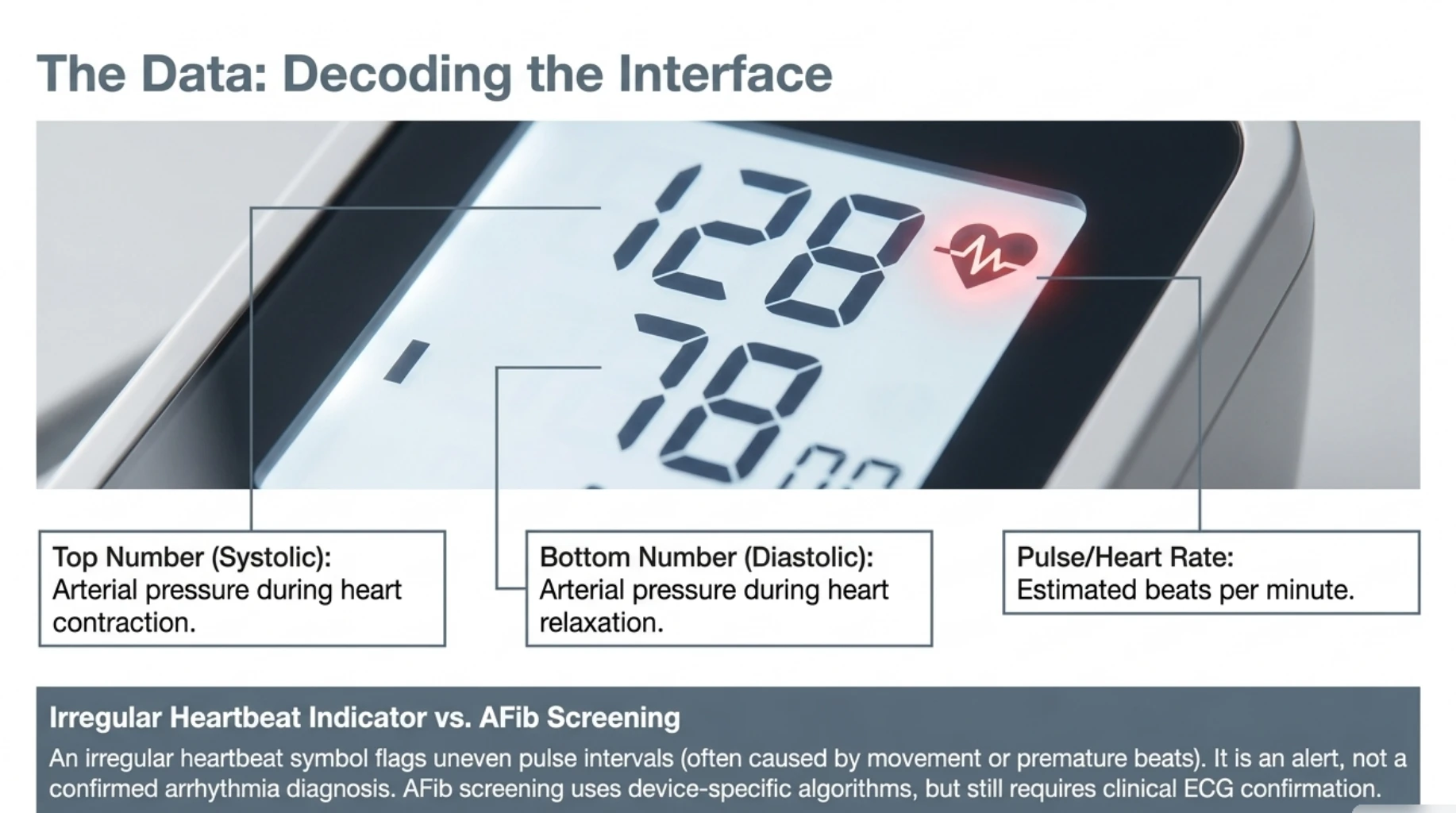
For example: 128/78 mmHg
The first number is the systolic blood pressure.
It represents arterial pressure during contraction of the heart.
The second is the diastolic blood pressure.
It represents arterial pressure during the relaxation phase between heartbeats.
Both numbers matter.
Is Systolic Blood Pressure More Important?
Systolic blood pressure becomes particularly important in cardiovascular risk assessment as people age, but that does not make diastolic pressure irrelevant.
Hypertension assessment considers the overall blood-pressure pattern, age, cardiovascular risk and clinical context.
A reading should not be interpreted by simply ignoring whichever number looks better.
What Is a Normal Home Blood Pressure?
This question needs more nuance than many online charts provide.
Diagnostic and treatment thresholds vary somewhat between major hypertension guidelines and depend on whether blood pressure is measured in a clinic, at home or using ambulatory monitoring.
Historically, many international home-monitoring frameworks have used an average home blood pressure of approximately 135/85 mmHg or higher as corresponding to clinic hypertension around 140/90 mmHg.
Some contemporary guidelines and treatment strategies use lower targets or thresholds in selected populations.
This is why a home reading should be interpreted according to the guideline and clinical context being used rather than assuming one internet number applies universally.
Why Home and Clinic Blood Pressure Thresholds Can Differ
Blood pressure measured at home is often lower than blood pressure recorded in a medical environment.
This is one reason home and clinic thresholds have traditionally differed.
| Setting | What to Remember |
|---|---|
| Clinic | Environment, technique and white-coat effect can influence the reading |
| Home | Repeated standardised readings may better represent usual out-of-office pressure |
| Ambulatory monitor | Provides daytime, night-time and 24-hour measurements using different diagnostic thresholds |
Do not mix thresholds from different measurement methods.
Do Not Diagnose Hypertension From One Home Reading
One reading of 145/90 does not provide the same information as an average of repeated correctly performed measurements remaining around that level.
Blood pressure varies.
Diagnosis usually relies on repeated measurements and appropriate clinical confirmation unless the blood pressure is severely elevated or there are circumstances requiring urgent evaluation.
This is why your home blood pressure monitor should be viewed as a tool for collecting useful data rather than a machine that independently diagnoses hypertension.
What Is White-Coat Hypertension?
White-coat hypertension describes a pattern in which blood pressure is elevated in the clinic but not elevated on appropriate out-of-office assessment.
Home blood-pressure monitoring or ambulatory monitoring can help identify this pattern.
It should not simply be assumed whenever someone dislikes visiting a doctor.
Appropriate measurements are needed to establish whether the discrepancy is real.
What Is Masked Hypertension?
Masked hypertension represents the opposite pattern.
Clinic blood pressure may appear acceptable while out-of-office blood pressure is elevated.
This is one reason a reassuring clinic reading does not always provide the entire picture in people with relevant cardiovascular risk or other reasons to suspect hypertension.
Home monitoring can sometimes help reveal this pattern.
Why Blood Pressure May Be Higher at Home Than at the Clinic
Although people commonly hear about white-coat hypertension, home readings can also be higher.
Possible explanations include:
- Masked hypertension.
- Incorrect home technique.
- Wrong cuff size.
- Recent physical activity.
- Caffeine or nicotine.
- Stress at home.
- Measurement at different times of day.
- Device problems.
Before concluding that one setting is “wrong,” compare technique, timing and equipment.
Why Blood Pressure Changes After Exercise
Exercise substantially alters cardiovascular physiology.
During aerobic exercise, systolic blood pressure normally rises to meet increased demand.
After exercise, blood pressure may temporarily fall in some people—a phenomenon known as post-exercise hypotension.
This is why measuring immediately before or after a workout is not equivalent to a standard resting home blood-pressure measurement.
If you are keeping a routine BP record, measure under consistent resting conditions.
Can Walking Lower Blood Pressure?
Regular aerobic activity, including brisk walking, can contribute to better blood-pressure control.
The effect develops through repeated exercise and broader cardiovascular adaptation rather than from obtaining one lower reading immediately after a walk.
For many people with hypertension, physical activity forms an important part of management alongside:
- Appropriate diet.
- Weight management when needed.
- Reduced excess sodium intake.
- Good sleep.
- Limiting alcohol.
- Medication when prescribed.
Blood Pressure After Coffee
Caffeine can temporarily increase blood pressure in some people.
The magnitude of the response varies.
If you drink coffee immediately before one measurement but not another, you introduce another variable into your home record.
For structured monitoring, measuring before caffeine under similar conditions can improve consistency.
Blood Pressure After Smoking or Nicotine
Nicotine can acutely influence heart rate and blood pressure.
This is one reason smoking or nicotine use shortly before a planned measurement should be avoided when possible.
More importantly, tobacco exposure is itself a major cardiovascular risk factor.
A normal home blood-pressure reading does not remove the cardiovascular harm associated with smoking.
Can a Full Bladder Increase Blood Pressure?
Yes, bladder distension can influence blood pressure.
This is why emptying your bladder is part of good measurement preparation.
It is a simple step, but home-monitoring accuracy depends on several simple steps being performed consistently.
Does Crossing Your Legs Affect Blood Pressure?
Leg position can influence measurement.
For standardised seated readings, keep both feet flat on the floor and avoid crossing your legs.
Again, the objective is not because crossing your legs suddenly causes hypertension.
It is because standardisation makes measurements more comparable.
Why Measuring Blood Pressure on a Sofa Can Be a Problem
A soft sofa may leave your back, feet or arm poorly supported.
You may also end up with the cuff substantially below heart level.
A normal chair and table often provide a much better setup.
Your measurement environment does not need to look like a clinic.
It simply needs to allow correct positioning.
Common Home Blood Pressure Measurement Mistakes
| Mistake | Better Approach |
|---|---|
| Measuring immediately after walking | Sit quietly for about 5 minutes first |
| Using a cuff that is too small | Match cuff size to measured arm circumference |
| Putting the cuff over clothing | Apply it to the bare upper arm |
| Arm hanging at the side | Support the arm around heart level |
| Crossing the legs | Keep both feet flat on the floor |
| Talking during measurement | Remain quiet |
| Taking only one reading | Use repeated readings when following a structured protocol |
| Recording only the lowest result | Record readings according to the planned protocol |
| Checking repeatedly because of anxiety | Use a predefined monitoring schedule |
| Changing medicines based on one home reading | Discuss treatment decisions with the treating clinician |
Why Your Home Blood Pressure Monitor May Seem Inaccurate
If your machine gives different readings within a few minutes, do not immediately conclude that it is defective.
First check:
- Was the cuff positioned the same way?
- Is the cuff the correct size?
- Were you talking?
- Was your arm supported?
- Had you rested adequately?
- Did you move during measurement?
- Is the device clinically validated?
Blood pressure itself changes continuously, so a good monitor is not expected to produce an identical number every time.
How to Check Whether Your Home BP Machine Is Working Properly
If you repeatedly obtain implausible or inconsistent readings despite correct technique, review the device instructions and cuff.
You can also bring the monitor to a medical appointment so your measurement technique can be observed and its readings can be compared with appropriately obtained clinic measurements.
Remember that this comparison is a practical check rather than a substitute for formal validation of the model.
Does a Blood Pressure Monitor Need Calibration?
Follow the manufacturer’s recommendations regarding maintenance, servicing and accuracy checks.
Electronic monitors can age or become damaged, particularly if dropped or stored poorly.
If a machine begins producing unexpected readings after years of use, do not automatically assume your blood pressure has suddenly become unstable.
Check both the patient and the equipment.
How Often Should You Replace a Home Blood Pressure Monitor?
There is no universal rule requiring every device to be replaced after a fixed number of years.
Consider replacement or assessment when:
- The device is damaged.
- The cuff or tubing deteriorates.
- The machine repeatedly produces questionable readings.
- The manufacturer no longer supports the device.
- A suitable cuff is no longer available.
A well-functioning validated monitor does not need to be replaced merely because a newer Bluetooth model has been released.
Should You Use the Same Home Blood Pressure Monitor for Years?
You can continue using a suitable device if it remains functional and the cuff is in good condition.
Consistency can actually be helpful for trend monitoring.
But do not allow familiarity with an old monitor to override obvious signs of damage or unreliable performance.
Home Blood Pressure Monitoring in Older Adults
For an older adult, usability may matter as much as advanced technology.
I would prioritise:
- A validated upper-arm device.
- A cuff that is easy to position.
- A large readable screen.
- Large buttons.
- Simple operation.
- Memory with date and time.
A complicated smartphone application may add little if it makes the device harder to use independently.
Home Blood Pressure Monitoring in People With Obesity
Cuff size becomes particularly important when upper-arm circumference is larger.
A standard cuff may not fit correctly.
Before buying a monitor, measure the arm and confirm that an appropriate cuff is supplied or available for that exact model.
This simple step can prevent a great deal of confusion from repeatedly elevated readings caused partly by incorrect cuff sizing.
Home Blood Pressure Monitoring in Diabetes
Blood-pressure control is especially important in people with diabetes because hypertension adds to cardiovascular and kidney risk.
Home monitoring can help assess blood-pressure patterns and treatment response.
However, having a home monitor does not replace periodic clinical assessment.
People with diabetes may also require monitoring of:
- Kidney function.
- Urine albumin.
- Blood glucose and HbA1c.
- Lipid levels.
- Other cardiovascular risk factors.
Home BP is one part of risk management.
Home Blood Pressure Monitoring and Kidney Disease
Blood-pressure management is also particularly important in chronic kidney disease.
But treatment targets can depend on kidney function, urine protein or albumin, age, medication and other clinical factors.
People with kidney disease should not independently intensify or reduce antihypertensive medication simply because a few home readings have changed.
The home record is valuable because it can inform treatment—not because it replaces treatment supervision.
Should You Check Blood Pressure When You Feel Dizzy?
It can sometimes provide useful information, particularly when symptoms may relate to low blood pressure or changes with posture.
But a normal seated reading does not explain every episode of dizziness.
If symptoms occur mainly after standing, formal assessment may require measurements in different positions.
Persistent dizziness, fainting or recurrent near-fainting deserves medical evaluation.
What if Your Home Blood Pressure Is Very Low?
There is no single low number that has the same meaning for everyone.
Some healthy people naturally have relatively low blood pressure without symptoms.
Concern increases when low readings are accompanied by:
- Dizziness.
- Fainting.
- Weakness.
- Confusion.
- Dehydration.
- Reduced urine output.
Medication, fluid loss, infection and other medical problems can contribute.
Treat the person, not just the monitor.
What if Your Home Blood Pressure Is Very High?
First, do not panic because of one unexpected reading.
Make sure the cuff is appropriate, sit quietly and repeat the measurement correctly.
However, very high blood pressure should not be repeatedly ignored, particularly when readings remain severely elevated.
Urgency becomes greater if markedly elevated blood pressure occurs with symptoms such as:
- Chest pain.
- Significant breathlessness.
- New neurological weakness or numbness.
- Difficulty speaking.
- Confusion.
- Severe visual disturbance.
- Other acute concerning symptoms.
In that situation, seek urgent medical care rather than spending time taking repeated measurements at home.
Never Change Blood Pressure Medication From One Reading
This is one of the most important safety rules in home monitoring.
Do not take an extra tablet because one reading is high unless you have specifically been given such a treatment plan by your clinician.
Similarly, do not routinely skip medication because one reading appears low or normal.
Treatment decisions usually depend on patterns, symptoms, medication timing and the broader clinical situation.
What Information Should You Record With Your Blood Pressure?
A useful home record does not need to become complicated.
Record:
- Date.
- Time.
- Systolic pressure.
- Diastolic pressure.
- Pulse.
When relevant, a short note can add context—for example, illness, unusual symptoms or a recent medication change.
There is usually no need to write an essay beside every reading.
Home Blood Pressure Monitoring: Consistency Beats Constant Checking
The objective is not to generate the largest possible collection of blood-pressure readings.
The objective is to obtain enough reliable, standardised measurements to understand the pattern.
A person who correctly measures twice in the morning and twice in the evening according to an agreed protocol can provide far more clinically useful information than someone who checks 15 times randomly throughout the day.
Your home blood pressure monitor is most valuable when it helps identify a pattern rather than encouraging you to chase individual numbers.
Budget vs Premium Home Blood Pressure Monitor: What Are You Really Paying For?
A more expensive blood pressure monitor is not automatically a more accurate one.
Once the essentials are covered—clinical validation, an appropriate cuff and reliable operation—the additional cost often pays for convenience features.
These may include:
- Bluetooth connectivity.
- Automatic smartphone syncing.
- More memory.
- Multiple-user profiles.
- Advanced averaging.
- Cuff-position indicators.
- Irregular-heartbeat or AFib screening features.
- Rechargeable batteries.
- Larger or more sophisticated displays.
Some of these features are genuinely useful.
But none should distract from the fundamental purpose of a home blood pressure monitor: obtaining reliable blood-pressure measurements.
Which Features Are Worth Paying Extra For?
If your budget allows, I would generally place additional value on features that either improve measurement technique or make long-term monitoring easier.
| Feature | How Useful Is It? |
|---|---|
| Validated measurement technology | Essential rather than optional |
| Wide-range correct-size cuff | Extremely important if it properly fits your arm |
| Automatic averaging | Useful for structured monitoring |
| Memory with date and time | Very practical for reviewing trends |
| Cuff-position indicator | Helpful for reducing some technique errors |
| Movement detection | Useful when movement may compromise a reading |
| Two-user memory | Useful when the device is shared |
| Bluetooth/app syncing | Convenient but not essential |
| Irregular-heartbeat alert | Potentially useful but not diagnostic |
| Voice function | Useful for selected users but unnecessary for many people |
Features You Probably Do Not Need to Prioritise
Marketing can make relatively minor features appear essential.
Do not choose a blood pressure monitor primarily because it has:
- A fashionable design.
- A colour screen.
- A large number of app graphs.
- Cloud storage.
- Voice announcements.
- Premium packaging.
There is nothing wrong with these features.
But they do not compensate for uncertain validation or an inappropriate cuff.
If your budget is limited, spend your money on measurement quality before digital extras.
Should You Buy a Bluetooth Blood Pressure Monitor?
Bluetooth is particularly useful if you know that maintaining a handwritten blood-pressure diary will be difficult.
Automatic syncing can reduce transcription errors and make it easier to review weeks or months of readings.
It may also make it easier to share a structured record during a consultation.
However, check what happens if the app stops working or you change your phone.
The monitor itself should remain usable without depending entirely on a smartphone.
Should You Buy a Rechargeable BP Monitor?
Rechargeability is primarily a convenience feature.
It does not make the measurement more accurate.
A rechargeable device can be useful if you measure frequently and do not want to replace batteries.
On the other hand, standard replaceable batteries can be convenient when travelling because replacements are widely available.
Choose whichever power system makes regular use easier for you.
Should You Buy a Monitor With AFib Screening?
An atrial-fibrillation screening feature may provide additional value for selected people, particularly when the feature has been specifically validated.
However, it should be understood as a screening function.
A possible AFib alert is not the same as a confirmed diagnosis.
Similarly, the absence of an alert does not guarantee that intermittent atrial fibrillation is absent.
Repeated alerts may require appropriate rhythm assessment, often involving an ECG or longer-duration rhythm monitoring depending on the clinical situation.
Can a Home Blood Pressure Monitor Detect an Irregular Heartbeat?
Many automatic monitors can detect irregular pulse intervals while the cuff is measuring blood pressure.
This may generate an irregular-heartbeat symbol.
The feature can be useful as an alert, but several things can produce irregularity during a measurement.
Therefore: Irregular-heartbeat symbol ≠ confirmed arrhythmia diagnosis.
If the alert appears repeatedly, especially if you also experience palpitations, dizziness, fainting or breathlessness, discuss it with your clinician.
Can a Home Blood Pressure Monitor Measure Heart Rate Accurately?
Most automatic monitors also display pulse rate during the blood-pressure measurement.
This provides a useful resting pulse estimate.
However, a blood-pressure machine is not intended to replace comprehensive rhythm assessment.
Heart rate and heart rhythm are related but different.
A display showing 76 beats per minute does not necessarily tell you whether every beat occurred in a normal rhythm.
Special Situations Where Choosing a BP Monitor Needs More Care
Standard automatic upper-arm monitors work well for many adults, but certain circumstances require additional consideration.
These can include:
- Pregnancy.
- Very large arm circumference.
- Very small arm circumference.
- Irregular heart rhythms.
- Significant movement disorders.
- Certain vascular or medical conditions.
In these situations, it becomes especially important to check whether the specific device has been validated for the relevant population or circumstances.
Home Blood Pressure Monitor During Pregnancy
Blood-pressure monitoring can be particularly important during pregnancy because hypertensive disorders of pregnancy require appropriate recognition and management.
If a monitor is being purchased specifically for use during pregnancy, check whether the particular model has been appropriately validated for pregnant populations.
This becomes especially important when hypertensive disorders of pregnancy are suspected or already present.
Do not assume that validation in the general adult population automatically guarantees equivalent performance in every special population.
Blood Pressure Monitoring With an Irregular Heart Rhythm
Automatic oscillometric monitors estimate blood pressure partly from pulse-related oscillations in the cuff.
Irregular rhythms can complicate measurement in some circumstances.
If you have a known arrhythmia, choose a monitor with evidence supporting its use in the relevant situation and discuss measurement strategy with your clinician.
Multiple readings may also become particularly important.
What if a Standard Upper-Arm Cuff Does Not Fit?
Do not force it.
First determine whether the manufacturer offers a compatible larger or smaller cuff.
If appropriate upper-arm measurement is genuinely impractical, an appropriately validated alternative device may need to be considered.
The important point is not to knowingly use an incorrectly fitting cuff simply because the monitor was already purchased.
Can Two Family Members Share the Same Blood Pressure Monitor?
Yes, provided the cuff fits both users appropriately and the device is cleaned and maintained according to the manufacturer’s instructions.
If the monitor stores readings, separate user profiles are helpful.
Otherwise, one person’s measurements may contaminate the other’s averages.
If arm sizes differ substantially, you may also need compatible cuffs of different sizes.
Should You Buy a Manual or Digital Blood Pressure Monitor?
For routine self-monitoring at home, an automatic digital upper-arm monitor is usually much easier to use correctly.
Manual auscultatory measurement requires:
- An appropriate cuff.
- A stethoscope.
- Correct inflation and deflation technique.
- Recognition of Korotkoff sounds.
- Adequate hearing and coordination.
There is little advantage in buying a manual sphygmomanometer for routine self-monitoring if you are not trained to use it correctly.
Should You Buy a Mercury Blood Pressure Monitor for Home Use?
No practical advantage exists for most people to seek a mercury sphygmomanometer for home self-monitoring.
Modern validated automatic upper-arm monitors are far more convenient for routine home use and avoid the practical and environmental issues associated with mercury-containing equipment.
Can You Buy a BP Monitor Online?
Yes, but online purchasing makes it particularly important to check the exact model rather than relying on the product title.
Before ordering, confirm:
- Exact model number.
- Validation status.
- Cuff-size range.
- Warranty.
- Availability of replacement cuffs.
- Power requirements.
- Whether the seller appears reliable.
Be cautious when a product page makes impressive accuracy claims but does not clearly identify the manufacturer or model.
Do Not Buy a Blood Pressure Monitor Based Only on “Best Seller” Status
Popularity is not clinical validation.
A product can become a bestseller because it is inexpensive, heavily advertised or highly rated for convenience.
None of those factors tells you whether the exact model has undergone an appropriate blood-pressure validation protocol.
Start with validation.
Then compare price and convenience.
Do You Need the Most Popular BP Monitor Brand?
No.
Brand reputation can be helpful because established manufacturers may offer better cuff availability, technical support and warranty service.
But I would still check the exact model.
Do not assume every monitor from a familiar manufacturer has identical validation evidence.
A Simple Home Blood Pressure Monitor Buying Checklist
Before pressing the “Buy Now” button, go through this checklist.
| Question | Check |
|---|---|
| Is the exact model clinically validated? | □ |
| Is it an automatic upper-arm monitor when appropriate? | □ |
| Have I measured my upper-arm circumference? | □ |
| Does the supplied cuff fit my arm? | □ |
| Can it store readings with date and time? | □ |
| Can it average repeated readings? | □ |
| Is the display easy for me to read? | □ |
| Are the buttons and cuff easy to use? | □ |
| If sharing it, does it have separate user profiles? | □ |
| Are replacement cuffs and accessories available? | □ |
| Does it have a suitable warranty? | □ |
| Do I actually need Bluetooth or an app? | □ |
The Three Things I Would Check First
If the buying process feels complicated, reduce it to three questions.
1. Is This Exact Model Validated?
Not just the brand.
Not a similar-looking model.
The exact model you intend to purchase.
2. Does the Cuff Fit My Arm?
Measure your upper-arm circumference rather than guessing.
3. Can I Use It Easily and Correctly?
If the machine is so complicated that you avoid using it, its extra features have little value.
Red Flags When Shopping for a Home Blood Pressure Monitor
I would be cautious if:
- The manufacturer is difficult to identify.
- The exact model number is unclear.
- No cuff-size range is provided.
- The seller makes unrealistic medical claims.
- Validation information cannot be found.
- The device promises to diagnose multiple cardiovascular diseases from a routine BP measurement.
- The product relies mainly on reviews rather than technical information.
A medical measurement device should inspire confidence because of evidence and appropriate design—not because of aggressive marketing.
What Should You Do After Buying a Home Blood Pressure Monitor?
Do not immediately begin taking random readings throughout the day.
First:
- Read the instructions.
- Set the correct date and time.
- Confirm the cuff fits.
- Learn correct sitting position.
- Decide which arm you will routinely use.
- Follow a structured monitoring schedule when monitoring is clinically indicated.
If you are uncertain about technique, take the machine to your next medical consultation.
When Should a Home Blood Pressure Reading Need Medical Attention?
The urgency depends on both the number and the person’s symptoms.
A single unexpectedly high reading should generally be repeated correctly after quiet rest rather than triggering panic.
Persistent severe elevation is different.
And severe elevation accompanied by acute symptoms requires greater urgency.
| Situation | Practical Response |
|---|---|
| One mildly elevated reading without symptoms | Rest, repeat correctly and look at the broader pattern |
| Repeated readings above your usual range | Keep an appropriate record and discuss persistent elevation with your clinician |
| Repeated very high readings | Seek timely medical advice rather than ignoring the pattern |
| Very high BP with chest pain, significant breathlessness, neurological symptoms or confusion | Seek urgent medical care |
| Low BP with fainting, severe dizziness or significant weakness | Seek medical assessment |
What About a Blood Pressure of 180/120 mmHg or Higher?
A reading around or above 180/120 mmHg represents severe blood-pressure elevation and should not simply be ignored.
If you obtain such a reading, remain seated and repeat it correctly after a short period of quiet rest to exclude an obvious measurement problem.
If severe elevation persists, seek prompt medical advice.
If markedly elevated blood pressure occurs with symptoms such as chest pain, severe breathlessness, new weakness or numbness, difficulty speaking, confusion, significant visual disturbance or other acute neurological symptoms, seek emergency medical care.
Do not spend the next hour repeatedly checking the machine while serious symptoms are present.
Can You Adjust Blood Pressure Medicine According to Home Readings?
Only when your treating clinician has provided a specific adjustment plan.
Otherwise, do not independently:
- Double a dose because of one high reading.
- Take an extra tablet “just in case.”
- Skip medication because today’s reading is normal.
- Stop treatment because several readings improved.
A normal blood pressure while taking medication may simply mean the treatment is working.
It does not necessarily mean the medication is no longer required.
Frequently Asked Questions About Home Blood Pressure Monitors
Which Type of Home Blood Pressure Monitor Is Best?
For most adults, a clinically validated automatic upper-arm monitor with an appropriately sized cuff is generally the preferred option for routine home monitoring.
Are Wrist Blood Pressure Monitors Accurate?
A validated wrist monitor can provide useful measurements when used correctly, but positioning is particularly important. An upper-arm device is generally preferred when appropriate upper-arm measurement is feasible.
Are Digital BP Machines Accurate?
Validated automatic devices can provide clinically useful home measurements. Accuracy depends on the specific device, correct cuff size and proper measurement technique.
How Do I Know Whether My BP Monitor Is Clinically Validated?
Check the exact model against a recognised validated-device listing or look for evidence that it has passed an accepted clinical validation protocol. Do not assume that every model from the same brand has identical validation status.
Does Cuff Size Really Affect Blood Pressure?
Yes. An inappropriate cuff can distort the reading. Measure your upper-arm circumference and ensure it falls within the cuff range specified for the monitor.
Should I Buy a BP Monitor With Bluetooth?
Bluetooth is optional. It can make record keeping and trend review easier, but it does not make the blood-pressure measurement inherently more accurate.
Do I Need an Irregular Heartbeat Detector?
It is a useful additional feature but not essential for everyone. Repeated irregular-heartbeat alerts should be interpreted clinically rather than treated as a confirmed diagnosis.
Can a BP Monitor Detect Atrial Fibrillation?
Some models include specifically designed AFib screening algorithms. A screening alert can indicate that further rhythm assessment may be appropriate, but it does not independently confirm the diagnosis.
How Many Times Should I Check My Blood Pressure?
For structured home monitoring, two readings approximately one minute apart during morning and evening sessions are commonly used over several days. The exact schedule should reflect why you are monitoring.
Which Arm Should I Use?
Both arms may be assessed initially. If a consistent difference is identified, the arm with the higher pressure is commonly used for ongoing measurements. Follow your clinician’s advice when a significant difference exists.
Why Is My First Blood Pressure Reading Always Higher?
You may still be settling down or experiencing anticipatory tension during the first measurement. Repeated standardised readings can provide a more representative picture.
Why Does My BP Machine Give Different Readings Within Minutes?
Blood pressure naturally fluctuates. Movement, posture, talking, stress and inadequate rest can add further variation. Different readings do not automatically mean the monitor is faulty.
Can I Measure Blood Pressure Over Clothing?
For consistent home measurement, apply the cuff to the bare upper arm rather than over clothing.
Can Two People Use the Same BP Monitor?
Yes, provided the cuff fits both people. Separate memory profiles are useful so readings and averages are not mixed.
How Long Does a Home BP Monitor Last?
There is no universal replacement interval. Follow the manufacturer’s maintenance guidance and reassess the device if it is damaged, the cuff deteriorates or readings become persistently questionable.
Should I Take My BP Machine to My Doctor?
It can be useful when you first start monitoring or when home readings appear inconsistent with clinic measurements. Your technique and cuff fit can also be reviewed.
Can I Diagnose Hypertension With a Home BP Monitor?
Home readings are extremely useful in evaluating hypertension, but diagnosis should be based on an appropriate series of measurements and clinical interpretation rather than one isolated reading.
What Should I Do if My Home BP Is Repeatedly High?
Make sure the measurements are being performed correctly, keep a structured record and arrange medical review if elevated readings persist. Severe elevations or concerning symptoms require more urgent assessment.
Home Blood Pressure Monitor: Final Buying Checklist
| Priority | What to Look For |
|---|---|
| Highest priority | Clinical validation of the exact model |
| Highest priority | Cuff size appropriate for your measured upper-arm circumference |
| Highest priority | Automatic upper-arm measurement when suitable |
| Very useful | Automatic averaging of repeated measurements |
| Very useful | Memory with date and time |
| Useful | Cuff-position and movement indicators |
| Useful | Irregular-heartbeat detection |
| Situation dependent | Separate user profiles |
| Optional convenience | Bluetooth and smartphone app |
| Optional convenience | Rechargeable battery, voice guidance and premium display |
Final Thought
When choosing a home blood pressure monitor, the most impressive feature is not Bluetooth, a colour display or a sophisticated smartphone graph.
It is obtaining a reliable blood-pressure reading from a properly validated device with the right cuff while using correct technique.
Buy the measurement first. Buy the smart features second.
If you want a personalized metabolic assessment and lifestyle strategy, you can book a consultation here:
Book an Appointment