

Why Choosing a Pulse Oximeter Requires More Than Checking the Price
A pulse oximeter is one of the simplest medical devices you can use at home. Place it on your fingertip, wait a few seconds, and the screen displays your oxygen saturation and pulse rate.
But a number appearing on the screen does not necessarily mean the measurement is accurate.
Two pulse oximeters placed on the same person may sometimes display different oxygen saturation values. Even the same device can produce different readings when the finger is cold, the person is moving, or the sensor is poorly positioned.
This is particularly important because oxygen saturation readings may influence decisions about seeking medical care.
During the COVID-19 pandemic, many households purchased inexpensive fingertip pulse oximeters. Some were useful, but consumers also encountered devices with uncertain performance, inconsistent readings and exaggerated marketing claims.
The purpose of this pulse oximeter buying guide is to explain what actually matters when choosing a device.
The most important considerations are not necessarily Bluetooth connectivity, a colourful display or a long list of advertised features. They are whether the device has appropriate evidence of performance, whether it produces a reliable signal and whether you understand its limitations.
What Is a Pulse Oximeter?
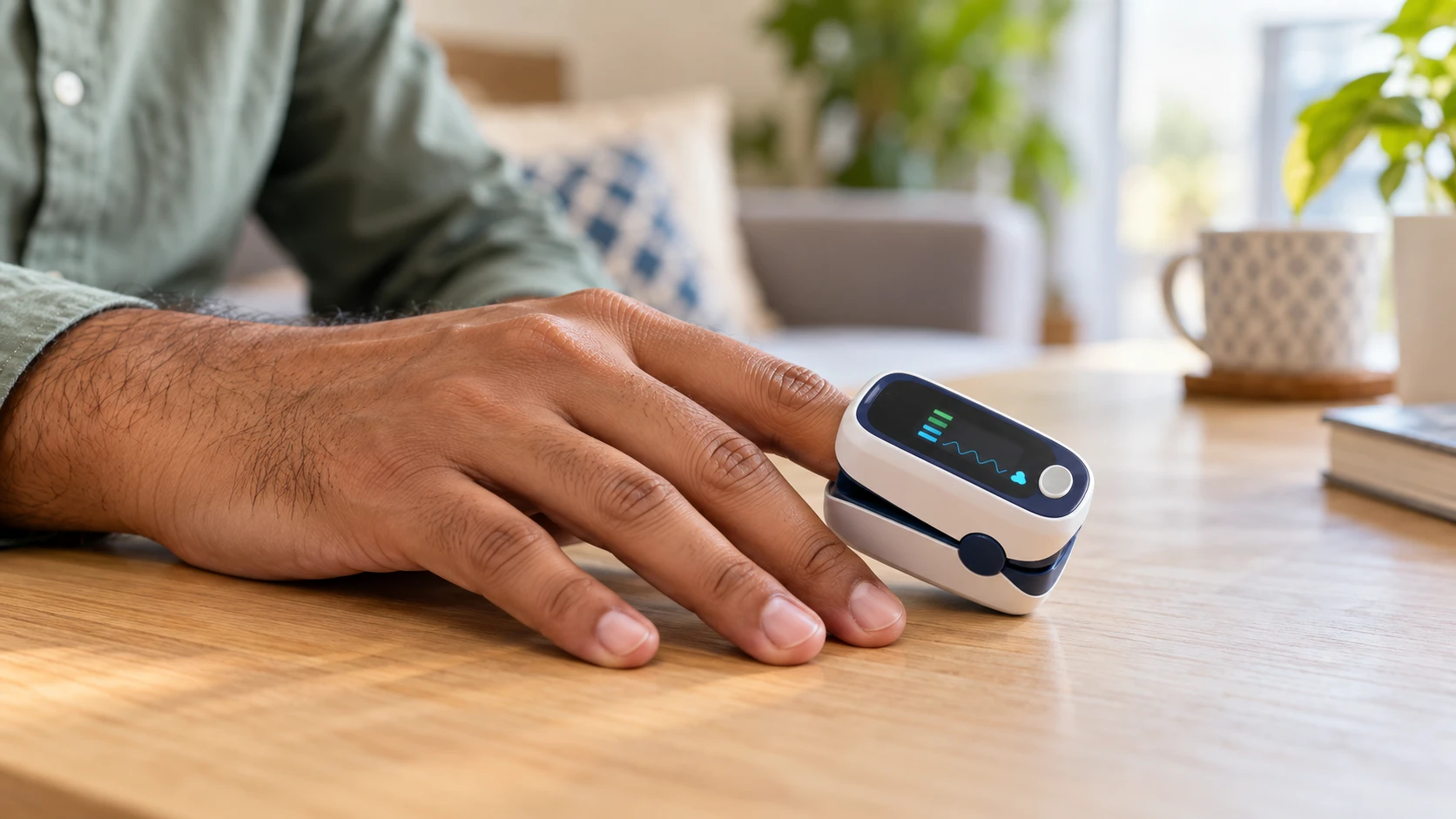
A pulse oximeter is a non-invasive device that estimates the percentage of haemoglobin in arterial blood carrying oxygen. This estimate is called peripheral oxygen saturation, abbreviated as SpO2.
Most home devices also display pulse rate in beats per minute.
For example, a reading may show:
- SpO2: 97%
- Pulse rate: 76 beats per minute
The first number estimates oxygen saturation. The second estimates how frequently your heart is beating.
These are different measurements and should not be confused.
How Does a Fingertip Pulse Oximeter Work?
A conventional pulse oximeter uses light at two different wavelengths, generally red and infrared, to estimate oxygen saturation.
Oxygenated and deoxygenated haemoglobin absorb these wavelengths differently. The device analyses changes in transmitted or reflected light associated with pulsatile blood flow and uses an algorithm to estimate SpO2.
This explains why circulation, finger positioning, movement and optical interference can affect the reading.
The device is not directly measuring the amount of oxygen dissolved in your blood. It is estimating haemoglobin oxygen saturation using an optical signal.
SpO2 vs PaO2: Understanding the Difference
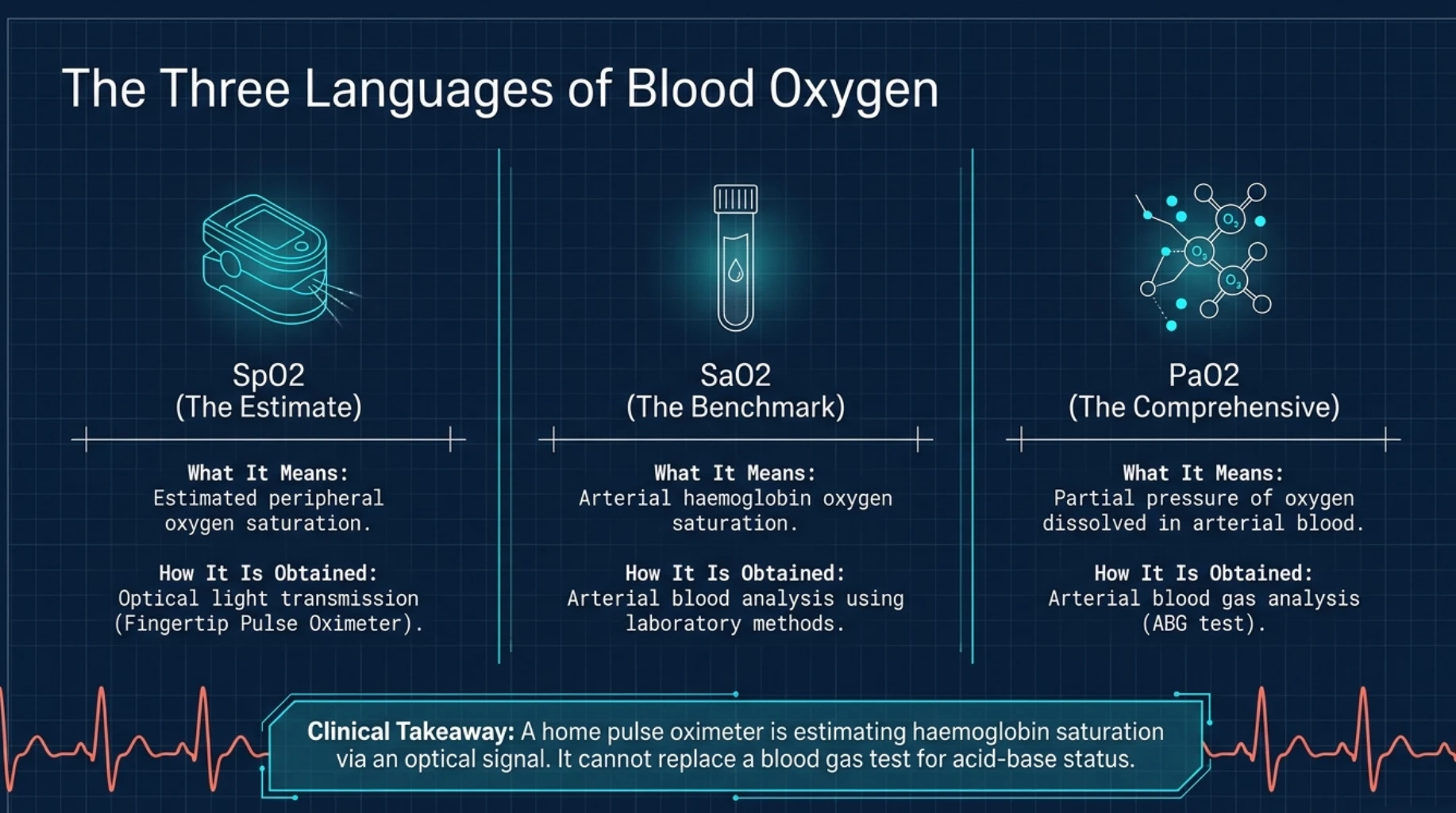
SpO2 and PaO2 are related, but they are not interchangeable.
| Measurement | What It Means | How It Is Obtained |
|---|---|---|
| SpO2 | Estimated peripheral oxygen saturation | Pulse oximeter |
| SaO2 | Arterial haemoglobin oxygen saturation | Arterial blood analysis using appropriate laboratory methods |
| PaO2 | Partial pressure of oxygen dissolved in arterial blood | Arterial blood gas analysis |
A pulse oximeter therefore cannot replace an arterial blood gas test when detailed assessment of oxygenation, ventilation or acid-base status is needed.
Who May Benefit From Having a Pulse Oximeter at Home?
Not every healthy adult needs to purchase a pulse oximeter.
However, home monitoring may be useful when recommended by a clinician for selected respiratory or medical conditions.
Examples include people with chronic respiratory disease, patients recovering from certain respiratory illnesses, or individuals receiving prescribed home oxygen therapy.
In these situations, a pulse oximeter may help identify changes from a person’s usual oxygen saturation.
But the device should be used as part of a clinical monitoring plan, not as a substitute for medical assessment.
Should Every Household Have a Pulse Oximeter?
There is no universal requirement for every household to own one.
For a healthy person without respiratory symptoms or a medical reason for monitoring, frequent SpO2 checks may add little useful information.
In contrast, a person with an established respiratory condition may benefit from knowing their usual readings and having clear instructions about when to seek help.
The usefulness of the device depends on why it is being used.
What Is a Normal Oxygen Saturation?
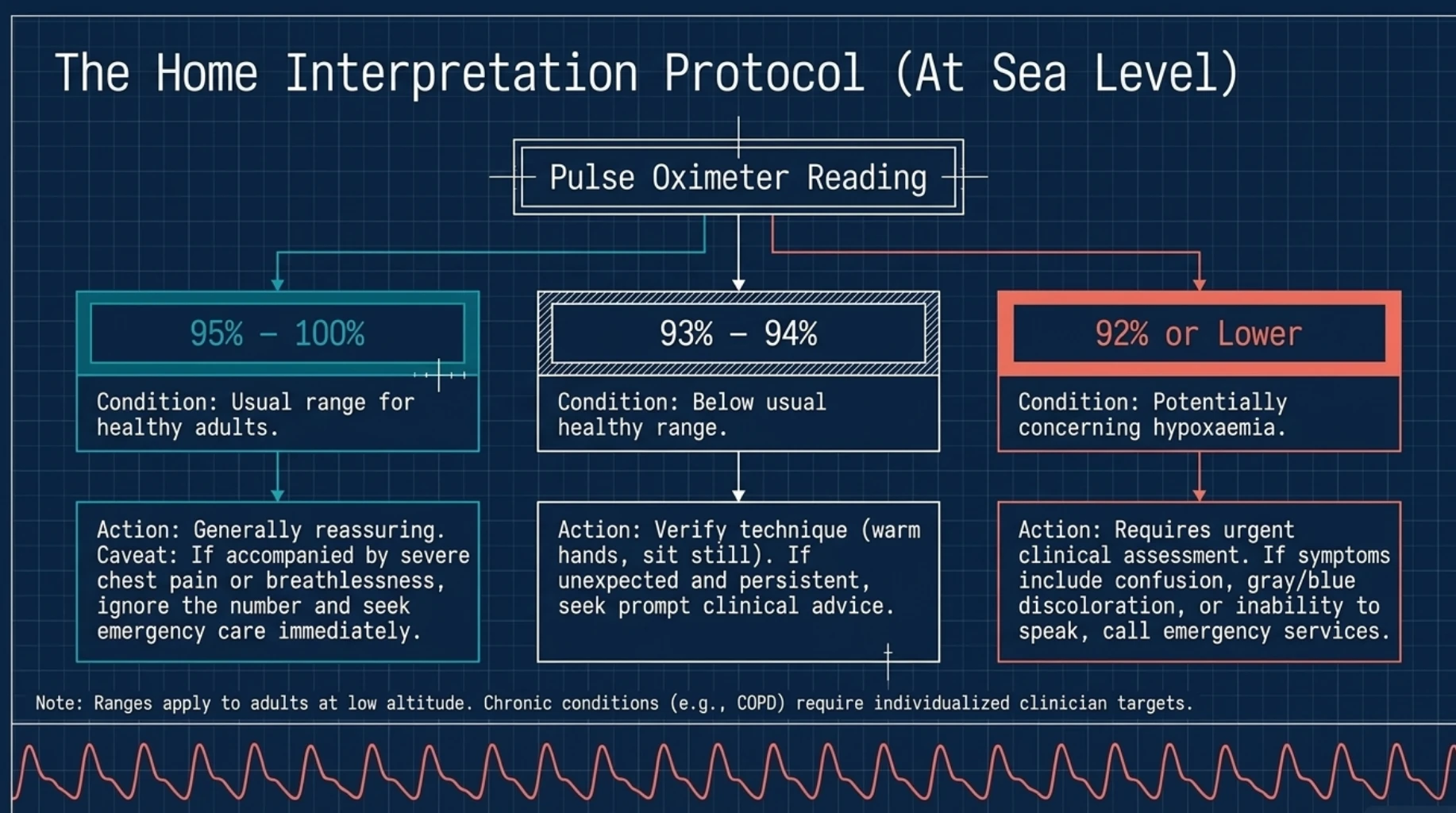
At sea level, healthy adults commonly have oxygen saturation readings around 95–100% while breathing room air.
However, interpretation depends on several factors, including altitude, underlying lung disease, clinical symptoms and the accuracy limitations of the device.
Some people with chronic respiratory conditions may have lower baseline readings or individualised oxygen targets established by their treating clinician.
A single number should never be interpreted without considering the person.
| SpO2 Reading | General Interpretation |
|---|---|
| 95–100% | Common range in healthy adults at sea level, but does not exclude serious illness |
| 93–94% | Below the usual healthy range; repeat correctly and seek prompt clinical advice if unexpected or persistent |
| 92% or lower | Potentially concerning; requires urgent clinical assessment when unexpected, with emergency care for severe symptoms |
| Individualised lower target | May apply to selected patients with chronic respiratory disease under a clinician-directed plan |
These ranges are general guidance for adults at low altitude, not universal diagnostic or treatment thresholds. Readings may be inaccurate, and symptoms always matter. Severe breathlessness, confusion, blue or grey discolouration, chest pain or collapse requires emergency assessment regardless of the displayed SpO2.
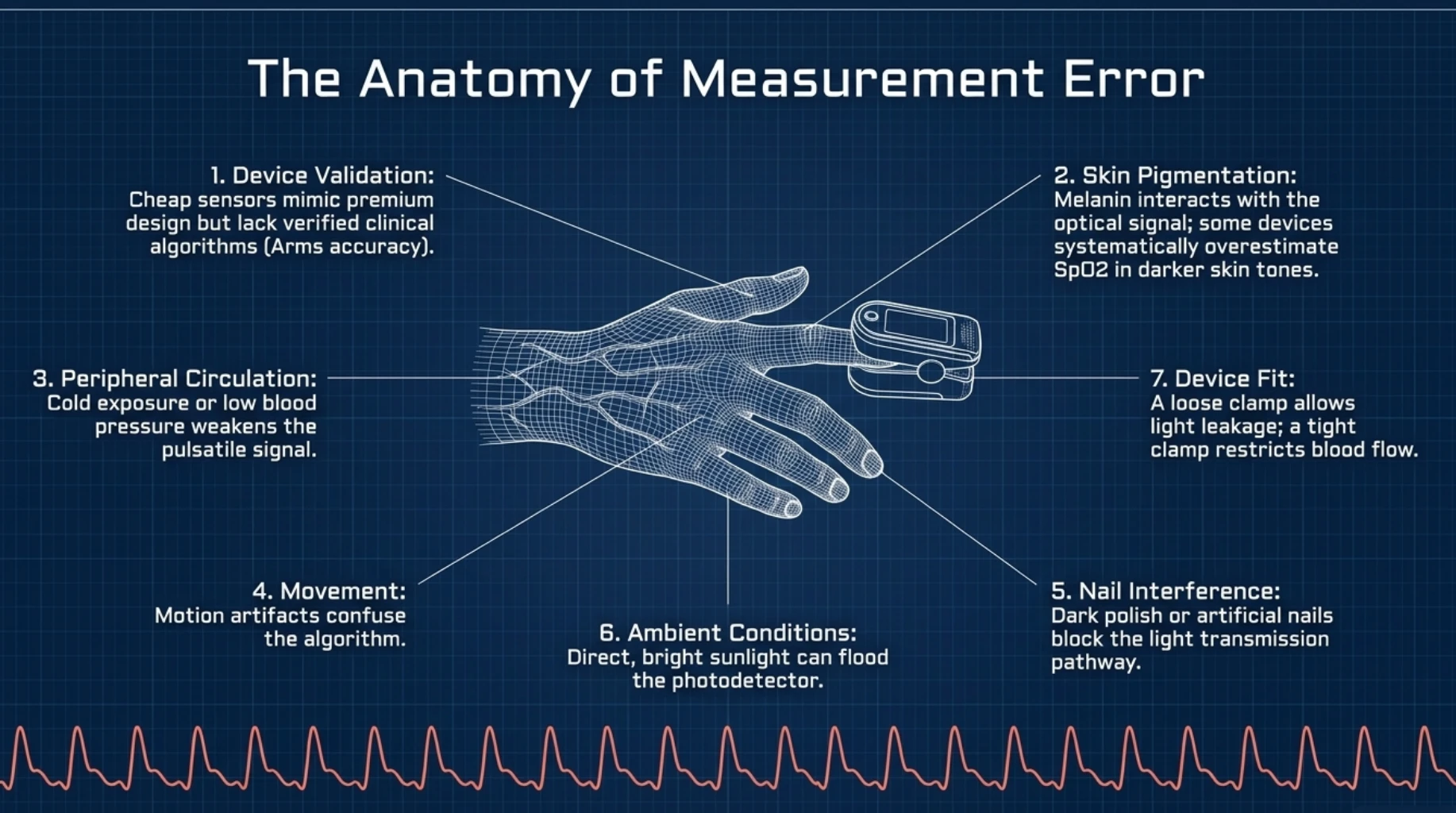
Pulse Oximeter Buying Guide: 7 Factors That Affect Accuracy
When comparing devices, it helps to separate two questions.
First, is the pulse oximeter itself capable of producing clinically useful measurements?
Second, are the conditions during measurement suitable for obtaining a reliable signal?
Both matter. A well-designed device can produce a misleading reading when used incorrectly, while perfect technique cannot compensate for a device with poor measurement performance.
1. Device Validation and Measurement Performance
The first consideration in any pulse oximeter buying guide should be evidence of device performance.
Many inexpensive pulse oximeters advertise accuracy without clearly explaining how that claim was established.
A statement such as “high precision” or “professional accuracy” is not sufficient evidence.
Ideally, the manufacturer should provide credible information about the device’s performance and the standards or testing methods used.
What Does Pulse Oximeter Accuracy Mean?
Pulse oximeter accuracy is commonly evaluated by comparing device readings with arterial oxygen saturation obtained through reference methods under controlled testing conditions.
Manufacturers may report an accuracy specification using a measure such as root mean square error, often called Arms.
This describes performance across a group of measurements. It does not mean every individual reading will be within the advertised number of percentage points of the true saturation.
For example, an advertised accuracy specification of ±2 percentage points should not be interpreted as a guarantee that every displayed value is within exactly two points of the true oxygen saturation.
Individual errors can be larger, particularly under difficult measurement conditions.
Why Regulatory Claims Need Careful Interpretation
When evaluating a pulse oximeter, look for clear manufacturer information, its intended medical use and appropriate regulatory status.
Be cautious about vague claims such as “hospital grade” without supporting evidence.
Similarly, a generic certification symbol or an online seller’s description does not by itself establish that the exact model has undergone adequate clinical performance testing.
For home medical monitoring, the exact device model matters more than an impressive-looking advertisement.
Medical Pulse Oximeter vs Wellness Gadget
Some products are intended for medical monitoring, while others are marketed primarily for fitness, wellness or general information.
These intended uses may be associated with different levels of evidence and regulatory oversight.
If you need oxygen saturation measurements because of a medical condition, choose a device intended for appropriate medical use rather than relying on a general wellness gadget.
2. Skin Pigmentation and Optical Measurement Bias
One of the most important limitations of pulse oximetry is that measurement performance can differ across skin pigmentation.
Research has identified situations in which pulse oximeters may overestimate oxygen saturation in people with darker skin pigmentation, potentially failing to identify some episodes of low arterial oxygen saturation.
This matters because a reassuring displayed value may not always reflect the true oxygen saturation.
Why Can Skin Pigmentation Affect Pulse Oximeter Accuracy?
Pulse oximeters estimate oxygen saturation using light passing through or reflecting from tissue.
Melanin and other optical characteristics of tissue can influence the light signal and interact with device algorithms.
The extent of bias varies between devices, measurement conditions and individuals.
It is therefore incorrect to assume that every device has exactly the same degree of bias.
Why This Matters for Indian Patients
India has considerable variation in skin pigmentation. Consumers should not assume that a pulse oximeter’s performance is identical across all skin tones simply because the product is widely sold.
When manufacturers provide credible evidence of testing across a diverse range of skin pigmentation, that information is valuable.
However, such evidence may not be readily available for many inexpensive consumer devices.
The practical message is important: do not allow a normal-looking SpO2 reading to override concerning respiratory symptoms.
Can a Pulse Oximeter Show Normal SpO2 During Low Oxygen Levels?
Yes. Pulse oximetry can sometimes overestimate arterial oxygen saturation.
This possibility is particularly concerning when the displayed reading delays recognition of clinically important hypoxaemia.
Someone with significant breathlessness, confusion, worsening respiratory symptoms or other concerning signs needs medical assessment even if the device displays a number that appears acceptable.
3. Finger Temperature and Peripheral Circulation
A pulse oximeter depends on detecting a pulsatile blood-flow signal.
When circulation to the finger is reduced, the signal may become weak or unstable.
This is why cold fingers can cause difficulty obtaining a reliable reading.
Peripheral circulation may be affected by:
- Cold exposure.
- Vasoconstriction.
- Low blood pressure.
- Shock.
- Peripheral vascular disease.
- Other conditions affecting tissue perfusion.
Why Does a Pulse Oximeter Sometimes Fail on Cold Fingers?
Cold exposure can reduce blood flow to the extremities.
The device may then struggle to identify the pulsatile component of the optical signal.
This can produce delayed readings, fluctuating values or failure to display a result.
When cold fingers are the likely explanation and the person is otherwise well, gently warming the hand and repeating the measurement may improve signal quality.
However, a persistently poor signal in someone who appears seriously unwell should not be dismissed as a minor equipment problem.
Does Low Blood Pressure Affect Pulse Oximeter Accuracy?
It can, particularly when low blood pressure is accompanied by reduced peripheral perfusion.
In serious illness, the device may have difficulty obtaining a reliable signal from the finger.
A missing or unstable reading does not necessarily mean oxygen saturation is normal or abnormal. It may mean the monitor cannot measure reliably under the circumstances.
4. Movement and Motion Artefacts
Movement is another major source of pulse oximeter error.
Most fingertip devices work best when the hand is still.
Movement can interfere with the optical signal and make it more difficult for the device to distinguish pulsatile blood flow from artefacts.
Why SpO2 May Fluctuate When You Move
If you repeatedly move your hand, tap your fingers or reposition the sensor, the displayed oxygen saturation may fluctuate.
This does not necessarily represent a real physiological change in blood oxygenation.
The monitor may simply be struggling to process the signal.
For routine measurement, sit comfortably, support the hand and remain still until the reading stabilises.
Do All Pulse Oximeters Handle Movement Equally Well?
No.
Signal-processing algorithms differ between manufacturers and models.
Some devices are specifically designed to perform better during motion or reduced perfusion, but such claims should be supported by appropriate performance evidence.
For most routine home measurements, avoiding unnecessary movement is still the simplest approach.
5. Nail Polish, Artificial Nails and Sensor Placement
Nail products can interfere with the optical pathway used by some fingertip pulse oximeters.
The effect varies with the type, colour and thickness of the material, as well as the device itself.
Dark nail polish and artificial nails may cause problems in some circumstances.
Should You Remove Nail Polish Before Measuring SpO2?
If the reading is unexpected, unstable or difficult to obtain, removing nail polish or using a suitable finger without nail products may help.
Not every nail polish colour causes a clinically meaningful error with every device, so the effect should not be exaggerated.
Nevertheless, avoiding potential optical interference is sensible when a reliable medical measurement is important.
Does Finger Position Matter?
Yes.
The fingertip should be inserted according to the manufacturer’s instructions, with the sensor properly aligned.
If the finger is only partly inserted, the optical signal may be inadequate.
Similarly, a device that fits poorly may produce unstable readings.
Some oximeters are designed primarily for adult fingers, while paediatric measurement may require a different sensor design.
Can You Use a Pulse Oximeter on Any Finger?
Many standard fingertip devices can be used on different fingers, but the best choice depends on fit, circulation and manufacturer guidance.
For repeated home monitoring, using a consistent finger and technique can make trends easier to interpret.
Do not assume that changing fingers and obtaining a different number necessarily means your oxygen saturation has changed.
6. Ambient Light and Environmental Conditions
Because pulse oximetry uses light, external lighting can sometimes interfere with the measurement.
Bright direct sunlight or certain strong light sources may affect some sensors, particularly if the device does not adequately shield the measurement area.
Good sensor design can reduce this interference, but environmental conditions still matter.
Can Sunlight Affect a Pulse Oximeter?
Yes, particularly when strong light reaches the sensor and interferes with optical detection.
If a reading is unstable outdoors, move into a more controlled environment and repeat the measurement.
Do not assume that every low or fluctuating value is caused by sunlight, especially when symptoms are present.
Does Room Temperature Affect SpO2 Readings?
Room temperature can influence peripheral circulation, especially when the environment is cold.
This is an indirect effect rather than a simple rule that colder rooms always produce lower oxygen saturation.
Cold-induced vasoconstriction may weaken the signal, making the device less reliable.
7. Device Fit, Signal Quality and Display Stability
The final factor combines several practical characteristics that determine whether the device can obtain and display a dependable reading.
A fingertip oximeter needs an appropriate fit, sufficient signal quality and a stable measurement before the number is interpreted.
These considerations become especially important when purchasing an inexpensive device.
Why Device Fit Matters
A sensor that is too loose may not maintain adequate alignment with the finger.
A poorly fitting device can allow movement or external light interference.
A device that is too small may be uncomfortable or unsuitable for larger fingers.
Fit is therefore a practical buying consideration, not merely a comfort issue.
What Is a Plethysmography Waveform?
Some pulse oximeters display a waveform representing changes in the detected pulsatile signal.
This is often called a plethysmographic or pleth waveform.
A consistent waveform may help indicate that the device is detecting a reasonably stable pulse signal.
However, a waveform does not independently prove that the oxygen saturation value is accurate.
What Is Perfusion Index?
Some devices display a perfusion index, often abbreviated as PI.
This is a device-derived indicator related to the strength of the pulsatile signal at the measurement site.
A low PI may indicate weak peripheral pulsation, but interpretation varies by device and clinical circumstances.
It is not a universal diagnostic measurement of circulation and should not be used to diagnose shock or vascular disease at home.
Why a Stable Reading Matters
When you first place a pulse oximeter on your finger, the displayed value may fluctuate as the device acquires the signal.
It is generally better to allow the reading to stabilise rather than recording the first number that appears.
But stability alone does not guarantee accuracy.
A consistently displayed number can still be biased by device limitations or measurement conditions.
The 7 Factors Affecting Pulse Oximeter Accuracy at a Glance
| No. | Factor | Why It Matters | What to Check |
|---|---|---|---|
| 1 | Device validation | Determines confidence in measurement performance | Credible testing and exact model information |
| 2 | Skin pigmentation | Can contribute to systematic overestimation in some devices | Evidence of performance across diverse skin pigmentation |
| 3 | Peripheral circulation | Weak blood-flow signals can reduce reliability | Cold fingers, low perfusion and unstable readings |
| 4 | Movement | Motion can interfere with optical measurements | Stable readings while the hand is still |
| 5 | Nails and placement | Optical interference or poor positioning can affect readings | Correct sensor placement and suitable finger |
| 6 | Ambient conditions | Strong light and cold conditions can interfere with measurement | Appropriate measurement environment |
| 7 | Fit and signal quality | Poor contact or weak signals can produce unreliable values | Proper fit, adequate signal and stable display |
Which Factor Is Most Important When Buying a Pulse Oximeter?
All seven factors matter, but they do not have equal importance at the time of purchase.
Device performance evidence should come first.
You can often improve technique by warming your hands, remaining still and positioning the sensor correctly. You cannot overcome an inadequately performing device simply by using it carefully.
After evaluating the device itself, consider fit, readability, ease of use and the availability of credible technical information.
Extra features should come later.
Why an Expensive Pulse Oximeter Is Not Automatically More Accurate
Price can reflect many things besides measurement quality.
A premium device may include a more sophisticated screen, rechargeable battery, smartphone connectivity, waveform display or additional monitoring functions.
These features may improve convenience, but they do not automatically establish superior SpO2 accuracy.
Similarly, a cheap device is not necessarily inaccurate solely because it is inexpensive.
The important question is whether there is credible evidence supporting the measurement performance of that particular model.
Can You Compare Two Pulse Oximeters to Identify the Accurate One?
Placing two devices on different fingers and comparing their readings may reveal that they disagree.
But it does not necessarily tell you which device is correct.
Both devices may have measurement error, and differences in finger circulation or positioning can influence the results.
A proper accuracy assessment requires an appropriate reference method rather than simply comparing two consumer devices.
If your device repeatedly produces unexpected readings, particularly in the presence of symptoms, seek medical assessment rather than trying to identify the correct number through repeated comparisons.
What Should You Remember Before Buying?
A useful pulse oximeter buying guide should help you understand that accuracy depends on both the device and the circumstances in which it is used.
Choose a device intended for appropriate medical monitoring, with credible performance information and a sensor that fits properly.
Be aware that skin pigmentation, cold fingers, movement, nail products, external light and weak pulse signals can all influence the displayed number.
Most importantly, do not use a normal-looking SpO2 reading to dismiss significant respiratory symptoms.
A pulse oximeter can provide useful information about oxygen saturation, but it cannot independently determine whether someone is medically stable.
How to Use a Pulse Oximeter Correctly at Home
Even a well-designed pulse oximeter can produce misleading results when used incorrectly. This is why measurement technique deserves as much attention as the device itself.
A fingertip pulse oximeter is easy to operate, but obtaining a reliable reading requires adequate circulation, correct sensor placement and minimal movement. The device also needs enough time to identify a stable pulse signal.
For someone using a pulse oximeter because of a respiratory illness or a chronic medical condition, understanding these steps can prevent unnecessary anxiety and reduce the risk of misinterpreting an unreliable reading.
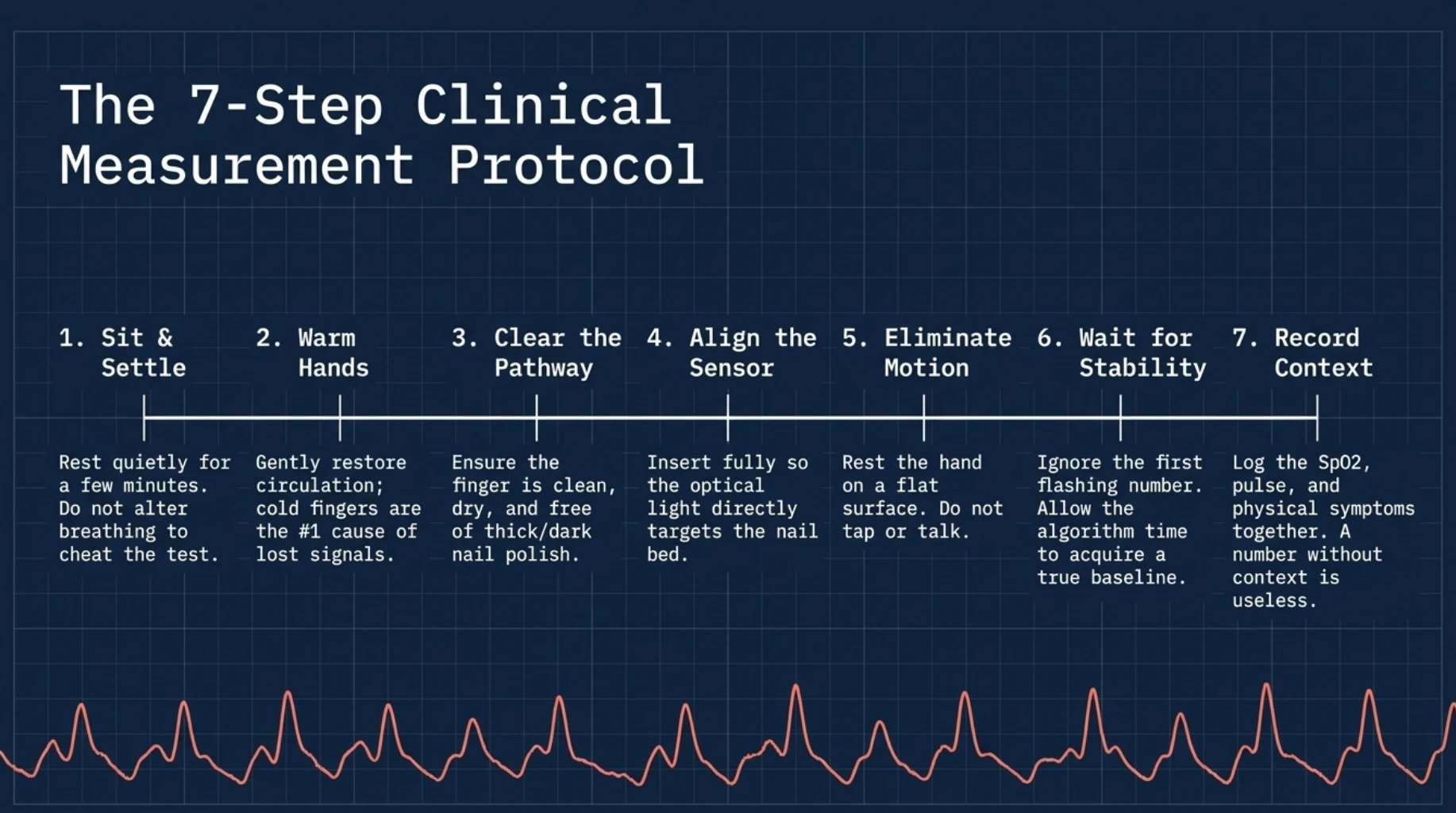
Step 1: Sit Down and Rest Before Measuring
For a routine resting oxygen saturation measurement, sit comfortably and allow yourself to settle before using the device. A few minutes of quiet rest can help standardise the conditions, particularly if you have just been walking or performing household activities.
Keep your breathing natural. Do not deliberately hold your breath, take repeated exaggerated deep breaths or change your breathing pattern simply to influence the displayed number.
If your clinician has specifically requested oxygen saturation measurements during walking or another activity, follow that protocol instead. Resting and exertional measurements answer different clinical questions.
Step 2: Make Sure Your Hands Are Warm
Cold fingers can reduce peripheral blood flow and make it difficult for the sensor to obtain a reliable signal. If your hands are cold, gently warm them before measuring.
Do not apply excessive heat or use very hot water, particularly if you have reduced sensation in your fingers.
Cold hands are a common explanation for an unstable reading, but they are not the only explanation. If you are unwell or experiencing significant breathlessness, do not delay medical assessment while repeatedly trying to warm your fingers.
Step 3: Remove Potential Optical Interference
Check whether nail polish, artificial nails or other material could interfere with the optical pathway. If the reading appears unreliable, try a suitable finger without these materials or remove them when practical.
Make sure the finger is clean and dry. Avoid placing the sensor over a finger with an injury, significant swelling or another problem that prevents proper positioning.
Step 4: Insert Your Finger Properly
Place your finger fully into the pulse oximeter according to the manufacturer’s instructions. The finger should fit comfortably and remain correctly aligned with the sensor.
Many adult fingertip oximeters are designed to accommodate a range of finger sizes, but this does not mean every device fits every person equally well.
If the sensor is too loose, too tight or poorly aligned, the signal may be unreliable.
Step 5: Keep Your Hand Still
Rest your hand comfortably on a table or your lap and avoid moving your fingers while the measurement is being taken.
Do not tap the device, repeatedly open and close your hand or adjust the sensor while watching the display. These movements can create artefacts and cause the displayed oxygen saturation or pulse rate to fluctuate.
Step 6: Wait for the Reading to Stabilise
Do not record the first number that appears on the screen. Allow the device enough time to acquire a stable signal and display a reasonably consistent reading.
Some devices also show a pulse waveform or signal-strength indicator. These may help identify whether the sensor is detecting a usable pulsatile signal, although they cannot independently confirm the accuracy of the SpO2 value.
The time needed to obtain a stable reading varies between devices and measurement conditions. Follow the manufacturer’s instructions rather than relying on a fixed number of seconds for every monitor.
Step 7: Record the Reading With Relevant Context
If you have been advised to monitor oxygen saturation at home, record the SpO2 value, pulse rate and measurement circumstances.
Useful additional information may include whether the reading was obtained at rest, during activity, while breathing room air or while receiving prescribed supplemental oxygen.
Symptoms such as breathlessness, chest discomfort or unusual fatigue may also be relevant. A number without clinical context is often less useful than a properly documented measurement.
Correct Pulse Oximeter Measurement: Quick Reference
| Measurement Step | Recommended Approach | Common Mistake |
|---|---|---|
| Preparation | Rest comfortably for a routine resting measurement | Measuring immediately after activity without noting it |
| Finger temperature | Use a comfortably warm hand | Measuring with very cold fingers |
| Nail condition | Minimise nail-related optical interference | Ignoring thick artificial nails or problematic nail polish |
| Sensor placement | Insert the finger fully and correctly | Partially inserting the fingertip |
| Movement | Keep the hand supported and still | Moving the hand repeatedly |
| Reading | Allow the display to stabilise | Recording the first flashing number |
| Documentation | Record SpO2, pulse and relevant circumstances | Recording a number without context |
Why Your Pulse Oximeter Reading Keeps Changing
One of the most common concerns people report is that their pulse oximeter displays 97%, then 94%, then 96%, all within a short period.
This does not automatically mean that their lungs are repeatedly losing and regaining oxygen.
Some fluctuation may occur because of normal physiological variation, changes in the optical signal, movement, sensor positioning or the device’s measurement algorithm.
It is important to distinguish a genuine change in oxygenation from an unreliable measurement.
Example: SpO2 Changes From 98% to 94%
Suppose you place a pulse oximeter on a cold finger and initially obtain 94%. After warming your hand and keeping it still, the reading stabilises at 98%.
The difference may be related to improved signal quality rather than a meaningful change in lung function.
However, the reverse situation also matters. If your oxygen saturation repeatedly falls below your usual baseline despite correct technique, particularly when symptoms are worsening, the change should not be dismissed as a device problem.
Should You Keep Changing Fingers Until You Get a Higher Reading?
No. Repeatedly moving the device between fingers until a reassuring number appears can create a misleading impression.
If a reading is unexpected, check the technique and repeat the measurement under appropriate conditions. If the result remains concerning, or symptoms suggest illness, seek medical advice rather than selecting the highest number obtained.
Does a Stable SpO2 Reading Guarantee Accuracy?
No. A stable display suggests that the device is producing a consistent estimate, but consistency is not the same as accuracy.
A pulse oximeter can produce a stable reading that differs from arterial oxygen saturation because of device limitations, systematic bias or particular measurement conditions.
This is one reason clinical symptoms should always remain part of the assessment.
How Accurate Are Home Pulse Oximeters?
Accuracy varies between devices, oxygen saturation ranges and measurement conditions. Some medically intended pulse oximeters undergo formal performance evaluation, while others sold for general consumer use may have limited publicly available validation data.
It is also important to understand that a manufacturer’s accuracy specification describes performance under defined testing conditions. It is not a guarantee that every reading obtained at home will fall within a particular number of percentage points of the true value.
What Does an Accuracy Specification of ±2% Mean?
Some manufacturers advertise an accuracy specification such as ±2 percentage points within a defined SpO2 range.
This may be based on a statistical measure of error across multiple paired observations rather than a strict maximum error for every individual measurement.
Consequently, a displayed value of 95% should not automatically be interpreted as proof that the true arterial oxygen saturation must be between 93% and 97%.
The individual measurement error can be larger, especially when the signal is poor or the device is operating outside the conditions in which its performance was evaluated.
Are Pulse Oximeters Less Reliable at Low Oxygen Saturation?
Measurement performance may become less reliable at lower oxygen saturation levels, depending on the device and the circumstances.
This is clinically important because low saturation is precisely when accurate information may be most urgently needed.
If a person appears seriously unwell, an uncertain or inconsistent pulse oximeter reading should never delay emergency medical assessment.
Pulse Oximeter Accuracy and Darker Skin Pigmentation
An important limitation of pulse oximetry is the possibility of measurement bias associated with skin pigmentation.
Research has identified situations in which some devices overestimate arterial oxygen saturation in people with darker skin pigmentation. This may contribute to missed recognition of hypoxaemia.
The degree of bias is not identical across all devices or individuals. It can also interact with other factors, including oxygen saturation level and signal quality.
Why a Normal SpO2 Reading May Be Misleading
Consider a person who has worsening breathlessness but whose fingertip device displays 95%.
That number may appear reassuring. However, pulse oximetry has measurement uncertainty, and some devices may overestimate oxygen saturation.
More importantly, oxygen saturation is only one part of respiratory assessment.
If the person is breathing rapidly, struggling to speak, developing confusion or experiencing chest discomfort, the clinical situation may be serious regardless of the displayed value.
This is why a pulse oximeter should support clinical assessment rather than replace it.
Can a Pulse Oximeter Show 98% When Someone Is Seriously Ill?
Yes. A normal SpO2 reading does not exclude serious illness.
Pulse oximetry estimates oxygen saturation. It does not directly assess every aspect of respiratory or cardiovascular function.
For example, a person may have significant respiratory distress before oxygen saturation falls. Some conditions may also impair ventilation, circulation or oxygen delivery without immediately producing an obviously abnormal SpO2 reading.
It is therefore unsafe to use oxygen saturation as the only criterion for deciding whether medical attention is needed.
Oxygen Saturation Is Not the Same as Oxygen Delivery
Oxygen delivery to tissues depends on several factors, including haemoglobin concentration, arterial oxygen saturation and cardiac output.
A pulse oximeter does not measure all of these.
Someone with severe anaemia may have a normal SpO2 reading because the available haemoglobin is highly saturated, even though the total oxygen-carrying capacity of the blood is reduced.
This illustrates an important principle: normal oxygen saturation does not automatically mean normal oxygen delivery.
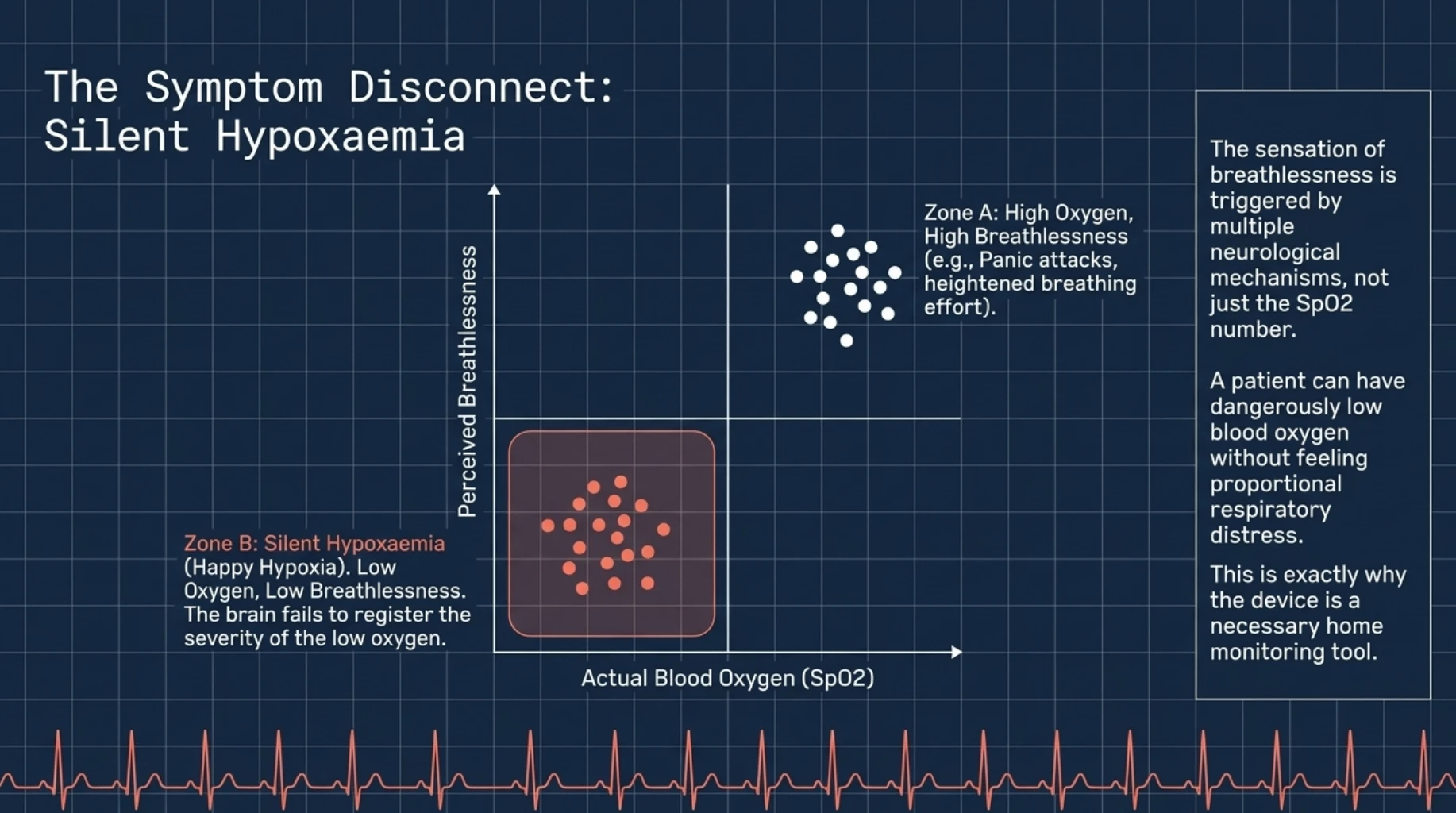
What Is Silent Hypoxaemia?
Silent hypoxaemia, sometimes called happy hypoxia, describes a situation in which a person has low blood oxygen levels without experiencing breathlessness proportional to the degree of hypoxaemia.
The term became widely discussed during the COVID-19 pandemic, although a mismatch between oxygenation and perceived breathlessness is not exclusive to COVID-19.
Some people may not recognise the severity of reduced oxygenation from symptoms alone.
This is one reason pulse oximetry can sometimes provide useful additional information during clinician-directed monitoring of respiratory illness.
Can You Have Low Oxygen Without Feeling Breathless?
Yes. The sensation of breathlessness depends on several physiological and neurological mechanisms, not simply the oxygen saturation number.
However, this does not mean that every person with a slightly lower home SpO2 reading has silent hypoxaemia.
The measurement must be interpreted carefully, including the possibility of device error.
Can You Feel Breathless With Normal Oxygen Saturation?
Yes. Breathlessness may occur with normal SpO2 in conditions involving the heart, lungs, circulation, anaemia or other physiological disturbances.
Breathlessness may also occur in situations where oxygen saturation is preserved but breathing effort is increased.
Persistent, worsening or unexplained breathlessness deserves medical assessment even when a pulse oximeter displays a normal value.
Pulse Oximeter Readings: When Should You Be Concerned?
There is no single oxygen saturation threshold that applies identically to every person, regardless of altitude, underlying disease or prescribed oxygen targets.
Nevertheless, unexpectedly low readings in an adult at low altitude should not be ignored.
Before interpreting an unexpected number, ensure that the device is positioned correctly and that the signal is adequate. If the reading remains low or the person has concerning symptoms, medical assessment is needed.
| Situation | Practical Response |
|---|---|
| Usual SpO2 95–100% at low altitude, no symptoms | Generally reassuring, but not a complete assessment of health |
| Unexpected reading of 93–94% | Repeat correctly and seek prompt medical advice if persistent or below the person’s usual baseline |
| Unexpected SpO2 of 92% or lower | Seek urgent clinical assessment; emergency evaluation may be needed depending on symptoms and circumstances |
| Markedly low or rapidly falling SpO2 | Seek emergency assessment, especially when accompanied by respiratory symptoms |
| Normal SpO2 with severe breathlessness or chest pain | Seek emergency care; do not rely on the normal reading |
| Known chronic respiratory disease with an individualised target | Follow the treating clinician’s monitoring and escalation plan |
These are general safety considerations rather than a substitute for an individualised clinical plan. A person receiving prescribed oxygen therapy or living at high altitude may require different interpretation.
What Does an SpO2 Reading of 94% Mean?
An SpO2 reading of 94% is below the range commonly seen in healthy adults at sea level, but its significance depends on the circumstances.
For someone whose usual reading is 98%, a persistent reduction to 94% during a respiratory illness may be clinically important.
For someone with an established chronic respiratory condition, the interpretation may differ.
First check measurement technique. If the reading remains unexpectedly low, seek clinical advice rather than repeatedly measuring until a higher number appears.
Is an Oxygen Saturation of 92% Dangerous?
An unexpected SpO2 reading of 92% can indicate clinically important hypoxaemia and warrants urgent assessment, particularly in a person who is normally at a higher saturation or has an acute respiratory illness.
However, the reading must still be interpreted with awareness of measurement error and individual circumstances.
Do not wait for the oxygen saturation to fall further before seeking help if the person is deteriorating.
What About an SpO2 Reading Below 90%?
An SpO2 reading below 90% is generally a serious finding when unexpected at low altitude and should prompt emergency medical assessment.
If the person has severe breathlessness, confusion, blue or grey discolouration, chest pain or reduced consciousness, seek emergency care immediately rather than attempting repeated home measurements.
Some patients with chronic respiratory disease may have individualised targets, but those targets should be established by their treating clinician and should not be generalised to others.
Why Oxygen Saturation May Fall During Sleep
Oxygen saturation can change during sleep because breathing patterns, respiratory drive and upper-airway behaviour differ from wakefulness.
Small variations may occur, but recurrent or substantial nocturnal desaturation can be associated with sleep-disordered breathing or underlying cardiopulmonary disease.
A single fingertip pulse oximeter reading obtained after waking cannot reliably determine what happened throughout the night.
Can a Pulse Oximeter Diagnose Sleep Apnoea?
No. Overnight oxygen saturation monitoring may provide useful information in selected circumstances, but pulse oximetry alone cannot reliably diagnose or exclude all forms of obstructive sleep apnoea.
Some respiratory events may cause arousal or airflow limitation without producing a large oxygen saturation drop.
When sleep apnoea is suspected, appropriate sleep testing may be required.
What About Smartwatch Overnight SpO2 Monitoring?
Some smartwatches and wearable devices estimate oxygen saturation during sleep.
These measurements may be useful for general trend awareness, but performance varies by device, sensor placement, movement and intended use.
A consumer wearable should not automatically be treated as equivalent to a medically validated continuous pulse oximetry system or a formal sleep study.
Pulse Oximeter Readings During Walking or Exercise
Some people with respiratory disease may experience a reduction in oxygen saturation during physical activity even when their resting reading is relatively preserved.
This is sometimes called exertional desaturation.
However, ordinary fingertip pulse oximeters can be particularly vulnerable to movement artefacts during exercise.
Therefore, a falling displayed number during walking does not automatically establish true exertional hypoxaemia.
Can You Use a Fingertip Pulse Oximeter While Walking?
You can attempt a measurement, but reliability depends on the device and the conditions.
For clinically important exercise oxygen assessment, supervised testing with appropriate equipment and protocols may be more useful.
If your clinician has requested exertional SpO2 monitoring, follow the specific instructions provided rather than inventing your own exercise test.
Should Healthy People Monitor SpO2 During Every Workout?
Generally, routine oxygen saturation monitoring is not necessary for most healthy adults during ordinary exercise.
Exercise intensity is usually better guided by the activity, perceived effort, breathing and appropriate fitness measures.
Pulse oximetry should not become another number that people feel compelled to monitor continuously without a medical reason.
Pulse Oximeter Accuracy in COPD
People with chronic obstructive pulmonary disease may have different baseline oxygen saturation values and may require individualised oxygen targets.
Home pulse oximetry can sometimes help monitor trends, but it does not provide a complete assessment of ventilation or carbon dioxide retention.
Importantly, a normal or acceptable SpO2 reading does not exclude elevated carbon dioxide levels.
Patients with COPD should follow their prescribed oxygen and monitoring plans rather than independently adjusting oxygen flow to achieve a universally assumed target of 100%.
Can a Pulse Oximeter Detect Carbon Dioxide Retention?
No. A standard pulse oximeter estimates oxygen saturation, not carbon dioxide levels.
A person may have impaired ventilation and elevated carbon dioxide even when oxygen saturation appears acceptable, particularly when receiving supplemental oxygen.
Assessment of carbon dioxide and acid-base status may require blood gas analysis or other appropriate clinical testing.
This distinction is particularly important in selected respiratory disorders and in patients at risk of ventilatory failure.
Pulse Oximeter Readings in Anaemia
Pulse oximetry does not measure haemoglobin concentration.
In anaemia, the percentage of available haemoglobin carrying oxygen may remain normal even though the total oxygen-carrying capacity is reduced.
For example, someone with significant iron-deficiency anaemia may display an SpO2 of 98% while still experiencing fatigue, reduced exercise tolerance or breathlessness.
A normal oxygen saturation therefore does not rule out anaemia.
Can a Pulse Oximeter Detect Carbon Monoxide Poisoning?
A conventional two-wavelength pulse oximeter cannot reliably distinguish oxyhaemoglobin from carboxyhaemoglobin.
As a result, it may display a misleadingly normal or high SpO2 in carbon monoxide poisoning.
This is a particularly important safety limitation.
If carbon monoxide exposure is suspected—for example, after exposure to fumes from faulty combustion appliances or generators—seek emergency medical care even if the pulse oximeter reading appears normal.
Appropriate assessment may require co-oximetry and other clinical investigations.
Can a Pulse Oximeter Detect Methemoglobinaemia?
Conventional pulse oximetry can also be misleading in methemoglobinaemia, a condition involving an abnormal form of haemoglobin.
Readings may tend towards approximately 85% in significant cases, regardless of the actual arterial oxygen saturation.
Diagnosis requires appropriate laboratory assessment rather than reliance on a standard fingertip oximeter.
This is another example of why the device cannot be considered a universal test of oxygen-related disorders.
Why SpO2 Can Be Normal During a Panic Attack
People experiencing panic or anxiety may feel intense breathlessness, chest tightness or a sensation of not getting enough air.
Oxygen saturation may remain normal during these episodes.
However, it is important not to assume that breathlessness is caused by anxiety simply because SpO2 is normal.
Cardiac, respiratory and other medical causes may need consideration, particularly when symptoms are new, severe or atypical.
Can a Pulse Oximeter Diagnose Pneumonia?
No. Pulse oximetry can help assess oxygenation in someone with suspected pneumonia, but it cannot establish the diagnosis.
A person may have pneumonia while maintaining normal oxygen saturation, especially earlier in the illness or when disease is less extensive.
Clinical assessment, examination and sometimes imaging are required depending on the situation.
Can a Pulse Oximeter Diagnose Asthma?
No. A pulse oximeter does not measure airflow obstruction and cannot diagnose asthma.
Someone experiencing an asthma exacerbation may initially maintain relatively normal oxygen saturation despite significant airflow limitation.
Symptoms, breathing effort and other clinical findings remain important.
A normal SpO2 reading should never delay treatment or emergency evaluation during a severe asthma attack.
Pulse Oximeter vs Smartwatch: Which Is Better for Oxygen Monitoring?
Smartwatches and dedicated fingertip pulse oximeters may use different sensor arrangements, measurement algorithms and operating conditions.
A medically intended fingertip device with appropriate performance evidence is generally more suitable when oxygen saturation is being monitored for a clinical reason.
However, not every fingertip oximeter is adequately validated, and not every smartwatch has identical limitations.
The exact device and its intended use matter more than the product category alone.
| Feature | Dedicated Fingertip Oximeter | Smartwatch SpO2 Feature |
|---|---|---|
| Primary purpose | Often designed specifically for spot SpO2 and pulse measurement | Usually part of broader fitness or wellness tracking |
| Sensor location | Finger | Wrist |
| Measurement method | Typically transmissive optical measurement | Typically reflective optical measurement |
| Clinical suitability | Depends on medical intended use and validation | Depends on model, intended use and regulatory status |
| Best use | Selected home medical monitoring when appropriately validated | General trend awareness unless specifically supported for medical use |
Why a Pulse Oximeter Cannot Replace a Medical Examination
One of the most important lessons in this pulse oximeter buying guide is that oxygen saturation is only one physiological measurement.
A pulse oximeter does not directly tell you:
- Whether your lungs are free from infection.
- Whether you have pneumonia.
- Whether you have asthma or COPD.
- Whether your blood carbon dioxide is elevated.
- Whether you have severe anaemia.
- Whether your heart is functioning normally.
- Whether your tissues are receiving adequate oxygen.
- Whether a respiratory illness is safe to manage at home.
These questions require clinical context and, when appropriate, further investigation.
The device is most useful when it adds information to a monitoring plan rather than becoming the sole basis for deciding whether someone needs treatment.
When Should You Stop Checking SpO2 and Seek Medical Care?
Do not continue repeating pulse oximeter measurements while someone is clearly deteriorating.
Emergency assessment is appropriate when symptoms include severe breathlessness, inability to speak normally because of breathing difficulty, chest pain, new confusion, collapse, reduced consciousness or blue or grey discolouration.
Unexpectedly very low oxygen saturation is also a reason for urgent evaluation, particularly when the reading remains low after a quick technique check.
Do not wait for the monitor to display a particular number before acting on serious symptoms.
What Matters More: The SpO2 Number or the Symptoms?
Both matter, but they provide different information.
A low SpO2 reading may identify a problem that is not yet causing obvious breathlessness. Conversely, severe symptoms may occur while the displayed saturation remains normal.
The safest approach is to interpret oxygen saturation alongside breathing effort, mental status, circulation, underlying medical conditions and the person’s usual baseline.
Home monitoring should never reduce clinical assessment to one number.
Measure Correctly, but Never Trust the Number Blindly
A useful pulse oximeter is one that has credible performance evidence, fits properly and is used under appropriate conditions.
Warm fingers, correct placement, minimal movement and adequate signal quality can all improve the reliability of a home measurement.
But even a stable reading has limitations. Skin pigmentation, reduced circulation, device bias and certain medical conditions can make the displayed oxygen saturation misleading.
The most important practical lesson is simple: an SpO2 reading should support medical decision-making, not replace it.
Budget vs Premium Pulse Oximeter: Is a More Expensive Device More Accurate?
When buying a pulse oximeter, one of the first questions is whether a more expensive device provides better accuracy. The answer is not necessarily.
Price may reflect differences in display quality, construction, battery life, additional features, warranty support and brand positioning. Some higher-priced devices also include more sophisticated signal-processing technology designed to improve performance under challenging conditions.
However, a higher price alone does not establish better measurement accuracy. Similarly, an inexpensive device should not automatically be considered inaccurate simply because it costs less.
The most important distinction is whether the manufacturer provides credible evidence of measurement performance for the exact model being purchased.
What Should You Expect From a Basic Fingertip Pulse Oximeter?
A basic home pulse oximeter should be easy to operate, fit the intended user’s finger properly and display oxygen saturation and pulse rate clearly. For medical monitoring, it should also have an appropriate medical intended use and credible supporting performance information.
A simple device with these characteristics may be sufficient for occasional home measurements when recommended by a clinician.
Additional features are worth considering only after these fundamentals have been addressed.
What Do Premium Pulse Oximeters Offer?
Premium models may include a plethysmographic waveform, perfusion index, adjustable display orientation, alarms, rechargeable batteries, smartphone connectivity or more advanced signal processing.
These features can improve usability or provide additional information, but they do not automatically make the SpO2 reading more accurate.
For example, a waveform may help identify an unstable pulse signal. It does not independently confirm that the oxygen saturation estimate is correct.
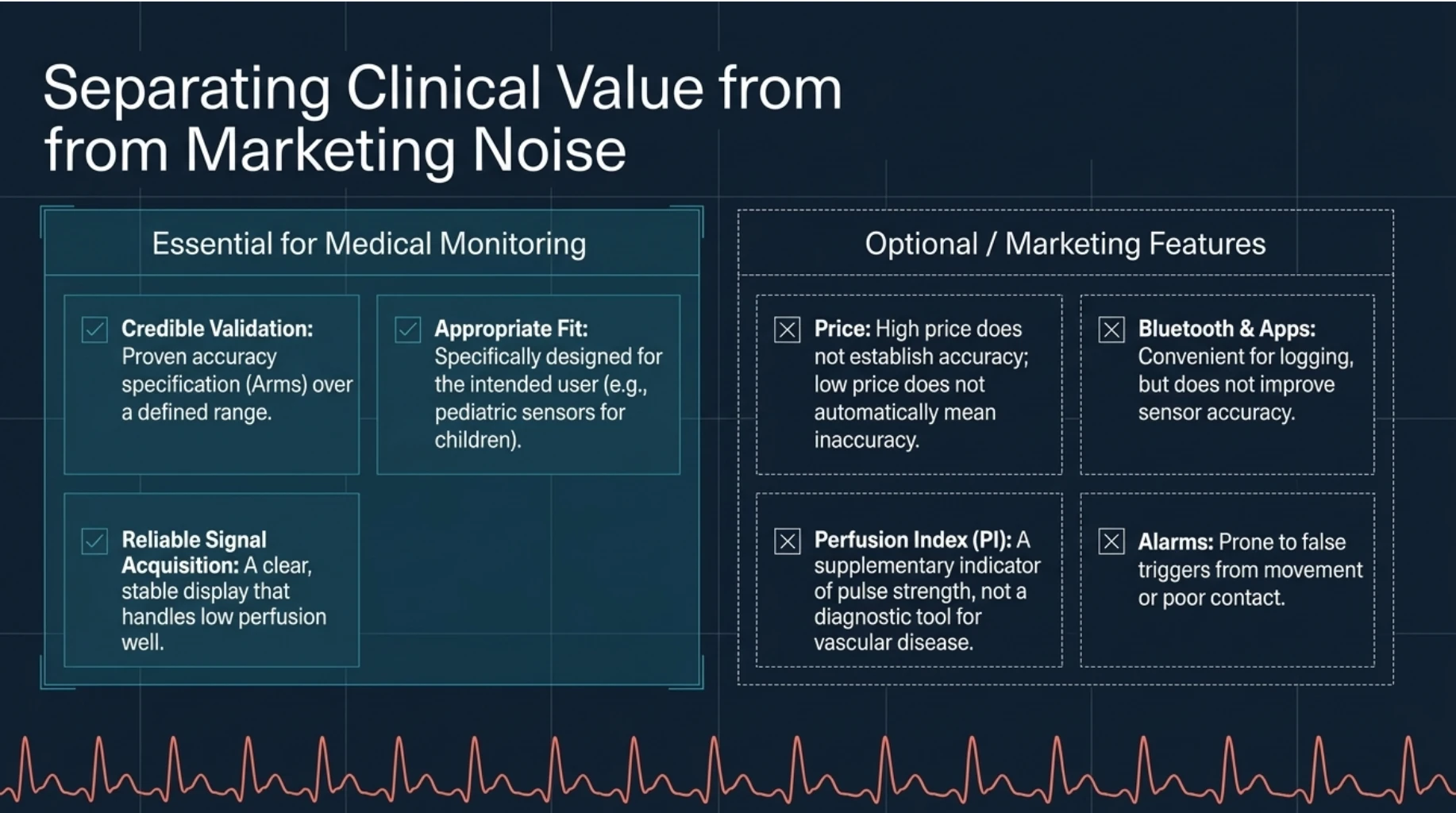
Pulse Oximeter Features: Essential vs Optional
| Feature | Priority | Why It Matters |
|---|---|---|
| Credible clinical performance evidence | Essential for medical monitoring | Provides confidence in the device’s measurement performance |
| Appropriate medical intended use | Essential for medical monitoring | Helps distinguish medical devices from general wellness products |
| Proper finger fit | Essential | Supports appropriate sensor positioning and signal acquisition |
| Clear SpO2 and pulse display | Essential | Makes readings easier to identify and record |
| Reliable signal acquisition | Very important | Reduces problems with unstable measurements |
| Plethysmographic waveform | Useful | May help assess signal consistency |
| Perfusion index | Optional | Provides additional information about the detected pulsatile signal |
| Bluetooth connectivity | Optional | Can simplify record keeping |
| Rechargeable battery | Optional | Offers convenience but does not establish accuracy |
| Automatic alarms | Situation dependent | May be useful in selected monitoring arrangements |
Should You Buy a Pulse Oximeter With a Plethysmographic Waveform?
Some fingertip pulse oximeters display a moving waveform in addition to SpO2 and pulse rate. This waveform represents the pulsatile component of the optical signal detected by the sensor.
It may help users recognise when the device is detecting a relatively consistent pulse signal, particularly when readings are fluctuating.
However, the presence of a waveform should not be confused with clinical validation. A visually attractive waveform does not prove that the oxygen saturation value is accurate.
For routine spot measurements, a waveform can be helpful but is not essential for everyone.
Is Perfusion Index Useful in a Home Pulse Oximeter?
Perfusion index, or PI, is a device-derived measure related to the relative strength of the pulsatile signal at the sensor site.
A low value may accompany reduced peripheral pulsation, such as when the fingers are cold. However, PI values depend on the device and measurement conditions, and there is no single universal cutoff that can reliably diagnose poor circulation in every person.
For most home users, perfusion index is an additional technical feature rather than a primary reason to buy a particular monitor.
It should not be used independently to diagnose shock, peripheral vascular disease or another circulation problem.
Do You Need Bluetooth in a Pulse Oximeter?
Bluetooth connectivity allows some devices to transfer measurements to a smartphone application. This may be convenient when a clinician has requested a structured oxygen saturation record.
It can also reduce the need to manually enter readings into a notebook.
However, Bluetooth does not make the optical measurement inherently more accurate. If you only need occasional spot measurements, a simple device without smartphone connectivity may be entirely adequate.
For people who do use an app, it is worth checking whether the data can be exported and whether the device remains functional without a smartphone connection.
Should You Buy a Pulse Oximeter With an Alarm?
Some pulse oximeters can produce an audible alert when the displayed oxygen saturation or pulse rate crosses a selected threshold.
This may sound reassuring, but alarms can be triggered by movement, poor sensor contact or inaccurate readings. Conversely, a device may fail to identify a clinically important event.
A standard consumer fingertip pulse oximeter should not be assumed suitable for unattended overnight monitoring or continuous safety surveillance simply because it has an alarm.
Patients who require continuous monitoring need equipment and a monitoring plan appropriate to their clinical circumstances.
Pulse Oximeter vs Smartwatch vs Smartphone App
Oxygen saturation technology is now advertised in fingertip devices, smartwatches and some smartphone applications. These products should not automatically be considered interchangeable.
A dedicated fingertip pulse oximeter generally measures light transmission through the finger, whereas many wrist-based wearables use reflected light. Smartphone-only applications may rely on different methods or may lack adequate clinical validation.
The appropriate choice depends on the device’s intended use, performance evidence and the reason for monitoring.
| Device | Potential Use | Main Limitation |
|---|---|---|
| Validated medical fingertip pulse oximeter | Clinician-directed spot oxygen saturation monitoring | Still affected by measurement conditions and known accuracy limitations |
| Smartwatch with SpO2 feature | General wellness or trend awareness, depending on model | Clinical suitability and accuracy vary considerably |
| Smartphone-only SpO2 application | Depends entirely on the technology and validation evidence | Many should not be relied upon for medical decisions |
| Medical continuous pulse oximetry system | Selected patients requiring ongoing monitoring | Requires suitable sensors, equipment and clinical oversight |
Can a Smartphone Camera Measure Oxygen Saturation?
Some applications claim to estimate oxygen saturation using a smartphone camera or related technology. However, performance and validation vary, and a smartphone application should not be assumed to provide medically reliable SpO2 measurements.
If oxygen saturation is being monitored because of respiratory illness or another medical condition, use equipment appropriate for that purpose.
Pulse Oximeter Buying Guide for Older Adults
When choosing a pulse oximeter for an older adult, ease of use deserves particular attention.
Small displays, complicated menus and difficult-to-read symbols can make an otherwise functional device frustrating to use. A clear screen, straightforward controls and comfortable sensor fit may be more valuable than Bluetooth or multiple display modes.
Peripheral circulation can also be reduced in some older adults, particularly when the hands are cold or vascular disease is present. This makes good signal acquisition important.
If an older person has tremors, difficulty keeping the hand still or problems positioning the sensor, assistance may be needed to obtain a reliable measurement.
What Features Matter Most for Older Users?
Look for a clear display, simple operation, comfortable fit, reliable signal acquisition and an easy-to-replace power source. A screen that can be read without repeatedly rotating the hand may also be helpful.
Choose a device that the intended user can operate consistently rather than one with the largest number of advertised functions.
Pulse Oximeter Buying Guide for Children
Children should not automatically be monitored using an adult fingertip pulse oximeter.
Sensor size and fit matter because the optical components need to align correctly with the measurement site. An adult device may not fit a young child’s finger adequately.
For children, select a device and sensor intended for the relevant age and size, with appropriate performance evidence.
Can You Use an Adult Pulse Oximeter on a Child?
Some manufacturers specify that particular devices are suitable for children above a certain age, weight or finger size. Others are intended primarily for adults.
Follow the exact model’s instructions rather than assuming that any fingertip oximeter can be used across all ages.
If a child has significant breathing difficulty, unusual drowsiness, blue or grey discolouration or other concerning symptoms, seek urgent medical care regardless of the displayed oxygen saturation.
What About Pulse Oximeters for Infants?
Infants generally require appropriately designed sensors and monitoring equipment. A standard adult fingertip clip is not a substitute for a neonatal or infant monitoring system.
Parents should also be cautious about consumer products claiming to provide continuous infant oxygen monitoring without adequate evidence or appropriate clinical oversight.
Such devices should not be treated as a replacement for safe-sleep practices, medical evaluation or prescribed monitoring.
Pulse Oximeter Use in People With Diabetes
People with diabetes may develop peripheral vascular disease or other circulation problems, although this does not mean every person with diabetes will have unreliable pulse oximeter readings.
If finger perfusion is reduced, the device may have difficulty obtaining a stable optical signal.
It is also important to remember that pulse oximetry does not assess blood glucose, HbA1c, kidney function or cardiovascular risk.
A normal SpO2 reading should not be interpreted as evidence that diabetes-related complications are absent.
Pulse Oximeter Use in People With COPD
For people with chronic obstructive pulmonary disease, the most useful pulse oximeter is not necessarily the one displaying the highest saturation. It is the one that provides sufficiently reliable information for an individualised clinical monitoring plan.
Some patients with COPD have prescribed oxygen saturation targets that differ from those used for otherwise healthy adults. In selected patients at risk of hypercapnic respiratory failure, clinicians may prescribe controlled oxygen therapy with a target such as 88–92% during acute care, depending on the situation.
That range should not be adopted as a universal home target for everyone with COPD.
Do not independently increase or decrease prescribed oxygen flow solely to make the pulse oximeter display a preferred number unless you have a specific clinician-directed adjustment plan.
Can a Pulse Oximeter Be Used at High Altitude?
Yes, but oxygen saturation is influenced by altitude.
As altitude increases, atmospheric pressure decreases, reducing the partial pressure of inspired oxygen. Oxygen saturation may therefore be lower than values typically observed at sea level.
This is relevant for people travelling to mountain destinations, including Himalayan regions.
However, a pulse oximeter cannot independently diagnose or exclude altitude illness. Symptoms such as headache, nausea, dizziness, impaired coordination, confusion or breathlessness require assessment in context.
Severe altitude illness is a medical emergency, and a seemingly acceptable SpO2 reading should not delay descent or appropriate treatment when serious symptoms are present.
Seven Common Mistakes When Buying a Pulse Oximeter
1. Choosing the Cheapest Device Without Checking Performance Evidence
Low price can be attractive, particularly when many devices look almost identical. However, visual similarity does not establish comparable measurement performance.
Check the manufacturer, exact model, intended use and available testing information before buying.
2. Assuming a Familiar Brand Guarantees Accuracy
A recognised brand may offer advantages in quality control, warranty support and product documentation. Nevertheless, performance evidence should ideally relate to the exact model.
Do not assume that every product sold under the same brand has undergone identical testing.
3. Confusing a Stable Reading With an Accurate Reading
A display that consistently shows 97% may appear trustworthy. However, systematic measurement bias can exist even when the number remains stable.
Signal stability is useful, but it is not a substitute for validation.
4. Buying Mainly for Bluetooth or a Colour Screen
These features can improve convenience but do not establish clinical accuracy. They should be considered after measurement performance and usability.
5. Ignoring Finger Size and Sensor Fit
A poorly fitting sensor may make it difficult to obtain a reliable reading. This is especially important for children and people with unusually small or large fingers.
6. Assuming Every Pulse Oximeter Works Equally Well With Cold Hands or Movement
Performance under low-perfusion and motion conditions can vary. Claims about advanced signal processing should be supported by credible evidence.
7. Believing the Device Can Diagnose Respiratory Diseases
A pulse oximeter estimates oxygen saturation and pulse rate. It cannot independently diagnose pneumonia, asthma, COPD, pulmonary embolism or other respiratory and cardiovascular conditions.
Buying the device should not create a false sense of diagnostic security.
How to Check a Pulse Oximeter Before Buying Online
Online shopping makes it easy to compare prices but can make technical evaluation difficult. Many product listings emphasise appearance and convenience while providing limited information about validation or intended medical use.
Before purchasing, review the manufacturer’s official product documentation whenever possible.
Look for the exact model number, intended use, measurement specifications, sensor suitability, warranty details and instructions for operation.
If the seller cannot clearly identify the device or its manufacturer, consider that a warning sign.
What Does an SpO2 Accuracy Specification Tell You?
Manufacturers may describe accuracy over a defined oxygen saturation range, such as 70–100%. The precise range and statistical method should be stated in the technical documentation.
An accuracy claim does not necessarily apply outside the tested range or under every condition, such as movement or reduced perfusion.
It is also important to remember that statistical accuracy specifications do not guarantee the maximum error of every individual reading.
Should You Trust Customer Reviews?
Customer reviews can provide useful information about display readability, battery life, comfort and durability.
However, most consumers do not have access to reference arterial oxygen saturation measurements and therefore cannot independently establish clinical accuracy.
Use reviews to evaluate usability, not as proof of measurement performance.
Pulse Oximeter Buying Checklist
Before ordering a device, use this checklist to compare the models you are considering.
| What to Check | Why It Matters | Checklist |
|---|---|---|
| Exact manufacturer and model | Allows verification of product documentation | □ |
| Medical intended use | Important when monitoring a health condition | □ |
| Credible performance evidence | Supports confidence in SpO2 measurements | □ |
| Appropriate finger fit | Supports reliable sensor positioning | □ |
| Readable SpO2 and pulse display | Improves usability | □ |
| Suitability for intended age group | Especially important for children | □ |
| Clear operating instructions | Helps reduce measurement errors | □ |
| Battery availability | Supports practical long-term use | □ |
| Warranty and manufacturer support | Useful if the device develops problems | □ |
| Optional waveform or signal indicator | May help identify unstable signals | □ |
| Optional Bluetooth or memory | Useful when structured records are needed | □ |
How to Maintain Your Pulse Oximeter
After buying a suitable device, proper maintenance can help preserve its usability.
Follow the manufacturer’s instructions for cleaning and storage. Keep the optical sensor surfaces clean and avoid exposing the device to unnecessary moisture, excessive heat or physical damage.
Replace batteries when required and inspect the sensor for damage if readings become difficult to obtain.
If the device is dropped, damaged or repeatedly produces implausible readings, contact the manufacturer or consider replacing it rather than assuming it remains reliable.
How Often Should You Replace a Pulse Oximeter?
There is no universal replacement interval for every consumer fingertip pulse oximeter.
Replacement may be appropriate when the device is damaged, its sensor deteriorates, the manufacturer no longer supports it or its performance becomes questionable.
A newer device is not automatically better merely because it has additional digital features.
Frequently Asked Questions About Pulse Oximeters
1. Which Pulse Oximeter Is Best for Home Use?
For medically indicated home monitoring, choose a device intended for medical use with credible performance evidence, appropriate finger fit, clear display and straightforward operation. The best choice depends on the intended user and monitoring purpose.
2. Are Cheap Pulse Oximeters Accurate?
Some inexpensive devices may perform adequately, but price alone cannot establish accuracy. Look for evidence supporting the exact model rather than assuming a low or high price predicts performance.
3. Is a Pulse Oximeter Reading of 97% Normal?
For a healthy adult at low altitude, 97% is generally within the commonly observed range. However, a normal reading does not exclude respiratory, cardiovascular or other medical problems.
4. Is 94% Oxygen Saturation Dangerous?
An SpO2 of 94% is below the usual healthy range at sea level. Its significance depends on the person’s baseline, symptoms, altitude and clinical circumstances. If unexpected and persistent, it warrants prompt medical advice.
5. Is an SpO2 of 92% an Emergency?
An unexpected reading of 92% or lower warrants urgent clinical assessment, especially during an acute illness. Severe symptoms require emergency care regardless of the displayed number.
6. Can Cold Fingers Cause a Low SpO2 Reading?
Cold fingers can reduce peripheral blood flow and interfere with the optical signal, potentially producing unstable or unreliable readings. Gently warming the hand may improve measurement conditions.
7. Does Nail Polish Affect Pulse Oximeter Accuracy?
Some nail products can interfere with optical measurement. The effect depends on the material, colour, thickness and device. If readings are unreliable, use an appropriate finger without nail products when possible.
8. Can Darker Skin Affect Pulse Oximeter Readings?
Yes. Research has identified overestimation of oxygen saturation in some devices and circumstances involving darker skin pigmentation. A reassuring reading should not override concerning clinical symptoms.
9. Which Finger Is Best for a Pulse Oximeter?
Use a finger that fits the device properly and provides a stable signal, following the manufacturer’s instructions. Consistent technique is more important than assuming one particular finger is universally best.
10. Why Does My Pulse Oximeter Show Different Readings on Different Fingers?
Differences in circulation, fit, movement and signal quality can contribute. Small differences do not necessarily indicate a meaningful physiological change.
11. How Long Should I Keep the Pulse Oximeter on My Finger?
Allow enough time for the device to acquire a stable signal and display a consistent reading. Follow the manufacturer’s instructions rather than relying on the first number displayed.
12. Can a Pulse Oximeter Detect Pneumonia?
No. It can provide information about oxygenation but cannot diagnose or exclude pneumonia. Medical assessment and sometimes imaging may be necessary.
13. Can a Pulse Oximeter Detect Sleep Apnoea?
Not reliably by itself. Overnight oximetry can sometimes contribute to evaluation, but appropriate sleep testing may be needed to diagnose or exclude sleep apnoea.
14. Can a Pulse Oximeter Detect Carbon Monoxide Poisoning?
No. Conventional pulse oximeters can display misleadingly normal values in carbon monoxide poisoning. Suspected exposure requires emergency assessment regardless of SpO2.
15. Does a Normal SpO2 Mean My Lungs Are Healthy?
No. Normal oxygen saturation does not exclude asthma, pneumonia, pulmonary embolism or other respiratory conditions. SpO2 is only one component of clinical assessment.
16. Is a Smartwatch as Accurate as a Fingertip Pulse Oximeter?
Accuracy depends on the exact device, sensor technology, validation and measurement conditions. A medically intended fingertip oximeter with appropriate evidence is generally preferable when monitoring oxygen saturation for a clinical reason.
17. Should I Check My SpO2 Every Day?
Daily monitoring is not necessary for every healthy adult. Follow an individualised monitoring schedule when a clinician recommends home measurements for a specific condition.
18. Can I Use a Pulse Oximeter While Walking?
Movement can interfere with many fingertip devices. If exertional oxygen assessment is clinically needed, use an appropriate protocol and equipment as advised by your clinician.
19. Can a Pulse Oximeter Measure Carbon Dioxide?
No. Standard pulse oximetry does not measure carbon dioxide retention or assess acid-base balance. These require different investigations.
20. When Should I Seek Medical Attention Despite Normal SpO2?
Seek urgent care for severe or worsening breathlessness, chest pain, confusion, collapse, reduced consciousness or other serious symptoms, even if the device displays a normal oxygen saturation.
When Should You Seek Medical Help Instead of Repeating the Measurement?
A pulse oximeter is most useful when it provides additional information without delaying appropriate care.
If a person has severe breathlessness, chest pain, confusion, difficulty speaking because of respiratory distress, blue or grey discolouration, or reduced consciousness, seek emergency medical assistance immediately.
Unexpectedly low oxygen saturation also deserves attention. A quick check of sensor placement and signal quality is reasonable when the person is stable, but repeated attempts to obtain a higher number should not delay clinical evaluation.
People with chronic respiratory disease, prescribed home oxygen or individualised SpO2 targets should follow their treating clinician’s escalation plan.
Final Buying Decision: What Matters Most?
| Buying Priority | Recommendation |
|---|---|
| First priority | Choose a device with credible evidence of measurement performance and appropriate medical intended use |
| Second priority | Ensure proper finger fit and suitability for the intended user |
| Third priority | Look for reliable signal acquisition and a clear display |
| Fourth priority | Consider ease of use, batteries, warranty and manufacturer support |
| Optional extras | Waveform, perfusion index, Bluetooth, rechargeable battery and additional display features |
Final Thought
When choosing a pulse oximeter, do not begin by asking which device has the brightest screen, the most graphs or the longest feature list.
Ask whether the device has credible evidence of accuracy, fits the intended user and can provide a dependable signal under appropriate measurement conditions.
And remember that even a good pulse oximeter has limitations.
Buy a device you can use correctly, understand what its numbers mean, and never allow a reassuring display to override concerning symptoms.
If you want a personalized metabolic assessment and lifestyle strategy, you can book a consultation here:
Book an Appointment
