


Warm-Up Before Exercise: 7 Mistakes That May Increase Injury Risk
Most people know that they are supposed to warm up before exercising. The problem is that “warming up” can mean completely different things to different people.
One person walks on a treadmill for ten minutes. Another performs a long series of stretches. Someone else does jumping jacks until they are sweating heavily. And many people simply start their workout immediately because they do not want to “waste” valuable training time.
None of these approaches should automatically be labelled right or wrong.
The purpose of a warm-up before exercise depends on what you are about to do.
A person preparing for a brisk walk does not need the same warm-up as someone preparing for heavy squats. A runner beginning an interval session has different requirements from someone performing an upper-body resistance workout.
There is also an important misconception to correct from the beginning.
A proper warm-up cannot guarantee that you will never get injured.
Injury risk is influenced by many factors, including training load, exercise technique, previous injury, fatigue, recovery, fitness level, sudden changes in activity and sometimes simple bad luck.
However, an appropriate warm-up can help prepare your body for the movements and intensity that are about to follow.
The goal is simple:
Start the workout prepared, but not already tired.

What Does a Warm-Up Before Exercise Actually Do?
A warm-up is a transition between your resting state and the more demanding activity you are about to perform.
When you begin moving gradually, heart rate and breathing increase. Blood flow to active muscles rises, muscle temperature increases and your nervous system begins preparing for faster or more forceful movement.
A well-designed warm-up can also give you an opportunity to practise the movement patterns that will appear in the workout.
For example, before performing heavy squats, progressively lighter squat sets can help prepare you specifically for squatting.
Before running quickly, gradually increasing running speed prepares you more specifically than simply stretching your hamstrings for several minutes.
This is why a useful warm-up before exercise is not simply about becoming hot or sweaty.
It is about becoming ready for the task.
Warm-Up, Stretching and Mobility Are Not the Same Thing
These terms are frequently used as though they mean the same thing.
They do not.
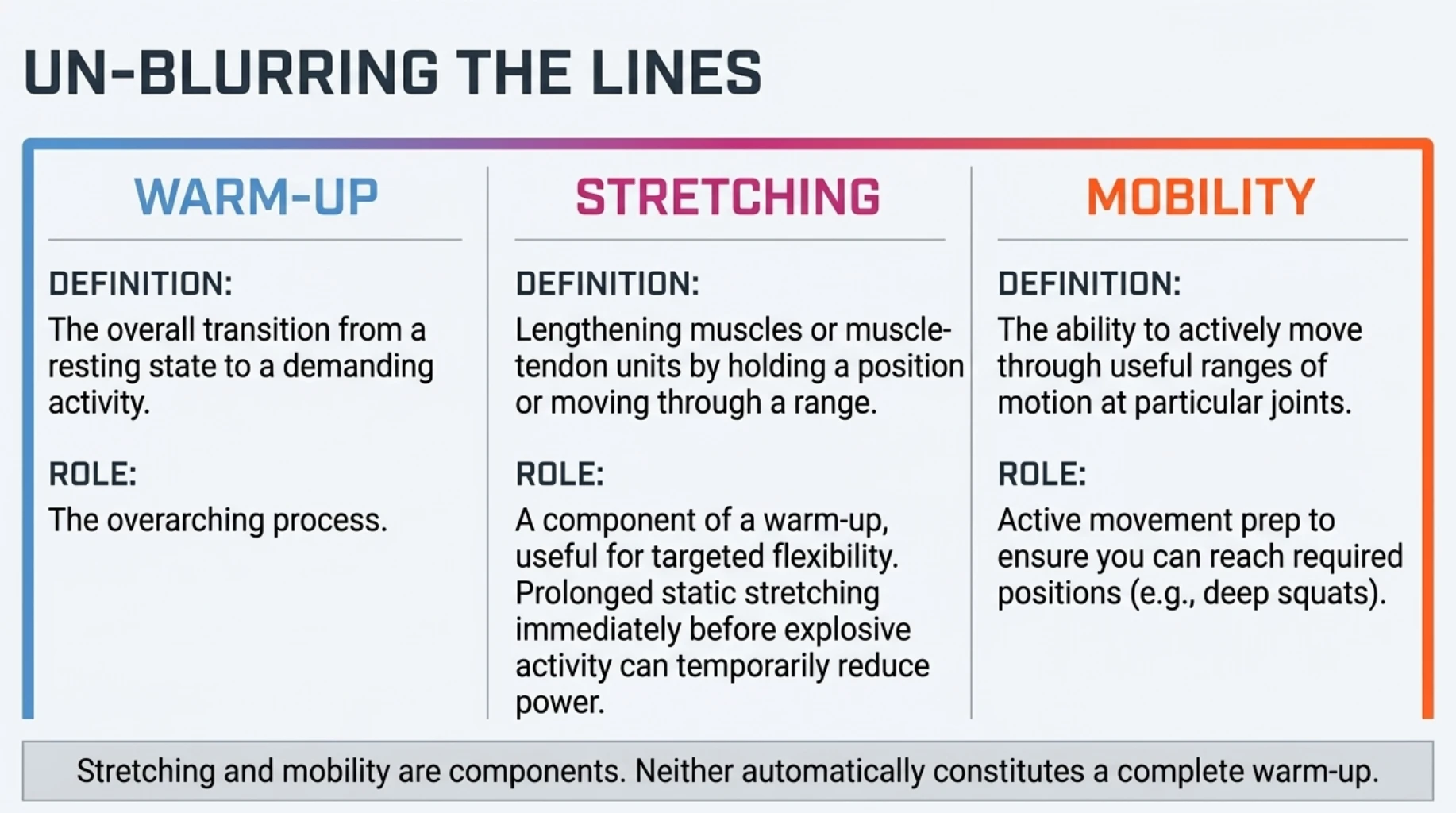
Warm-up refers to the overall preparation for exercise.
Stretching generally involves lengthening muscles or muscle-tendon units, either by holding a position or moving through ranges of motion.
Mobility work generally focuses on your ability to actively move through useful ranges of motion at particular joints.
Stretching and mobility exercises can be components of a warm-up, but neither automatically constitutes a complete warm-up.
For example, holding several static stretches for ten minutes may improve flexibility in the short term, but it does not necessarily prepare you specifically for a demanding set of squats, sprints or presses.
Does Warming Up Really Prevent Injuries?
The answer is more nuanced than many fitness claims suggest.
It is difficult to prove that a particular warm-up prevents every type of exercise injury because injuries occur for many different reasons.
Research on structured injury-prevention programmes in sport suggests that programmes incorporating several components—such as strength, balance, movement preparation and sport-specific exercises—can reduce certain injuries in particular populations.
But that does not mean five minutes of random movement provides guaranteed protection against injury.
Warm-ups have clearer benefits for preparing the body for exercise and, in many situations, improving subsequent physical performance.
So rather than thinking:
“Warm up and you cannot get injured,”
think:
“Warm up so that your body is better prepared for the demands you are about to place on it.”
Mistake 1: Skipping the Warm-Up Completely
Skipping the warm-up is particularly common when someone has limited time.
If the workout is only 30 minutes, spending ten minutes preparing can feel inefficient.
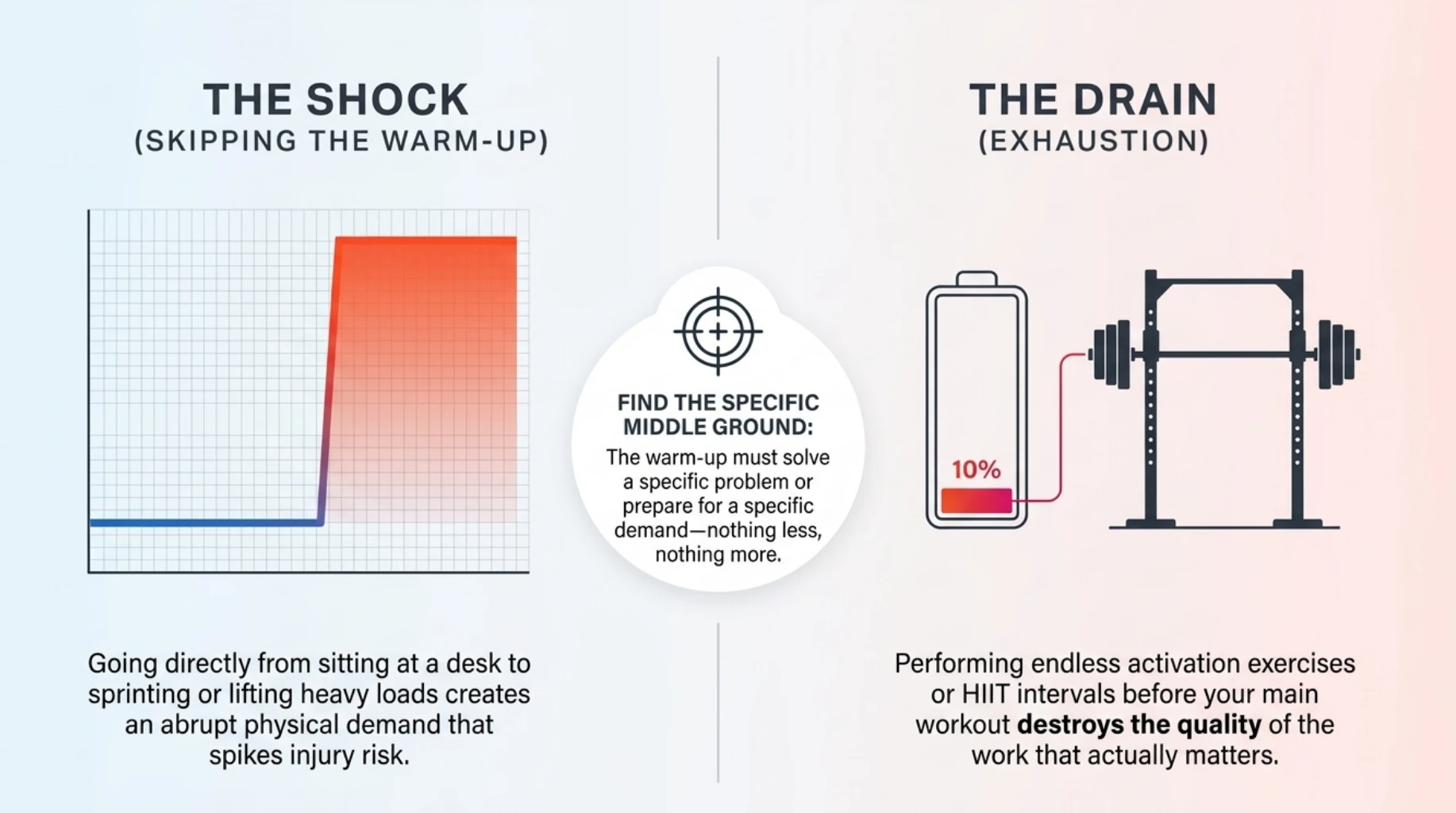
But going directly from sitting at a desk or driving a car to sprinting, jumping or lifting a heavy load creates a very abrupt change in physical demand.
The importance of warming up also increases with the intensity and complexity of the activity.
A gentle walk is itself capable of acting as a gradual warm-up.
A heavy deadlift session is different.
You should therefore avoid treating every type of exercise as though it requires exactly the same preparation.
Do You Need to Warm Up Before Walking?
For an otherwise healthy person beginning an easy or moderate walk, an elaborate warm-up is usually unnecessary.
The first few minutes of the walk can simply be performed at a comfortable pace before gradually increasing speed.
This is an important practical point because warm-ups do not need to become complicated rituals.
Sometimes the activity itself can provide the warm-up when intensity is increased gradually.
Do You Need to Warm Up Before Strength Training?
Strength training generally deserves more deliberate preparation, particularly when exercises are heavy or technically demanding.
A strength-training warm-up may include:
- A few minutes of easy general movement if needed.
- Relevant dynamic mobility or activation work.
- Practice of the exercise movement.
- Progressively heavier warm-up sets before demanding working sets.
The heavier and more technically demanding the exercise, the more useful specific preparation generally becomes.
Mistake 2: Using Static Stretching as the Entire Warm-Up
For decades, many people were taught to stand still and stretch every major muscle before exercise.
Static stretching means moving a muscle into a lengthened position and holding that position for a period of time.
Static stretching is not inherently bad.
It can be useful when improving flexibility is an objective, and it may have a place within an overall training programme.
The mistake is assuming that static stretching alone is always the ideal preparation for every type of workout.
Can Static Stretching Reduce Strength or Power?
Long or aggressive static stretching immediately before activities requiring maximal strength, sprinting or explosive power may temporarily reduce aspects of performance, particularly when stretching volume is substantial.
This does not mean that briefly stretching a tight muscle will destroy your workout.
Again, context matters.
Shorter static stretches used when necessary and followed by dynamic or exercise-specific preparation are very different from spending a prolonged period performing intense static stretches immediately before maximal lifting or sprinting.
When Is Static Stretching Useful?
Static stretching may be appropriate when flexibility itself is being trained, when a particular range of motion needs attention, or at another point in the training session when maximal force production is not immediately required.
Some people also simply enjoy stretching after exercise or at a separate time of day.
The important point is not to declare static stretching “good” or “bad.”
Instead, use it according to the goal.
What Should You Do Instead of Only Stretching?
A more useful pre-exercise sequence often moves from general preparation towards specific preparation.
For example:
| Stage | Example |
|---|---|
| General movement | Easy walking, cycling or similar activity |
| Dynamic preparation | Controlled movements through relevant ranges |
| Exercise-specific preparation | Practising the movement you are about to perform |
| Progressive loading | Gradually heavier warm-up sets before heavy strength work |
Not every workout needs all four stages.
The warm-up should match the activity.
Mistake 3: Turning the Warm-Up Into a Workout
Some warm-ups are so demanding that the person reaches the main workout already fatigued.
This may happen with:
- Long treadmill sessions before lifting.
- Repeated high-intensity intervals.
- Large numbers of burpees.
- Excessive jumping.
- High-repetition bodyweight circuits.
- Too many “activation” exercises.
If your primary goal is strength, muscle gain or explosive performance, exhausting yourself during the warm-up can reduce the quality of the work that actually matters.
A warm-up should increase readiness rather than consume your available performance.
You Do Not Need to Be Drenched in Sweat
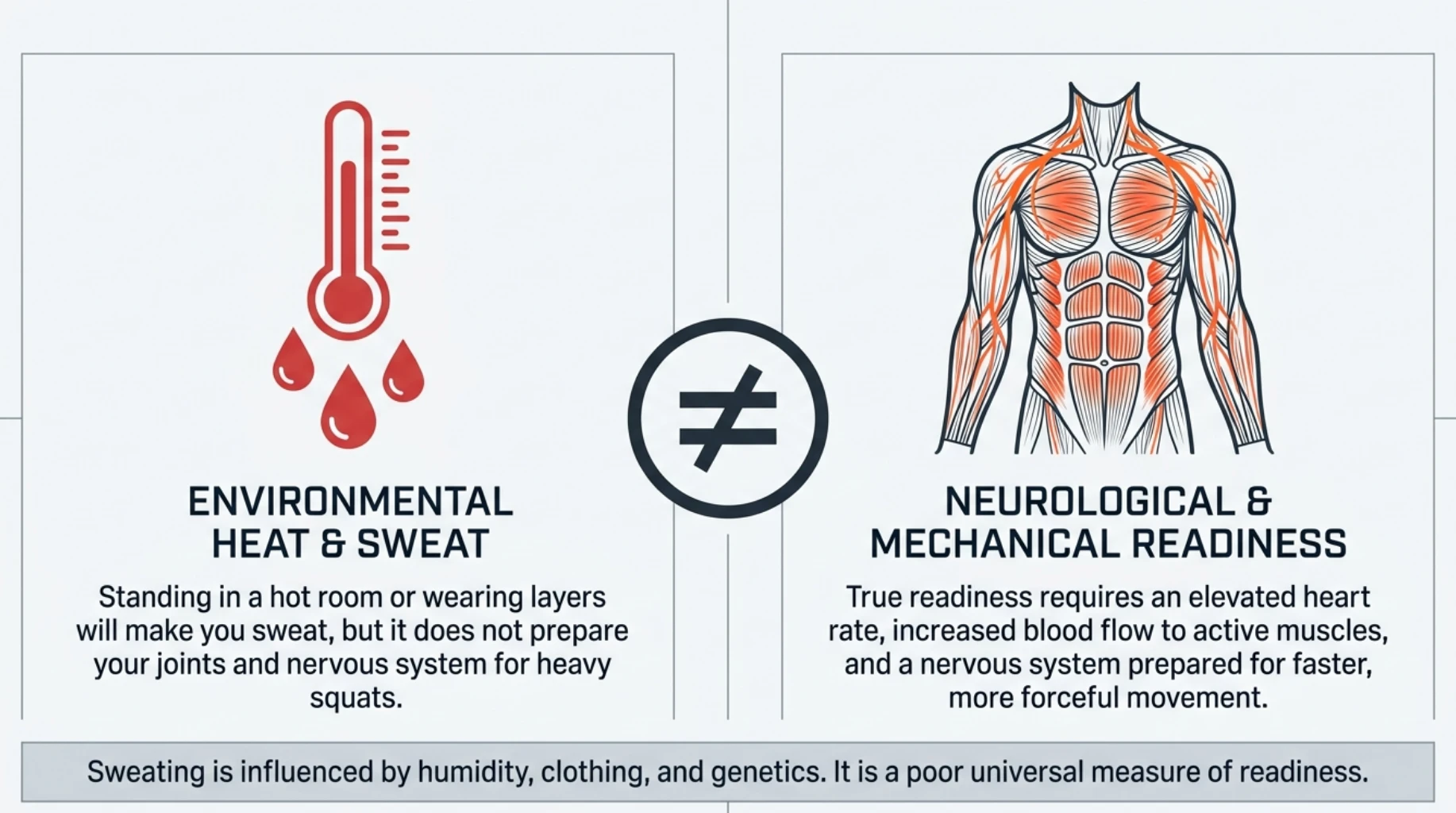
Sweating is influenced by exercise intensity, temperature, humidity, clothing and individual differences.
It is therefore a poor universal measure of whether someone is adequately warmed up.
You can be physiologically and mechanically prepared for a workout without being covered in sweat.
Conversely, standing in a hot environment can make you sweat without preparing you for a heavy squat.
Sweating and readiness are not the same thing.
How Long Should a Warm-Up Before Exercise Last?
There is no universal ten-minute rule.
The required duration depends on:
- The activity you are about to perform.
- Workout intensity.
- Your training experience.
- Age and individual mobility.
- Environmental temperature.
- Whether you have been sitting immediately beforehand.
- Previous injuries or movement limitations.
For a moderate recreational workout, several minutes of progressive preparation may be sufficient.
A demanding strength, sprint or sports session may require longer and more specific preparation.
Rather than watching the clock alone, ask:
Do I feel physically and technically ready for the intensity of my first important exercise?
A Simple Principle for Every Warm-Up
The best warm-up before exercise usually becomes more specific as you approach the main activity.
If you are going to run, gradually prepare for running.
If you are going to squat, prepare for squatting.
If you are going to perform explosive movements, gradually prepare for speed and force.
This leads to another common mistake: performing the same generic warm-up regardless of what the actual workout contains.
Mistake 4: Using the Same Generic Warm-Up for Every Workout
A few minutes on a treadmill followed by arm circles may be perfectly reasonable preparation for some workouts.
But there is no single warm-up routine that is ideal before running, heavy squats, bench pressing, sprinting, cycling and high-intensity interval training.
A useful warm-up before exercise should gradually become specific to what you are about to do.
This principle is sometimes called specificity.
If your workout requires a particular movement, speed, joint position or level of force, at least part of the warm-up should prepare you for those demands.
The closer you get to the main workout, the more the warm-up should resemble the activity that follows.
Warm-Up Before Running
Before an easy recreational run, the warm-up can be simple.
You might begin with a few minutes of brisk walking followed by easy jogging and gradually increase your pace.
For a harder running session involving intervals, hills or faster running, additional dynamic preparation may be useful.
This could include controlled leg movements, marching, skipping or progressive running drills appropriate to your experience.
The key word is progressive.
Going directly from standing still to maximum-speed sprinting creates a much larger transition than gradually increasing running intensity.
Warm-Up Before Strength Training
A strength-training warm-up should prepare you for the exercises and loads you are about to use.
For example, before a demanding lower-body session, several minutes of easy cycling or walking may increase general readiness.
But that alone does not fully prepare you for a heavy squat.
You may then need relevant mobility work if required, followed by progressively loaded squat sets.
A general structure could be:
General movement → relevant dynamic preparation → exercise-specific warm-up sets → working sets
Not everyone needs a long list of mobility and activation exercises before every strength session.
The warm-up should solve a problem or prepare for a demand, rather than becoming a ritual containing 15 exercises simply because you saw them online.
Warm-Up Before Leg Day
Leg training may involve squats, lunges, deadlifts, leg presses and other movements requiring substantial force from the hips, knees and ankles.
A practical warm-up could include:
- A few minutes of easy walking or cycling.
- Controlled dynamic movements through the ranges you will use.
- Bodyweight or lightly loaded versions of the main exercise.
- Progressively heavier warm-up sets.
If ankle or hip mobility genuinely limits a particular movement, targeted mobility work may also be useful.
But you do not need to perform every mobility drill you know before every leg workout.
Warm-Up Before Upper-Body Training
Before pressing, pulling or overhead work, the preparation should again reflect the session.
Easy general movement may be followed by controlled shoulder and upper-back movements and lighter versions of the exercises you are about to perform.
Someone preparing for a heavy bench press, for example, usually gains more specific preparation from progressively loaded bench-press sets than from spending 20 minutes performing unrelated shoulder drills.
Mistake 5: Starting Heavy Lifts Without Progressive Warm-Up Sets
This is one of the most important mistakes for people performing resistance training.
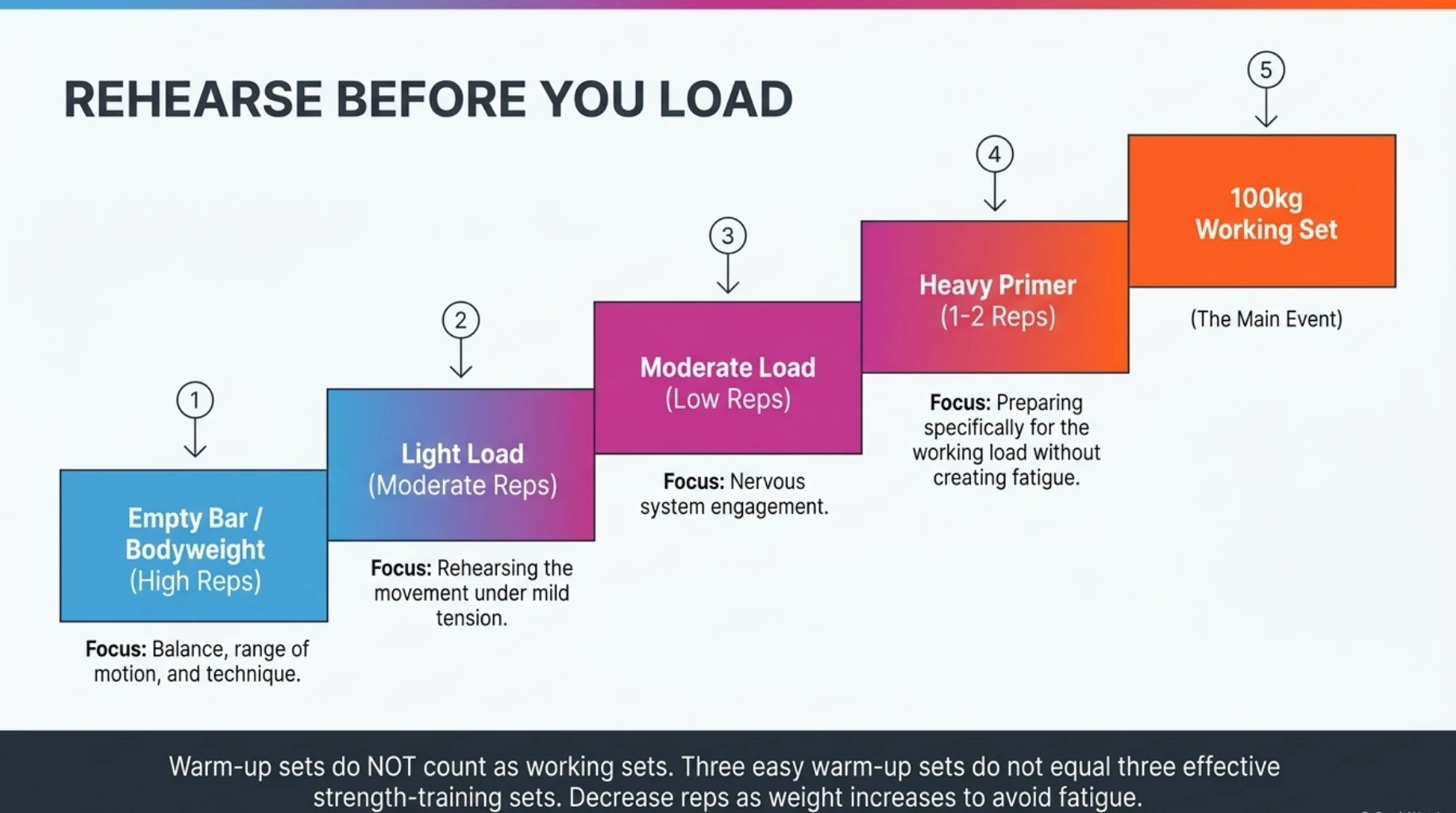
Imagine that your working weight for a squat is 100 kg.
Walking on a treadmill for five minutes does not mean you should immediately place 100 kg on the bar and begin your first working set.
Your cardiovascular system may be warmer, but you have not yet prepared specifically for the load and movement.
Progressive warm-up sets allow you to rehearse the exercise while gradually increasing the demand.
What Are Progressive Warm-Up Sets?
Warm-up sets use lighter loads before your main working weight.
For example, someone whose working weight is 100 kg might gradually progress through lighter loads before reaching 100 kg.
The exact sequence depends on the person, exercise and working weight, so there is no universal percentage progression that everyone must follow.
The principle is more important:
Start lighter and gradually approach the load you intend to train with.
Do Not Exhaust Yourself With Warm-Up Sets
Progressive does not mean performing a full workout before the workout.
As the warm-up weight becomes heavier, repetitions can often decrease.
For example, someone might perform more repetitions with the lightest load and progressively fewer repetitions as the weight approaches the working load.
The purpose is to prepare the movement and nervous system without creating unnecessary fatigue.
Do Warm-Up Sets Count as Working Sets?
Usually not when programming resistance training.
A working set is generally a set intended to provide a substantial training stimulus.
A warm-up set primarily prepares you for those harder sets.
That distinction matters because someone who performs three easy warm-up sets should not necessarily assume they have completed three effective strength-training sets.
Do You Need Warm-Up Sets for Every Exercise?
Not necessarily to the same extent.
Suppose you have already completed several progressively loaded squat sets followed by your working sets. Your lower body is no longer starting from a resting state when you move to the next leg exercise.
You may need less preparation for subsequent exercises.
However, if the movement changes substantially or the next exercise is particularly heavy or technically demanding, one or more specific preparation sets may still be useful.
Warm-ups should adapt as the workout progresses.
Mistake 6: Ignoring Pain, Unusual Stiffness or a Previous Injury
A warm-up is also an opportunity to notice how your body is responding that day.
Perhaps your knees feel normal while walking but hurt when you begin squatting.
Perhaps your shoulder feels unusually restricted during overhead movement.
Or an old injury suddenly feels different from its usual baseline.
The wrong response is automatically assuming:
“I just need to warm it up more and push through.”
Sometimes stiffness does improve as you begin moving.
But pain should not automatically be treated as stiffness.
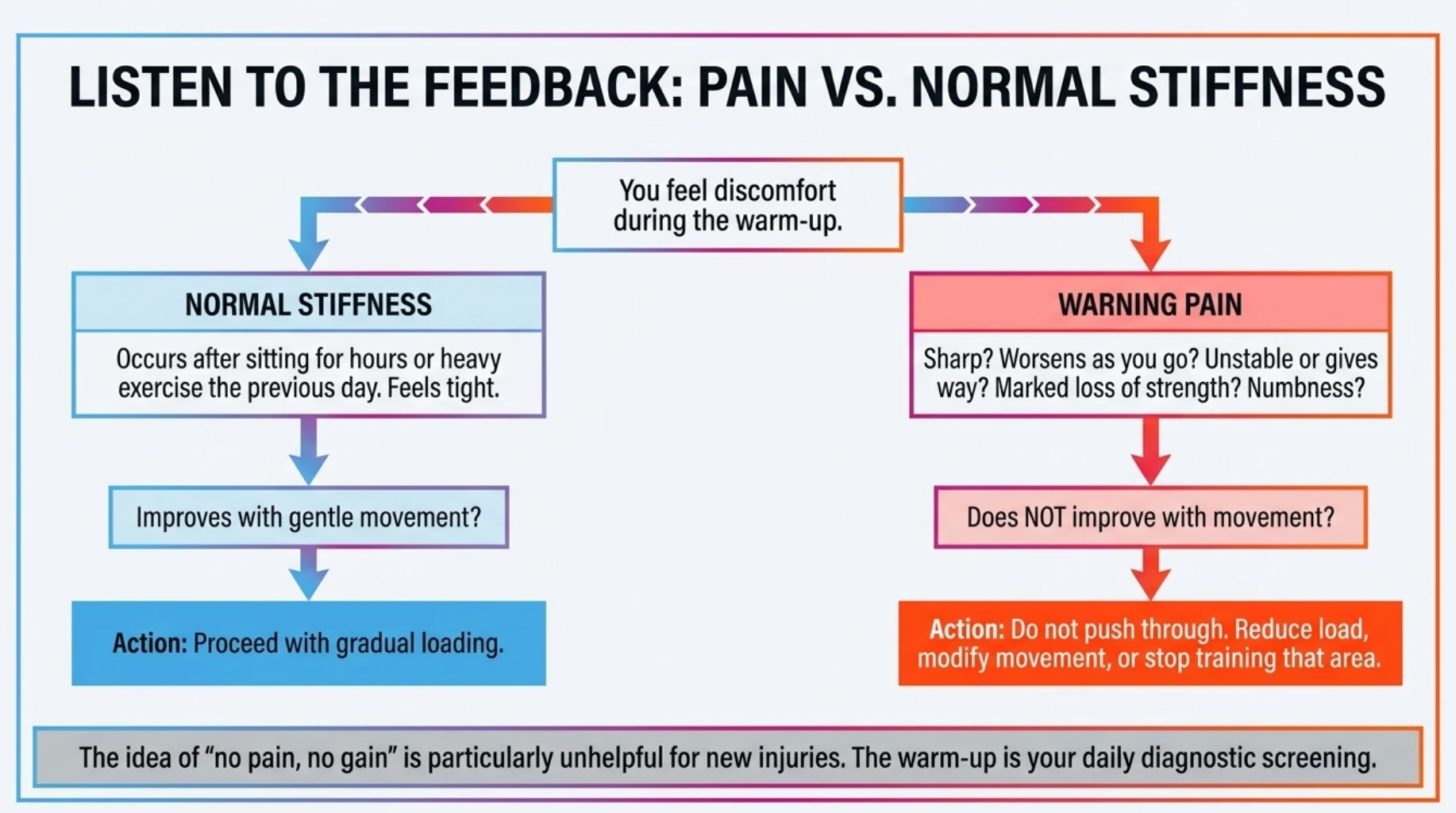
Normal Stiffness and Warning Pain Are Not the Same
After sitting for several hours or exercising hard the previous day, you may initially feel stiff.
Gentle movement can sometimes make this sensation improve.
More concerning symptoms include:
- Sharp or severe pain.
- Pain that progressively worsens as you continue.
- New swelling.
- A joint that feels unstable or gives way.
- Marked loss of movement or strength.
- Pain following a significant fall or injury.
- Numbness or significant neurological symptoms.
These situations should not simply be managed by adding another ten minutes of stretching.
Depending on the severity and circumstances, the workout may need to be modified or stopped and the problem assessed appropriately.
Do Not Use the Warm-Up as a Test of How Much Pain You Can Tolerate
The idea of “no pain, no gain” is particularly unhelpful when applied to a new injury.
A warm-up can provide useful information.
If a movement that is normally comfortable suddenly produces significant pain, that information should influence the workout.
You may need to reduce the load, modify the movement, choose a different exercise or stop training that area.
What If You Have an Old Injury?
A previous injury does not necessarily mean you must permanently avoid exercise.
In many situations, progressive rehabilitation and appropriately loaded exercise are important parts of returning to normal function.
However, someone returning from an injury may require more specific preparation than someone without that history.
This might involve exercises recommended during rehabilitation, gradual exposure to the movement and careful progression of load.
The important distinction is between preparing an area appropriately and repeatedly provoking symptoms in the belief that pain must be overcome.
Warm-Up Before Exercise After Age 40
There is no birthday at which the body suddenly requires a completely different warm-up.
However, training history, mobility, previous injuries and recovery can change as people get older.
Someone who has spent years sitting for long periods and is returning to exercise at 45 may benefit from a more gradual preparation than they used at 20.
This does not mean adults over 40 are fragile.
It means the warm-up should reflect the person’s current capacity rather than their memory of what they could do decades ago.
Strength Training After 40
Resistance training becomes particularly valuable as maintaining muscle, strength and physical function becomes increasingly important.
A useful strength warm-up after 40 may include:
- Several minutes of easy movement.
- Mobility work for areas that genuinely require it.
- Practice of the main movement.
- Progressive warm-up sets before heavy loading.
There is no need to spend 30 minutes stretching simply because you are over 40.
Preparation should remain purposeful.
Does Morning Exercise Require a Longer Warm-Up?
Some people feel noticeably stiffer when exercising soon after waking.
If that describes you, a slightly more gradual warm-up may improve comfort and readiness.
Rather than jumping directly into demanding exercise, begin with easy movement and progressively increase the range, speed and load.
But morning exercise is not inherently dangerous.
The required preparation varies considerably between individuals.
Warm-Up Before Exercise in Cold Weather
Environmental temperature can influence how quickly you feel physically ready.
In colder conditions, athletes and recreational exercisers may benefit from a somewhat longer progressive warm-up and from avoiding long periods of inactivity after warming up.
Clothing can also help maintain body temperature while preparing.
Again, the goal is not simply to sweat heavily.
The goal is to reach an appropriate level of readiness for the activity.
Should You Stretch More When It Is Cold?
Cold weather does not mean you need to perform prolonged static stretching before exercise.
Gradually increasing movement intensity is usually a more logical way to transition from rest towards demanding activity.
If stretching is included because a particular range of motion needs attention, it can be incorporated within a broader warm-up rather than replacing the warm-up entirely.
How Do You Know When You Are Warmed Up?
There is no laboratory test required before every workout.
In practical terms, you should generally feel:
- Warmer and more comfortable moving.
- Gradually prepared for the intended intensity.
- Able to perform the required movement through an appropriate range.
- Technically comfortable with the exercise.
- Ready rather than fatigued.
For resistance training, the final warm-up sets can also provide useful feedback.
If a weight that is normally easy feels unexpectedly difficult, your planned working load may need adjustment that day.
Your Warm-Up Can Help You Adjust the Workout
This is one of the most overlooked benefits of a warm-up before exercise.
A training programme may say that you should lift a particular weight or run at a particular speed, but your readiness can vary from day to day.
Poor sleep, recent illness, accumulated training fatigue, unusual soreness and other factors can affect performance.
If the warm-up feels unusually difficult, that does not always mean you should abandon exercise.
But it may be useful information suggesting that the day’s intensity or volume should be adjusted.
A good warm-up therefore does more than prepare the body.
It gives you an opportunity to assess whether today’s body is ready for today’s planned workout.
A Good Warm-Up Becomes More Specific as the Workout Approaches
A useful way to remember the process is:
| Warm-Up Stage | Main Purpose |
|---|---|
| General movement | Transition from rest towards activity |
| Dynamic preparation | Move relevant joints and muscles through useful ranges |
| Movement-specific practice | Rehearse what you are about to perform |
| Progressive loading or speed | Approach workout intensity gradually |
| Main workout | Begin once prepared without unnecessary fatigue |
The exact content will differ between a walker, runner, recreational gym user and competitive athlete.
That brings us to the seventh major mistake: assuming that everyone needs the same warm-up simply because they are doing the same exercise.
Mistake 7: Using the Same Warm-Up Regardless of Age, Fitness Level or Workout Intensity
Two people may be performing the same exercise but require different preparation.
A 25-year-old experienced runner preparing for an easy five-kilometre run may not need the same warm-up as a 55-year-old beginner returning to exercise after several years of inactivity.
Similarly, your own warm-up should not necessarily remain identical every day.
An easy recovery session, a heavy strength workout and a high-intensity interval session place very different demands on the body.
A useful warm-up before exercise therefore considers both the person and the activity.
Beginners May Need More Rehearsal, Not More Exhaustion
Beginners sometimes assume that a serious warm-up must be physically demanding.
In reality, one of the most useful parts of a beginner’s warm-up may simply be practising the movements that will appear in the workout.
Before adding significant resistance to a squat, for example, a beginner can practise the movement with body weight or a light load.
This allows attention to be placed on balance, range of motion and technique before fatigue becomes a major factor.
The goal is preparation and skill development, not proving fitness during the warm-up.
Experienced Exercisers May Need Less General Preparation but More Specific Preparation
Someone who has trained consistently for years often knows which movements help them feel prepared.
They may require less time experimenting with general mobility drills and more time progressively approaching demanding working loads.
Experience, however, should not become an excuse to skip preparation completely.
A person who can lift a heavy weight is also exposing the body to substantial forces, making appropriate progressive loading particularly useful.
Warm-Up Before Exercise for Older Adults
Older adults can benefit enormously from regular exercise, including resistance training, aerobic activity and balance exercises.
Age alone should not be treated as a reason to avoid challenging exercise.
However, the transition from rest to demanding activity may need to be more gradual depending on mobility, fitness, medical conditions and previous injuries.
A practical warm-up may begin with comfortable whole-body movement and then progress towards exercises resembling the planned workout.
Someone with balance limitations may also need stable support and a safer exercise environment rather than complicated dynamic drills.
Warm-Up Before HIIT
High-intensity interval training deserves particular attention because the demanding portion of the session may involve rapid increases in heart rate, speed and muscular effort.
Going directly from sitting to near-maximal intervals is generally not a sensible progression.
A better approach is to gradually increase intensity.
For example, someone using a stationary bike might begin with easy cycling, increase cadence and resistance gradually, perform one or more shorter preparation efforts, and then begin the harder intervals.
The warm-up should resemble the demands of the upcoming activity without reproducing the full fatigue of the workout.
Do Not Perform HIIT During Your HIIT Warm-Up
This sounds obvious, but it is a common mistake.
If the main workout contains repeated hard intervals, the preparation phase should not contain so many hard efforts that performance is already declining before the first planned interval.
The warm-up should improve readiness for intensity, not use up your capacity for intensity.
Warm-Up Before Cardio
For moderate-intensity cardio, warming up can often be incorporated directly into the activity.
If you are cycling, start with easier cycling.
If you are using an elliptical trainer, begin at a comfortable resistance.
If you are walking briskly, begin more slowly.
Then gradually increase towards your intended training intensity.
This can be simpler and more specific than performing an unrelated ten-minute warm-up routine.
Warm-Up Before Sports
Sports such as football, badminton, tennis, basketball and cricket can involve acceleration, deceleration, jumping, landing, rapid changes of direction and explosive movements.
A warm-up for these activities may therefore need to progress beyond simply jogging slowly.
Depending on the sport, preparation may include progressive running, controlled changes of direction, jumping or landing practice, balance work and sport-specific movement patterns.
Structured neuromuscular warm-up programmes that combine several of these elements have shown injury-reduction benefits in some sporting populations.
This is different from claiming that any random warm-up prevents all sports injuries.
Should You Warm Up Differently in the Morning and Evening?
You do not need two completely different programmes simply because the clock has changed.
However, many people feel stiffer shortly after waking than later in the day.
If you train early in the morning, you may prefer a slightly more gradual transition from easy movement towards full range, speed or load.
In the evening, especially if you have already been physically active during the day, you may feel ready more quickly.
Individual response matters more than following a rigid morning-versus-evening rule.
Common Warm-Up Myths
Myth 1: You Must Warm Up for Exactly 10 Minutes
There is no universal ten-minute requirement.
A short, low-intensity workout may need very little formal preparation, while heavy strength training, sprinting or competitive sport may require considerably more.
Warm-up duration should reflect the demands of the activity and the individual.
Myth 2: A Good Warm-Up Must Make You Sweat
Sweating is not a reliable measure of readiness.
Temperature, humidity, clothing and individual sweating patterns all influence how quickly you sweat.
Judge the warm-up by whether you are prepared for the activity, not by how wet your T-shirt becomes.
Myth 3: Stretching Is the Same as Warming Up
Stretching can be one component of a warm-up, but it does not automatically provide cardiovascular, neurological and movement-specific preparation.
A complete warm-up may involve general movement, dynamic preparation and increasingly specific rehearsal of the upcoming activity.
Myth 4: Static Stretching Before Exercise Is Always Bad
This is another oversimplification.
Long-duration or aggressive static stretching immediately before maximal strength or explosive activity can temporarily affect performance.
That does not mean all static stretching before exercise is harmful.
Brief targeted stretching can sometimes be useful, particularly when a particular range of motion is required, especially when followed by dynamic and activity-specific preparation.
Myth 5: More Warm-Up Is Always Better
No.
Once preparation becomes unnecessarily long or intense, fatigue can begin to interfere with the main workout.
The best warm-up is not the longest one.
It is the one that gets you ready with minimal unnecessary fatigue.
Myth 6: A Warm-Up Guarantees You Will Not Get Injured
No warm-up can provide such a guarantee.
Injury risk is influenced by many factors, including previous injuries, sudden increases in training load, technique, fatigue, recovery, the activity being performed and unpredictable events.
A warm-up is one component of sensible training, not an insurance policy against injury.
A Practical 5-Minute Warm-Up
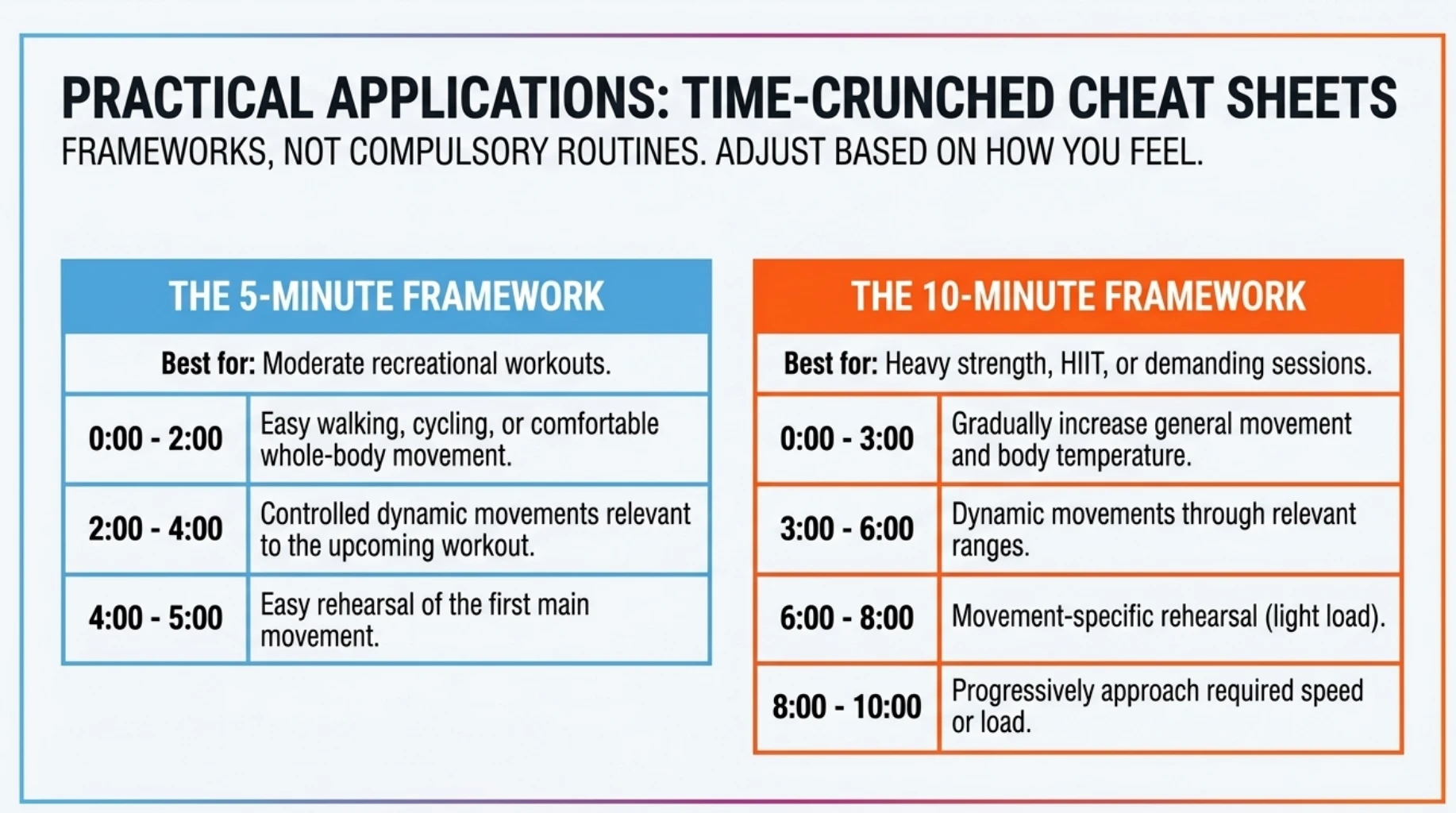
For many moderate recreational workouts, a short warm-up may be sufficient.
A simple framework could look like this:
| Approximate Time | Activity |
|---|---|
| 2 minutes | Easy walking, cycling or another comfortable whole-body movement |
| 2 minutes | Controlled dynamic movements relevant to the upcoming workout |
| 1 minute | Easy rehearsal of the first main movement |
This is a framework rather than a compulsory routine.
If the planned workout is heavy, explosive or technically demanding, additional specific preparation is likely to be useful.
A Practical 10-Minute Warm-Up
For a more demanding session, preparation could be extended:
| Approximate Time | Purpose |
|---|---|
| 3 minutes | Gradually increase general movement and body temperature |
| 3 minutes | Dynamic movements through relevant ranges |
| 2 minutes | Movement-specific rehearsal |
| 2 minutes | Progressively approach the speed or load required |
The sequence matters more than precisely following the clock.
Move from general preparation towards specific preparation.
A Practical Warm-Up Before Strength Training
Strength training deserves a slightly different approach because the first major exercise may eventually involve a substantial external load.
Consider someone planning to squat.
The session could progress through:
Step 1: General movement
Perform a few minutes of comfortable walking, cycling or another activity if it helps you transition into training.
Step 2: Relevant mobility
If ankle, hip or another area genuinely requires preparation for the movement, perform targeted dynamic mobility work.
Step 3: Movement rehearsal
Perform bodyweight or lightly loaded squats.
Step 4: Progressive loading
Increase the weight gradually while avoiding unnecessary repetitions.
Step 5: Working sets
Begin the planned training sets once you feel technically and physically prepared.
Choose Your Warm-Up
| Planned Exercise | Practical Warm-Up Approach |
|---|---|
| Easy walking | Start slowly and gradually increase pace |
| Moderate cardio | Begin with the same activity at lower intensity |
| Running | Walking/easy jogging followed by progressively faster running as needed |
| Strength training | General movement if useful, relevant dynamic preparation and progressive warm-up sets |
| Heavy compound lifts | Several progressively loaded exercise-specific sets without creating fatigue |
| HIIT | Gradually increase intensity and include brief preparation efforts before hard intervals |
| Sports | General movement followed by dynamic and sport-specific movement preparation |
When Should You Stop the Warm-Up and Reconsider the Workout?
A warm-up is also a useful screening period for how you feel that day.
Consider modifying or stopping the planned workout if you develop symptoms such as:
- New or severe chest pain or pressure.
- Unusual severe shortness of breath.
- Fainting or near-fainting.
- New severe dizziness.
- Sharp or rapidly worsening musculoskeletal pain.
- Sudden weakness, instability or significant loss of function.
- Symptoms suggesting that you have not adequately recovered from an acute illness.
These are not situations where a longer warm-up should automatically be used to force the workout to continue.
Warm-Up Before Exercise: Frequently Asked Questions
How Long Should I Warm Up Before Exercise?
There is no single duration that works for everyone. A moderate recreational workout may require only several minutes of progressive preparation, while heavy lifting, sprinting or competitive sport may require a longer and more specific warm-up.
Is Five Minutes Enough for a Warm-Up?
It can be for some activities. Five minutes may be adequate before a moderate workout if the preparation is appropriate. More demanding exercise may require additional movement-specific preparation or progressive loading.
Should I Stretch Before Exercise?
Stretching can be included when useful, but static stretching should not automatically replace the entire warm-up. Dynamic and activity-specific preparation is often more relevant immediately before demanding exercise.
Is Static Stretching Bad Before Strength Training?
Not automatically. Prolonged or aggressive static stretching immediately before maximal strength or explosive activity may temporarily reduce aspects of performance. Brief targeted stretching followed by dynamic and exercise-specific preparation is different from prolonged stretching.
Do I Need to Warm Up Before Walking?
An elaborate warm-up is usually unnecessary before an easy walk for an otherwise healthy person. Simply begin at a comfortable pace and gradually increase your walking speed.
Should I Warm Up Before Every Weight-Training Exercise?
You may not need the same amount of preparation before every exercise. After several exercises, your body is already warm. However, additional preparation may still be useful when changing to a substantially different, heavy or technically demanding movement.
Can Warming Up Prevent Exercise Injuries?
A warm-up can contribute to sensible exercise preparation, and structured multicomponent warm-up programmes can reduce certain injuries in some sporting settings. However, no warm-up can guarantee that an injury will not occur.
Should People Over 40 Warm Up Longer?
Not simply because they are over 40. Warm-up requirements should reflect fitness, mobility, training history, previous injuries and workout intensity. Some people may benefit from a more gradual preparation as they get older, but age alone does not determine the exact duration.
What Is the Best Warm-Up Before Strength Training?
A practical approach is to move from general preparation towards exercise-specific preparation: easy movement if needed, relevant dynamic mobility, rehearsal of the main exercise and progressively heavier warm-up sets before demanding working sets.
The 7 Warm-Up Mistakes at a Glance
| Mistake | Better Approach |
|---|---|
| Skipping the warm-up completely | Gradually transition from rest to the demands of the workout |
| Using only static stretching | Include dynamic and activity-specific preparation when appropriate |
| Making the warm-up exhausting | Finish feeling prepared rather than fatigued |
| Using the same generic routine for every workout | Match preparation to the activity |
| Starting heavy lifts immediately | Use progressive warm-up sets |
| Ignoring pain or previous injuries | Use symptoms to modify training when necessary |
| Using one warm-up for everybody | Adapt it to fitness, experience, age and workout intensity |
Final Thought
Do not judge a warm-up by how much you sweat or how many exercises you complete. Judge it by what happens next. If you begin the main workout feeling mobile, comfortable, technically prepared and ready to increase effort without already being tired, your warm-up has probably done its job.
If you want a personalized metabolic assessment and lifestyle strategy, you can book a consultation here:
Book an Appointment