

Returning to Exercise After Illness: 8 Safe Step-by-Step Fitness Restart
Returning to exercise after illness? Learn a safe step-by-step plan to restart walking, cardio and strength training without pushing recovery too fast.
After several days—or sometimes several weeks—of fever, cough, stomach upset, weakness, or complete rest, you finally begin to feel better. Naturally, you want to return to your usual walking, running, gym sessions, or strength training as quickly as possible.
But feeling better enough to resume normal daily activities does not always mean your body is ready for a hard workout.
Returning to exercise after illness requires a different approach from restarting after a holiday or a busy week. Illness can temporarily affect hydration, appetite, sleep, muscle strength, cardiovascular fitness, and overall exercise tolerance. Some infections can also affect the heart, lungs, or other organs.
The appropriate restart therefore depends on what illness you had, how severe it was, how long you were inactive, whether symptoms have completely resolved, and what type of exercise you normally perform.
Someone recovering from a mild cold may need only a short adjustment period.
Someone recovering from pneumonia, dengue, severe COVID-19, prolonged fever, or hospitalisation may need a much slower and more individualised return.
The objective is not to regain all your lost fitness in the first few workouts.
It is to return safely enough that you can keep exercising consistently.
Why Returning to Exercise After Illness Needs a Gradual Approach
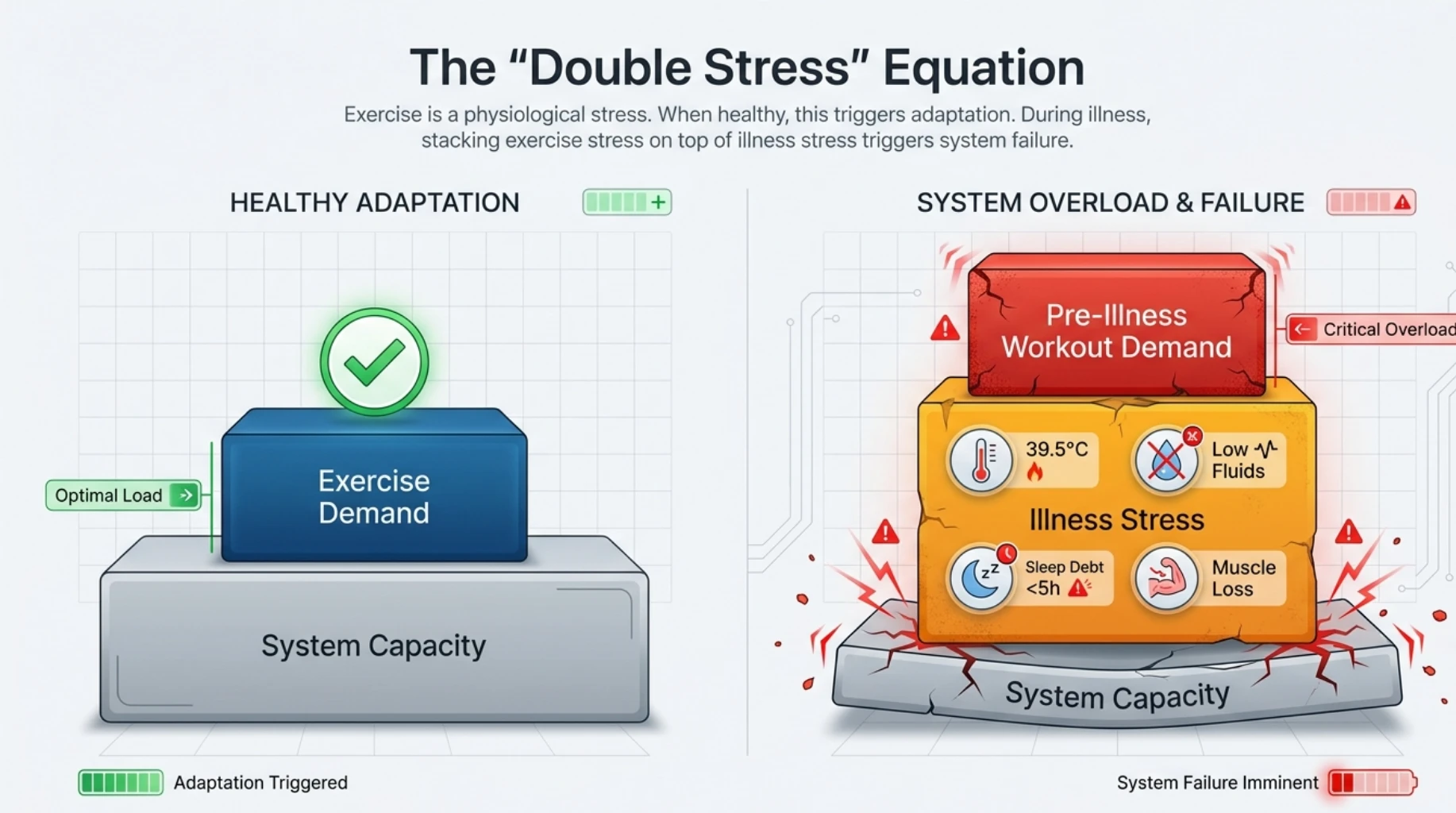
Exercise is a physiological stress.
When you are healthy and adequately recovered, that stress can stimulate useful adaptations such as improved cardiovascular fitness, greater muscle strength, and better metabolic health.
During an acute illness, however, your body is already dealing with another physiological challenge.
Depending on the illness, you may experience:
- Fever and increased fluid losses.
- Reduced food intake.
- Dehydration.
- Loss of electrolytes through vomiting or diarrhoea.
- Several days of very low physical activity.
- Poor sleep.
- Muscle weakness.
- Reduced exercise tolerance.
- Residual respiratory symptoms.
Trying to immediately reproduce your pre-illness workout can therefore create much more stress than expected.
A better strategy is to temporarily reduce the exercise demand and allow your body to demonstrate that it can tolerate progressively more activity.
When Is It Safe to Start Exercising Again?
There is no universal rule such as “wait exactly three days after every illness.”
The answer depends heavily on the condition.
As a general principle, strenuous exercise should be avoided during an active systemic illness, particularly when you have fever, significant weakness, dehydration, chest symptoms, or substantial gastrointestinal symptoms.
Before returning to exercise after illness, you should be clearly improving and able to manage ordinary daily activities without significant difficulty.
Do Not Exercise Through Fever
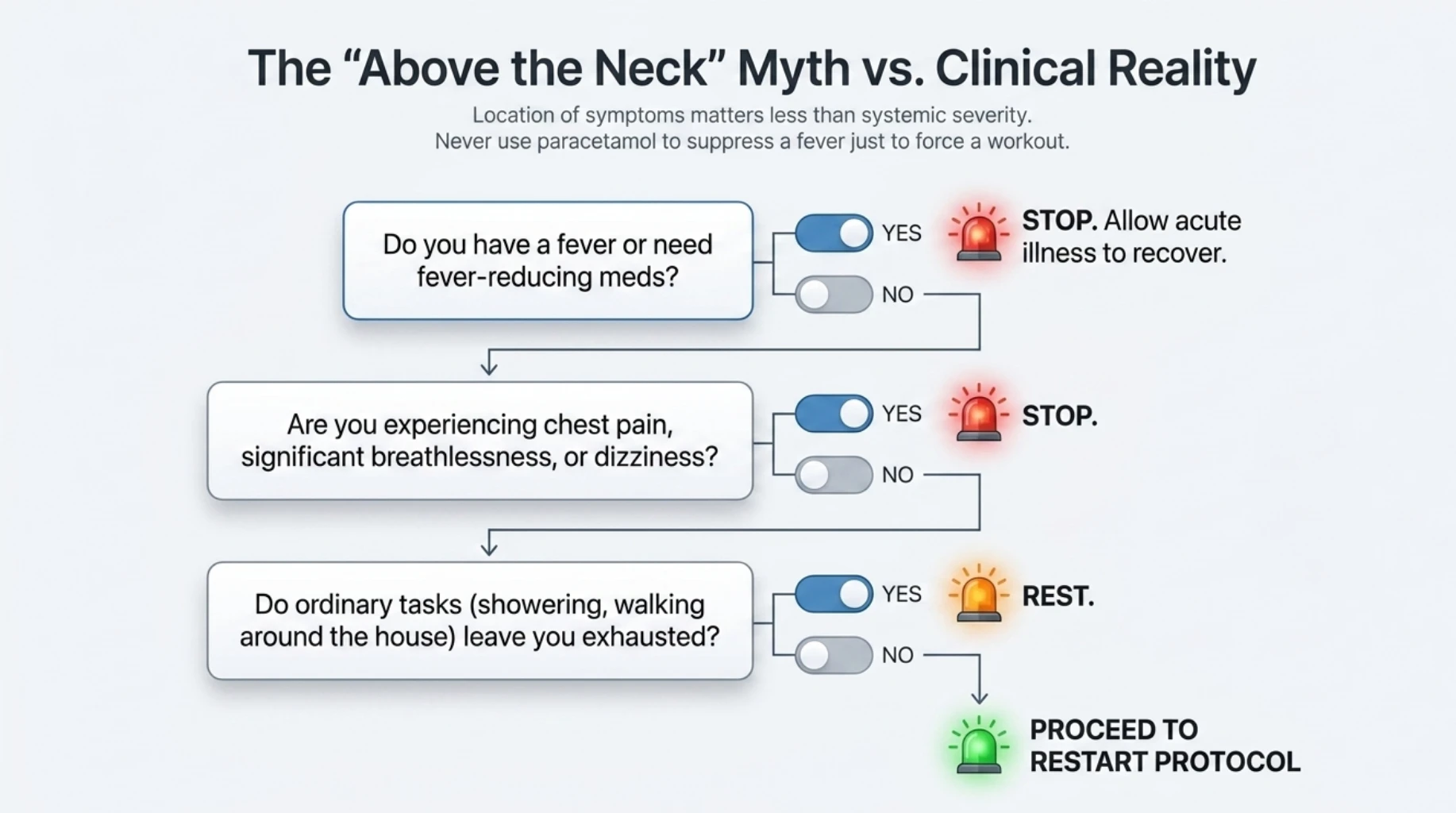
Fever is a clear reason to avoid strenuous exercise.
Exercising while febrile increases physiological stress at a time when the body is already responding to illness.
Do not use paracetamol or another fever-reducing medicine simply to suppress the temperature so that you can complete a workout.
Allow the acute illness to recover.
What About the “Above the Neck” Rule?
You may have heard the popular advice that exercise is safe when symptoms occur only “above the neck,” such as a runny nose or mild sore throat, but should be avoided when symptoms occur below the neck.
This can be a rough practical concept, but it is not a reliable medical clearance test.
Symptoms, severity, fever, general well-being, underlying medical conditions, and the suspected infection all matter.
A better question is not simply where the symptoms are located.
Ask:
“Am I well enough for exercise, and is there anything about this illness that makes exercise unsafe?”
Mild Illness vs Serious Illness: The Restart Is Not the Same
A major mistake when returning to exercise after illness is treating every infection identically.
A few days of mild upper respiratory symptoms in an otherwise healthy adult are very different from:
- Prolonged high fever.
- Pneumonia.
- Severe influenza.
- Dengue.
- Significant COVID-19 illness.
- Severe dehydration.
- Hospitalisation.
- An illness associated with cardiac complications.
The more severe or prolonged the illness, the more cautious the return generally needs to be.
If the illness affected the heart or lungs, or if significant symptoms persist, medical assessment may be appropriate before restarting strenuous exercise.
Returning to Exercise After Illness: An 8-Step Restart
The following progression is intended as a general framework for adults recovering from uncomplicated illness.
It is not a substitute for individual medical advice after serious infection, hospitalisation, cardiac disease, severe respiratory illness, or another condition requiring specific restrictions.
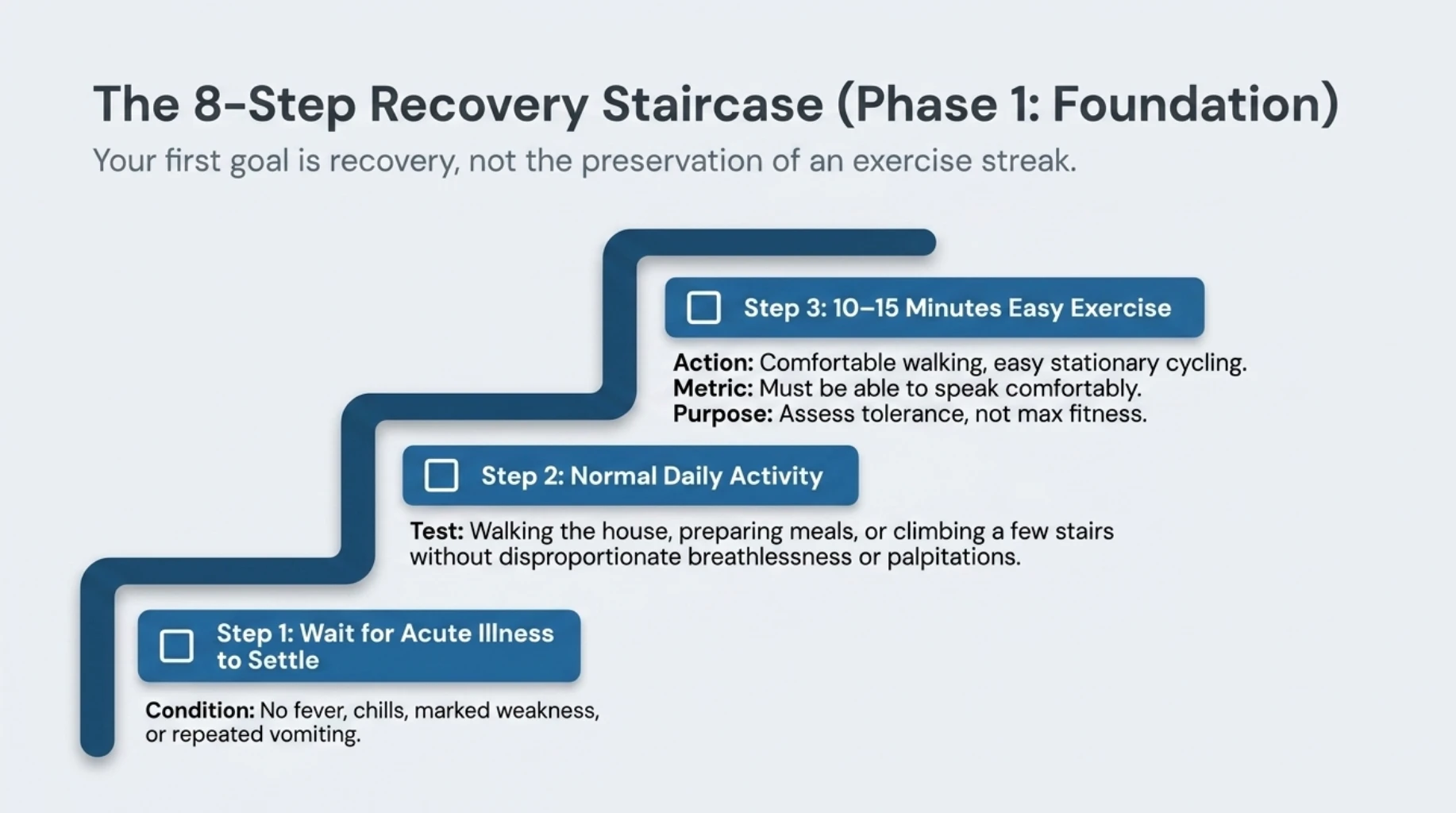
Step 1: Make Sure the Acute Illness Has Settled
Your first goal is recovery from the illness, not preservation of your exercise streak.
Before restarting structured exercise, look for clear improvement in your general condition.
You should not be trying to perform a demanding workout while experiencing:
- Fever.
- Chills.
- Marked weakness.
- Significant breathlessness.
- Chest pain.
- Repeated vomiting.
- Significant diarrhoea.
- Important dehydration.
- Dizziness or near-fainting.
A mild residual symptom does not necessarily prevent all physical activity, but the overall clinical picture matters.
If ordinary activities such as showering, dressing, preparing food, or walking around the house leave you unusually exhausted, you are probably not ready for hard training.
Step 2: Start With Normal Daily Activity
Before testing yourself with a gym workout or run, see how your body responds to ordinary movement.
This may include:
- Walking around the house.
- Preparing meals.
- Light household activities.
- Walking outdoors for a few minutes.
- Climbing a small number of stairs if normally tolerated.
Pay attention to symptoms during and after these activities.
If a short walk causes disproportionate breathlessness, dizziness, palpitations, or exhaustion lasting for hours, increasing exercise intensity is unlikely to be sensible.
Step 3: Begin With 10–15 Minutes of Easy Exercise
Once normal daily movement feels comfortable, begin with a deliberately easy session.
For many people, this could be 10–15 minutes of:
- Comfortable walking.
- Easy stationary cycling.
- Gentle mobility work.
- Another familiar low-intensity activity.
The purpose of this session is not to test your maximum fitness.
It is to assess tolerance.
You should generally be able to speak comfortably during the activity rather than struggling for breath.
If the session feels almost too easy, that is acceptable.
You are establishing a starting point.
Step 4: Increase Duration Before Intensity
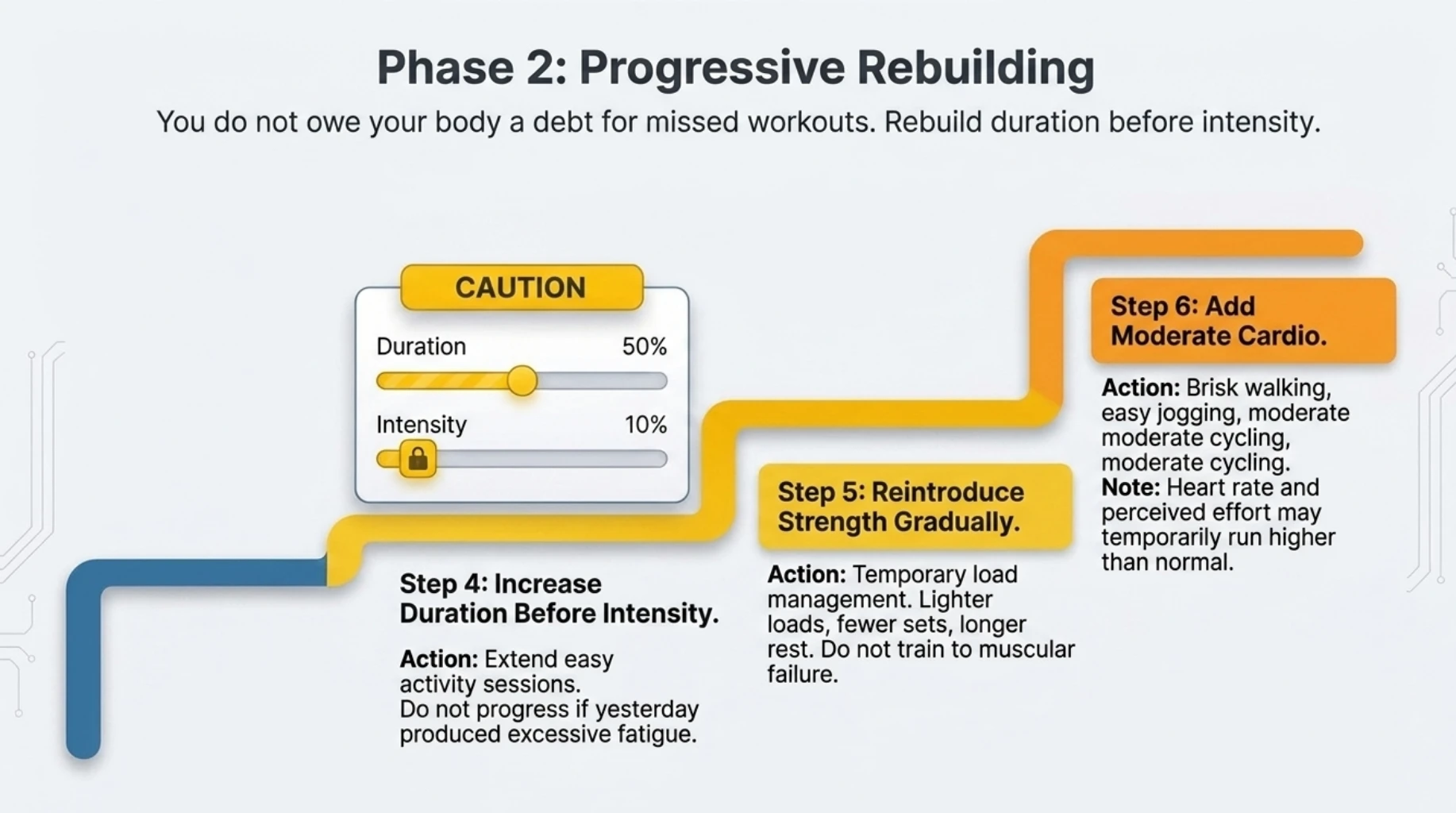
When returning to exercise after illness, one of the simplest strategies is to rebuild the duration of easy activity before reintroducing substantial intensity.
For example, instead of immediately turning a 15-minute walk into a hard run, you might progress through comfortable walking sessions of increasing duration as tolerated.
This gives you an opportunity to observe whether your cardiovascular system, muscles, energy levels, and symptoms are responding normally.
There is no requirement to increase exercise every day.
If yesterday’s activity produced excessive fatigue, repeat an easier level or take additional recovery rather than automatically progressing.
Step 5: Reintroduce Strength Training Gradually
Your first gym session after illness should usually not be a test of how much strength you have retained.
Temporarily reduce the workload.
Depending on the duration and severity of illness, this might involve:
- Using lighter loads than before illness.
- Performing fewer sets.
- Leaving more repetitions in reserve.
- Taking longer rest periods.
- Avoiding training to muscular failure.
- Reducing total session duration.
For someone recovering from a short uncomplicated illness, beginning around half to two-thirds of the previous workload can sometimes provide a practical starting point, but this should not be treated as a universal medical rule.
Someone recovering from a longer or more serious illness may need to start considerably lower.
Do Not Try to “Make Up” Missed Workouts
If you missed six workouts while sick, you do not owe your body six extra workouts.
Trying to compensate by doubling training volume after illness simply increases the sudden workload at exactly the time you are rebuilding exercise tolerance.
Resume from an appropriate current level rather than attempting to repay an imaginary exercise debt.
Step 6: Add Moderate Cardio After Easy Exercise Is Well Tolerated
Once comfortable activity is no longer producing unusual symptoms or prolonged fatigue, moderate aerobic exercise can gradually return.
This might mean progressing from easy walking to:
- Brisk walking.
- Moderate cycling.
- Easy jogging for someone accustomed to running.
- Swimming when otherwise appropriate.
- Other familiar aerobic activities.
Keep the first few sessions shorter or easier than your previous routine.
Do not use your pre-illness pace as a compulsory target.
Your heart rate or perceived effort may temporarily be higher at workloads that previously felt easy.
Step 7: Return to High-Intensity Exercise Last
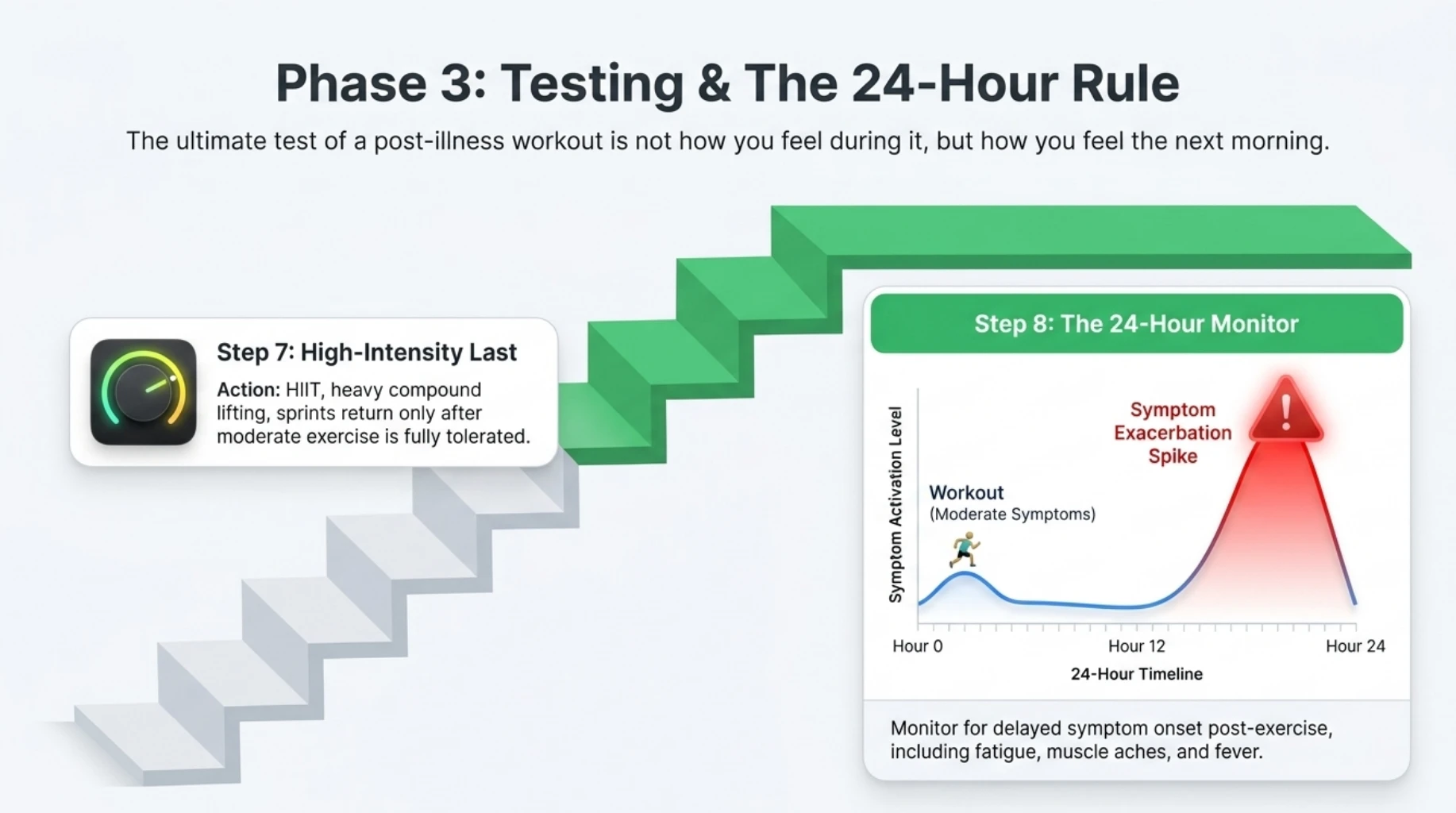
High-intensity exercise creates greater cardiovascular and metabolic demand.
Activities such as:
- HIIT.
- Sprints.
- Hard running.
- Heavy compound lifting.
- Training to failure.
- Long endurance sessions.
- Competitive sport.
should generally return after easier and moderate exercise have already been tolerated.
The fact that you can complete a gentle walk does not automatically mean you are ready for repeated all-out intervals.
Build the foundation first.
Step 8: Monitor How You Feel for the Next 24 Hours
This is one of the most useful parts of returning to exercise after illness.
Do not judge the session only by how you feel while exercising.
Also pay attention to what happens later that day and the following morning.
Ask yourself:
- Did fatigue become disproportionately worse?
- Did dizziness appear?
- Did breathlessness remain elevated?
- Did palpitations occur?
- Did symptoms of the illness return?
- Did I sleep normally?
- Do I feel capable of ordinary daily activity today?
If you tolerate the session and recover normally, gradual progression is reasonable.
If symptoms clearly worsen, return to the previous tolerated level rather than continuing to increase training.
Why Exercise Feels Harder After Illness
One of the most frustrating experiences after illness is discovering that an easy workout suddenly feels difficult.
This does not necessarily mean something is permanently wrong.
Several temporary changes can contribute.
Temporary Deconditioning
Fitness is specific to what you regularly do.
When training stops, some adaptations begin to decline.
The amount depends on how long you were inactive, your previous fitness, the severity of illness, and how much movement you maintained during recovery.
A few missed workouts are not a disaster.
Longer periods of bed rest or inactivity can have a greater effect.
Reduced Food Intake
Illness often reduces appetite.
If you have eaten very little for several days, your energy intake and carbohydrate availability may be lower than usual.
Returning immediately to demanding training while continuing to eat very little can make exercise feel considerably harder.
Dehydration and Fluid Loss
Fever, sweating, vomiting, and diarrhoea can all increase fluid loss.
If hydration has not been adequately restored, exercise tolerance may remain reduced.
Rehydration is therefore particularly important after illnesses involving significant gastrointestinal or fluid losses.
Muscle Loss After Prolonged Inactivity
A few rest days do not suddenly erase your muscle.
But prolonged illness, bed rest, low protein intake, and substantial calorie restriction can contribute to loss of muscle mass and strength.
This becomes particularly important in older adults and after hospitalisation.
Strength may therefore need to be rebuilt rather than simply tested.
Poor Sleep and Residual Fatigue
Sleep is often disrupted during illness by fever, cough, nasal congestion, pain, medication schedules, or anxiety.
Even after the main infection settles, accumulated sleep disruption can contribute to fatigue.
Allowing adequate sleep during the restart period can be just as important as adjusting the exercise itself.
Returning to Exercise After Fever or a Viral Illness
Fever is a reason to stop strenuous exercise during the acute phase of illness.
Once fever has resolved and the person is otherwise recovering, normal activity can be reintroduced gradually according to symptoms and the nature of the infection.
Do not judge recovery simply by temperature.
A person may no longer have fever but still experience substantial weakness, dehydration, breathlessness, or poor exercise tolerance.
The more prolonged the fever or systemic illness, the more conservative the return should be.
Do Not Use Exercise to “Sweat Out” an Infection
Sweating is a normal mechanism for regulating body temperature.
It does not remove viruses or bacteria from the body.
Trying to perform a hard workout or sit in excessive heat to “sweat out” an infection can worsen dehydration and physiological stress.
Recovery from infection depends on the underlying illness and appropriate medical and supportive care—not on producing more sweat.
Returning to Exercise After COVID-19
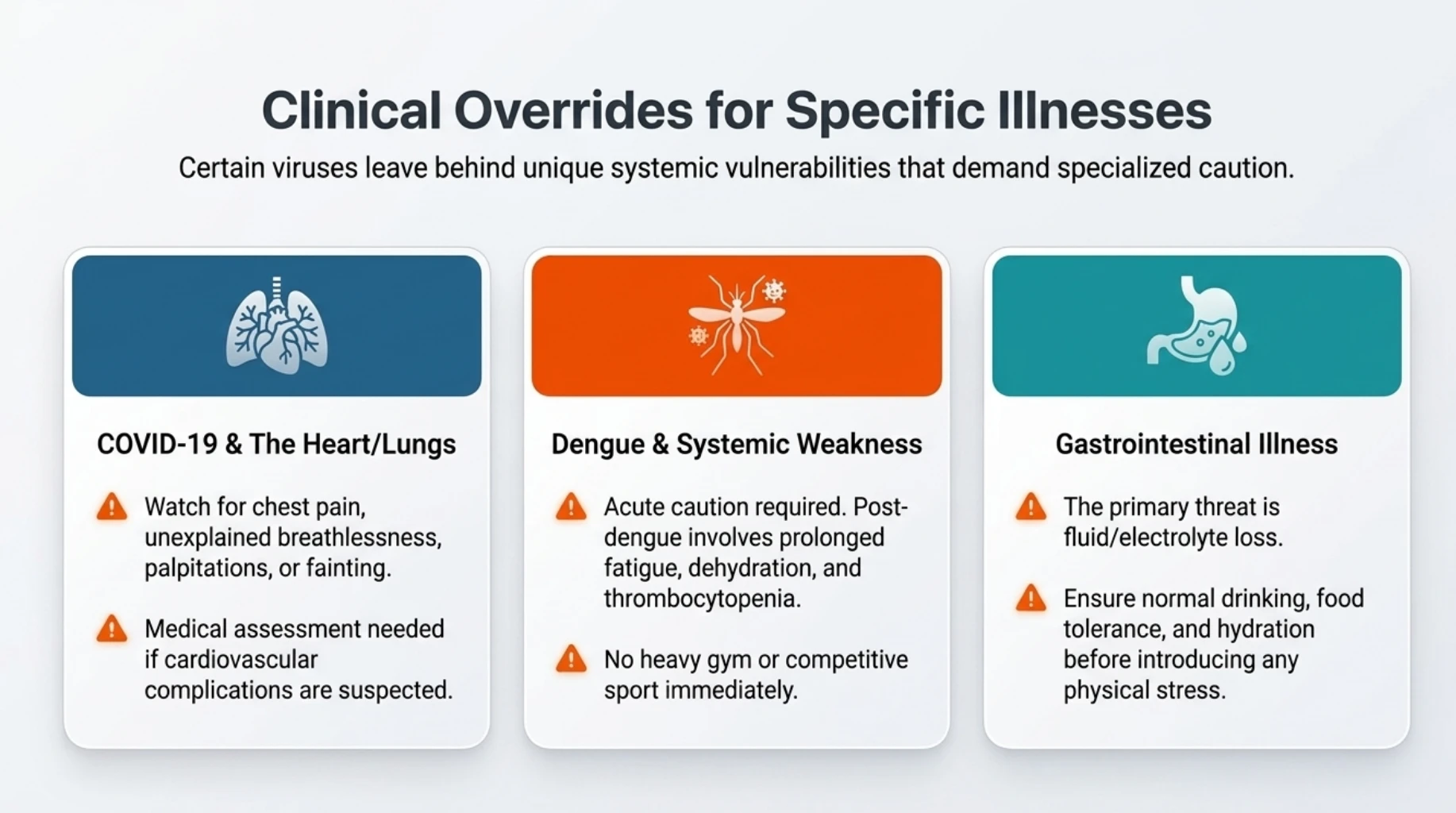
Return to exercise after COVID-19 should be individualised according to illness severity, ongoing symptoms, underlying health, and whether there was any suggestion of cardiac or pulmonary involvement.
Many people with mild uncomplicated illness can gradually resume activity after recovery.
However, persistent symptoms require greater caution.
Symptoms such as:
- Chest pain.
- Palpitations.
- Unexplained breathlessness.
- Fainting.
- Marked reduction in exercise tolerance.
should not simply be pushed through.
Medical assessment may be appropriate before returning to strenuous exercise, particularly when symptoms raise concern about cardiovascular or respiratory complications.
Returning to Exercise After Dengue
Dengue deserves particular caution because it is not simply an illness that causes a few days of fever.
During and after dengue, people may experience significant weakness, dehydration, reduced appetite, thrombocytopenia, and prolonged fatigue.
Rarely, cardiac complications can also occur.
Vigorous exercise should not be attempted during the acute illness.
After clinical recovery, activity should restart gradually rather than immediately returning to running, heavy gym training, or competitive sport.
Someone who continues to have marked weakness, dizziness, bleeding symptoms, significant breathlessness, chest symptoms, or other concerning features should receive medical assessment.
Returning to Exercise After Vomiting or Diarrhoea
Gastrointestinal illness creates a different recovery problem.
The major concerns can include:
- Dehydration.
- Sodium and other electrolyte losses.
- Low calorie intake.
- Reduced carbohydrate stores.
- General weakness.
Do not rush back to a hard workout simply because the diarrhoea has stopped that morning.
First ensure that you can drink normally, tolerate food, maintain hydration, and perform ordinary activities without significant dizziness or weakness.
Then restart exercise gradually.
Food and Hydration When Returning to Exercise After Illness
People often focus so heavily on the exercise programme that they forget the body also needs adequate nutrition to recover.
After illness, the priority is generally to restore a normal, balanced intake rather than immediately beginning an aggressive fat-loss diet.
Important areas include:
- Adequate total energy intake.
- Protein-containing meals.
- Carbohydrate appropriate to activity level.
- Fruits and vegetables.
- Fluids.
- Electrolyte replacement when significant losses have occurred.
Protein Becomes Particularly Important After Prolonged Illness
Protein supports maintenance and rebuilding of muscle tissue.
After prolonged inactivity or reduced food intake, including meaningful protein sources across meals can be useful.
For Indian diets, options may include:
- Eggs.
- Milk and curd.
- Paneer.
- Tofu.
- Soy foods.
- Dal and pulses.
- Chicken or fish where consumed.
Protein requirements should be individualised in people with conditions such as significant kidney disease or other illnesses requiring dietary modification.
Do Not Use Pre-Workout Stimulants to Hide Post-Illness Fatigue
If you need a large dose of caffeine or a strong pre-workout product simply to feel capable of exercising after illness, reconsider whether you are ready for that workout.
Stimulants can change how tired you feel.
They do not necessarily correct the reason you are tired.
When returning to exercise after illness, your actual exercise tolerance is more useful information than your ability to temporarily mask fatigue.
Returning to Exercise After Hospitalisation
Returning home from hospital does not necessarily mean the body has returned to its previous level of physical function.
Hospitalisation can involve several days or weeks of reduced movement, bed rest, disrupted sleep, poor appetite, inflammation, procedures, medications, and loss of normal routine.
Older adults and people who were critically ill may experience particularly noticeable declines in muscle strength and mobility.
For this reason, returning to exercise after illness following hospitalisation often requires a more structured approach than restarting after a mild infection at home.
The initial goal may not be a gym workout at all.
It may be:
- Walking safely around the house.
- Getting up from a chair independently.
- Climbing stairs safely.
- Improving balance.
- Rebuilding basic lower-body strength.
- Increasing walking duration gradually.
Depending on the reason for admission, physiotherapy, cardiac rehabilitation, pulmonary rehabilitation, or another supervised programme may be appropriate.
Do Not Compare Post-Hospital Fitness With Your Pre-Illness Best
Someone who previously walked 10,000 steps or trained in the gym five days per week may become frustrated when a short walk feels difficult after hospitalisation.
That comparison is rarely useful during early recovery.
Your starting point should be based on what you can safely tolerate now.
Fitness can be rebuilt progressively.
Returning to Strength Training After Illness
Strength training is valuable during recovery because prolonged inactivity can reduce muscle strength and physical capacity.
But the first session back should not become an attempt to discover your new one-repetition maximum.
Start conservatively.
For example, you may temporarily reduce:
- The weight lifted.
- The number of exercises.
- The number of sets.
- The number of repetitions.
- Total session duration.
Leave several repetitions in reserve rather than immediately training to failure.
If the session is well tolerated during exercise and over the following day, the workload can gradually increase.
Your First Workout Should Feel Easier Than Your Last Pre-Illness Workout
This can be psychologically difficult for experienced exercisers.
If you previously squatted, pressed, or deadlifted a certain weight, using substantially less after illness can feel like regression.
It is better viewed as temporary load management.
Your previous strength provides useful background information, but it does not dictate what you must lift on the first day back.
Give your body an opportunity to demonstrate its current capacity.
Returning to Running After Illness
Running places greater cardiovascular and musculoskeletal demands on the body than comfortable walking.
A useful progression for some previously active runners may therefore move from:
Walking → brisk walking → short easy jogging intervals → continuous easy running → normal training → higher-intensity sessions.
The exact progression depends on illness severity and previous fitness.
Do not immediately attempt your usual pace, long run, or interval session simply because you have completed one comfortable walk.
Ignore Your Usual Pace Initially
After illness, a familiar running pace may produce a higher perceived effort or heart rate than before.
Trying to force the old pace can turn an intended easy session into a much harder workout.
Initially, use effort and symptoms to guide the session rather than trying to prove that fitness has not changed.
Returning to Exercise After Illness: When Should You Progress?
A gradual restart does not mean remaining at very low intensity indefinitely.
If activity is well tolerated, progression is appropriate.
Signs that you may be ready to progress include:
- Normal daily activities feel comfortable.
- The current exercise level does not produce unusual symptoms.
- You recover normally later that day.
- There is no substantial worsening of fatigue the following day.
- Breathing feels appropriate for the exercise intensity.
- Your general energy is continuing to improve.
Progress one variable at a time when practical.
For example, increase duration before simultaneously increasing duration, speed, resistance, and training frequency.
What If You Feel Worse the Next Day?
Do not assume that every increase in fatigue means something dangerous has happened.
Some tiredness after restarting exercise can be expected.
But if a small increase in activity repeatedly produces disproportionate or prolonged worsening of symptoms, continuing to push harder may not be appropriate.
Return to the previous tolerated level and consider medical assessment when symptoms are persistent, substantial, or unexplained.
What About Persistent Fatigue After a Viral Illness?
Some people continue to experience fatigue for considerably longer than the acute infection itself.
In this situation, the common advice to simply “push through” can be inappropriate.
Persistent fatigue may have several explanations, including:
- Incomplete recovery from the infection.
- Sleep disruption.
- Reduced calorie intake.
- Anaemia or iron deficiency.
- Medication effects.
- Post-viral symptoms.
- Cardiorespiratory complications.
- Other unrelated medical conditions.
If fatigue is substantial or persists despite appropriate recovery, medical evaluation may be more useful than repeatedly trying harder workouts.
Post-Exertional Symptom Exacerbation Needs Particular Caution
Some people with post-viral conditions, including some individuals with Long COVID, experience a delayed and disproportionate worsening of symptoms after physical or cognitive exertion.
This is often described as post-exertional symptom exacerbation or post-exertional malaise.
The worsening may not occur during the activity itself. Symptoms can become more noticeable later and may persist beyond the normal recovery expected from exercise.
In this situation, a conventional programme that automatically increases exercise every few days may not be appropriate.
Activity may need to be carefully paced and individualised with appropriate clinical guidance.
This is an important exception to the idea that everyone recovering from illness should simply keep increasing exercise until fitness returns.
Returning to Exercise After Illness: Stop and Seek Medical Advice for These Symptoms
Most people recovering from an uncomplicated minor illness can return to activity without extensive testing.
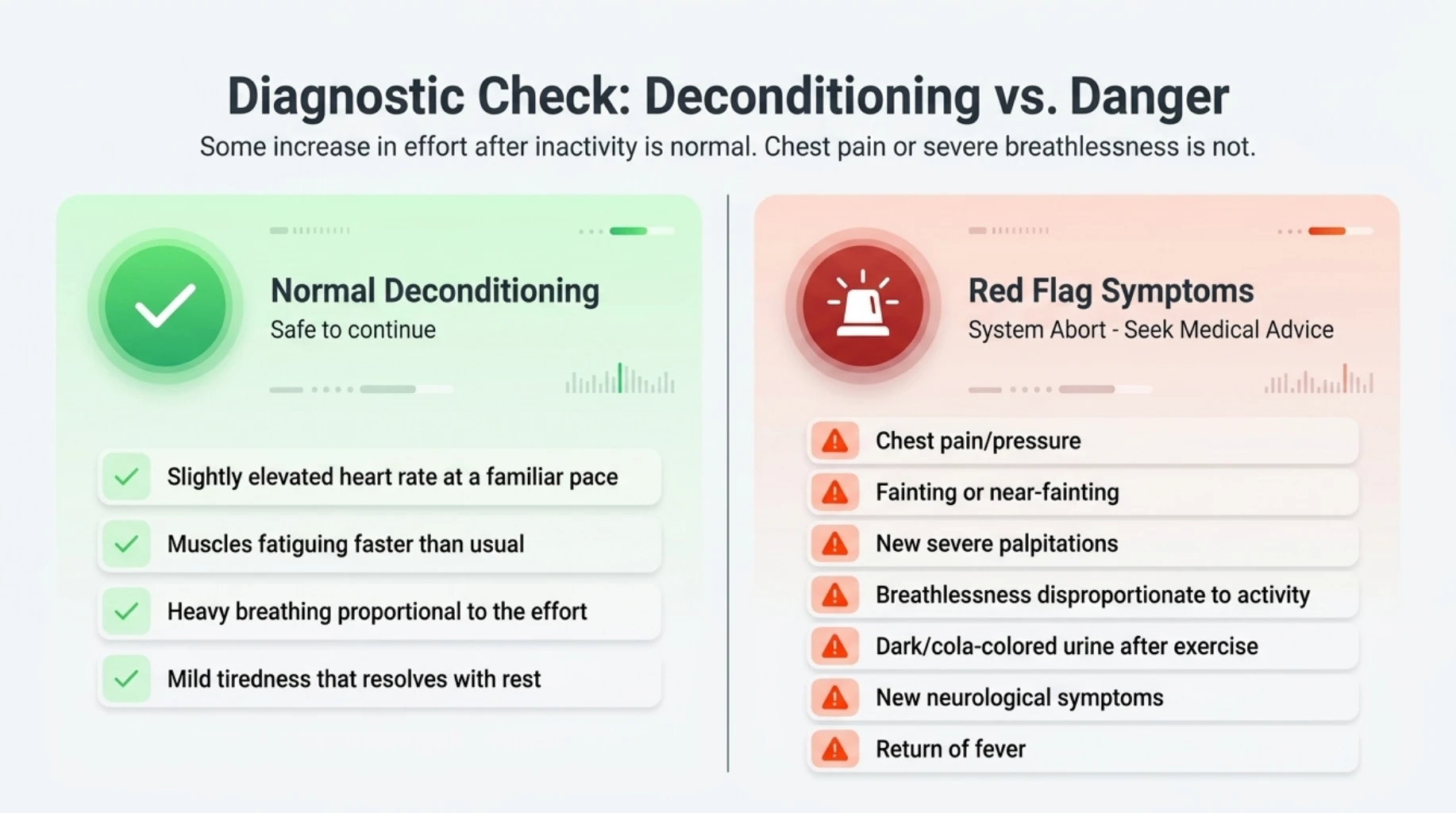
However, some symptoms should not be dismissed as simple deconditioning.
Stop strenuous exercise and seek appropriate medical assessment if you develop:
- Chest pain, pressure, or unexplained chest discomfort.
- Fainting or near-fainting.
- New or significant palpitations.
- Unusual breathlessness that is disproportionate to the activity.
- Marked or progressive exercise intolerance.
- Persistent dizziness.
- New severe weakness.
- Return of fever.
- Significant worsening of respiratory symptoms.
- Dark or cola-coloured urine after exercise.
- New neurological symptoms.
The appropriate urgency depends on the symptom and its severity. Severe chest pain, severe breathlessness, fainting, or other acute concerning symptoms may require urgent medical attention rather than waiting for a routine appointment.
Why Chest Symptoms After Viral Illness Matter
Most viral infections do not cause myocarditis, but viral illnesses can occasionally involve the heart muscle or the tissues surrounding the heart.
Symptoms can include chest discomfort, breathlessness, palpitations, unexplained fatigue, or reduced exercise tolerance.
For this reason, new cardiac-type symptoms during returning to exercise after illness should not simply be treated as evidence that you have become unfit.
When myocarditis is suspected or diagnosed, strenuous exercise requires medical restriction and specialist guidance. This is not a situation for a self-directed rapid return to training.
Do You Need Blood Tests Before Returning to Exercise After Illness?
Not routinely.
An otherwise healthy person recovering normally from a short uncomplicated illness generally does not need a panel of blood tests simply because they missed several workouts.
Testing becomes more relevant when symptoms, examination findings, or the nature of the illness suggest a specific problem.
For example, persistent fatigue or poor exercise tolerance may sometimes lead a clinician to consider conditions such as:
- Anaemia.
- Iron deficiency.
- Electrolyte abnormalities.
- Thyroid dysfunction.
- Persistent infection or inflammation.
- Other medical causes according to the clinical history.
Tests should answer a clinical question rather than being ordered automatically as a “fitness clearance package.”
Should You Check Your Heart Rate When Restarting Exercise?
Heart-rate monitoring can provide useful information, particularly if you already know your normal exercise response.
After illness, you may notice that a familiar workload produces a somewhat higher heart rate or feels more difficult.
However, heart rate is affected by many factors, including:
- Dehydration.
- Heat.
- Poor sleep.
- Caffeine.
- Medication.
- Stress.
- Residual illness.
Do not diagnose yourself from one smartwatch reading.
Symptoms, exercise tolerance, and trends are more useful than becoming preoccupied with a single number.
Common Mistakes When Returning to Exercise After Illness
Mistake 1: Restarting Exactly Where You Stopped
Your old programme reflected your pre-illness fitness.
Your first workout back should reflect your current capacity.
Those two may not be identical.
Mistake 2: Trying to Make Up for Missed Workouts
Exercise is not a debt.
There is no physiological benefit in squeezing several missed sessions into the following week.
Resume progressively instead.
Mistake 3: Combining a Fitness Restart With Crash Dieting
Some people become concerned about weight gained during inactivity and immediately combine severe calorie restriction with increased exercise.
This can make fatigue and poor recovery worse.
Restore a balanced nutritional pattern first and use a sustainable weight-management strategy if fat loss is actually required.
Mistake 4: Using Caffeine to Override Fatigue
A cup of coffee is not inherently problematic for most people who tolerate caffeine.
The problem is using large amounts of caffeine or stimulant-containing pre-workout products specifically to override obvious post-illness exhaustion.
Fatigue can contain useful information.
Mistake 5: Assuming Every Symptom Is Just Deconditioning
Some increase in effort after inactivity is normal.
Chest pain, fainting, marked palpitations, severe breathlessness, or profound weakness are not symptoms to simply train through.
Mistake 6: Increasing Everything at Once
If you simultaneously increase training frequency, session duration, running speed, and resistance, it becomes difficult to know which change your body is struggling to tolerate.
Progress more systematically.
Common Myths About Returning to Exercise After Illness
Myth 1: You Should Sweat Out the Illness
Sweating does not remove an infection.
Hard exercise during acute illness can add physiological stress and worsen dehydration.
Myth 2: A Week Off Will Destroy Your Fitness
A short break from exercise may cause little meaningful change in some aspects of fitness, although the effect varies with training status and the illness itself.
There is no reason to risk exercising through significant illness simply because you are afraid of losing all your progress.
Myth 3: If You Can Walk, You Can Do HIIT
Walking tolerance is a useful first step.
It does not automatically establish readiness for maximal or near-maximal exercise.
Higher-intensity training should return later in the progression.
Myth 4: More Exercise Will Help You Recover Faster
Physical activity is beneficial for health, but more exercise is not automatically better during recovery from illness.
The appropriate dose depends on your current capacity.
Excessive exercise can simply add more stress when recovery is incomplete.
Myth 5: You Need Supplements to Regain Your Lost Fitness
Most people do not need a collection of recovery supplements after a short illness.
Adequate food, protein, hydration, sleep, and progressive exercise provide the foundation.
Specific deficiencies or nutritional problems should be addressed appropriately rather than assuming that everyone requires the same supplement.
A Simple 7-Day Fitness Restart Example After a Mild Illness
The following is an example, not a mandatory protocol. Someone recovering from a more significant illness may require a much slower progression.
| Day | Example Activity | Main Goal |
|---|---|---|
| Day 1 | 10–15 minutes comfortable walking | Assess basic exercise tolerance |
| Day 2 | 15–20 minutes easy walking | Increase duration gently if Day 1 was well tolerated |
| Day 3 | Easy activity or recovery day | Assess fatigue and symptoms |
| Day 4 | 20–30 minutes easy-to-moderate activity | Rebuild aerobic tolerance |
| Day 5 | Light resistance training | Reintroduce strength without training to failure |
| Day 6 | Easy activity or rest | Monitor recovery |
| Day 7 | Moderate session if previous sessions were well tolerated | Continue gradual progression |
You do not need to progress because the calendar says it is the next day.
If Day 2 causes substantial fatigue, there is no prize for forcing yourself into Day 4.
Repeat, reduce, or rest according to your response.
The Most Important Rule When Returning to Exercise After Illness
Do not try to prove that you have fully recovered in a single workout.
Use the first few sessions to gather information.
If easy exercise feels normal and recovery remains good over the following day, gradually do more.
If a small amount of exercise produces disproportionate symptoms, listen to that response rather than covering it with motivation, caffeine, or a harder training plan.
Returning to exercise after illness is successful when each stage prepares you for the next one—not when you reach your old workout as quickly as possible.
How to Rebuild Fitness Without Losing Confidence
One of the hardest parts of returning to exercise after illness is psychological.
You may know that a gradual restart is sensible, but it can still feel discouraging when a workout that was previously easy suddenly feels demanding.
This is especially common in people who exercised consistently before becoming ill.
Instead of viewing reduced performance as failure, treat it as temporary information about your current recovery status.
The goal is not to prove that nothing changed during illness.
The goal is to rebuild safely enough that strength, endurance, and confidence return progressively.
Compare Yourself With Last Week, Not Your Pre-Illness Best
Your previous performance remains useful as a long-term reference, but it should not determine every early workout.
During the first few weeks, more useful questions are:
- Can I walk slightly longer than last week without excessive fatigue?
- Does the same exercise feel easier now?
- Am I recovering normally by the next day?
- Is my strength gradually returning?
- Are ordinary daily activities becoming easier?
Small improvements are often better evidence of recovery than trying to immediately reproduce a personal best.
Returning to Exercise After Illness After Age 40
Adults over 40 can return successfully to exercise after illness, but preserving muscle and avoiding excessive deconditioning becomes increasingly important with age.
Several days of inactivity after a mild illness usually do not cause dramatic muscle loss. However, prolonged illness, poor appetite, bed rest, and hospitalisation can have a greater effect on strength, particularly in older adults.
A sensible restart should therefore include both aerobic movement and progressive resistance exercise when medically appropriate.
Walking alone can rebuild some endurance, but strength training helps restore muscle function that may have declined during inactivity.
Protein and Strength Training Become Especially Important After Prolonged Illness
After a longer period of inactivity, muscle rebuilding requires both an exercise stimulus and sufficient nutrition.
A practical approach is to include meaningful protein sources across the day while gradually reintroducing resistance exercise.
Examples include:
- Eggs.
- Milk and curd.
- Paneer.
- Tofu.
- Soy foods.
- Dal and other pulses.
- Fish or chicken where consumed.
Protein requirements should still be individualised, particularly in people with kidney disease, significant liver disease, or other medical conditions affecting nutrition.
Returning to Exercise After Illness During Weight Loss
People trying to lose weight often worry that a week or two without exercise has ruined their progress.
This can lead to two mistakes:
- Returning to intense exercise before recovery is complete.
- Cutting food intake aggressively to compensate for reduced activity.
Neither is usually necessary.
Short-term changes in body weight during illness can reflect fluid balance, reduced food intake, constipation, lower glycogen stores, or temporary inactivity rather than meaningful changes in body fat.
During recovery, restoring normal hydration and nutrition should generally come before aggressively pursuing further weight loss.
Do Not Sacrifice Muscle to Recover Lost Scale Progress
If illness has already reduced appetite and activity, combining recovery with a severe calorie deficit may make it harder to regain strength.
When weight loss remains appropriate, restart with a sustainable calorie deficit once normal eating, exercise tolerance, and general recovery have returned.
The priority should be reducing excess body fat while preserving muscle—not simply forcing the scale downward as quickly as possible.
Can You Return to Exercise If You Still Have a Cough?
It depends on the cause, severity, and associated symptoms.
A mild residual cough after an uncomplicated respiratory infection may persist even after other symptoms have improved.
If ordinary activity is comfortable and there is no fever, significant breathlessness, chest pain, dizziness, or other concerning feature, light activity may sometimes be tolerated.
However, exercise should be reduced or stopped if coughing becomes severe with exertion or is accompanied by:
- Unusual breathlessness.
- Chest discomfort.
- Wheezing.
- Marked fatigue.
- Fever returning.
- Low oxygen levels where clinically relevant.
A persistent or worsening cough may require medical evaluation rather than repeated attempts to exercise through it.
Can You Exercise If You Still Feel Weak?
Mild weakness after illness is common.
The key question is whether gentle activity helps rebuild capacity or produces disproportionate worsening.
If a short walk feels manageable and you recover normally afterwards, gradual activity can be useful.
If basic movement causes severe fatigue, dizziness, breathlessness, or prolonged exhaustion, more recovery or medical assessment may be appropriate.
Weakness should not automatically be treated with a stronger pre-workout drink.
How Quickly Will Fitness Return?
There is no fixed timeline.
Fitness recovery depends on:
- How long you were ill.
- How severe the illness was.
- How much activity you maintained.
- Your pre-illness fitness.
- Your age.
- Sleep and nutrition.
- Whether complications occurred.
After a brief uncomplicated illness, many people regain their normal routine relatively quickly.
After prolonged illness or hospitalisation, recovery may take substantially longer.
The safest approach is to let functional improvement guide progression rather than setting an arbitrary deadline.
How to Know You Are Ready for Your Normal Workout Again
There is no single test that proves full recovery, but several signs can be reassuring.
You are more likely to be ready for your usual programme when:
- Normal daily activities feel normal again.
- Easy and moderate exercise are well tolerated.
- You recover normally by the following day.
- There is no fever or return of systemic symptoms.
- Your breathing is appropriate for the workload.
- Your strength is returning progressively.
- You do not have concerning chest, neurological, or cardiovascular symptoms.
Even then, the first “normal” workout does not need to become your hardest workout.
Common Myths About Returning to Exercise After Illness
Myth 1: You Lose All Your Fitness After One Week Off
No.
Some detraining can occur with inactivity, but a short break does not erase months or years of training.
Your previous training history often makes fitness easier to rebuild than it was to develop initially.
Myth 2: The Faster You Restart, the Faster You Recover
Not necessarily.
Progressing faster than your current capacity may simply increase fatigue or prolong symptoms.
A gradual restart is often more efficient because it allows consistent progression instead of repeated setbacks.
Myth 3: If Your Temperature Is Normal, You Are Fully Recovered
Fever resolution is reassuring, but it does not automatically mean hydration, strength, appetite, respiratory function, and exercise tolerance have returned to normal.
Recovery should be assessed more broadly.
Myth 4: You Need to Sweat Heavily to Rebuild Fitness
Sweating is primarily a temperature-regulation response.
It does not indicate how effectively fitness is returning.
A short easy session that produces little sweat may be exactly the appropriate starting point after illness.
Myth 5: A High Heart Rate Means You Should Push Through to Regain Fitness
Heart rate may temporarily be higher after illness because of deconditioning, dehydration, heat, medication, or incomplete recovery.
A disproportionate response should encourage you to reduce the workload and consider the broader clinical context rather than simply pushing harder.
Myth 6: Supplements Can Speed Up Every Post-Illness Recovery
There is no universal supplement that restores exercise capacity after every illness.
Specific nutritional deficiencies should be treated when present, but most people benefit first from adequate food, hydration, protein, sleep, and a gradual return to activity.
Myth 7: Resting Too Much Is Always Better
During acute illness, rest can be necessary.
But once the illness has settled, prolonged unnecessary inactivity can contribute to deconditioning.
The goal is not endless rest. It is an appropriately timed transition from recovery to progressively greater movement.
Frequently Asked Questions About Returning to Exercise After Illness
How Long Should I Wait After a Fever Before Exercising?
There is no universal number of days that applies to every illness. Strenuous exercise should be avoided while fever is present.
Once fever has resolved and your general condition is clearly improving, activity can usually be reintroduced gradually according to the illness, associated symptoms, and your exercise tolerance.
Can I Go to the Gym the Day After I Feel Better?
Possibly after a mild uncomplicated illness, but the first session should generally be easier than your normal routine.
If the illness was prolonged, involved significant fever, dehydration, respiratory symptoms, or hospitalisation, a slower progression is more appropriate.
Should I Do Cardio or Strength Training First?
Easy walking or another low-intensity aerobic activity is often a simple way to assess general exercise tolerance.
Light resistance training can then be reintroduced as tolerated.
There is no need to choose one permanently; both are useful for rebuilding fitness.
Why Is My Heart Rate Higher After Being Sick?
Possible contributors include temporary deconditioning, dehydration, residual illness, poor sleep, heat, medication effects, or reduced circulating volume after inactivity.
If the increase is marked, persistent, or associated with chest pain, palpitations, dizziness, or unusual breathlessness, medical assessment may be appropriate.
Can I Exercise After Dengue?
Exercise should be avoided during acute dengue. After clinical recovery, activity should be restarted gradually because weakness and fatigue can persist.
Persistent symptoms, bleeding, dizziness, chest symptoms, or significant exercise intolerance require medical review.
Can I Exercise After COVID-19?
Many people recovering from mild uncomplicated COVID-19 can gradually resume exercise once the acute illness has settled.
Persistent chest pain, palpitations, unexplained breathlessness, fainting, or marked exercise intolerance require greater caution and may warrant medical assessment.
What If I Feel Very Tired the Day After Exercise?
Some fatigue can occur during a fitness restart.
However, if even low-level activity repeatedly causes disproportionate or prolonged worsening of symptoms, reduce the activity and consider whether further medical evaluation is needed.
How Quickly Should I Increase Exercise?
There is no fixed percentage increase that works for every illness or person.
Progress when the current level is well tolerated during the session and over the following day.
Increase one component at a time where practical, such as duration before intensity.
Do I Need Medical Clearance Before Returning to Exercise?
Not every mild illness requires medical clearance.
Assessment becomes more important after serious illness, hospitalisation, suspected cardiac involvement, significant respiratory disease, prolonged symptoms, or the development of concerning symptoms during activity.
Final Thought
Missing exercise because you were ill is not lost discipline. Recovery is part of health too. When you restart, let your current capacity—not your pre-illness expectations—set the first step. Fitness usually returns more reliably when you rebuild it rather than try to reclaim it in a single week.
If you want a personalized metabolic assessment and lifestyle strategy, you can book a consultation here:
Book an Appointment
One Comment
Leave a ReplyOne Ping
Pingback:Digital Thermometer Accuracy: 8 Mistakes That Can Give a Wrong Reading – Diet Plus Minus