

Dal and Rice as a Protein Source: Is the Combination Enough for Muscle Health?
Dal and rice is one of the most familiar meals in Indian households. It is affordable, comforting, easy to prepare, and provides carbohydrates, protein, fibre, minerals, and several other nutrients. It is also frequently described as a good example of protein complementation.
But there is an important question that often gets overlooked: Is dal and rice protein actually enough to maintain or build muscle?
The answer is more nuanced than simply calling dal and rice a “complete protein.”
Dal and rice can certainly contribute valuable protein to the diet. The amino-acid profiles of pulses and cereals complement each other, making the combination nutritionally stronger than relying heavily on either food alone. However, amino-acid complementation does not automatically mean that a typical plate provides enough total protein for optimal muscle health.
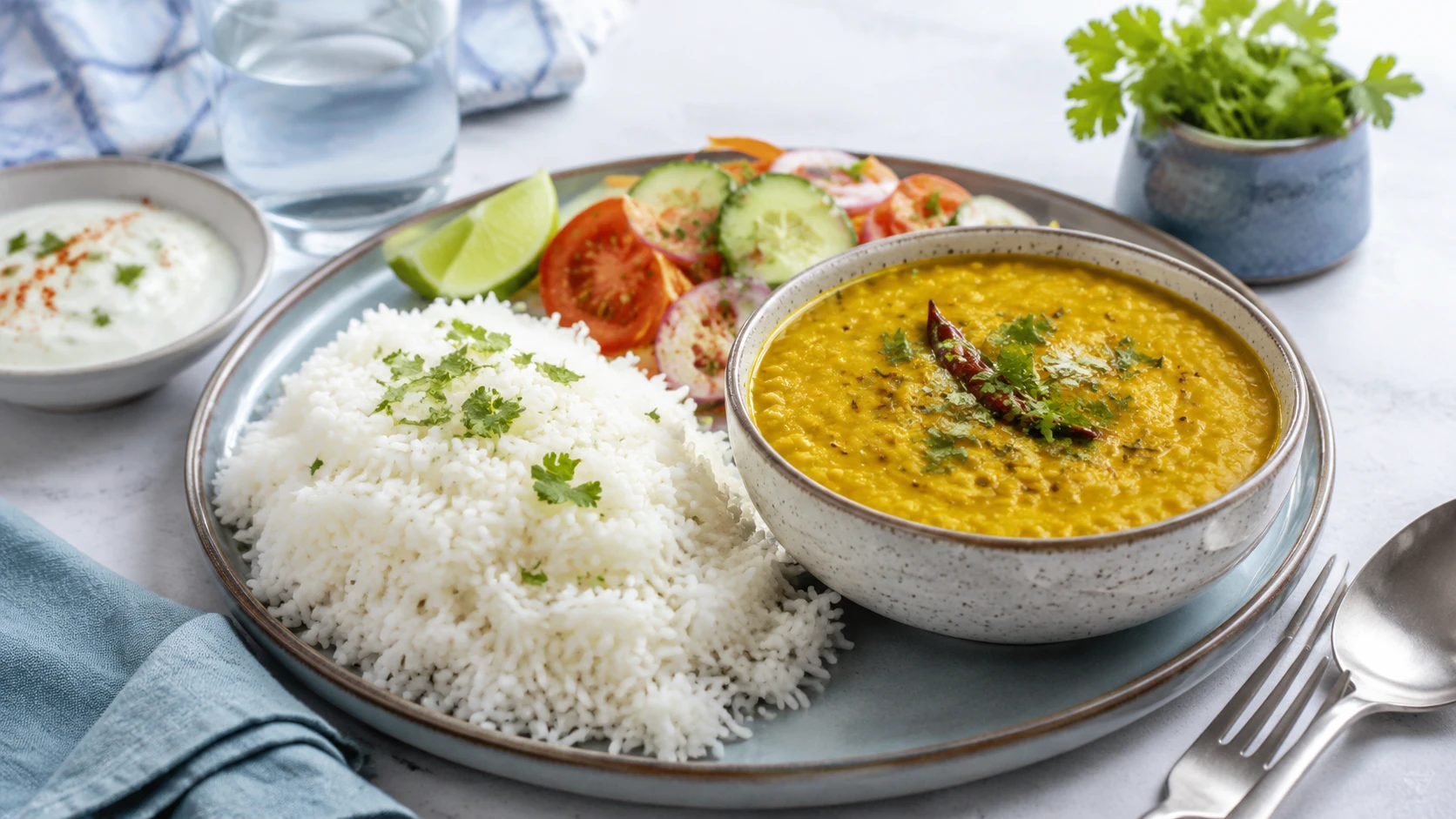
This becomes particularly important for adults over 40, people performing resistance training, women during and after the menopausal transition, older adults at risk of muscle loss, and people trying to lose fat while preserving lean mass.
Understanding dal and rice protein therefore requires looking at three separate questions:
- Does the combination provide essential amino acids?
- How much total protein does the meal actually contain?
- Is that amount sufficient for your individual muscle-health needs?
Once these questions are separated, it becomes much easier to understand where dal and rice fits into a healthy, protein-conscious Indian diet.
What Makes Dal and Rice Protein Complementary?
Dietary proteins are made from amino acids. Nine amino acids are considered essential because the human body cannot produce them in sufficient amounts and therefore needs to obtain them through food.
Different plant foods contain different proportions of these essential amino acids.
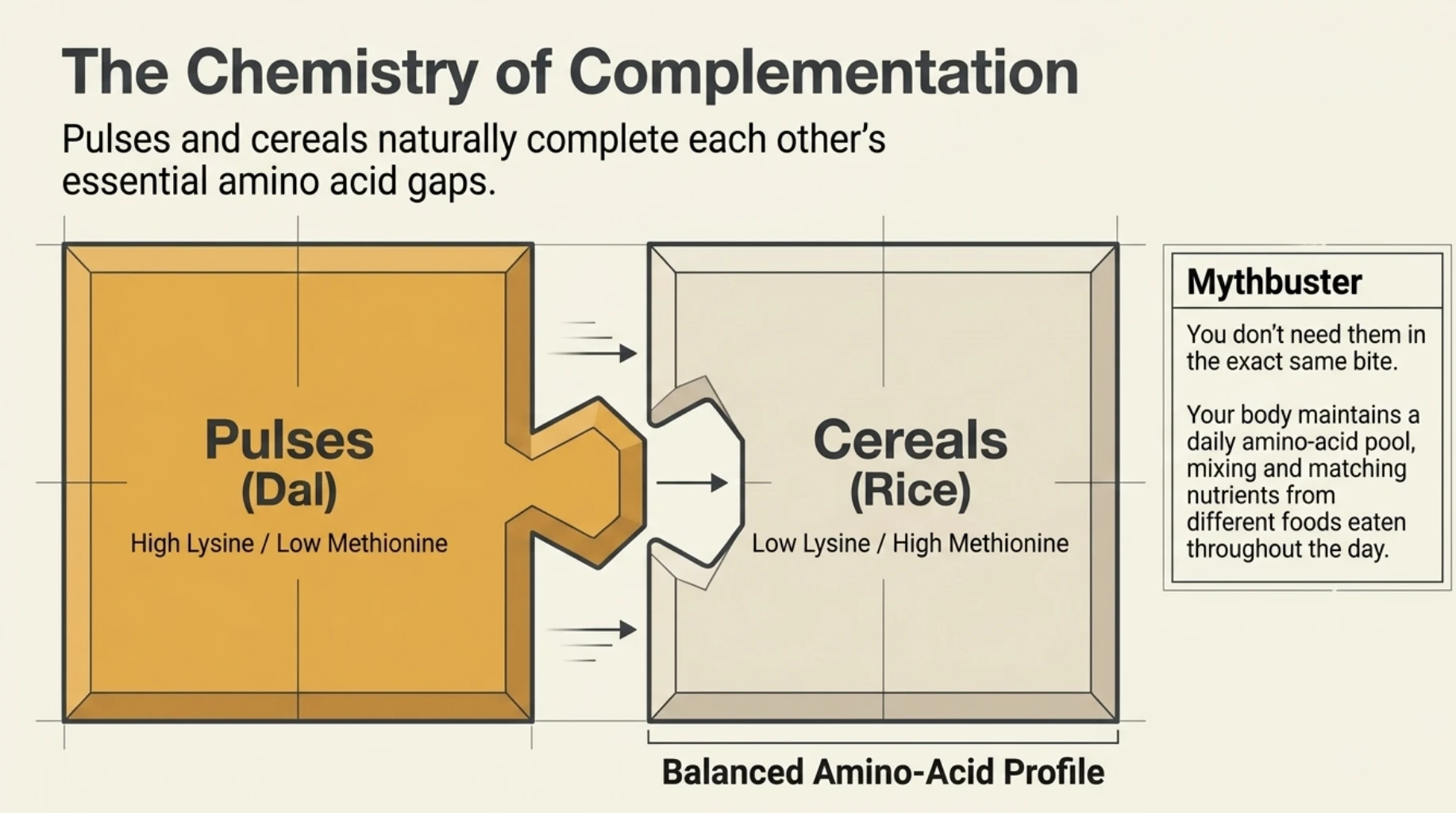
Pulses such as dal are particularly useful sources of lysine but tend to be relatively limited in sulphur-containing amino acids such as methionine.
Cereals such as rice have a different amino-acid pattern. They tend to provide relatively less lysine while contributing methionine.
When cereals and pulses are consumed as part of the same overall diet, their amino-acid profiles complement each other.
This is the nutritional principle behind familiar combinations such as:
- Dal and rice.
- Rajma and rice.
- Chole and roti.
- Khichdi.
- Idli and sambar.
- Dal and roti.
This complementary relationship is one reason dal and rice protein can form a useful part of a balanced vegetarian diet.
Why Dal and Rice Protein Is Often Called a Complete Protein
You may frequently hear that combining dal and rice “makes a complete protein.”
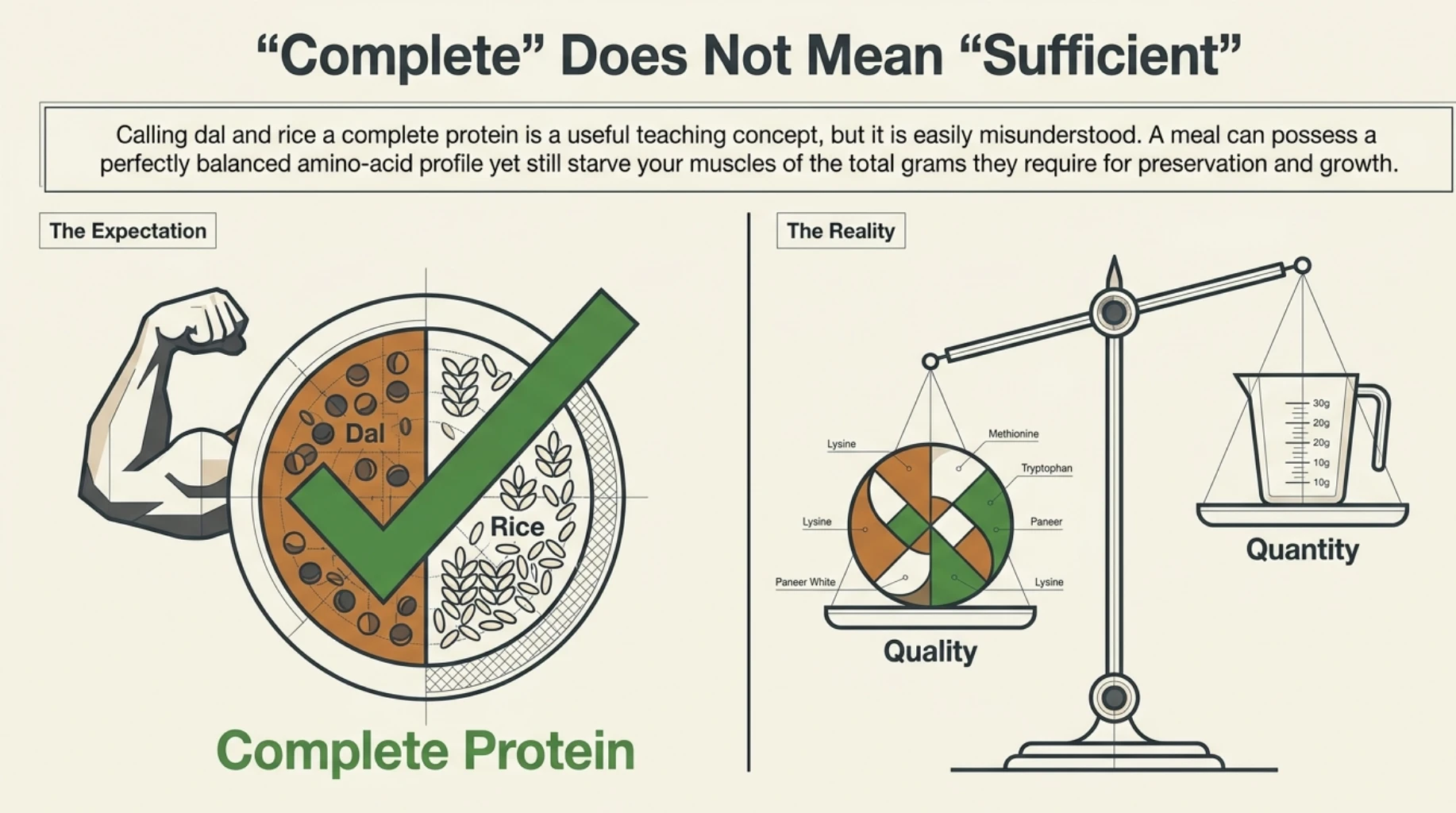
This is a useful teaching concept, but it can easily be misunderstood.
Dal and rice together provide a more complementary essential amino-acid pattern than either food alone. However, calling a meal “complete” does not tell you how much protein the meal contains.
This distinction is extremely important.
A meal can have a reasonably balanced amino-acid profile but still provide too little total protein to meet a person’s muscle-health goals.
For example, a large serving of rice accompanied by only a small amount of thin dal may contain all the relevant amino acids across the meal but still be relatively low in total protein compared with a meal containing a larger portion of dal plus curd, paneer, tofu, soy, eggs, fish, or chicken.
Therefore, when evaluating dal and rice protein, both protein quality and protein quantity matter.
Do Dal and Rice Have to Be Eaten Together?
No.
Another common misconception is that complementary plant proteins must be consumed together at exactly the same meal for the body to use them properly.
For most healthy people eating a varied diet, this is unnecessary.
Your body maintains an amino-acid pool and uses amino acids obtained from different foods eaten throughout the day. Therefore, consuming pulses, grains, nuts, seeds, soy foods, dairy, or other protein sources across a varied diet can collectively help meet essential amino-acid requirements.
Dal and rice happen to be a convenient and traditional combination, but there is no biological requirement to consume a spoonful of dal with every spoonful of rice.
The bigger priority is achieving sufficient total protein and essential amino acids across the day.
How Much Protein Does a Dal and Rice Meal Provide?
This is where the discussion becomes more practical.
The protein content of dal and rice varies considerably according to the type of dal, amount used, cooking method, water content, and serving size.
As an approximate guide, one cup of cooked dal or lentils may provide roughly 12–18 grams of protein, depending on the pulse and consistency, while one cup of cooked rice typically provides around 4–5 grams of protein.
A substantial meal containing approximately one cup of cooked dal and one cup of cooked rice could therefore provide roughly 16–23 grams of protein.
These numbers are approximate rather than universal.
A small katori of watery dal will provide considerably less protein than a full cup of thick cooked dal containing a larger amount of actual pulses.
This is why simply saying, “I eat dal every day, so I get enough protein”, may not always be correct.
Why a Typical Dal and Rice Protein Serving May Be Lower Than You Think
Consider a common Indian plate:
- A generous mound of rice.
- One small katori of dal.
- Sabzi.
- Pickle or chutney.
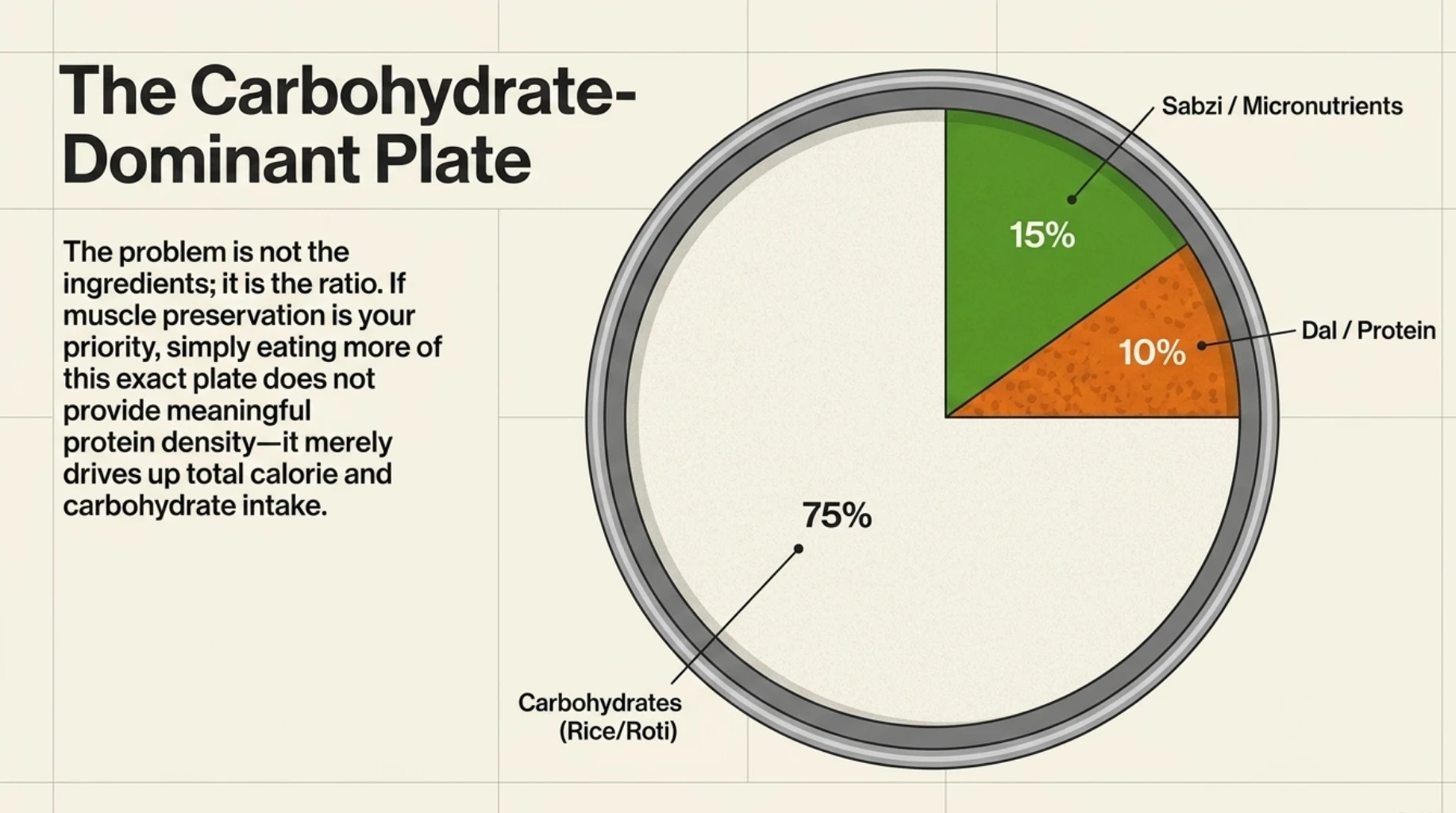
The meal may be nutritious, but its calorie distribution can be heavily weighted towards carbohydrate if the rice portion is large and the dal portion is small.
This does not mean rice is unhealthy.
The problem is the proportion.
If muscle preservation is a priority, simply increasing the rice portion does relatively little to increase the meal’s protein density.
Increasing the dal portion and adding another protein-rich food can make a much greater difference.
Is Dal and Rice Protein Enough for Muscle Health?
For some people, a well-portioned dal and rice meal can make a meaningful contribution towards daily protein requirements.
But whether dal and rice protein is enough for muscle health depends on the rest of the diet and the individual.
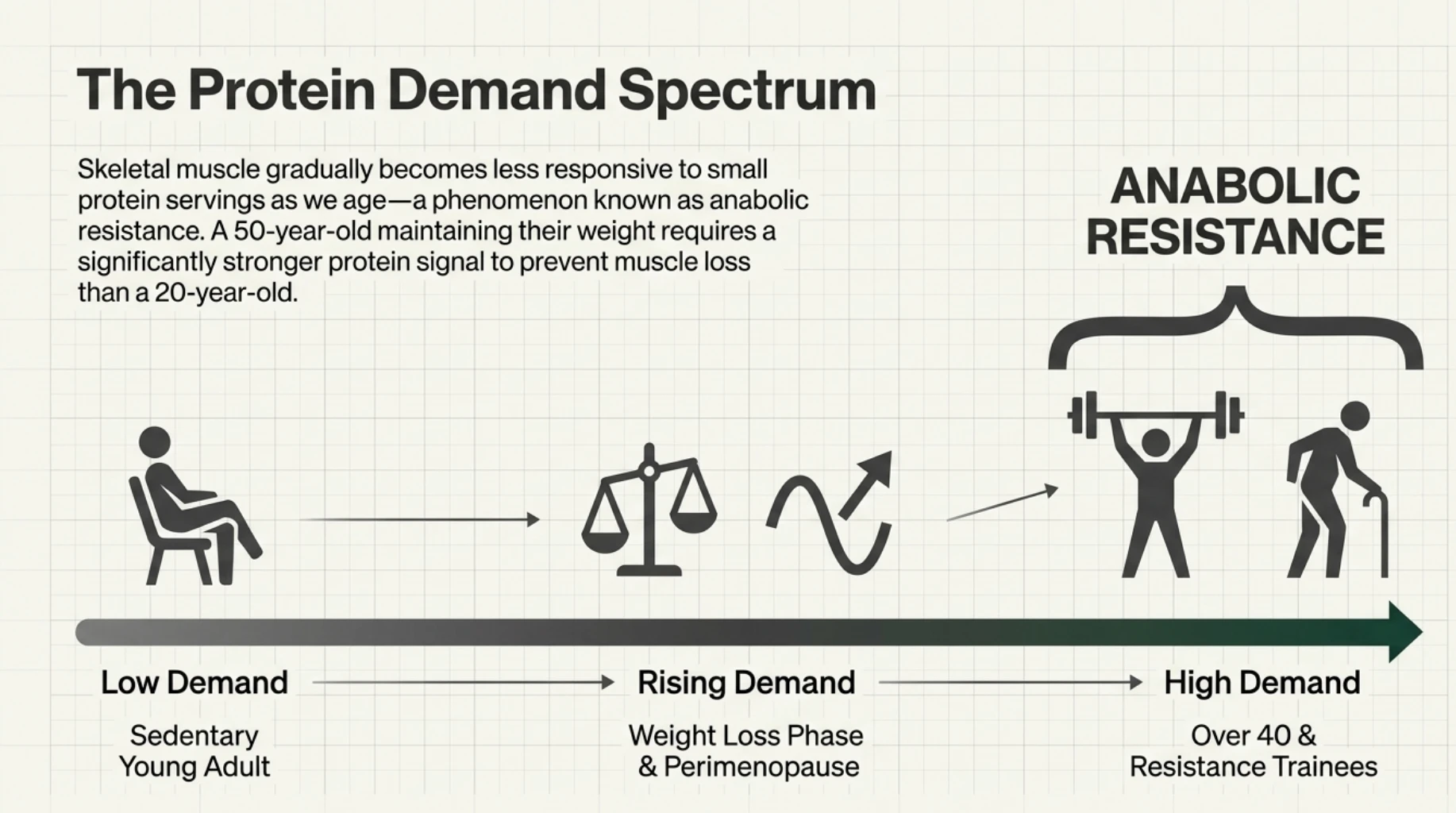
A sedentary young adult with relatively modest protein requirements is very different from:
- A 50-year-old trying to preserve muscle.
- A woman going through perimenopause.
- An older adult at risk of sarcopenia.
- Someone performing resistance training four times per week.
- A person losing weight while trying to minimise muscle loss.
These individuals may need greater attention to total daily protein, protein distribution, and protein quality.
For them, a small serving of dal with a large portion of rice may not provide a sufficiently strong protein serving at that meal.
Dal and Rice Protein: Total Protein Still Matters
Amino-acid complementation cannot compensate for inadequate total protein intake.
This is one of the most important concepts to understand.
Imagine a meal provides a well-balanced mixture of essential amino acids but contains only a small quantity of protein overall. The amino-acid profile may be favourable, but the total amount available for muscle protein synthesis and other physiological functions remains limited.
Therefore, people concerned about muscle health should look beyond whether a food combination is technically “complete.”
Ask instead:
“How many grams of protein am I actually getting from this meal?”
Dal and Rice Protein: Leucine Matters Too
Leucine is an essential amino acid that plays an important signalling role in stimulating muscle protein synthesis.
High-quality animal proteins such as dairy, eggs, fish, and meat generally provide relatively concentrated amounts of essential amino acids and leucine.
Plant-based proteins can also support muscle health, but some meals may require larger quantities or a combination of protein-rich foods to provide comparable amounts of essential amino acids.
This does not make dal and rice protein inferior or unsuitable.
It simply means that someone relying predominantly on plant foods should pay attention to total protein intake, portion sizes, variety, and overall diet quality rather than assuming any cereal-pulse combination automatically meets muscle-building requirements.
Dal and Rice Protein After 40: Why the Question Becomes More Important
Protein requirements deserve greater attention as we age because skeletal muscle gradually becomes less responsive to small protein servings—a phenomenon commonly described as anabolic resistance.
At the same time, adults often become less physically active, perform less resistance exercise, and may gradually lose muscle mass.
Someone may therefore maintain approximately the same body weight while slowly losing muscle and gaining body fat.
This makes dal and rice protein after 40 particularly relevant.
Dal and rice can absolutely remain part of the diet, but the plate may need to be redesigned so that protein is no longer treated as a small side component.
For example, instead of:
Large rice portion + small katori of dal
consider:
More dal + appropriate rice portion + vegetables + an additional protein source when needed.
The additional protein could come from curd, paneer, tofu, soy, eggs, chicken, or fish depending on dietary preferences.
Dal and Rice Protein Should Work with Strength Training
Eating more protein without challenging your muscles is only part of the solution.
Muscle preservation depends on the interaction between nutrition and physical activity.
Resistance training provides a powerful stimulus for maintaining and building muscle, while dietary protein supplies the amino acids needed to support muscle repair and adaptation.
Therefore, adults concerned about muscle loss should combine adequate dal and rice protein and other protein sources with regular resistance exercise rather than relying on nutrition alone.
Why Vegetarian Diets Need Protein Planning, Not Protein Fear
Vegetarian diets can provide adequate protein.
The solution is not to label vegetarian diets as protein-deficient or insist that everyone needs meat or protein supplements.
However, vegetarian diets do benefit from thoughtful planning—particularly when protein requirements are higher.
Useful protein sources can include:
- Dal and other pulses.
- Rajma and chana.
- Soybeans and soy chunks.
- Tofu.
- Paneer.
- Milk.
- Curd or Greek-style yoghurt.
- Besan.
- Peas.
- Nuts and seeds as supplementary sources.
A varied diet using several of these foods makes it much easier to meet protein requirements than relying almost entirely on dal and rice protein at one or two meals.
What Is the Real Problem with Dal and Rice?
For most people, the problem is not dal and rice itself.
The problem is often the ratio on the plate.
When rice occupies a very large portion of the meal while dal is served in a small quantity, the meal becomes carbohydrate-dominant and relatively protein-light.
This can be particularly relevant for people trying to preserve muscle while controlling total calorie intake.
Rather than eliminating rice, a more practical approach is to rethink the proportions.
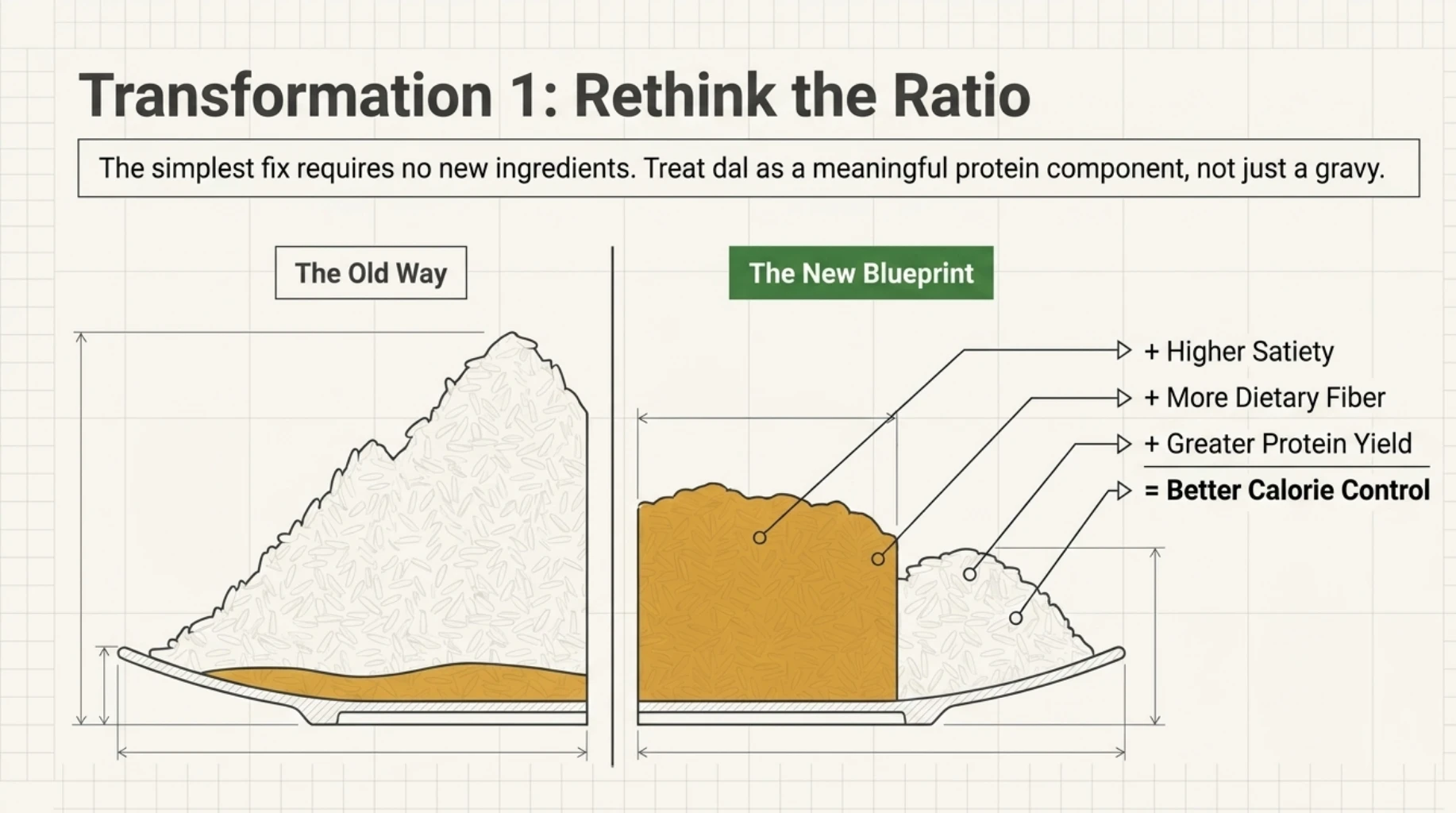
Dal should be treated as a meaningful protein-containing component of the meal rather than simply a gravy poured over rice.
This simple shift can substantially improve the nutritional value of a traditional dal-rice meal without abandoning familiar Indian foods.
How to Make Dal and Rice Protein Better for Muscle Health
The solution is not to stop eating dal and rice. For most people, a better strategy is to improve the proportions and overall composition of the meal.
A traditional meal can remain familiar, affordable, and enjoyable while providing considerably more protein.
The following strategies can help improve dal and rice protein without unnecessarily eliminating carbohydrates.
1. Increase the Dal-to-Rice Ratio
One of the simplest changes is to increase the amount of dal relative to rice.
If your usual plate contains a large serving of rice and only a small katori of dal, consider gradually increasing the dal portion while keeping the rice portion appropriate for your energy requirements.
This changes the nutritional balance of the meal without requiring completely different foods.
More dal generally means:
- More protein.
- More fibre.
- Greater satiety.
- More micronutrients.
For someone concerned about muscle preservation, this is usually more useful than simply removing rice from the meal.
2. Add Curd or Greek-Style Yoghurt to Dal and Rice Protein Meals
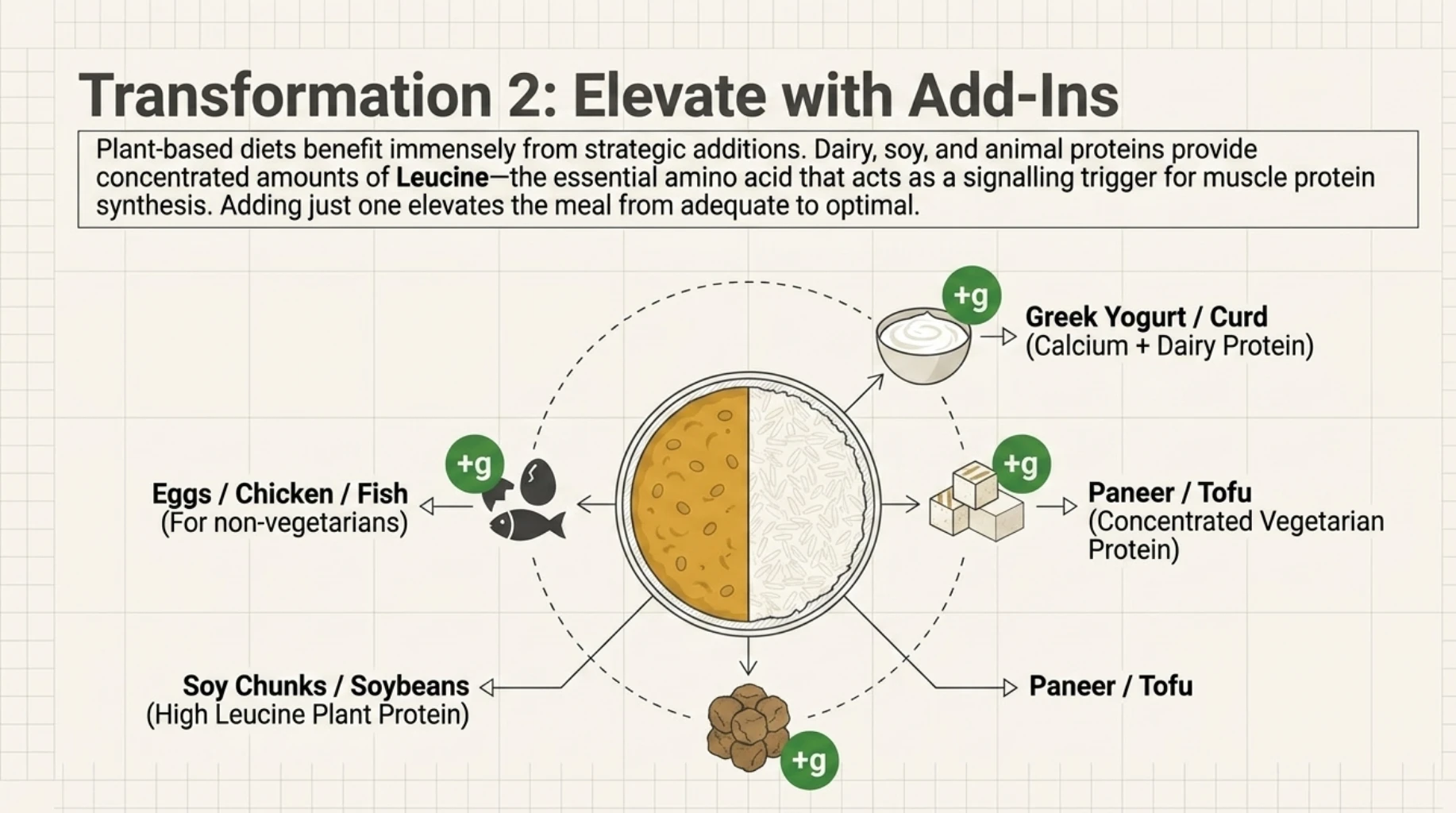
Dairy is one of the easiest ways for lacto-vegetarians to improve the protein quality and quantity of an Indian meal.
Adding curd alongside dal and rice provides additional high-quality protein as well as calcium and other nutrients.
Thicker strained or Greek-style yoghurt generally provides more protein per serving than regular curd, although the exact amount varies between products.
This simple addition can make a dal and rice protein meal more substantial without dramatically changing familiar eating habits.
3. Add Paneer, Tofu, or Soy
Another practical strategy is to add a more concentrated protein source.
For vegetarians, useful options include:
- Paneer.
- Tofu.
- Soy chunks.
- Soybeans.
- Tempeh where available.
Soy deserves particular attention because it provides a favourable essential amino-acid profile and is one of the better-studied plant proteins for supporting muscle protein synthesis.
A meal containing dal, an appropriate amount of rice, vegetables, and tofu or soy can provide substantially more protein than a traditional rice-heavy plate.
4. Add Eggs, Chicken, or Fish If You Eat Non-Vegetarian Foods
For people who consume animal foods, eggs, chicken, and fish can easily increase the protein content of a dal-rice meal.
There is no nutritional rule stating that dal should be removed simply because another protein source is present.
For example, a meal containing rice, dal, vegetables, and fish provides protein from several sources while maintaining the familiarity of a traditional Indian meal.
The appropriate portions depend on individual calorie requirements, body size, health conditions, and goals.
5. Use Different Dals and Pulses Across the Week
There is no need to rely on the same dal every day.
A varied diet can include:
- Moong dal.
- Masoor dal.
- Toor or arhar dal.
- Urad dal.
- Chana dal.
- Rajma.
- Chole.
- Lobia.
- Whole moong.
These foods differ somewhat in protein, fibre, micronutrients, cooking characteristics, and amino-acid composition.
Variety improves overall diet quality and makes it easier to maintain a protein-rich eating pattern without becoming dependent on one food.
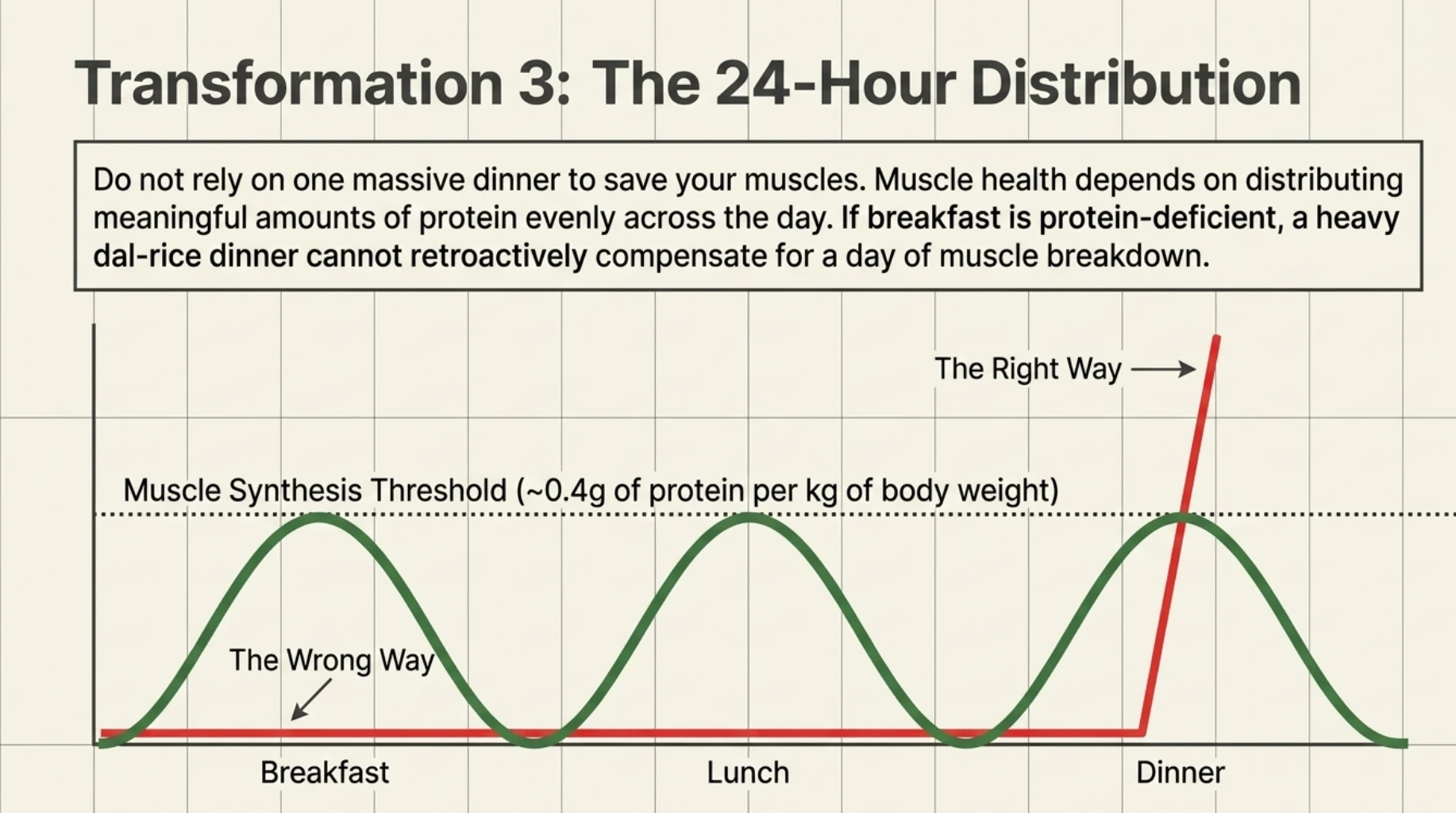
6. Do Not Depend on Dal and Rice Protein at Only One Meal
Another common problem is consuming relatively little protein at breakfast and then expecting lunch or dinner to provide almost the entire day’s requirement.
Muscle health depends on total daily protein, but distributing meaningful amounts across meals can also be useful, particularly for middle-aged and older adults.
Instead of thinking only about dal and rice protein at lunch or dinner, consider how much protein your breakfast contains as well.
For example, a day might include:
- Breakfast: Eggs, paneer, curd, milk, tofu, besan, or another meaningful protein source.
- Lunch: Dal, rice, vegetables, and an additional protein source if needed.
- Dinner: Paneer, tofu, soy, pulses, eggs, chicken, or fish according to dietary preference.
This approach is generally more useful than relying on one extremely protein-heavy meal.
Dal and Rice Protein vs Paneer, Eggs, Chicken, and Soy
Comparing foods purely by whether they contain protein can be misleading.
The amount of protein obtained relative to the portion size and calorie content also matters.
Cooked dal contains substantial water, while rice primarily contributes carbohydrate. Therefore, a large volume of dal and rice may be required to obtain the same amount of protein provided by a more concentrated protein source.
Foods such as paneer, tofu, soy, eggs, chicken, fish, and strained yoghurt can therefore make it easier to achieve a meaningful protein target without requiring an extremely large meal.
This does not make dal and rice protein nutritionally poor. It simply means that different foods have different protein densities.
Why Protein Density Matters for Weight Management
Protein density becomes particularly important when someone is trying to lose excess body fat while preserving muscle.
During weight loss, total calorie intake usually needs to be controlled. If obtaining adequate protein requires very large portions of calorie-containing foods, maintaining a calorie deficit may become more difficult.
For example, continually increasing rice and dal portions solely to increase protein may also substantially increase total carbohydrate and calorie intake.
Instead, combining dal with a more concentrated protein source can sometimes provide a better balance.
The goal is not to create a carbohydrate-free meal. It is to achieve adequate protein within an appropriate overall energy intake.
Dal and Rice Protein for Weight Loss
Dal and rice can absolutely be included in a weight-loss diet.
There is no scientific reason to automatically remove rice simply because someone wants to lose body fat.
Weight loss depends largely on maintaining an appropriate energy deficit over time while meeting nutritional requirements.
The composition of the plate still matters because meals containing adequate protein and fibre may improve satiety and help preserve lean tissue when combined with resistance training.
A more balanced plate could include:
- A substantial serving of dal.
- An appropriate portion of rice.
- Plenty of vegetables.
- Curd or another protein source where required.
This can provide better satiety and protein density than a large bowl of rice accompanied by only a small quantity of dal.
Does Dal and Rice Protein Cause Weight Gain?
No individual food combination automatically causes weight gain.
Body-fat gain occurs when energy intake consistently exceeds energy expenditure over time.
However, portion sizes matter.
A very large serving of rice, multiple servings of dal prepared with substantial added fat, fried accompaniments, papad, sweets, and calorie-rich beverages can collectively turn an otherwise balanced meal into a high-calorie meal.
Therefore, blaming dal and rice itself misses the bigger picture.
Meal composition, cooking methods, portions, overall dietary intake, and physical activity determine the outcome.
Dal and Rice Protein for People with Diabetes
People with diabetes do not necessarily need to eliminate dal or rice.
However, carbohydrate quantity, rice portion, overall meal composition, medication, activity level, and individual glucose response should be considered.
Dal provides protein and fibre, which can make the meal nutritionally more balanced than eating rice alone.
Adding vegetables and an appropriate additional protein source can further improve meal composition.
For many people, the more useful question is not:
“Can I eat rice?”
but:
“How much rice am I eating, what am I eating with it, and how does the complete meal affect my glucose?”
Individual responses vary, so glucose monitoring and personalised dietary advice may be useful for people with diabetes.
Dal and Rice Protein for Vegetarians Who Exercise
Vegetarians who perform resistance training can build and maintain muscle successfully, but protein planning becomes important.
A diet based predominantly on cereal foods with small quantities of pulses may provide less protein than expected.
Someone who exercises regularly should therefore look at the entire day’s intake rather than assuming that eating dal twice daily automatically provides sufficient protein.
A well-planned vegetarian diet might use combinations of:
- Dal and pulses.
- Soy and tofu.
- Paneer.
- Milk and curd.
- Besan.
- Beans and chickpeas.
- Nuts and seeds as supplementary sources.
Protein supplements may be convenient for some individuals, but they are not mandatory if adequate protein can be obtained from food.
Can Dal and Rice Protein Build Muscle?
Yes, dal and rice protein can contribute to the protein required for muscle growth.
But muscle growth does not depend on a single food combination.
Building muscle requires:
- Progressive resistance training.
- Adequate total daily protein.
- Sufficient essential amino acids.
- Adequate overall energy intake.
- Good-quality sleep.
- Recovery between training sessions.
If total protein intake remains inadequate, simply eating dal and rice after a workout will not automatically maximise muscle growth.
Similarly, consuming large amounts of protein without progressive resistance training will not produce optimal muscle development.
Dal and Rice Protein During Perimenopause and Menopause
Women approaching menopause should pay increasing attention to muscle preservation.
Ageing and hormonal changes can contribute to gradual reductions in muscle mass and changes in body-fat distribution.
Resistance training and adequate protein therefore become particularly important during this stage.
Dal and rice can remain part of the diet, but a small dal serving may not provide enough protein for a woman trying to preserve or build muscle.
Increasing the dal portion and adding curd, paneer, tofu, soy, eggs, fish, or another appropriate protein source can make the meal more supportive of muscle health.
Is Brown Rice Better Than White Rice for Dal and Rice Protein?
Brown rice contains more fibre and retains more of the grain’s outer layers than white rice, but switching from white to brown rice does not dramatically transform the protein content of the meal.
If the main objective is improving dal and rice protein, increasing the protein-containing components of the meal generally matters more than simply changing the colour of the rice.
Both white and brown rice can fit into a healthy diet depending on individual preferences, gastrointestinal tolerance, portion size, metabolic health, and the overall composition of the meal.
The bigger nutritional question remains what accompanies the rice.
Is Khichdi a Good Protein Source?
Khichdi combines a cereal and pulse in a single dish and therefore benefits from the same principle of amino-acid complementation as dal and rice.
However, its protein content depends heavily on the ratio of dal to rice.
A khichdi made predominantly from rice with a relatively small amount of dal may still be protein-light.
Increasing the pulse proportion or adding curd, paneer, tofu, soy, or another suitable protein source can improve the meal’s overall protein content.
Again, the name of the dish does not determine its nutritional quality—the ingredients and proportions do.
How Much Dal and Rice Protein Do You Actually Need Per Meal?
There is no single protein target that applies to every person. Protein requirements vary according to body size, age, physical activity, total energy intake, health status, and whether the goal is simply maintaining health or actively preserving or building muscle.
For adults interested in muscle health, a practical approach sometimes used in the scientific literature is to distribute approximately 0.4 grams of protein per kilogram of body weight across each main meal.
This is not a strict biological threshold or a maximum amount the body can use. It is better viewed as a practical starting framework for distributing daily protein.
For example:
| Body Weight | Approximate Protein Target Per Main Meal |
|---|---|
| 50 kg | 20 g |
| 60 kg | 24 g |
| 70 kg | 28 g |
| 80 kg | 32 g |
| 90 kg | 36 g |
| 100 kg | 40 g |
These figures help explain why a small katori of dal with a large serving of rice may not always provide enough dal and rice protein for someone with higher protein requirements.
Instead of assuming that every dal-rice meal automatically meets your needs, consider how much actual protein is present in the complete meal.
Dal and Rice Protein Needs Are Different for Different People
A 55-kg sedentary young adult does not necessarily need the same amount of protein as an 85-kg adult performing regular resistance training.
Similarly, protein requirements may deserve greater attention in older adults, people losing weight while trying to preserve muscle, and individuals recovering from illness or prolonged inactivity.
This is why the question “Is dal and rice enough protein?” cannot be answered without considering the person eating it.
The combination may contribute significantly towards one person’s needs while providing an inadequate meal-level protein dose for another.
7 Practical Ways to Improve Dal and Rice Protein
You do not need to abandon traditional Indian food to improve protein intake. In most cases, small changes in proportions and food combinations can make a substantial difference.
1. Increase the Quantity of Dal
If your plate contains a large quantity of rice and only a small amount of dal, begin by changing the ratio.
A more substantial dal portion increases protein and fibre without requiring unfamiliar foods.
2. Keep the Rice Portion Appropriate
Rice provides useful carbohydrate and can remain part of a balanced diet. However, increasing rice substantially does relatively little to improve the protein density of the meal.
Choose the amount according to your appetite, activity, metabolic health, and energy requirements.
3. Add a Concentrated Protein Source
Depending on your dietary preferences, add curd, Greek-style yoghurt, paneer, tofu, soy, eggs, chicken, or fish.
This is often the easiest way to increase total dal and rice protein without dramatically increasing meal volume.
4. Add Plenty of Vegetables
Vegetables are not usually the major protein component of the meal, but they contribute fibre, micronutrients, and food volume.
A balanced plate should therefore not become simply a large serving of protein and rice.
5. Rotate Your Pulses
Use moong, masoor, chana dal, urad, arhar, rajma, chole, lobia, and other pulses across the week.
Dietary variety improves micronutrient intake and provides a broader range of plant foods.
6. Spread Protein Across the Day
Do not rely entirely on lunch or dinner to meet your protein requirement.
Include meaningful protein at breakfast and other meals so that the day’s intake is more evenly distributed.
7. Combine Dal and Rice Protein with Resistance Training
If muscle preservation or growth is your goal, nutrition alone is not enough.
Regular resistance exercise provides the stimulus muscles need to maintain strength and adapt. Adequate protein then supplies amino acids needed for repair and remodelling.
Common Myths About Dal and Rice Protein
Myth 1: Dal and Rice Is Automatically a High-Protein Meal
Not necessarily.
The combination provides complementary amino acids, but the total protein content depends on the amount of dal and rice actually eaten.
A large bowl of rice with a small serving of watery dal can still be relatively protein-light.
Myth 2: Dal and Rice Protein Is Incomplete and Therefore Useless
This is also incorrect.
Pulses and cereals have complementary amino-acid profiles. When consumed as part of a varied diet, they can contribute meaningfully towards essential amino-acid and total protein requirements.
Plant protein should not be dismissed simply because individual foods differ in amino-acid composition.
Myth 3: Dal and Rice Must Be Eaten Together for Protein to Work
No.
Complementary plant proteins do not have to be consumed in the same spoonful or necessarily within the same meal.
Eating a varied diet containing adequate protein and essential amino acids across the day is generally more important.
Myth 4: Rice Has No Protein
Rice does contain protein, but it is not a protein-dense food.
Its primary nutritional contribution is carbohydrate.
The protein from rice still contributes to total intake, but relying on rice as a major protein source would require impractically large portions for most people.
Myth 5: Vegetarians Cannot Build Muscle with Dal and Rice Protein
Vegetarians can build muscle successfully.
The important factors are adequate total protein, sufficient essential amino acids, appropriate energy intake, progressive resistance training, and recovery.
Dal and rice protein can contribute to this intake, but it is usually sensible to include a variety of other protein-rich foods as well.
Myth 6: Protein Powder Is Necessary If You Are Vegetarian
No.
Protein supplements can be convenient, particularly for people with higher requirements or limited appetite, but they are not mandatory.
A well-planned vegetarian diet containing pulses, soy, tofu, dairy where consumed, beans, chickpeas, and other protein-rich foods can meet protein requirements for many people.
A supplement should solve a practical nutritional problem rather than become an automatic requirement.
When Dal and Rice Protein May Not Be Enough
Some people should pay particularly close attention to protein quantity rather than assuming their usual meals provide enough.
This may include:
- Adults over 40 who are becoming less physically active.
- Older adults at risk of sarcopenia.
- People performing regular resistance training.
- Individuals losing weight while trying to preserve lean mass.
- Women during and after the menopausal transition.
- Vegetarians consuming predominantly cereal-based diets.
- People recovering from illness, surgery, or prolonged inactivity when clinically appropriate.
- People with poor appetite or unintentional weight loss.
In these situations, simply confirming that the diet contains dal does not establish that protein intake is adequate.
When Protein Intake Should Be Individualised Medically
Increasing protein is not appropriate without consideration of medical history in every situation.
Individualised advice may be necessary for people with:
- Chronic kidney disease.
- Advanced liver disease.
- Certain inherited metabolic disorders.
- Significant malnutrition.
- Complex gastrointestinal conditions.
- Major illness or recent surgery.
For example, protein recommendations in chronic kidney disease depend on the stage of kidney disease, nutritional status, whether the person receives dialysis, and other clinical factors.
These individuals should not simply follow high-protein targets designed for healthy gym-going adults.
Frequently Asked Questions About Dal and Rice Protein
Is Dal and Rice a Complete Protein?
Dal and rice have complementary amino-acid profiles. Pulses provide relatively more lysine but tend to be limited in sulphur-containing amino acids, while cereals such as rice have a complementary pattern.
Together, and within a varied diet, they can provide a favourable essential amino-acid balance. However, describing the combination as “complete” does not tell you whether the meal contains enough total protein for your individual needs.
Is Dal and Rice Protein Enough for Muscle Building?
It can contribute to muscle-building nutrition, but whether it is enough depends on portion size, total daily protein intake, protein distribution, overall diet quality, and resistance training.
A small amount of dal with a large rice portion may provide less protein than someone trying to build muscle requires at that meal.
How Can I Increase Protein in Dal and Rice?
Increase the dal-to-rice ratio and consider adding curd, Greek-style yoghurt, paneer, tofu, soy, eggs, chicken, or fish according to your dietary preferences.
These changes can substantially increase the meal’s protein density.
Is Dal and Rice Good After a Workout?
Dal and rice provides carbohydrate and protein and can form part of a post-exercise meal. However, someone with higher protein requirements may benefit from a larger dal serving or an additional protein source to increase the meal’s total protein and essential amino-acid content.
Can I Eat Dal and Rice While Losing Weight?
Yes. There is no need to automatically eliminate dal or rice during weight loss.
Portion size, total calorie intake, protein adequacy, vegetables, cooking methods, and overall dietary patterns matter more than simply removing a traditional food.
Is Dal and Rice Good for People with Diabetes?
It can be included in many diabetes meal plans, but the quantity of rice and overall carbohydrate load need to be considered individually.
Increasing dal, adding vegetables and an appropriate protein source, controlling rice portions, and considering the individual’s glucose response can create a more balanced meal.
Final Thought
Dal and rice does not need to be labelled either a “perfect protein” or a “poor protein.” Both descriptions miss the point. It is a nutritious traditional combination that can contribute meaningfully to protein intake. For better muscle health, focus less on whether the combination is technically complete and more on whether your entire meal—and your entire day—provides enough protein for your individual needs.
If you want a personalized metabolic assessment and lifestyle strategy, you can book a consultation here:
Book an Appointment