


Why Crash Diets Fail Long Term
Why crash diets fail is a question millions of people ask after regaining weight. The pattern is common. Rapid weight loss in a few weeks. Visible change on the scale. Then gradual regain over months.
Crash diets promise fast results. They restrict calories drastically, eliminate food groups, or rely on extreme meal plans. While short term weight reduction may occur, the body does not cooperate long term.
What Is a Crash Diet?
A crash diet typically involves severe calorie restriction, often below 800 to 1000 calories per day, or elimination of entire macronutrient groups.
Common examples include:
- Liquid only diets
- Very low carbohydrate plans without supervision
- Extreme fasting without nutritional balance
- Single food diets
Although these strategies may produce rapid weight loss risks in the short term, they rarely support sustainable weight loss.
According to a 2021 systematic review available via long term outcomes of rapid weight loss interventions, very low calorie diets often result in significant weight regain within one to two years.
This data highlights a critical truth. Losing weight quickly is not the same as keeping it off.
How Your Body Responds to Extreme Dieting
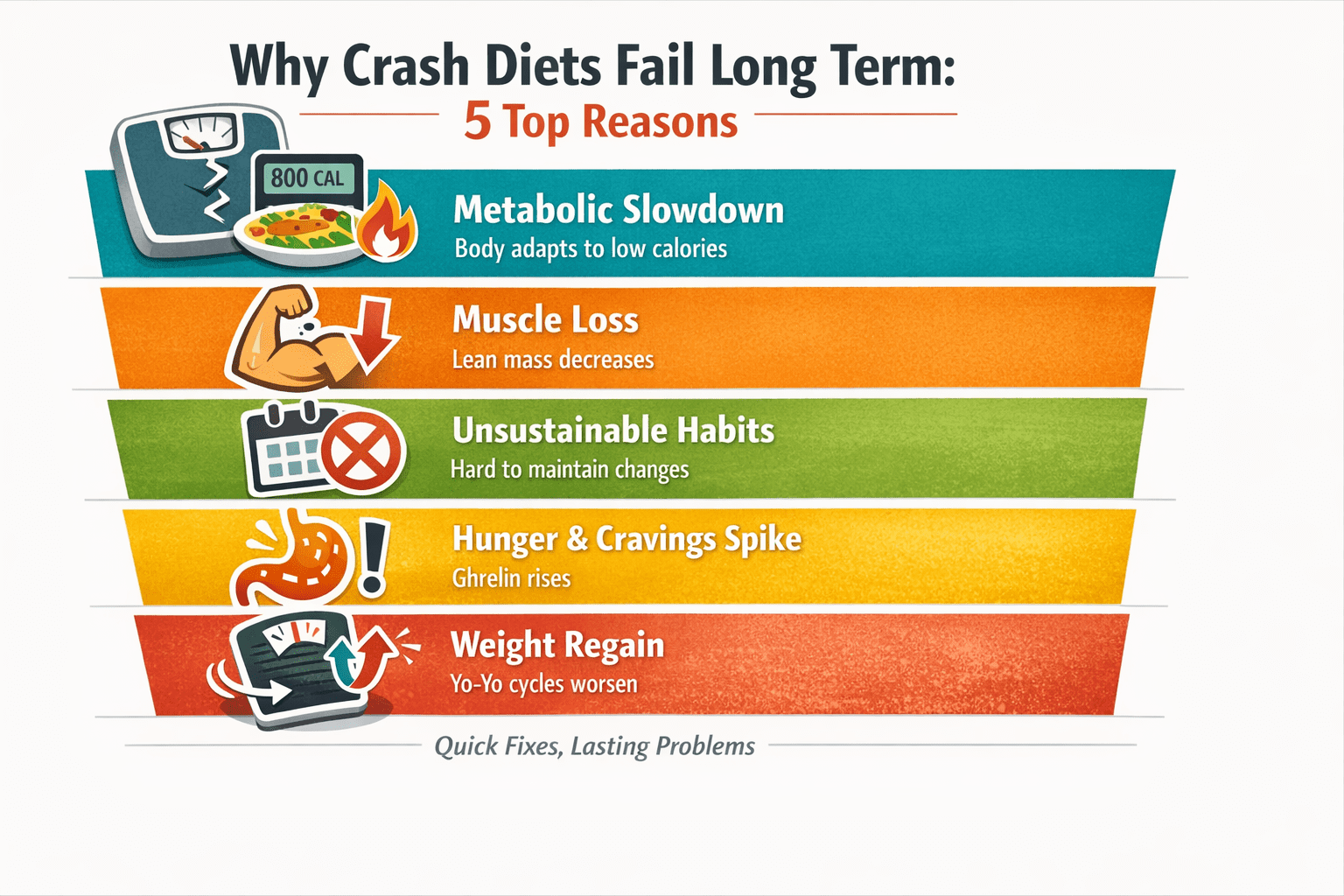
When calorie intake drops drastically, the body interprets it as a threat. Energy expenditure decreases. This phenomenon is called adaptive thermogenesis.
A 2022 review examining metabolic adaptation during calorie restriction confirms that resting metabolic rate can decline significantly during extreme dieting.
This metabolic slowdown makes further weight loss harder and increases the risk of weight regain after diet completion.
In simple terms, your body becomes more efficient at conserving energy. It burns fewer calories for the same activities.
Muscle Loss and Metabolism Slowdown
One of the biggest reasons why crash diets fail is muscle loss. When calorie intake is severely restricted without adequate protein and resistance training, the body breaks down muscle tissue for energy.
Muscle is metabolically active. It burns calories even at rest. Losing muscle reduces basal metabolic rate, making future fat loss harder.
A 2021 clinical analysis available through research on muscle loss during rapid weight reduction shows that aggressive dieting leads to disproportionate lean mass reduction.
This explains why people often regain fat more easily after completing a crash diet. Their metabolism has slowed, and muscle mass has declined.
Hormonal Changes During Rapid Weight Loss
Hormones play a powerful role in appetite and metabolism. Extreme dieting problems disrupt these signals.
Leptin, the hormone that signals fullness, decreases sharply during calorie restriction. Ghrelin, the hunger hormone, increases. This makes long term adherence extremely difficult.
A 2022 review examining hormonal adaptation during weight loss confirms that appetite stimulating hormones remain elevated even after weight reduction.
This persistent hormonal imbalance explains intense cravings and overeating after crash diets end.
Why Weight Comes Back After a Crash Diet
Weight regain after diet completion is not a personal failure. It is a predictable physiological response.
When calorie intake returns to normal, the slowed metabolism burns fewer calories than before the diet. At the same time, hunger hormones remain elevated.
A 2023 longitudinal study available here long term weight regain patterns after rapid dieting shows that most participants regained the majority of lost weight within two years.
This repeated cycle is known as yo yo dieting effects. Each cycle may increase fat percentage while reducing muscle mass.
Psychological Impact of Crash Dieting
Beyond physical changes, extreme dieting often damages mental health. Restrictive eating can create guilt, binge cycles, and distorted food relationships.
Sustainable weight loss requires consistency, not punishment.
A Better Approach to Healthy Fat Loss
If why crash diets fail is rooted in biology, the solution must also respect biology.
Research consistently shows that gradual fat loss of 0.5 to 1 percent of body weight per week improves long term maintenance. Balanced macronutrient intake, adequate protein, strength training, and sufficient sleep support metabolic stability.
Instead of extreme dieting problems, a healthy fat loss approach emphasizes:
- Moderate calorie deficit
- High protein intake
- Resistance training
- Fiber rich whole foods
- Sleep optimization
Prevention based education is central to long term success. You can explore additional evidence based lifestyle strategies on our platform.
How to Transition From Crash Dieting to Sustainable Weight Loss
If you now understand why crash diets fail, the next step is changing strategy rather than repeating the cycle.
1. Reverse Gradually
After a period of severe calorie restriction, gradually increase calories instead of jumping back to previous eating patterns. This supports metabolic recovery.
2. Rebuild Muscle Mass
Strength training is essential. Restoring lean body mass helps reverse metabolism slowdown and improves long term fat loss potential.
3. Track Habits, Not Just Weight
Focus on daily protein intake, sleep hours, hydration, and physical activity rather than obsessing over scale fluctuations.
4. Prioritize Consistency
Sustainable weight loss is built over months, not weeks. Small consistent changes outperform aggressive short term interventions.
5. Avoid Extreme Restriction
Eliminating entire food groups without medical supervision increases nutrient deficiency risk and promotes binge behavior.
Key Takeaways
References
- Long term outcomes of rapid weight loss interventions (2021)
- Metabolic adaptation during calorie restriction (2022)
- Muscle loss during rapid weight reduction (2021)
- Hormonal adaptation during weight loss (2022)
- Long term weight regain patterns (2023)
Disclaimer: This article is for educational purposes only and does not replace professional medical advice.